
hlayiso mock exams
Practice Series:
Grade 11 Exam Preparation
WWW.HLAYISO.COM
NATIONAL
SENIOR CERTIFICATE
GRADE 11
GEOGRAPHY P2
NOVEMBER EXAMINATION 2026 (MOCK)
MARKING GUIDELINES
MARKS: 150
These marking guidelines consist of 9 pages.
Copyright reserved Please turn over
Skip to contentAll 2026 papers 
View all
Geography Grade 11 Paper 2 November Mock 2026 Memo (English)
Grade 11 Geography Paper 2 memorandum from the November Mock Exam 2026 (English), 9 pages. Read online or download the free PDF.
Geography · Grade 11 · November Mock Exam · 2026 · English. Memorandum, 9 pages. Read online or download the PDF.
- Subject
- Geography
- Grade
- Grade 11
- Language
- English
- Document type
- Memorandum
- Year
- 2026
- Exam period
- November Mock Exam
- Paper
- 2
- Publisher
- Hlayiso
- Curriculum
- CAPS
- Pages
- 9
- File size
- 140.1 KB
Free to read online, no sign-up needed
Loading document…
Loading document…
1 of 9
This exam
November Mock Exam 2026
- Paper 1Question paperAddendumMemo
- Paper 2Question paperAddendumMemo
Document textSearch extracted text and jump to a page.
Geography/P2 2 Hlayiso/Mock 2026
NSC – Marking Guidelines
NOTE TO MARKERS:
• Accept alternative answers that are correct and relevant to the question, even if not
listed.
• A mark is allocated for each correct fact. For (2 x 2) questions, award 2 marks per
complete, well-explained point.
• Paragraph questions (approximately EIGHT lines): assess the quality and relevance of
the response.
• For calculations, follow the steps indicated. Measurements were taken on the A3 map
sheet printed at 100%;
accept answers within the given ranges.
SECTION A
QUESTION 1: DEVELOPMENT GEOGRAPHY
1.1 1.1.1 Y (1) (8 x 1) (8)
1.1.2 Z (1)
1.1.3 Z (1)
1.1.4 Y (1)
1.1.5 Z (1)
1.1.6 Y (1)
1.1.7 Z (1)
1.1.8 Y (1)
1.2 1.2.1 A (1) (7 x 1) (7)
1.2.2 B (1)
1.2.3 B (1)
1.2.4 C (1)
1.2.5 A (1)
1.2.6 A (1)
1.2.7 C (1)
1.3.1 A group of countries that agree to remove (reduce) tariffs and other (1 x 2) (2)
trade barriers on goods traded between them (2)
1.3.2 Raw materials (crude oil, minerals, cash crops) (1) (1 x 1) (1)
1.3.3 Poor roads and railways (1) (2 x 1) (2)
Long delays at border posts (1)
Many different trade rules (1)
Trade is slow and expensive (1)
[ANY TWO]
1.3.4 Raw materials earn low prices compared to manufactured goods (2 x 2) (4)
(unfair terms of trade) (2)
Prices of raw materials fluctuate on the world market, so income is
unreliable (2)
The processing (value adding) and jobs take place in the importing
countries (2)
Countries must import expensive manufactured goods, causing
trade deficits and debt (2)
[ANY TWO]
Copyright reserved Please turn over
Geography/P2 3 Hlayiso/Mock 2026
NSC – Marking Guidelines
1.3.5 South African manufacturers gain access to a much larger market, (3 x 2) (6)
so they can sell more goods (2)
Increased production creates jobs and reduces unemployment (2)
Lower tariffs make imported inputs cheaper for South African
businesses (2)
It attracts foreign investment into South Africa (2)
Improved transport links/corridors and border posts (2)
Increased export income improves the balance of trade and
economic growth (2)
[ANY THREE]
1.4.1 Assistance (money, goods, services or expertise) given by (1 x 2) (2)
developed countries or organisations to developing countries to
improve living conditions/promote development (2)
1.4.2 Non-governmental organisation (NGO) (1) (1 x 1) (1)
1.4.3 Spare parts had to be imported (1) (2 x 1) (2)
No local people were trained to repair them (1)
1.4.4 The local community was involved in planning and decision-making (1 x 2) (2)
(choosing sites, training local mechanics, paying for repairs), so the
project met its needs and the community took ownership (2)
1.4.5 Advantages: provides funds for infrastructure such as roads, (4 x 2) (8)
schools and clinics (2); emergency aid saves lives after disasters
(2); technical aid transfers skills and technology (2); improves
health care and education (2); creates jobs and stimulates
economic growth (2)
Disadvantages: countries become dependent on aid (2); tied aid
benefits the donor country (2); loans increase debt (2); aid may be
lost through corruption/mismanagement (2); projects may not suit
local needs (top-down) (2); donors may interfere in political
decisions (2)
[ANY FOUR]
1.5.1 A set of 17 global goals adopted by the United Nations to end (1 x 2) (2)
poverty, protect the planet and improve the lives of all people by
2030 (2)
1.5.2 Ending poverty (No poverty) (1) (1 x 1) (1)
Achieving gender equality (1)
[ANY ONE]
1.5.3 Women produce most of the food in rural areas (1) (2 x 1) (2)
They spend their income on the family (food, school fees, health) (1)
They care for children and the elderly (1)
Empowered women improve the education and health of the next
generation (1)
Women make up a large part of the rural population/workforce (1)
[ANY TWO]
Copyright reserved Please turn over
Geography/P2 4 Hlayiso/Mock 2026
NSC – Marking Guidelines
1.5.4 Long distances to markets increase transport costs and reduce (2 x 2) (4)
profits (2)
Unreliable electricity interrupts processing, so less is produced (2)
Without bank loans the co-operative cannot buy equipment or
expand (2)
Products may spoil/orders cannot be delivered on time (2)
[ANY TWO]
1.5.5 Provide small-business loans/grants and funding (2) (3 x 2) (6)
Improve rural roads to markets (2)
Provide reliable electricity/solar power for processing (2)
Offer training in business skills, marketing and product quality (2)
Help the co-operative to find markets/link it to buyers and exporters
(2)
Provide processing equipment and facilities (2)
[ANY THREE]
[60]
Copyright reserved Please turn over
Geography/P2 5 Hlayiso/Mock 2026
NSC – Marking Guidelines
QUESTION 2: RESOURCES AND SUSTAINABILITY
2.1 2.1.1 Y (1) (8 x 1) (8)
2.1.2 Z (1)
2.1.3 Z (1)
2.1.4 Y (1)
2.1.5 Y (1)
2.1.6 Z (1)
2.1.7 Y (1)
2.1.8 Z (1)
2.2 2.2.1 B (1) (7 x 1) (7)
2.2.2 C (1)
2.2.3 B (1)
2.2.4 B (1)
2.2.5 A (1)
2.2.6 C (1)
2.2.7 B (1)
2.3.1 The removal (wearing away) and transport of the top layer of soil by (1 x 2) (2)
agents such as water and wind (2)
2.3.2 Gully (donga) erosion (1) (1 x 1) (1)
2.3.3 Animals eat the grass faster than it can grow, leaving the soil bare (2 x 2) (4)
and unprotected (2)
Without roots the soil is loose and easily washed or blown away (2)
Trampling by hooves loosens the soil/forms paths that channel
runoff (2)
Bare soil increases surface runoff (2)
[ANY TWO]
2.3.4 Terraces break the slope into flat steps, which reduces the speed of (2 x 2) (4)
runoff (2)
Water is held on each step and soaks into the soil (more infiltration)
(2)
Soil that is washed off is trapped on the terrace below (2)
Crops on the terraces bind the soil (2)
[ANY TWO]
2.3.5 Soil (sediment) is deposited in rivers and dams (siltation), reducing (2 x 2) (4)
their storage capacity (2)
The water becomes muddy and less suitable for drinking/more
expensive to purify (2)
Fertilisers carried with the soil cause eutrophication (algal blooms)
(2)
Aquatic plants and animals die because of less sunlight/oxygen (2)
Silted rivers flood more easily (2)
[ANY TWO]
Copyright reserved Please turn over
Geography/P2 6 Hlayiso/Mock 2026
NSC – Marking Guidelines
2.4.1 Close to the coalfields (raw material) (1) (2 x 1) (2)
Coal can be transported cheaply over short distances/by conveyor
belts (1)
Water available for cooling (1)
Flat land for large power stations (1)
Close to the large market of Gauteng/national grid (1)
[ANY TWO]
2.4.2 Sulphur dioxide (1) (1 x 1) (1)
Nitrogen oxides (1)
[ANY ONE]
2.4.3 Acidic water containing dissolved metals that flows out of (1 x 2) (2)
(abandoned) mines into streams and groundwater (2)
2.4.4 Burning coal releases carbon dioxide (a greenhouse gas) that traps (1 x 2) (2)
more heat (long-wave radiation) in the atmosphere, raising global
temperatures (2)
2.4.5 Fit scrubbers/filters (flue-gas desulphurisation) to remove sulphur (4 x 2) (8)
dioxide and dust (2); use cleaner coal technology/wash coal before
burning (2); gradually replace coal with renewable energy (solar,
wind) (2); close old, inefficient power stations (2); rehabilitate mined
land and treat acid mine drainage (2); enforce air-quality
laws/carbon tax (2); promote energy saving to reduce demand (2);
monitor air quality near power stations (2)
[ANY FOUR]
2.5.1 Energy from sources that are not widely used/traditional and are (1 x 2) (2)
mostly renewable (e.g. wind, solar) (2)
2.5.2 Strong and steady winds blow for most of the year (1) (1 x 1) (1)
2.5.3 No fuel is burned (no pollution/greenhouse gases) (1) (2 x 1) (2)
No water is used (1)
Farmers can still graze cattle between the turbines (1)
Creates jobs during construction (1)
[ANY TWO]
2.5.4 Rotating blades kill birds and bats (2) (2 x 2) (4)
Noise from the turbines disturbs residents and animals (2)
Turbines spoil the scenic beauty, which may reduce tourism and
property values (2)
Construction of roads and foundations disturbs natural vegetation
(2)
[ANY TWO]
Copyright reserved Please turn over
Geography/P2 7 Hlayiso/Mock 2026
NSC – Marking Guidelines
2.5.5 Switch off lights and appliances when not in use (2) (3 x 2) (6)
Use energy-saving LED globes (2)
Install solar water heaters/insulate geysers and set them at a lower
temperature (2)
Use energy-efficient appliances (2)
Insulate ceilings to reduce heating and cooling (2)
Use gas or solar for cooking/heating (2)
[ANY THREE]
[60]
TOTAL SECTION A: 120
Copyright reserved Please turn over
Geography/P2 8 Hlayiso/Mock 2026
NSC – Marking Guidelines
SECTION B
QUESTION 3: GEOGRAPHICAL SKILLS AND TECHNIQUES
3.1.1 C (1) (1 x 1) (1)
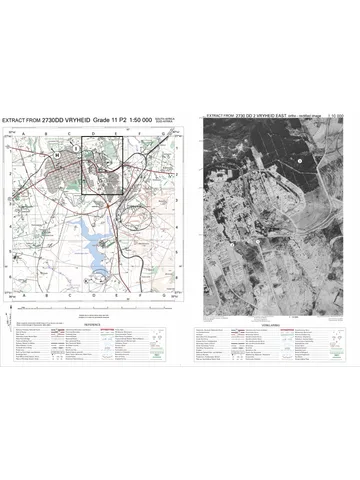
3.1.2 1 650,2 m – 1 558,3 m (1) (2 x 1) (2)
= 91,9 m (1)
3.1.3 11,9 cm × 0,5 km (1) (range 11,7 – 12,1 cm) (2 x 1) (2)
= 5,95 km (1) (range 5,85 – 6,05 km)
3.1.4 VI = 1 607 − 1 571 = 36 m (1) (4 x 1) (4)
HE = 8,4 cm × 100 = 840 m (1) (range 8,2 – 8,5 cm; 820 – 850 m)
36
Gradient = (1) (correct substitution)
840
= 1 : 23,3 (1) (range 1 : 22,8 – 1 : 23,6)
3.1.5 Difference in years: 2026 − 2014 = 12 years (1) (3 x 1) (3)
Total change: 12 × 5′ = 60′ = 1◦ 00′ west (1)
Magnetic declination 2026: 18◦ 19′ + 1◦ 00′ = 19◦ 19′ west of true north
(1)
3.2.1 Coal (1) (1 x 1) (1)
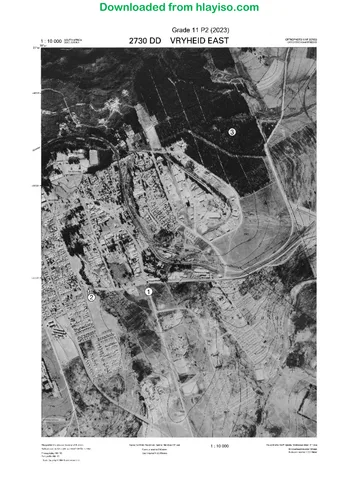
3.2.2 Opencast mine(s) (1) (2 x 1) (2)
Slimes dam (1)
Conveyor belts (1)
Diggings (1)
Mine dumps/excavations (1)
[ANY TWO]
3.2.3 Subsidence (1) (1 x 1) (1)
3.2.4 Coal is removed from underground, leaving empty spaces (1 x 2) (2)
(cavities); the rock above loses its support and collapses, so the
surface sinks (2)
3.2.5 Buildings and houses can collapse/crack (1) (2 x 1) (2)
Roads, railways and pipelines are damaged (1)
People and animals can fall into them and be injured or killed (1)
Land becomes unusable for farming or building (1)
Underground coal fires/toxic gases may escape (1)
[ANY TWO]
3.2.6 Terraces reduce the length and angle of the slope, which slows (1 x 2) (2)
down runoff and traps eroded material (2)
The flat steps allow water to infiltrate and vegetation to establish,
which binds the soil and stabilises the slope (2)
[ANY ONE]
3.2.7 Acid mine drainage/polluted water from mines and slimes dams can (1 x 2) (2)
flow into the wetland (2)
Dust and sediment from mining and mine dumps can be washed or
blown into the wetland (2)
[ANY ONE]
3.3.1 C (1) (1 x 1) (1)
Copyright reserved Please turn over
Geography/P2 9 Hlayiso/Mock 2026
NSC – Marking Guidelines
3.3.2 An area of a specific width demarcated around a feature (point, line (1 x 2) (2)
or polygon) in GIS (2)
3.3.3 To prevent people from building or living on unstable land that may (1 x 2) (2)
collapse (2)
To protect lives and infrastructure from sinkholes (2)
[ANY ONE]
3.3.4 Undermined areas/old mine workings (1) (1 x 1) (1)
Location of sinkholes/subsiding ground (1)
Slope/contours (1)
Flood lines/wetlands (1)
Existing land use/infrastructure (roads, water, electricity) (1)
[ANY ONE]
[30]
TOTAL SECTION B: 30
GRAND TOTAL: 150
Copyright reserved
Study this subject
Recommended for this subject
Memorandum
Geography Grade 11 P2 Eastern Cape November 2020 Memo (Eng)
Memorandum
Geography Grade 11 P2 Eastern Cape November 2018 Memo (Eng)
Question paper
Geography Grade 11 P2 Eastern Cape November 2024 QP (Eng)
Question paper
Geography Grade 11 P2 North West November 2024 QP (Eng)
Question paper
Geography Grade 11 P2 Eastern Cape November 2022 QP (Eng)
Addendum
Geography Grade 11 P2 Eastern Cape November 2020 Addendum
More from Grade 11 Geography
Question paper
Geography Grade 11 P1 Eastern Cape November 2025 QP (Eng)
Question paper
Geography Grade 11 P2 Eastern Cape November 2025 QP
Question paper and memo
Geography Grade 11 Free State March Test 2025 Paper & Memo
Question paper
Geography Grade 11 MAPS 2023 Question Paper
Question paper
Geography Grade 11 MAPS 2023 Question Paper
Question paper