
PROVINCIAL ASSESSMENT
GRADE 11
ENGLISH FIRST ADDITIONAL LANGUAGE
LIFE SCIENCES
NOVEMBER 2011
JUNE 2017
MARKS: 150
TIME: 2½ hours
This question paper consists of 14 pages.
Skip to contentAll 2017 papers 
View all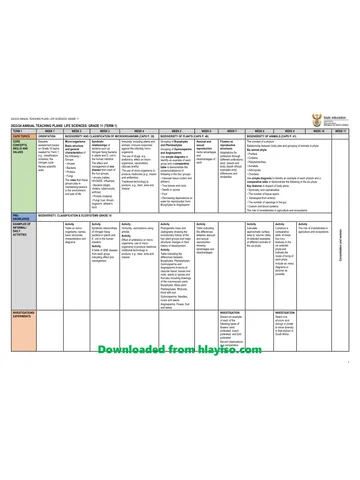


Life Sciences Grade 11 North West June 2017 Question Paper
Grade 11 Life Sciences question paper from the North West June 2017, 14 pages. Read online or get the free PDF download, memo linked when available.
Life Sciences · Grade 11 · North West June · 2017. Question paper, 14 pages. Read online or download the PDF.
- Subject
- Life Sciences
- Grade
- Grade 11
- Document type
- Question paper
- Year
- 2017
- Exam period
- North West June
- Curriculum
- CAPS
- Pages
- 14
- File size
- 657.9 KB
Free to read online, no sign-up needed
Loading document…
Loading document…
1 of 14
This exam
North West June 2017
- Other filesQuestion paperMemo
Document textSearch extracted text and jump to a page.
Lifel Sciences/P2 2
NSC – Grade 11
INSTRUCTIONS AND INFORMATION
Read the following instructions carefully before answering the questions.
1. Answer ALL the questions.
2. Write ALL the answers in your ANSWER BOOK.
3. Start the answer to each question at the top of a NEW page.
4. Number the answers correctly according to the numbering system used in this
question paper.
5. Present your answers according to the instructions of each question.
6. ALL drawings should be done in pencil and labeled in blue or black ink.
7. Draw diagrams or flow charts only when asked to do so.
8. The diagrams in this question paper are NOT necessarily all drawn to scale.
9. Do NOT use graph paper.
10. You may use a non- programmable calculator, protractor and a compass where
necessary.
11. Write neatly and legibly.
Life Sciences/P1 3 NW/June 2017
NSC – Grade 11
SECTION A
QUESTION 1
1.1 Various options are provided as possible answers to the following questions.
Choose the correct answer and write only the letter (A to D) next to the question
number (1.1.1 to 1.1.9) in your ANSWER BOOK, for example 1.1.10 D.
1.1.1 A sporangium has the following characteristics:
A It produces spores; it is in the sporophyte generation and is
therefore haploid.
B It produces gametes; it is in the gametophyte generation and is
therefore haploid.
C It produces gametes; it is in the sporophyte generation and is
therefore diploid.
D It produces spores; it is in the sporophyte generation and is
therefore diploid.
1.1.2 Which of the following substances will increase inside a muscle cell during
strenuous exercise?
A ATP
B glucose
C alcohol
D lactic acid
1.1.3 The part of a plant that receives the pollen during pollination is the …
A Stigma.
B Anther.
C Ovule.
D Petal.
1.1.4 The following are involved in the process of cellular respiration:
1 Energy
2 Carbohydrates
3 Carbon dioxide
4 Water
5 Oxygen
Which of the following correctly represent their involvement in the process?
A 1+2=3+4+5
B 2+5=1+3+4
C 2+3+1+4+5
D 2+4=1+3+5
1.1.5 Some people grow their plants in greenhouse tunnels…
A to keep the plants in the dark.
B to regulate the amount light and heat provided for the plants.
C to grow a mixture of crops.
D to increase the plant’s rate of respiration.
Life Sciences/P1 4 NW/June 2017
NSC – Grade 11
1.1.6 Which of the following concerning bacteria is incorrect?
A Bacteria are prokaryotic.
B All bacteria cause diseases.
C Certain bacteria are autotrophic.
D Certain bacteria are anaerobic
1.1.7 Which of the following shows the correct path of air movement during
inhalation?
A Trachea → bronchus → bronchioles → alveoli
B Alveoli → bronchioles → trachea → bronchus
C Alveoli → bronchioles → bronchus → trachea
D Bronchus → bronchioles → trachea → alveoli
1.1.8 Study the diagram and answer the question below.
Radiant energy is…
A Not involved in these processes.
B Needed by both X and Y.
C Needed by Y and released by X.
D Needed by X only.
1.1.9 Which statement best describes the relationship between a parasite and its
host?
A the host is harmed while the parasite benefits.
B the parasite is harmed while the host benefits.
C both host and parasite benefit.
D the parasite benefits and the host is not affected at all. (9 x 2) (18)
Life Sciences/P1 5 NW/June 2017
NSC – Grade 11
1.2 Give the correct biological term for each of the following descriptions. Write only
the term next to the question number (1.2.1 to 1.2.7) in your ANSWER BOOK.
1.2.1 Seed producing plants
1.2.2 Keeping the internal environment at constant level always
1.2.3 Small lymph vessels in the villi of the small intestine
1.2.4 A gut which has two openings allowing for the one directional passage of
food and wastes.
1.2.5 An organism that causes disease
1.2.6 The sexual, gamete-producing stage in the life cycle of a plant showing
alternation of generations
1.2.7 The type of anaerobic respiration that takes place in yeast cells
(7x1) (7)
1.3 Indicate whether each of the descriptions in COLUMN I applies to A ONLY, B
ONLY, BOTH A AND B or NONE of the items in COLUMN II. Write A ONLY, B
only, both A and B or none next to the question number (1.3.1 to 1.3.5) in the
ANSWER BOOK.
COLUMN I COLUMN II
A: Insulin
1.3.1 Controls blood glucose level
B: Glucagon
1.3.2 Phylum with segmented bodies A: Arthropoda
and appendages. B: Chordata
A: Cnidaria
1.3.3 Radially symmetrical
B: Porifera
1.3.4 Produced when glucose is broken A: Lactic acid
down completely B: Ethanol
A: Detoxification
1.3.5 Function of the liver
B: Deamination
(5 x 2) (10)
Life Sciences/P1 6 NW/June 2017
NSC – Grade 11
1.4 Study the diagram which shows an organism that causes Ebola and answer
the questions that follow.
1.4.1 Identify the type of organism shown in the diagram. (1)
1.4.2 Name the structures labelled A and B. (2)
1.4.3 Describe how Ebola is transmitted (2)
1.4.4 A person infected with the organism can get an antibiotic prescription
from the doctor.
Explain why this is possible even if antibiotics cannot kill the organism.
(2)
(7)
Life Sciences/P1 7 NW/June 2017
NSC – Grade 11
1.5 Study the diagram of a Bryophyte below and answer the questions that follow.
1.5.1 Identify the structures labelled A and B. (2)
1.5.2 What are the functions of structure A? (2)
1.5.3 What generation does A belong to? (1)
1.5.4 What is produced in Structure B? (1)
(6)
TOTAL SECTION A: 50
SECTION B
Life Sciences/P1 8 NW/June 2017
NSC – Grade 11
QUESTION 2
2.1 The graph below shows effect of light intensity on the rate of photosynthesis.
2.1.1 Identify the following
(a) Independent variable in this investigation?
(b) Dependent variable? (2)
2.12 How was rate of photosynthesis measured? (1)
2.1.3 What is the highest reading of the rate of photosynthesis? (2)
2.1.4 Name some factors that are limiting the rate of photosynthesis in the graph
above. (2)
(7)
2.2 Study the phylogenetic tree below and answer the questions that follow.
Life Sciences/P1 9 NW/June 2017
NSC – Grade 11
2.2.1 What animal group(s)
(a) does not have the organ level of organisation? (2)
(b) has no nervous system? (2)
(c) has a nervous system, exoskeleton but no vertebrae? (2)
(d) are members of Phylum Arthropoda (3)
(e) of the vertebrates has no fingers and toes? (1)
(f) has feathers? (1)
2.2.2 Which group of the mammals does not have a placenta? (1)
2.2.3 What property, on this phylogenetic tree, distinguishes birds from
crocodiles ? (1)
2.2.4 If A were a hypothetical common ancestor, which animal group(s) evolved
from it? (2)
2.2.5 Mention 4 properties from this phylogenetic tree which all mammals
have in common? (4)
(19)
Life Sciences/P1 10 NW/June 2017
NSC – Grade 11
2.3 Study the diagram of part of the human gaseous exchange surface and
answer the questions that follow.
2.3.1 Provide labels for parts A and B respectively. (2)
2.3.2 List two features that are visible on the diagram above that make it
efficient for gaseous exchange in humans. (2)
2.3.3 State one major difference between the composition of the blood in
vessel D and vessel E. (2)
(6)
2.4 During an investigation on a field trip, a professor found three unidentified
organisms. After examining their external and internal structural
characteristics using a microscope, he recorded his observations as follows:
ORGANISM A ORGANISM B ORGANISM C
Bilateral Bilateral symmetrical Asymetrical
symmetrical
Triploblastic Triploblastic Diploblastic
Coelomate Coelomate No coelom
Chitinous Coelomic Fluid
Exoskeleton
2.4.1 Name the different phyla to which organisms A, and B belong. (2)
2.4.2 Arrange the 3 phyla mentioned in the table above in the correct
order from the most primitive to the most developed. (3)
2.4.3 Describe ONE disadvantage of an exoskeleton in members of group A.
(2)
(7)
Life Sciences/P1 11 NW/June 2017
NSC – Grade 11
QUESTION 3
3.1 Most agriculturally important plants are angiosperms. In South Africa, agriculture is an
important source of income and employment. The table shows the Gross Farming Income
earned in South Africa from field crops and horticultural crops for the financial years
2007/2008 and 2008/2009.
Gross farming income in the Gross farming income in
Type of crop year 2007/2008 the year 2008/2009
(Millions of Rands) (Millions of Rands)
Field crops 23 800 37 800
Horticultural
26 200 30 200
crops
3.1.1 Calculate the change in income generated by farming of field crops in
the year 2007/2008 to 2008/2009. (3)
3.1.2 Draw a bar graph showing the Total Gross Farming Income for ALL
crops for the years 2007/2008 and 2008/2009. (6)
3.1.3 Horticultural crops include citrus fruit, deciduous fruit, and subtropical
fruit and vegetables.
(a) In addition to fresh table grapes and dried fruit, what product is
made from grapes grown in South Africa? (1)
(b) In addition to income generated from the sale of crops, how else
does agriculture benefit the economy of South Africa? (2)
3.1.4 Field crops include maize, sunflower, sugar cane and wheat.
(a) Which of these crops is a dicotyledonous angiosperm? (1)
(b) Seeds are the main source of food for many mammals including
humans. Draw a labelled diagram of a bean seed showing the
embryo. (4)
(17)
3.2 Study the nutritional information for 80 g of a breakfast cereal that is shown in the table
below. Use the information to answer the following questions.
Life Sciences/P1 12 NW/June 2017
NSC – Grade 11
Value per 80 g
Energy 1140 K j
Protein 10,0 g
Carbohydrate 54,0 g
Saturated fat 0,2 g
Unsaturated fat 1,4 g
Cholesterol Nil
Vitamins 8,8 mg
Dietary fibre 8,0 g
3.2.1 Which nutrient is abundant in this cereal? (1)
3.2.2 Name ONE function that the nutrient in 3.2.1 performs in the human
body. (1)
3.2.3 Give TWO reasons why you think it is important that nutritional
information is provided on food packaging. (2)
(4)
3.3 Tabulate THREE differences between aerobic and anaerobic respiration. (7)
(7)
3.4 A scientist designed an investigation to determine whether microbes were
present on human hair.
The procedure was as follows:
A sterile Petri-dish (round, flat container) containing sterile nutrient agar
(substance on which microbes feed and grow) was used.
The lid of the Petri-dish was removed carefully and a strand of human hair
was laid on the surface of the agar.
The lid was then replaced and the Petri-dish was placed in an incubator
(apparatus in which temperature can be controlled) for 48 hours.
The dish was then examined
3.4.1 What is meant by a sterile Petri-dish? (1)
3.4.2 State a hypothesis for testing for the above investigation. (2)
3.4.3 At which one of the following temperatures (0ºC, 30ºC, 80ºC, 100ºC)
should the incubator have been set? (1)
3.4.4 Explain your answer to Question 3.4.3 (2)
(8)
Life Sciences/P1 13 NW/June 2017
NSC – Grade 11
3.5 An investigation was done to determine the role of petals in insect pollination
in apple flowers. When flowers are self-pollinated, the pollen tubes grow a
little into the stigma and style and fertilisation does not take place.
• 10 flowers with petals and 10 flowers without petals were used.
• After two days the flowers were prevented from further pollination.
• After seven days the extent of pollination and fertilisation was recorded.
The diagrams below show the appearance of the flowers with and without
petals.
The results are shown in the table below.
NUMBER
Flower with petals Flower without petals
Pollen on stigma 158 25
Pollen tubes in the style 86 8
Ovules fertilised 38 4
3.5.1 Give an explanation for the presence of more pollen on the stigmas
of the flowers with petals than on the flowers without petals. (2)
Life Sciences/P1 14 NW/June 2017
NSC – Grade 11
3.5.2 Explain why there are more pollen tubes present in the styles of both
types of flowers than the number of ovules fertilised. (2)
3.5.3 State THREE ways in which this investigation could be improved. (3)
(7)
(40)
TOTAL SECTION B: 80
SECTION C
QUESTION 4
Describe the process of digestion of a sandwich made up of two slices of bread,
polony, cheese and lettuce through the human alimentary canal. In your essay
mention the the process of digestion as it is taking place in the mouth, stomach as
well as in the small intestine.
Content : (17)
Synthesis: (3)
(20)
NOTE: NO marks will be awarded for answers in the form of flow charts, tables or
diagrams.
TOTAL SECTION C: 20
GRAND TOTAL :150
Study this subject
Recommended for this subject
Question paper
Life Sciences Grade 11 P2 Eastern Cape November 2017 QP
Question paper
Life Sciences Grade 11 P2 Eastern Cape November 2017 QP
Question paper
Life Sciences Grade 11 North West June 2019 Question Paper
Memorandum
Life Sciences Grade 11 P1 Eastern Cape November 2017 Memo
Memorandum
Life Sciences Grade 11 P1 Eastern Cape November 2017 Memo
Memorandum
Life Sciences Grade 11 P2 Eastern Cape November 2017 Memo
More from Grade 11 Life Sciences
Annual teaching plan
Gr 11 Life Sci ATP 2023 24
Memorandum
Life Sciences Grade 11 Eastern Cape November 2025 Memo (Afr)
Memorandum
Life Sciences Grade 11 P1 Eastern Cape November 2025 Memo
Question paper and memo
Life Sciences Grade 11 KZN June 2025 Paper & Memo
Question paper and memo
Life Sciences Grade 11 Eastern Cape June 2024 Paper & Memo
Memorandum