
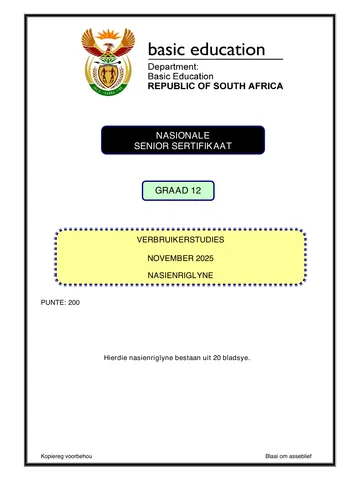
GRAAD 12
NATIONAL
SENIOR CERTIFICATE
GRADE 12
CONSUMER STUDIES
NOVEMBER 2025
MARKING GUIDELINES
MARKS: 200
These marking guidelines consist of 20 pages.
Copyright reserved Please turn over
Skip to contentMemorandum 
View all
Consumer Studies Grade 12 NSC November 2025 Memo
Grade 12 Consumer Studies memorandum from the NSC November Exam 2025, 20 pages. Read online or get the free PDF download, question paper linked when available.
Consumer Studies · Grade 12 · NSC November Exam · 2025. Memorandum, 20 pages. Read online or download the PDF.
- Subject
- Consumer Studies
- Grade
- Grade 12
- Document type
- Memorandum
- Year
- 2025
- Exam period
- NSC November Exam
- Curriculum
- CAPS
- Pages
- 20
- File size
- 641.2 KB
Loading document…
Loading document…
1 of 20
Document textSearch extracted text and jump to a page.
Consumer Studies 2 DBE/November 2025
NSC – Marking Guidelines
SECTION A: SHORT QUESTIONS
QUESTION 1
1.1 1.1.1 A Remembering, moderate (Focus, p.171; Successful, p.191) (1)
1.1.2 C Understanding, easy (Focus, p.141,174; Successful, p.193) (1)
1.1.3 D Understanding, easy (Focus, p.157; Successful, p.174) (1)
1.1.4 B Understanding, moderate (Focus, p.166; Successful, p.184) (1)
1.1.5 D Understanding, moderate (Focus, p.164-165; Successful,
p.182) (1)
1.1.6 C Remembering, moderate (Focus, p.90; Successful, p.106–107) (1)
1.1.7 D Remembering, easy (Focus, p.94; Successful, p.113–114) (1)
1.1.8 C Remembering, easy (Focus, p.74; Successful, p.83) (1)
1.1.9 B Understanding, easy (Focus, p.103; Successful, p.123) (1)
1.1.10 A Remembering, easy (Focus, p.104; Successful, p.125) (1)
1.1.11 B Understanding, easy (Focus, p.54; Successful, p.57) (1)
1.1.12 B Applying, moderate (Grade 11) (1)
1.1.13 C Remembering, easy (Focus, p.49; Successful, p.51) (1)
1.1.14 A Remembering, easy (Focus, p.119; Successful, p.139) (1)
1.1.15 D Understanding, easy (Focus, p.148; Successful, p.162) (1)
1.1.16 B Understanding, easy (Focus, p.30-31; Successful, p.30) (1)
1.1.17 B Remembering, easy (Focus, p.19; Successful, p.23) (1)
1.1.18 A Understanding, moderate (Focus, p.35; Successful, p.35) (1)
1.1.19 D Understanding, moderate (Focus, p.8; Successful, p.11) (1)
1.1.20 A Remembering, moderate (Focus, p.40; Successful, p.42) (1)
Copyright reserved Please turn over
Consumer Studies 3 DBE/November 2025
NSC – Marking Guidelines
1.2 1.2.1 Antioxidants
1.2.2 Stabilisers/ emulsifiers
1.2.3 (Chemical) preservatives
1.2.4 Bleaches/ colourants (4)
Remembering, easy (Focus, p.93–94; Successful, p.113–114)
1.3 A
C
E (Any order) (3)
Understanding, moderate (Focus, p.64; Successful, p.72)
1.4 1.4.1 D
1.4.2 C
1.4.3 E
1.4.4 B
1.4.5 F (5)
Understanding, moderate (Focus, p.155, 156, 158,161,162; Successful, p.169, 173,
175–179)
1.5 A
C
F
H (Any order) (4)
Understanding, difficult (Focus, p.16; Successful, p.24)
1.6 1.6.1 Levy
1.6.2 Rent
1.6.3 (Homeowner's comprehensive) insurance
1.6.4 Rates/ property taxes/ services fees (4)
Understanding, moderate (Focus, p.117, 122, 127,128; Successful, p.137, 139, 140, 145)
[40]
Copyright reserved Please turn over
Consumer Studies 4 DBE/November 2025
NSC – Marking Guidelines
SECTION B: LONG QUESTIONS
QUESTION 2: THE CONSUMER
2.1 Define the following terms:
2.1.1 Consumer Price Index (CPI)
The consumer price index (CPI) measures/ calculates/
determines✓1 the change in the price of a group of products and
services✓2 over a specific period/ 12 months.✓3 (Any 2) (2)
Remembering, easy (Focus, page 167; Successful, page 185)
2.1.2 Pay as you earn (PAYE)
It is tax deducted from an employee's✓1 salary on a monthly basis/
at the same time his/ her income is earned.✓2 (2)
Remembering, easy (Focus, p.163; Successful, p.181)
2.2 Name the body that is responsible for setting the repo rate.
(South African) Reserve Bank (SARB).✓ (1)
Remembering, moderate (Focus, p.166; Successful, p.184)
2.3 Name THREE basic services that are provided by municipalities.
• Electricity✓1
• Water✓2
• Sanitation/ sewage collection✓3
• Refuse/ waste removal✓4 (Any 3) (3)
Remembering, easy (Focus, p.183; Successful, p.202)
2.4 Name TWO types of credit contracts in which goods and services are
bought and paid for later.
• Mortgage bonds✓1
• Bank loans/ loans from financial institutions✓2
• Instalment sale/ hire purchase✓3
• Store credit accounts/ store card✓4
• Credit card✓5 (Any 2) (2)
Remembering, easy (Focus, p.155-156; Successful, p.170–172)
Copyright reserved Please turn over
Consumer Studies 5 DBE/November 2025
NSC – Marking Guidelines
2.5 State TWO ways to reduce the consumption of electricity when drying
clothes.
•Hang washing out to dry instead of using a tumble dryer.✓1
•Dripping wet clothes must not be tumble dried/ wring out clothes before
tumble drying✓2 because they will take longer to dry.
• Use the correct temperature setting on a tumble dryer to minimize the
amount of electricity used.✓3
• Only use the tumble dryer when there is a full load.✓4
• Use an energy efficient tumble dryer with an A rating.✓5
• You can avoid ironing clothes by removing clothing promptly from the
tumble dryer and folding it carefully.✓6
• Ensure that rubber seals are intact to prevent heat from escaping.✓7
• Clean filters regularly to reduce drying time.✓8
• Do not overload the tumble dryer.✓9
• Use a gas tumble dryer.✓10 (Any 2) (2)
Understanding, moderate (Focus, p.174; Successful, p.193–194)
2.6 Explain why compound interest is beneficial for investments/
savings.
• In compound interest, interest is earned on the original/ principal investment/
savings/ amount1 and the interest already earned.2
• Money grows faster3 over a short period of time.
• It is a better long-term choice because it gives higher returns.4 (Any 2) (2)
Understanding, easy (Focus p.166; Successful p.184)
2.7 Explain why it is advantageous for a consumer to buy a product that has
a warranty/ guarantee.
•It assures a consumer that a product will meet the quality/ durability/
standards1 and remain in working order2 for a particular length of time.3
• It ensures that a product will be repaired4 if it has any defects without the
cost to the consumer.5
• Warranty/ guarantee promises that product will be replaced6 if the product
is not in working order7 within a given period of time.
• It allows for the consumer to be refunded8 if the product does not satisfy
the terms agreed upon.9
• It safe guards the consumer against any loss.10 (Any 4) (4)
Understanding, moderate (Focus, p.158; Successful, p.175)
Copyright reserved Please turn over
Consumer Studies 6 DBE/November 2025
NSC – Marking Guidelines
2.8 2.8.1 Identify the type of scam that is represented in the SMS above.
Lottery/ prize notification scam.✓ (1)
Understanding, moderate (Focus, p.159; Successful, p.177)
2.8.2 Explain why the above SMS is regarded as a scam.
•Alex received an SMS stating that he won a lottery jackpot.✓1
•It required Alex to provide his personal details.✓2
•Alex must pay a processing fee of $200 to claim the price.✓3
•The SMS stated that 'Don't miss out on this amazing opportunity'
even though it stated that he/she has already won the lottery.✓4
• There is a spelling error (clam) on the SMS indicating that it is
not legitimate.✓5
• It sounds too good to be true.✓6
• Alex might not have entered the lottery jackpot.✓7
• There are no contact details/ name of lottery is not provided.✓8
• A lotto ticket is claimed on site and a SMS is not sent to the
winner/ Alex.✓9 (Any 4) (4)
Understanding, moderate (Focus, p.159; Successful, p.177)
2.9 Differentiate between the inflation rate and the interest rate.
•Inflation rate is the average percentage increase1 in prices of goods and
services in a year/ annually2 which is based on the Consumer Price Index
(CPI).3
• Interest rate is the rate at which borrowers pay interest4 for the money
they borrowed5 from financial institutions. It is charged on a month to
month basis.✓6
• The interest rate is also the rate at which consumers receive interest on
their investments/ savings.7
• Interest rate is determined by the repo rate.✓8 (Any 4) (4)
Understanding, moderate (Focus, p.166-168; Successful, p.184–185)
NOTE: Candidate must refer to both inflation rate and interest rate to be awarded 4 marks.
Copyright reserved Please turn over
Consumer Studies 7 DBE/November 2025
NSC – Marking Guidelines
2.10 Explain the causes of the continuous increase in prices.
• The increase in the price of electricity✓1 caused manufactures and sellers
to increase their prices to cover the increased electricity costs.✓2
• The prices of raw materials increase✓3 causing the selling prices to
increase.
• An increase in the cost of fuel/ transportation✓4 would also contribute to
price increases.
• The manufactures/ businesses increased salaries/ wages✓5 and rental
increases.✓6 cost the businesses more money/ increasing the overhead
costs✓7 and the cost of the increases are added✓8 to the price of goods
and services.
• Strikes/ protest actions/ riots/ wars can cause prices to increase.✓9
• Loadshedding/ watershedding may also cause prices to increase.✓10
• The increase in the interest rate✓11 would have cost businesses that has
debt more money to pay off✓12 the debt.
• An increase in the inflation rate✓13 also caused prices to increase.
• If the government prints more money without security/ spend more than it
receives.✓14
• The increase in levies/ sugar tax/ sin tax/ fuel tax/ import duties/ exchange
rate✓15 also caused an increase in the price of goods and services.
• Floods/ drought✓16 could have impacted local farms resulting in low crop
yield✓17 which increased prices. (Any 5) (5)
Analysing, difficult (Focus, p.164–168; Successful, p.182, 184, 185)
Copyright reserved Please turn over
Consumer Studies 8 DBE/November 2025
NSC – Marking Guidelines
2.11 Both communities and municipalities have a responsibility towards
combating the problem.
Validate the above statement.
Municipalities must …
• collect the rubbish/ waste regularly1 from the community.
• build/ maintain/ manage landfill sites2 for the refuse collected.
• encourage communities to recycle3 waste that is recyclable like
glass/ paper/ plastic/ cardboard.4
• provide recycling areas.5
• put up ‘no dumping’ signs/ boards/ notifications and ensure there are
consequences/ fines6 for illegal dumping.
• provide wheely bins/ trash bags7 so that animals cannot destroy black
bags before they are collected.
• use rates and taxes responsibly to ensure that rubbish is collected.✓8
Communities must …
• throw away their rubbish in a responsible manner,9 and not litter.10
• pay rates and taxes11 so that municipalities can have funds to collect
waste.12
• recycle13 their waste like paper/ plastic/ glass/ cardboard instead of
throwing it away.
• put their bins out on collection days.14
• organise community clean up campaigns.15
• communities must submit recommendations and complaints about rubbish
that is not collected/ removed to the municipality in writing.16
• report illegal dumping to the municipality.17
• attend council meetings18 to show support or stay informed of what the
municipality is doing with regards to refuse removal.19 (Any 8) (8)
Analysing, moderate (Focus, p.183, 185; Successful, p.203, 205)
NOTE: Candidate must refer to both municipalities and communities to be awarded full
marks.
[40]
Copyright reserved Please turn over
Consumer Studies 9 DBE/November 2025
NSC – Marking Guidelines
QUESTION 3: FOOD AND NUTRITION
3.1 Define the following terms:
3.1.1 Cholesterol
It is a soft/ white,1 waxy/ fatty substance2 that occurs naturally in
the blood/ is a component of body cells/ hormones3 and is
produced in the liver and body cells.4 (Any 3) (3)
Remembering, easy (Focus, p.74; Successful, p.84)
3.1.2 Food security
It is the ability of individuals to obtain/ access sufficient/ enough/
adequate,1 nutritious2 food that is safe3 on a daily basis4 to
maintain a healthy/ active lifestyle.5 (Any 3) (3)
Remembering, easy (Focus, p.106; Successful, p.128)
3.1.3 Organic foods
Organic foods are grown in an environmentally friendly way/ using
traditional/ natural farming methods1 without the use of pesticides/
herbicides/ chemicals/ fertilisers.2 (2)
Remembering, easy (Focus, p.104; Successful, p.125)
3.2 List the information found on a food label that could assist in preventing
food poisoning.
• Date stamp/ markings1 (used by/ best before)
• Ingredients2
• Storage instructions3
• Cooking/ heating instructions4 (Any 3) (3)
Understanding, moderate (Focus, p.97; Successful, p.117)
3.3 Write a paragraph to discuss the difference between high-density
lipoprotein (HDL) and low-density lipoprotein (LDL) cholesterol.
HDL is the good1 cholesterol. It gathers up excess cholesterol2 and
removes some cholesterol already deposited on the artery walls3 and
transports it to the liver where it is broken down to be excreted.4 It lowers the
risk of heart disease.5 It is increased by exercising.6 LDL is the bad/
dangerous7 cholesterol. It builds up in the arteries8 causing the gradual
narrowing9 of the blood vessels. It contributes to heart disease.10 It is
increased by saturated/ trans fatty acid.11 (Any 6) (6)
Understanding, moderate (Focus, p.74; Successful, p.84)
NOTE: Candidates must refer to both HDL and LDL to be awarded full marks.
Copyright reserved Please turn over
Consumer Studies 10 DBE/November 2025
NSC – Marking Guidelines
3.4 Discuss how hepatitis A can be transmitted in the food environment.
•
Transmission can occur when an infected person does not wash his/ her
hands1 after using the toilet2 and then touches food/ drinks.3
• Poor sanitation may also lead to the transmission of Hepatitis A.4
• Hepatitis A can spread when an uninfected or unvaccinated person5 eats
or drinks food that was contaminated by the faeces6 of an infected person.
• It can also spread through contaminated food/ water.7 (Any 3) (3)
Remembering, easy (Focus, p.89; Successful, p.103)
3.5 Explain the advantages of the irradiation of fruit and vegetables.
•Delays the ripening of fruit.1
•Reduces loses during transportation and storage.2
•Controls the sprouting of onions, garlic and potatoes.3
•Delays the greening of potatoes.4
•Increases/ extends the shelf life of fruit and vegetables.5
•Destroys insects in/ on tropical fruit that are imported/ exported.6
•It destroys harmful organisms thus preventing food-borne diseases. 7
(Any 4) (4)
Understanding, moderate (Focus, p.105; Successful, p.127)
3.6 Explain how anaemia can be prevented and managed by vegetarians
• They must eat sufficient quantities of foods that are rich in iron1 and folic
acid.2
• Other sources of iron/ folic acid are fish/ wholegrain cereals/ legumes/ green
leafy vegetables.3
• They must also eat foods that contain vitamin C/ ascorbic acid4 such as
dark leafy vegetables/ berries/ citrus fruit/ tomatoes5 because it promotes
the absorption of iron.6
• Coffee/ tea must not be consumed with a meal7 because it reduces the
absorption of iron.8
• Vegetarians must take iron/ vitamin B12 supplements9 because vitamin B12
is only found in animal foods.10
• Include foods fortified11 with vitamin B12 such as bread. (Any 6) (6)
Understanding, moderate (Focus, p.77; Successful, p.91)
Copyright reserved Please turn over
Consumer Studies 11 DBE/November 2025
NSC – Marking Guidelines
3.7 Discuss the effect that a diet high in fruit, vegetables and fish may have
on the prevention and management of hypertension and coronary heart
disease.
• A diet high in fruit, vegetables and fish reduce the risk and improve✓1 the
management of hypertension and coronary heart disease.
• Fruit and vegetables contain antioxidants/ vitamin C/ ascorbic acid/
carotene✓2 minimizing the effect of free radicals✓3 which reduces the risk
of heart disease.
• Fruit and vegetables are rich in (soluble) fibre✓4 which helps lower LDL
(bad cholesterol)✓5 that clogs the arteries which leads to heart disease.
• Potassium/ magnesium✓6 found in some fruit and vegetables are essential
for blood pressure regulation✓7 reducing strain on the arteries✓8 and
reducing the risk of hypertension.
• Fruit/ vegetables are low in sodium/ salt✓9 which will reduce hypertension.
• Fruit/ vegetables do not contain animal fat or cholesterol.✓10 This will reduce
the risk of coronary heart disease and hypertension.
• Fruit/ vegetables do not contain fat✓11 and are low in kilojoules✓12 reducing
the risk of obesity✓13 and thus reducing the risk of hypertension and
coronary heart disease.
• Dark green leafy vegetables such as spinach/ broccoli contain large
amounts of phytochemicals✓14 that help to reduce the build-up of
cholesterol in the arteries✓15 and reduces the risk of atherosclerosis.
• Fish contain unsaturated fats✓16 which reduces the LDL
(bad cholesterol)✓17 thus lower the risk of coronary heart disease.
• The fat in fish has omega 3 fatty acids18 that protect the heart and blood
vessels.19 (Any 10) (10)
Analysing, difficult (Focus, p.74,75,77; Successful, p.83–88)
[40]
Copyright reserved Please turn over
Consumer Studies 12 DBE/November 2025
NSC – Marking Guidelines
QUESTION 4: CLOTHING
4.1 Name TWO factors that influence fashion change.
• Social1
• Economic2
• Technological3
• Political/ Judicial4
• Cultural5
• Boredom of current fashion.6 (Any 2) (2)
Remembering, easy (Focus, p.49, 51; Successful, p.53–55)
4.2 Explain the term trademark.
A trademark is any word/ symbol/ logo/ label/ device/ name✓1 that is used to
identify/ distinguish2 goods from those manufactured/ sold by others.✓3
(Any 2) (2)
Remembering, easy (Focus, p.64; Successful, p.28,71)
4.3 State TWO illegal clothing practices.
• Brand piracy✓1
• Counterfeiting✓2
• Replication✓3
• Knock-offs✓4
• Fake/ imitation✓5 (Any 2) (2)
Remembering, easy (Focus, p.64; Successful, p.72)
4.4 4.4.1 Identify the type of fashion that is represented by the graph.
Fashion fad (1)
Understanding, moderate (Focus, p.49-50; Successful, p.50–51)
4.4.2 Name the stage in the fashion cycle that is represented by the
following months:
(a) December: Introduction/ beginning/ launch (1)
(b) February: Peak (1)
Understanding, easy (Focus, p.50; Successful, p.50)
4.4.3 Explain what happens to the cost of clothing items in the
following months.
(a) February
The price is more affordable/ cheaper and many people are
buying it. (1)
(b) March
The prices have gone down/ most of the items are on sale. (1)
Applying, moderate (Focus, p.50; Successful, p.50)
Copyright reserved Please turn over
Consumer Studies 13 DBE/November 2025
NSC – Marking Guidelines
4.5 Discuss the versatility of the shoes.
• The shoes can be worn formally or informally.✓1
• Can be worn in different seasons.✓2
• Can be worn for different occasions/ types of work places.✓3
• Can be worn by males or females/ different age groups.✓4
• Can be worn with or without socks.✓5
• The shoes can be worn with a dress/ shorts/ long pants/ skirt.✓6
• Black is a neutral colour which makes it easy to wear with different coloured
clothes.✓7 (Any 4) (4)
Applying, moderate (Focus, p.55; Successful, p.62)
4.6 Analyse the long-term effects that fast fashion will have on the natural
environment.
• Fast fashion lasts for a very short time which means it will be discarded1 if
it cannot be recycled and end up on landfills (cradle-to-grave).2 More
landfill sites will be required3 using up valuable/ productive/ farmland.4
• Non-biodegradable textiles/ packaging does not break down5 and will pile
up on landfill sites causing soil/air pollution.6
• New textiles need to be produced all the time7 to meet the demand of
making new clothing8 which requires more water9 and electricity10
causing depletion of natural resources11 and increasing the carbon
footprint/ global warming.12
• Toxic chemicals/ dyes13 used in the production of the textiles harm the
natural environment/ water/ soil pollution.14
• The import of clothing15 from all over the world could lead to air/ noise
pollution16 causing high carbon emissions during transportation.17
(Any 5) (5)
Analysing, difficult (Focus, p.61-63; Successful, p.67–69)
NOTE: Water/ Soil/ Air pollution should only be awarded a mark once. [20]
Copyright reserved Please turn over
Consumer Studies 14 DBE/November 2025
NSC – Marking Guidelines
QUESTION 5: HOUSING AND INTERIOR
5.1 Name the housing ownership option that is managed by a body corporate.
Sectional title/ condominium✓ ownership (1)
Remembering, easy (Focus, p.122; Successful, p.140)
5.2 Briefly describe what the body corporate is.
• Every owner is a member in a sectional title complex and forms part of the
body corporate.✓1
• The group of people/ trustees elected by the owners of the units in the
complex✓2 who control/ administer/ manage/ run the complex.✓3
OR
• A professional managing agent appointed by the owners.✓4 (Any 1) (1)
Remembering, easy (Focus, p.122-123; Successful, p.140–141)
5.3 State THREE disadvantages of buying household appliances on credit.
•Repayments of the appliance must be paid promptly/ on time/ monthly/
over a long period,✓1 which may decrease consumers' disposable
income.✓2
• Failure to pay may result in repossession of the appliances.✓3
• There is a certain limit that can be spent/ provided by the credit provider.✓4
• There are other costs such as interest/ administration fee/ initial fees that
must be paid/ penalties for late payment✓5 which makes it expensive.✓6
• The consumer cannot negotiate for a discount.✓7
• Consumers can spend more than they can afford✓8 and could be black
listed.✓9
• Instalments must still be paid even if the appliance is broken/ stolen.✓10
• If a consumer stop paying the instalments he/ she loses all the money
already paid.✓11 (Any 3) (3)
Understanding, easy (Focus, p.148; Successful, p.162)
5.4 List the information that must be included in a lease agreement to
protect both the tenant and the landlord.
•The date at which the rental of the property starts/ the length of the lease.1
•Details on the renewal of the lease.2
•The amount of the rental instalment3 and the date on which it must be
paid.4
• Rental conditions.✓5
• Clauses indicating the rights and responsibilities of the tenant and property
owner.6
• Property inspection before moving in and after the lease expires.7
• Entry/access to the unit by the property owner.8
• Rules regarding deposit/ water/ electricity/ sub-letting/ pets.9 (Any 3) (3)
Understanding, moderate (Focus, p.118; Successful, p.138)
Copyright reserved Please turn over
Consumer Studies 15 DBE/November 2025
NSC – Marking Guidelines
5.5 5.5.1 Explain the advantages of the energy sources of the fridge/
freezer.
•It uses gas which is cheaper1 than electricity, thus saving the
cost of electricity.2
• It will convert to gas when there is no electricity3 and food will
not spoil.4
• It switches itself over to electricity when gas runs out.5
• It saves electricity/ lowers the demand for electricity6 and
lightens the load on the country's over-stretched supply,7
thereby reducing the negative environmental impact of
generating electricity.8
• Although LPG is a fossil fuel, it is relatively clean compared to
coal/ oil/ less air pollution9 and produces fewer emissions of
carbon dioxide.10
• When used correctly, LPG is completely safe,11 like electricity.
(Any 4) (4)
Applying, moderate (Focus, p.134, 176; Successful, p.155, 193, 195)
5.5.2 Discuss how the fridge/ freezer saves human energy and time.
•The consumer will not have to manually switch to either gas or
electricity1 as it switches automatically.
• The consumer does not have to buy the regulator and hose to
connect the gas separately,2 this save time.
• The aluminium interior/ metallic exterior is easy to clean.3
• See through glass makes it easy to see what is inside,4 without
opening the fridge.
• The fridge does not need to be opened to get cold water because
it is already on the outside.5
• It seems to have wheels which makes it easy to move/ clean
underneath.6
• An upright fridge/ freezer does not require uncomfortable
bending.7 (Any 3) (3)
Understanding, moderate (Focus, p.134, 136,145; Successful, p.140)
Copyright reserved Please turn over
Consumer Studies 16 DBE/November 2025
NSC – Marking Guidelines
5.6 Evaluate the negative financial impact that the non-payment of the
accommodation will have on landlords.
• They will not be able to pay their mortgage bonds1 and might have cash
flow2 problems which may cause them to fall into debt3 and could lead to
being blacklisted4 or lose/ sell their properties.5
• They will not be able to pay their monthly insurance fees6 which may be
costly if any problems occur.7
• They will not be able to pay rates and taxes8 to their municipalities which
will increase their debt9 and cause basic services not to be provided.10
• They will have to pay reconnection fees11 to reconnect their services if
they were disconnected.
• It will be difficult for them to maintain12 their properties which could cause
the value of the property to depreciate.13
• Unpaid rent may lead to legal costs/ administrative expenses.14
• It may result in landlords not being able to invest in other properties.15
(Any 5) (5)
Evaluating, difficult (Focus, p.118, 124; Successful, p.140,142)
[20]
Copyright reserved Please turn over
Consumer Studies 17 DBE/November 2025
NSC – Marking Guidelines
QUESTION 6: ENTREPRENEURSHIP
6.1 State the purpose of adhering to product specifications.
It is to ensure that all products are always the same1 in terms of appearance/
quality/ size/ weight/ colour/ style.2 Customers will get exactly what they
expect.3 (Any 2) (2)
Remembering, easy (Focus, p.16; Successful, p.21)
6.2 Explain the following terms:
6.2.1 Mark-up
The amount/ percentage✓1 added to the cost price of goods2 to
cover overhead expenses✓3 and still leave money for a profit.✓4
(Any 3) (3)
Remembering, easy (Focus, p.37; Successful, p.39)
6.2.2 A best-sale scenario
It is a forecast of what could happen1 when the product sells very
well.2 The business was able to meet its sales target3 and
achieve its sales objective/ make a profit.4 (Any 2) (2)
Remembering, easy (Focus, p.39; Successful, p.41)
6.3 State how a business can use its time effectively.
•
Prioritise tasks per day so that they can be completed on time.✓1
•
Set performance targets to be accomplished.✓2
•
Ensure that all needed stock/ raw materials/ equipment is available for
continuous production.✓3
• Establish routines and adhere to them as much as possible.✓4
• Plan the use of all equipment to its full capacity.✓5
• Preventative maintenance of equipment will save loss of production
time.✓6
• Plan the use of all workers to be efficient/ maximized/ train workers to be
more productive.✓7
• Set time limits for each task to be completed/ compile work schedules with
time allocations.✓8
• Keep workstations organised and tidy for an easy workflow.✓9
• Do not postpone tasks, complete them immediately to save time.✓10
(Any 2) (2)
Remembering, moderate (Focus, p.24; Successful, p.25)
Copyright reserved Please turn over
Consumer Studies 18 DBE/November 2025
NSC – Marking Guidelines
6.4 Describe FOUR characteristics of sustainable producers.
They …
•use goods/ services to improve quality of life and meets the needs of
consumers.✓1
• produce products that are not harmful to human health.✓2
• use electronic storage systems to reduce the use of paper.✓3
• making use of recycled raw materials/ packaging✓4
• make use of locally produced raw materials/ suppliers.✓5
• make only the required products and not unnecessary products✓6 to
prevent waste.
• reduce waste by recycling.✓7
• use raw materials wisely/ do not waste.✓8
• reuse leftover materials and waste.✓9
• ensure that the process of making a product has minimal environmental
impact.✓10
• protect resources/ energy/ water/ land.✓11
• reduce/ eliminate the use of chemical/ toxic materials.✓12
• use minimum packaging✓13 and packaging that is biodegradable/
environmentally friendly.✓14
• produce eco-friendly products/ low carbon footprint products.✓15
• use natural ingredients.✓16
• use renewable sources of energy/ solar energy to reduce carbon footprint/
pollution.✓17
• do not waste energy/ are energy efficient.✓18 (Any 4) (4)
Understanding, moderate (Focus, p.27; Successful, p.26)
6.5 Explain how the training of staff improves productivity in a business.
• Staff will be skilled1 and have knowledge2 of what to do/ is required in
their work.
• Staff will make less/ fewer mistakes.3
• Staff may be able to work independently4 and faster5 in producing
products, thus saves time.
• Production will not stop6 because the staff know what to do.
• There will be less repairs/ equipment break down.7
• Training increases the morale/ motivation8 and this increases productivity.
(Any 3) (3)
Applying, moderate (Focus, p.25; Successful, p.26)
6.6 6.6.1 Explain how the couple identified a potentially profitable
business opportunity.
•
Buying a cup of coffee was expensive.1
•
They wanted everybody to have access to affordable coffee on
a daily basis.2 (2)
Remembering, easy (Focus, p.7; Successful, p.10)
Copyright reserved Please turn over
Consumer Studies 19 DBE/November 2025
NSC – Marking Guidelines
6.6.2 Identify the target market of Expresso Café.
It is people who love coffee1/ pastries/ pies/ sandwiches2 but do
not have a lot of money to spend on it/ with a low budget.3 (Any 2) (2)
Understanding, easy (Focus, p.34; Successful, p.11)
6.6.3 Describe how Expresso Café was marketed.
It was marketed by word of mouth from customers,1 customers
talked about the price on social media2 and through featuring on
radio3 and television.4 (Any 3) (3)
Remembering, easy (Focus, p.30; Successful, p.29)
6.6.4 Discuss why it was important for them to spend two years
refining their model.
•
It gave them time to do a SWOT analysis/ look at their strengths
and weaknesses.1
• They had no experience2 therefore they needed to gain
knowledge/ skills.3
• To make sure that their idea was going to be possible to become
a success/ feasible.4
• They needed to source suppliers.5 (Any 3) (3)
Applying, moderate (Focus, p.8, 10, 35; Successful, p.10,13,14,17,35)
6.6.5 The selling price of R14,00 per cup of coffee included 30% profit.
Calculate the profit made if 100 cups were sold. Show ALL
calculations.
METHOD 1:
R 14 ÷ 1.30 = R10.771
profit per cup R 14 – R 10.77 = R 3.232 x 100 = R 3233
OR
30 ÷ 1304 x R 14 = R3.235 x 100 = R 3236
METHOD 2:
R14 x 30% = R4,207 OR R14 x 30 = R4,208OR R14 x 0,3 = R4,209
100
R4,20 x 10010 = R420,0011 (100 cups)
OR
100 x R14 = R1 40012
R1 400 x 30%13 = R42014 (Any 3) (3)
Understanding, moderate (Focus, p.39–40; Successful, p.35–39)
Copyright reserved Please turn over
Consumer Studies 20 DBE/November 2025
NSC – Marking Guidelines
6.6.6 Calculate the new selling price. Show ALL calculations.
R14 x 45% 1 =R6,30 OR R14 x 45 2 = R6,30
100
OR
R14 x 0,453 =R6,30
R14 + R6,304 = R20,305
OR
R146 x 1,457 = R20,308 (Any 3) (3)
Understanding, moderate (Focus, p.39–40; Successful, p.35–39)
6.6.7 Their business is definitely able to sustain its profitability.
Validate the above statement.
• Their products are affordable1 compared to their competitors
and more products will be sold.2
• They already have over 65 stores nationwide3 and sell over
50 000 cups a day.4
• They provide a variety of products/ coffee/ pastries/ pies/
sandwiches5 at the same low price.6
• The products they provide are not seasonal,7 they are everyday
products required by consumers.8
• They have their own food factory9 which supplies their
franchises meaning they do not have to pay other suppliers.10
This also ensures consistent quality11 products and their
customers know what to expect.12
• They have franchises13 which means many people are using
their idea and they get more profit.14
• They use a wide variety of marketing methods/ television/ social
media/ radio15 which reaches more people.16 (Any 8) (8)
Evaluating, difficult (Focus, p.35; Successful, p.34)
[40]
TOTAL SECTION B: 160
GRAND TOTAL: 200
Copyright reserved
Study this subject
Revise the topics in this paper, then practise them question by question.
- Grade 12 Consumer Studies notes
CAPS revision notes with worked examples.
- Consumer Studies questions by topic
Past exam questions sorted by CAPS topic, with memos where available.
- All Grade 12 Consumer Studies past papers
Past papers by year, with memos where available.
- Grade 12 past papers
More Consumer Studies and other subjects in this collection.
Recommended for this subject
More papers and memos for this grade and subject.
Memorandum
Consumer Studies Grade 12 Eastern Cape Mock 2025 Memo
Memorandum
Consumer Studies Grade 12 NSC June 2025 Memo (English)
Memorandum
Consumer Studies Grade 12 NSC November 2025 Memo (Afrikaans)
Memorandum
Consumer Studies Grade 12 Eastern Cape Prelim 2024 Memo (Afr)
Memorandum
Consumer Studies Grade 12 Eastern Cape Prelim 2024 Memo (English)
Memorandum
Consumer Studies Grade 12 Eastern Cape Mock 2023 Memo (Afrikaans)
Related documents
Question paper
Consumer Studies Grade 12 NSC November 2025 Question Paper
Memorandum
Consumer Studies Grade 12 NSC November 2020 Memo
Memorandum
Consumer Studies Grade 12 NSC November 2020 Memo
Memorandum
Consumer Studies Grade 12 NSC November 2019 Memo
Memorandum
Consumer Studies Grade 12 NSC November 2018 Memo
Memorandum
Consumer Studies Grade 12 NSC November 2017 Memo
More from Grade 12 Consumer Studies
Annual teaching plan
Gr 12 Con Stu ATP 2023 24
Question paper
Consumer Studies Grade 12 Eastern Cape Mock 2025 Question Paper
Question paper
Consumer Studies Grade 12 NSC June 2025 Question Paper (Afr)
Errata
Consumer Studies Grade 12 Eastern Cape Prelim 2024 Errata
Question paper
Consumer Studies Grade 12 Eastern Cape Prelim 2024 QP (Afr)
Question paper