1
TOM NEWBY SCHOOL TEST
Subject Geography Examiner Mrs. v Coppenhagen
Date November 2021 Total marks 30 marks
Grade 5 Duration 1 hour
Moderator Miss Botha
Special instructions/ 1. Write as many details as possible.
Equipment 2. Read and answer ALL questions thoroughly.
3. Write neatly and legibly in blue pen.
4. Good luck! Think before you INK!
This assessment has been compiled using notes and information contained in the Tom
Newby School resource material. The marking memorandum has been compiled
accordingly. While alternative responses will be given due acknowledgement, the official
memorandum will be considered a priority document to ensure uniformity of marking.
Name: Surname: Class:
SECTION A [10]
QUESTION 1 – MATCH COLUMN B WITH COLUMN A
Match column B with column A and write only the letter under the number, eg.1.1 F [5]
COLUMN A COLUMN B
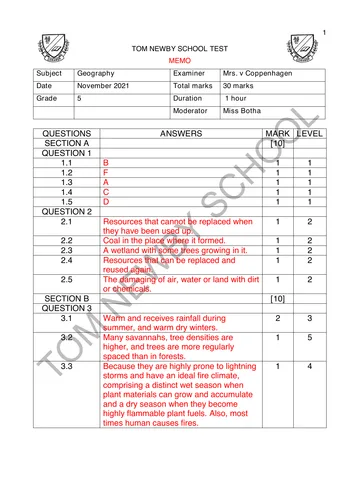
1.1 Copper A To purify water and kill bacteria and fungi.
1.2 Chrome B For electrical wiring: pots and pans.
1.3 Silver C In car exhausts to make fumes less harmful.
1.4 Platinum D Coins and jewelry.
1.5 Gold E To colour glass.
F To harden steel and to make stainless steel
1.1 1.2 1.3 1.4 1.5
(5)
1
You're offline
Skip to contentQuestion paper
Grade 5 Geography Exam November 2021
Geography · Grade 5 · November Exam · 2021. Question paper, 6 pages. Read online or download the PDF.
- Subject
- Geography
- Grade
- Grade 5
- Document type
- Question paper
- Year
- 2021
- Exam period
- November Exam
- Pages
- 6
- File size
- 362.4 KB
Loading document…
Loading document…
1 of 6
Document textSearch extracted text and jump to a page.
2
QUESTION 2 [5]
Write the correct definition for the following words:
2.1 Non-renewable (1)
__________________________________________________________________________
2.2 Coal deposit (1)
__________________________________________________________________________
2.3 Swamp (1)
__________________________________________________________________________
2.4 Renewable (1)
__________________________________________________________________________
2.5 Pollution (1)
__________________________________________________________________________
SECTION B – CASE STUDY: CLIMATE [10]
QUESTION 3
Read the following case study about the Savannah grasslands and answer the questions that
follow.
Case study: Savannah Grasslands
Different types and areas of vegetation have different names. One type is called savannah.
A savannah is a grassland area that has trees and other smaller bushes. Savannahs occur on
lower areas of land than other grasslands do. In some savannahs, the trees grow far apart, and
in others, there are more trees that can grow quite close together.
There are different types of savannahs, with many different types of landscapes and vegetation.
The main types of savannahs in South Africa are those:
where the grasses are not eaten by animals, so there are few animals in the area,
where the grasses are eaten by the animals, so there are many animals in the area.
Almost a third of South Africa is covered by savannah vegetation. The savannah is warm
throughout the year. It receives rainfall during summer, and has warm, dry winters.
2
3
The wet summer season provides just enough rain to allow grasses to grow well in areas that
are more moist and not overpowered by trees. The tall grasses provide good food for grass-
eating animals such as springbok, buffalo, and wildebeest.
Fire outbreaks on the savannah are common. Almost all plants and grasses that grow here are
able to survive fires, even when badly burnt. Some plants are able to store water and nutrients
in their roots. When fires burn the stems, the food and water stored underground allows the
plant to grow again. Some trees also have thick bark to protect them from being permanently
damaged by fires.
Acacia trees are found in savannahs. They have long tap roots that can find water deep
underground. This helps them to survive drought conditions. Acacias also have sharp thorns
for protection. The thorns make it difficult for most animals to eat the leaves of the plant. Only
specially adapted animals such as giraffes, are able to eat leaves from branches that have
thorns.
Because savannahs have many different kinds of plants, they can support many different types
of animals. Savannahs are home to animals that feed on plants and trees, e.g. giraffes, rhinos,
elephants, zebras and many types of antelope. Then, there are animals that eat these plant-
eaters, such as lions, cheetahs and hyenas. There are also numerous kinds of insects and
birds.
(Platinum Social Sciences, 2012, P. Ranby, B. Johannesson, R. Versfeld, M. Slamang, B.) Roberts)
3.1 What kind of climate do savannahs have? (2)
__________________________________________________________________________
__________________________________________________________________________
3.2 In what way is a savannah different to a forest? (1)
__________________________________________________________________________
3.3 Why are fire outbreaks common in the savannah area? (1)
__________________________________________________________________________
3
4
3.4 How is it possible for plants and grasses to be able to survive the fires? (2)
__________________________________________________________________________
__________________________________________________________________________
3.5 Name two types of herbivore animals that live in the savannah (2)
__________________________________________________________________________
3.6 Name the two main types of savannahs in South Africa (2)
__________________________________________________________________________
__________________________________________________________________________
__________________________________________________________________________
SECTION C – MINERALS AND MINING IN SOUTH-AFRICA [10]
QUESTION 4
Answer the following questions on minerals and mining in South Africa.
4.1 Are minerals a renewable or non-renewable resource? (1)
________________________________________________________________________
4.2 In three steps, briefly explain how coal is formed. (3)
__________________________________________________________________________
__________________________________________________________________________
__________________________________________________________________________
__________________________________________________________________________
__________________________________________________________________________
__________________________________________________________________________
4.3 Name one thing gases and other substances that we get from heated coal can be used
to make. (1)
__________________________________________________________________________
4.4 Name one way in which mining can cause:
a) Air pollution (1)
_____________________________________________________________________
_____________________________________________________________________
4
5
b) Water pollution (1)
_____________________________________________________________________
_____________________________________________________________________
4.5 Name and describe three health and safety risks for miners. (3)
__________________________________________________________________________
__________________________________________________________________________
__________________________________________________________________________
__________________________________________________________________________
GRAND TOTAL [30]
5
6
Analysis of Geography Grade 5 Test (Teacher use only)
Name of learner:__________________________________
ALLOCATED MARK LEARNERS MARK MODERATED
MARK
SECTION A [10]
QUESTION 1 5
QUESTION 2 5
ALLOCATED MARK LEARNERS MARK MODERATED
MARK
SECTION B [10]
QUESTION 3 10
ALLOCATED MARK LEARNERS MARK MODERATED
MARK
SECTION C [10]
QUESTION 4 10
TOTAL [30]
6
Recommended for this subject
Published documents with matching subject and grade metadata.
Related documents
Matched using subject, grade, language, document type and exam metadata.