1
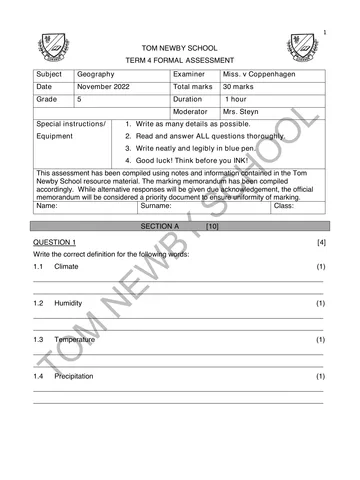
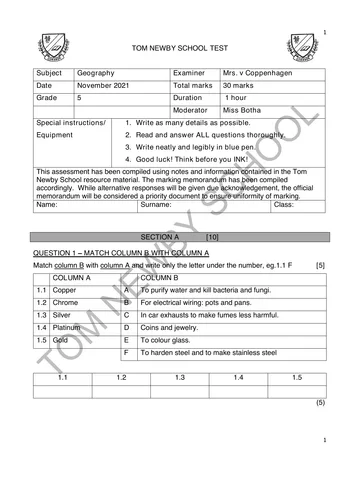
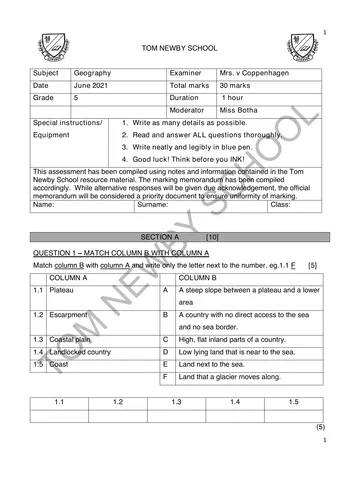
TOM NEWBY SCHOOL
TERM 4 FORMAL ASSESSMENT
MEMO
Subject Geography Examiner Miss. v Coppenhagen
Date November 2022 Total 30 marks
marks
Grade 5 Duration 1 hour
Moderator Mrs. Steyn
QUESTIONS ANSWERS MARK LEVEL
SECTION A [10]
QUESTION 1 [4]
1.1 It is a long-term weather pattern in an area. 1 2
1.2 The amount of water vapour in the air. 1 2
1.3 This tells us how hot or cold the air is. We 1 2
use words like hot, warm, cool, and cold to
describe different temperatures.
1.4 Water that falls from a cloud is called 1 2
precipitation.
QUESTION 2 [6]
2.1 If there is one wrong answer NO MARK 1 3
a) Easterly wind
b) North-East
2.2 If there is one wrong answer NO MARK 1 3
a) Cloudy with rain
b) Partly cloudy
2.3 Rain 1 2
2.4.1 If there is one wrong answer NO MARK 1 4
June
July
August
2.4.2 Winter 1 3
2.4.3 81-84mm 1 3
SECTION B [20]
QUESTION 3 [16]
3.1 Coal is something that is formed over 2 4
millions of years. Like most minerals, it is a
non-renewable resource. It is formed from
plant material and is therefore not a
mineral.
You're offline
Skip to contentMemorandum
Grade 5 Geography Memo November 2022
Geography · Grade 5 · November Exam · 2022. Memorandum, 3 pages. Read online or download the PDF.
- Subject
- Geography
- Grade
- Grade 5
- Document type
- Memorandum
- Year
- 2022
- Exam period
- November Exam
- Pages
- 3
- File size
- 150.7 KB
Loading document…
Loading document…
1 of 3
Document textSearch extracted text and jump to a page.
2
3.2 - Dead plant and animal matter from 3 5
millions of years ago gets covered with
mud, rain, and lava.
- The weight of the layers on top of each
other causes pressure and heat and so the
once living trees change to dead carbon.
- Coal is found in layers with the oldest
layers deep down and the youngest layers
close to the surface.
3.3 Soaps, aspirins, fertilizers, dyes, solvents, 3 3
shampoos, tennis rackets, mountain bikes
and fabrics.
3.4 a) To harden steel. Make dyes, to colour 3 4
paint, shiny surfaces.
b) electrical wiring, pot, pans, pipes in
plumbing
c) jewellery, batteries for hearing aids,
purify water
3.5 a) Air pollution 2 3
-Dust from drilling and blasting pollutes the
air.
-In coal mines, digging coal out of the
ground releases harmful gases into the air.
-Wind lifts fine particles of rock in waste
dumps into the air.
-Coal mine dumps often catch fire. The
burning coal releases harmful gases.
b) Water pollution
-Rainwater passing through mine dumps is
polluted by dust and chemicals in the
dumps.
-Chemicals are added to water to separate
minerals from the rock. The wastewater is
often piped into a river.
-Polluted water from inside the mine flows
onto the surface. This is known as acid
mine drainage
3.6 -Rockfalls: More miners are killed by rock 3 3
falls underground than any other accidents.
3
-Heat stroke: The hard work for long hours
at high temperature causes some miners to
collapse.
-Lung disease: The dust from blasted rock
damages miners’ lungs and affects their
breathing.
QUESTION 4 [4]
Open pit mining is used when the minerals 4 5
or the coal layer is close to the surface of
the earth.
Shaft mining or underground mining is used
when the minerals or coal layers are deep
under the surface.
With open pit mining the covering of rock
and soil is dug out and the hole gets larger
and deeper. The hole is then left open. It is
wide enough on the sides for trucks and
lorries to drive in to collect the mineral or
coal. Once the mineral or coal is reached,
drilling and blasting break up the mineral or
coal layer.
With shaft mining a shaft is drilled and
blasted into the ground. Then tunnels are
dug out horizontally from the shaft. A lift
system is used to take the miners down into
the mine and back to the surface again.
The deeper we go into the earth, the hotter
it becomes. Other shafts must be drilled so
that clean air can get into the mine. These
are called ventilation shafts. Underground
water must be pumped out of the mine
otherwise the mine will flood.
However, while the extraction of mineral
resources provides developing countries
with their economy, it also has a huge risk
to the environment.
Recommended for this subject
Published documents with matching subject and grade metadata.
Related documents
Matched using subject, grade, language, document type and exam metadata.