
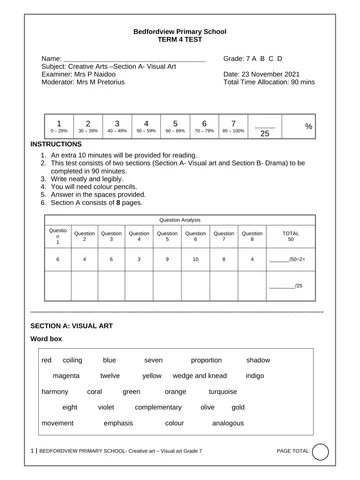
Bedfordview Primary School
TERM 4 TEST
Name: Grade: 7 A B C D
Subject: Creative Arts –Section A- Visual Art
Examiner: Mrs P Naidoo Date: 23 November 2021
Moderator: Mrs M Pretorius Time Allocation: 1 hour – VA
1 2 3 4 5 6 7 %
0 – 29% 30 – 39% 40 – 49% 50 – 59% 60 – 69% 70 – 79% 80 – 100%
25
INSTRUCTIONS
1. An extra 10 minutes will be provided for reading.
2. Write neatly and legibly.
3. You will need colour pencils.
4. Answer in the spaces provided.
5. Section A consists of 8 pages.
Question Analysis
Questio
Question Question Question Question Question Question Question TOTAL
n
2 3 4 5 6 7 8 50
1
6 4 6 3 9 10 8 4 _______/50÷2=
_________/25
~~~~~~~~~~~~~~~~~~~~~~~~~~~~~~~~~~~~~~~~~~~~~~~~~~~~~~~~~~~~~~~~~~~~~~~~~~~~~~~~~~~~~~~~~~~~~~
SECTION A: VISUAL ART (60 minutes)
Word box
red coiling blue seven proportion shadow
magenta twelve yellow wedge and knead indigo
harmony coral green orange turquoise
eight violet complementary olive gold
movement emphasis colour analogous
1 | BEDFORDVIEW PRIMARY SCHOOL SUBJECT PAGE TOTAL:
Skip to contentAll 2021 papers 
Creative Arts Grade 7 November 2021 Memo
Grade 7 Creative Arts memorandum from the November Exam 2021, 7 pages. Read online or get the free PDF download, question paper linked when available.
Creative Arts · Grade 7 · November Exam · 2021. Memorandum, 7 pages. Read online or download the PDF.
- Subject
- Creative Arts
- Grade
- Grade 7
- Document type
- Memorandum
- Year
- 2021
- Exam period
- November Exam
- Curriculum
- CAPS
- Pages
- 7
- File size
- 336.9 KB
Free to read online, no sign-up needed
Loading document…
Loading document…
1 of 7
This exam
November Exam 2021
Document textSearch extracted text and jump to a page.
Question 1 [6]
Match the definition in column B to the Element in column A and write down only the correct
number in column C. example: g – 12
A Element of art B Definition C Correct match
a. Line 1. An artist’s attempt to create an illusion of 3D on a
flat surface a.___2___
b. Tone 2. It is made up of many points or dots.
b.___5____
c. Texture 3. Shows the external outline
of an object. c.___6____
d. Shape 4. Shows the entire appearance of the object- its
material, size, shape and texture. d.___3___
e. Form 5. Sows the change from light to dark in a drawn or
painted picture or object. e.___4___
f. Space 6. Shows the surface quality of an object as well as
the material that object is made of.
f.___1___
_____/6
Question 2 [4]
Give the definitions of the following exactly as we learnt in class.
2.1 Pattern
The repetition of the elements of art. (1)
2.2 Emphasis
Focus/main idea. What ‘grabs’ your attention in a picture. (1)
2.3 Variety
How the elements work together to complete an artwork. (1)
2.4 Rhythm and movement
A regular repetition of the elements to create a sense of rhythm and movement. (1)
_____/4
2 | BEDFORDVIEW PRIMARY SCHOOL SUBJECT PAGE TOTAL:
Question 3 [6]
Use the word box on p1 to write one word or term for each of the following descriptions.
Description Term
3.1. The darkest parts of an object/scene which do not have light on them.
Shadow
3.2. The focus or main idea that grabs your attention in a picture.
Emphasis
3.3. The opposites on the colour wheel.
Complementary
3.4. Fold and compress clay over itself a few times to squeeze out any air Wedge and
bubbles. knead
3.5. When elements work well together and relate to one another.
Proportion
3.6. Creates mood and meaning in an artwork.
Colour
________/6
Question 4 [3]
licensed under CC BY-NC
Contouring Cross-hatching Blending _______/3
Use your grey lead pencil to draw in the shading techniques indicated below the vase.
3 | BEDFORDVIEW PRIMARY SCHOOL SUBJECT PAGE TOTAL:
Question 5 [9]
Use the word box on p1 to help you answer the following about the colour wheel. You can use the
colour pencil, or you can mix the colour.
5.1 Colour in the two colours that are analogous to yellow.
and gold and olive
(2)
5.2 Colour in the colours that make magenta.
and red and violet
(2)
5.2 Turquoise is complementary to coral (write the name of the colour) (1)
5.3 A rainbow has seven colours. (1)
5.4 Name and colour in any 3 tertiary colours
_________________ __________________ __________________ 6x ½ = (3)
_____/9
Question 6 [10]
Study the picture below and read the paragraph. Then answer the questions that follow.
Old couple or musician – Salvador Dali – 1930
4 | BEDFORDVIEW PRIMARY SCHOOL SUBJECT PAGE TOTAL:
Salvador Dali Paintings
Salvador Felipe Jacinto Dali Domenech popularly known as Salvador Dali is a surreal artist. He
was born in Catalonia, Spain on the 11th May 1904. When he was a child Salvador showed great
interest in painting and drawing. He initially started off with charcoal drawings and his father helped
set up various exhibitions to show off surreal Dali paintings. Even at such a young age, Salvador’s
paintings were highly sophisticated and as an act of support his father built him a studio.
Salvador Dali graduated from San Francisco School of fine arts with a Fine art degree in the year
1922. One of his most famous paintings were of melting clocks. During 1920 he went to Madrid,
here he had the chance to meet Picasso and other artists. Which changed his focus to surrealism,
like the optical illusion above, His work always leaves onlookers amazed.
Questions:
6.1. Who is the artist? Salvador Dali (1)
6.2. What is the title of the painting? Old couple or Musician. (1)
6.3. Where was the artist born and on which date?
Catalonia, Spain on 11 May 1904. (2)
6.4. In which medium did the artist originally start off?
Charcoal. (1)
6.5. Which two realities can you see in the painting? Describe each shortly. (4)
Reality one - faces of an old couple
One can see the wrinkles in their faces and ths old man has a moustache.
The old lady has wavy hair and an earring that looks like a bottle.
Reality two - Musician and lady
One can see a man playing guitar to a lady sitting opposite him.
He is wearing a sombrero hat and at her feet is a bottle of wine.
6.6 Choose the correct answer and underline it. (1)
His paintings are called…
a. Surreal and optical illusion.
b. Still life and optical illusion.
c. Surreal and impressionistic. _____/8
5 | BEDFORDVIEW PRIMARY SCHOOL SUBJECT PAGE TOTAL:
Question 7 [8]
Look at the picture on the following page. Redraw figure1 and enlarge with grey lead pencil.
RUBRIC:
Criteria 7- 8 5-6 3-4 2-1
Proportion Excellent Good proportions Moderate Poorly redrawn
proportions and and well redrawn. proportions and and proportions
precisely redrawn drawing well tried. warped.
Shading Shading Shading Shading techniques Shading
techniques techniques well lack preciseness. techniques
excellently done. done. barely visible.
_______/16 ÷2 = ______/8
Figure 1
7.1. Redraw the picture in Figure 1 in the block below. Remember to enlarge and add shading
techniques precisely.
6 | BEDFORDVIEW PRIMARY SCHOOL SUBJECT PAGE TOTAL:
Question 8 [4]
. Value is the range from light to dark in art. Do the following value scales.
8.1. Grey lead pencil shading value scale. (1)
8.2. Ink blue pen shading value scale with vertical lines. (1)
8.3. Red colour pencil shading value scale with dots. (1)
8.4. Use complementary colours on the colour wheel to show the value of contrast. (1)
-------/4
7 | BEDFORDVIEW PRIMARY SCHOOL SUBJECT PAGE TOTAL:
Study this subject
Recommended for this subject
Question paper
Creative Arts Grade 7 November 2021 Question Paper
Question paper
Creative Arts Grade 7 November 2021 Question Paper
Question paper
Creative Arts Grade 7 November 2021 Question Paper
Question paper
Creative Arts Grade 7 June 2021 Question Paper
Question paper
Creative Arts Grade 7 November 2020 Question Paper
Question paper