BEDFORDVIEW PRIMARY SCHOOL
JUNE EXAMINATION - 2017
ECONOMIC MANAGMENT SCIENCES
GRADE: 7 DURATION: 90 minutes
EDUACTOR: MRS T. NAIDOO MODERATOR: MRS P. NAIDOO
TOTAL MARK: 75 DATE: 9 June 2017
NAME OF PUPIL
___________________________________GRADE 7____
Instructions:
1. Please ensure that you write your name on the
Answer sheet.
2. Write neatly and legibly.
3. Answer all questions.
4. Work carefully and watch your time usage. ALL THE BEST!
---------------
75 %
1 2 3 4 5 6 7
TEACHER COMMENT:
PARENT SIGNATURE:
1
Skip to contentAll 2021 papers 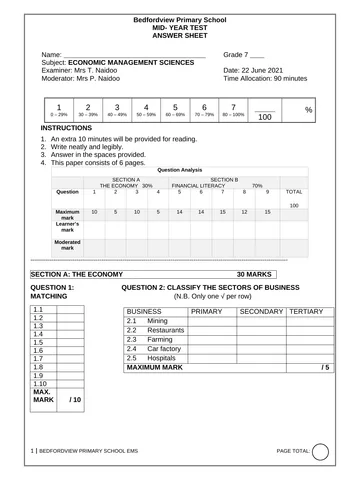
View all
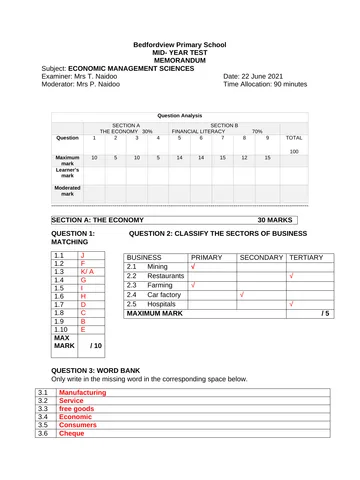
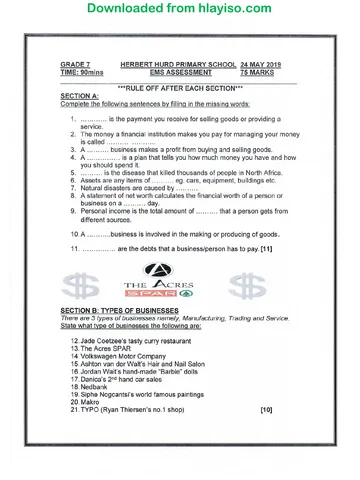
Economic Management Sciences Grade 7 June 2021 QP
Grade 7 Economic Management Sciences question paper from the June Exam 2021, 9 pages. Read online or get the free PDF download, memo linked when available.
Economic Management Sciences · Grade 7 · June Exam · 2021. Question paper, 9 pages. Read online or download the PDF.
- Subject
- Economic Management Sciences
- Grade
- Grade 7
- Document type
- Question paper
- Year
- 2021
- Exam period
- June Exam
- Curriculum
- CAPS
- Pages
- 9
- File size
- 163.3 KB
Free to read online, no sign-up needed
Loading document…
Loading document…
1 of 9
This exam
June Exam 2021
Document textSearch extracted text and jump to a page.
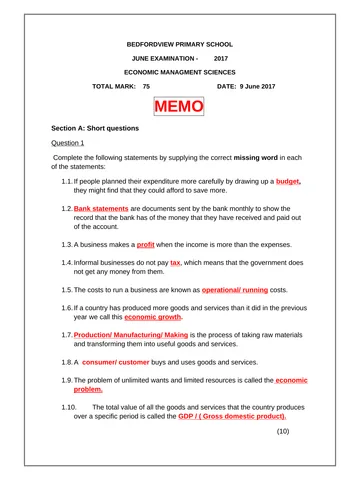
Section A: Short questions
Question 1
Complete the following statements by supplying the correct missing word in each
of the statements:
word bank
1.1. If people planned their expenditure more carefully by drawing up a
_______________________________, they might find that they could afford
to save more.
1.2. _____________________________________ are documents sent by the
bank monthly to show the record that the bank has of the money that they
have received and paid out of the account.
1.3. A business makes a ______________________________ when the income
is more than the expenses.
1.4. Informal businesses do not pay _____________________________, which
means that the government does not get any money from them.
1.5. The costs to run a business are known as ___________________________
costs.
1.6. If a country has produced more goods and services than it did in the previous
year we call this ___________________________________________.
1.7. _____________________________________ is the process of taking raw
materials and transforming them into useful goods and services.
1.8. A ________________________________ buys and uses goods and
services.
1.9. The problem of unlimited wants and limited resources is called the
_____________________________________________ .
1.10. The total value of all the goods and services that the country produces
over a specific period is called the
2
_______________________________________________. (10)
Question 2:
State if the following statements are true or false:
2.1 A promissory note is a piece of paper on which one person writes a promise
to pay the other person a certain sum of money at some time in the future.
2.2 When people barter, they exchange goods for money
2.3 Public goods are the things that the government provides which everyone in
the community uses, for example a park or a library
2.4 A business that buys goods in large quantities from manufacturers and then
sells the goods to other shops or customers in smaller quantities is known as
a retailer.
2.5 The net worth of a business is the amount of money that the owner invests in
the business at the start-up.
2.6 Net worth of a person = assets – liabilities
2.7 Ill health and people staying away from work decreases productivity
2.8 A deficit is when your cash receipts are greater than your payments
3
2.9 The people you plan to sell your product or service to is known as your
target market.
2.10 The four factors of production are land, labour, capital and
entrepreneurship.
(10)
Question 3: Choose the most correct answer for each of the questions below:
Highlight / Circle the correct answer.
3.1 Rent paid by a business is classified as:
A an asset account
B a balance sheet account
C an expense account
D an income account
3.2 Bank balances, investments, trading stock and policies are examples of
A Fixed / non- current assets
B long-term liabilities
C current liabilities
D current assets
3.3 Is not an example of a financial record:
A payslip
B ATM slip
C change
D credit note
4
3.4 A portion of your monthly earnings are invested and when you retire, the fund
pays you a monthly income.
A shares
B pension
C rental
D savings
3.5 The minimum income needed to meet a person’s basic needs is
A the poverty cycle
B the bread price line
C the poverty line
D the social acceptance scale (5)
Section B: The economy
Question 4 :
4.1 Complete the following table, by deciding if these items possess the four
characteristics of money. Indicate yes or no or yes, but difficult
Is the item Is the item Is the item Can the item
relatively durable? portable? be divided into
scarce? smaller units?
Gold
Coins and
notes
(4)
4.2 Banks serve as vital institutions in our day to day lives. List any SIX services
offered by banks. (6)
___________________________________________________________________
___________________________________________________________________
5
___________________________________________________________________
Section C: Financial literacy
Question 5: Choose the most suitable match. Write down only the letter next to the
corresponding number.
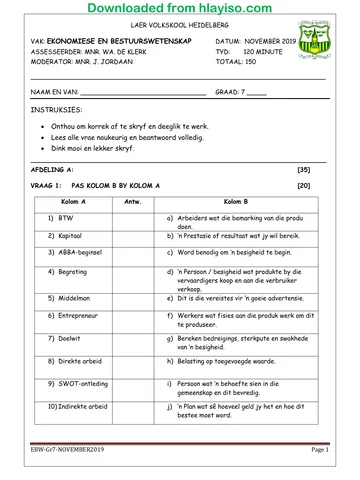
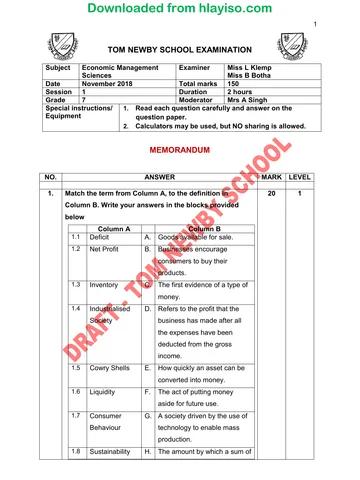
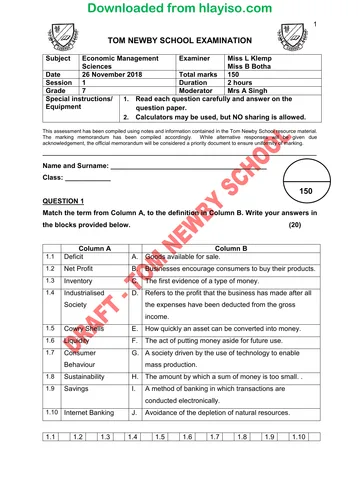
1. Assets A When money is put aside for the
future
2. Capital B The total debts that the business
has to pay back
3. Fixed deposit C Planning how much money you
will have in the future
4. Bank D The money or assets invested in
the business by the owner
5. Budgets E Money that is earned by the
business for providing a service
6. Savings F A savings account where you can
withdraw money whenever you
need to
7. Liability G The possessions that are valuable
to the business
8. Call account H Money earned and paid to the
employees of the business
9. Loan: FNB bank I The cost of borrowing money
10. Current income J An investment made in order to
earn a fixed interest rate
11. Salaries and wages K An account opened by the
business to deposit and withdraw
money
12. Interest on loan L Money that the business has
borrowed from a financial
institution
1. _______ 2. _______ 3. _______ 4. _______ 5. _______ 6. _______
7. _______ 8. _______ 9. _______ 10. _______ 11. _______ 12. _______
6
(12)
Question 6:
Home Fixers has the following information in their financial records. Use the
information to answer the questions that follow:
Advertising costs 2 000
Bank 17 000
Start- up Capital 56 000
Current income 50 000
Water and electricity 2 000
Equipment 40 000
Loan 130 000
Material costs 20 500
Rent income 3 500
Telephone 1 500
Vehicles 155 000
Wages 00
6.1 Name the three assets that home Fixers have. (3)
6.2 Calculate the total value of these assets (2)
6.3 Does this business have any liabilities? If so, how much does the business
owe? (2)
6.4 Name two income accounts (2)
7
6.5 Calculate the total income that the business has earned (2)
6.6 Make a list of expenses and calculate the total expenses (2)
6.7 Did home Fixers make a profit or a loss?
Provide a reason and show the calculation to support your answer? (2)
6.8 How much is the business worth? Show the calculation to support your
answer. (3)
Section D: Entrepreneurship
Question 7:
Choose the most suitable match. Write down only the letter in the space provided.
8
7.1
1. An advantage of an informal A A business that makes a profit
business from buying and selling of goods
2. An informal business B Because they do not pay taxes,
the government does not get any
money from them to provide
goods and services in the
economy
3. A micro-enterprise C A small informal business
4. A SSME D A business that employs hundreds
of people and sells goods and
services on a large scale
5. A large business E A business that is not taxed or
monitored in any way by any form
of government
6. A formal business F They offer an opportunity for
unskilled, uneducated, disabled
and unemployed people to earn
an income when there are no job
opportunities
7. A trading business G Very little capital is invested in the
business and generally the
business does not own the land or
pay rent for it
8. A manufacturing business H A term given to small, medium
and micro-businesses
9. A disadvantage of an informal I A business that makes a profit by
business selling goods that it has made
10. A characteristic of an informal J A business that has registered for
business tax and keeps accurate
accounting records
1. _______ 2. _______ 3. _______ 4. _______ 5. _______ 6. _______
7. _______ 8. _______ 9. _______ 10. _______
(10)
9
Study this subject
Recommended for this subject
Addendum
Economic Management Sciences Grade 7 June 2021 Addendum
Memorandum
Economic Management Sciences Grade 7 June 2021 Memo
Memorandum
Economic Management Sciences Grade 7 June 2021 Memo
Question paper
Economic Management Sciences Grade 7 June 2019 QP
Memorandum
Economic Management Sciences Grade 7 June 2018 Memo
Question paper