Downloaded from hlayiso.com
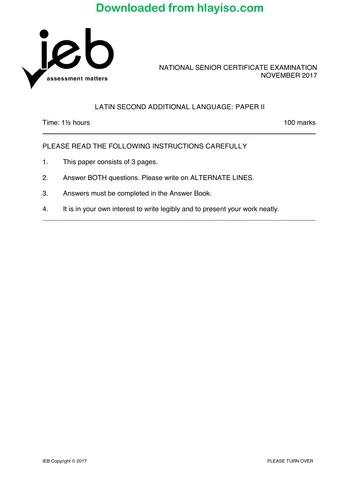
NATIONAL SENIOR CERTIFICATE EXAMINATION
NOVEMBER 2017
LATIN SECOND ADDITIONAL LANGUAGE: PAPER I
Time: 3 hours 200 marks
PLEASE READ THE FOLLOWING INSTRUCTIONS CAREFULLY
1. This question paper consists of 20 pages and an Answer Sheet of 2 pages. Please
check that you have the correct number of pages.
2. Note that there are options: choose EITHER 'QUESTION 1 – Rhetoric' OR
'QUESTION 2 – Historiography' from SECTION A; choose EITHER 'QUESTION 3 –
Epic' OR 'QUESTION 4 – Elegiac and Lyric' from SECTION B.
3. Read the questions carefully.
4. In SECTION C the options are clearly set out on page 12. DO NOT ATTEMPT TO
ANSWER QUESTIONS ON SET WORK THAT YOU HAVE NOT STUDIED.
5. Number your answers exactly as the questions are numbered.
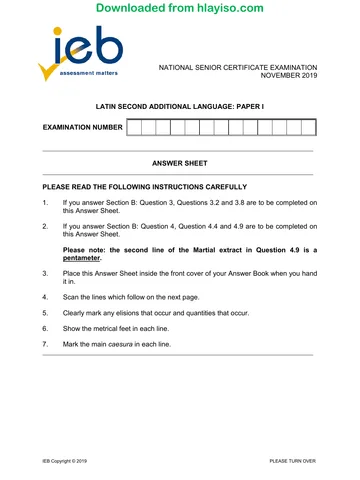
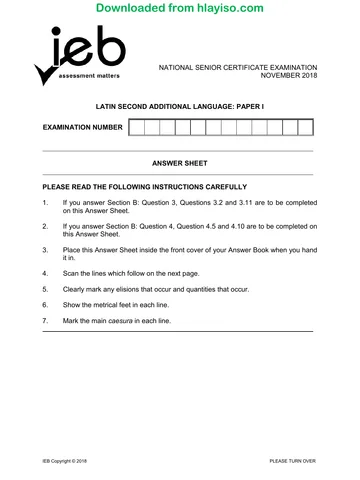
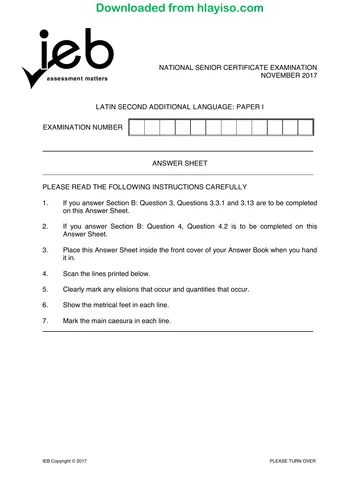
6. Answers must be written on the Answer Sheet according to instructions.
7. Please hand in the Answer Sheet together with your Answer Book. Please fill in
your examination number on the Answer Sheet.
8. It is in your own interest to write legibly and to present your work neatly.
IEB Copyright © 2017 PLEASE TURN OVER
You're offline
Skip to contentQuestion paper View all
Latin SAL P1 2017 hlayiso.com
Latin SAL · Grade 12 · 2017. Question paper, 20 pages. Read online or download the PDF.
- Subject
- Latin SAL
- Grade
- Grade 12
- Document type
- Question paper
- Year
- 2017
- Paper
- 1
- Publisher
- IEB
- Pages
- 20
- File size
- 713.3 KB
Loading document…
Loading document…
1 of 20
Document textSearch extracted text and jump to a page.
Downloaded from hlayiso.com
NATIONAL SENIOR CERTIFICATE: LATIN SECOND ADDITIONAL LANGUAGE: PAPER I Page 2 of 20
SECTION A PROSE SET TEXTS
You should answer either Question 1 or Question 2 from this section.
QUESTION 1 RHETORIC
Read the passages below and answer the questions that follow.
occurrebat ei mancam ac debilem praeturam futuram suam consule Milone: eum porro
summo consensu populi Romani consulem fieri videbat. contulit se ad eius competitores,
sed ita, totam ut petitionem ipse solus etiam invitis illis gubernaret, tota ut comitia suis, ut
dictitabat, umeris sustineret. convocabat tribus, se interponebat, Collinam novam
dilectu perditissimorum civium conscribebat. quanto ille plura miscebat, tanto hic 5
magis in dies convalescebat. ubi vidit homo ad omne facinus paratissimus fortissimum
virum inimicissimum suum certissimum consulem idque intellexit non
solum sermonibus, sed etiam suffragiis populi Romani saepe esse declaratum,
palam agere coepit et aperte dicere occidendum Milonem.
[Cicero, Pro Milone, XXV]
1.1 'occurebat … videbat ' (lines 1 – 2)
1.1.1 For which positions did Milo and Clodius respectively contend, as
alluded to in these lines? (2)
1.1.2 How does Cicero, mainly through his use of contrasts and opposites,
successfully contrast the weakness of Clodius with the popularity of
Milo? You should quote at least two sets of words or phrases which
are used in these lines. (4)
1.2 'contulit … sustineret ' (lines 2 – 4)
1.2.1 Describe the step taken by Clodius to control Milo's competitors as
explained in these lines. (2)
1.2.2 Give one example of how Cicero draws attention to Clodius'
manipulative behaviour through his choice and placement of words. (2)
1.3 Translate lines 4 to 9 printed in BOLD ('convocabat … Milonem'). (16)
1.4 'ubi vidit … Milonem ' (lines 6 – 9)
Describe the contrasts Cicero draws between the influence and intentions of
Milo and Clodius in these lines and explain how he draws attention to them.
You should find at least two contrasts and, with reference to the Latin,
explain how Cicero carefully places words to draw attention to the
differences between the two men. (6)
IEB Copyright © 2017
Downloaded from hlayiso.com
NATIONAL SENIOR CERTIFICATE: LATIN SECOND ADDITIONAL LANGUAGE: PAPER I Page 3 of 20
valebat apud vos, iudices, Milonis erga me remque publicam meritorum memoria, valebant
preces et lacrimae nostrae, quibus ego tum vos mirifice moveri sentiebam, sed plus multo
valebat periculorum impendentium timor. quis enim erat civium qui sibi solutam P.
Clodi praeturam sine maximo rerum novarum metu proponeret? solutam autem fore
videbatis, nisi esset is consul, qui eam auderet possetque constringere. eum 5
Milonem unum esse cum sentiret universus populus Romanus, quis dubitaret
suffragio suo se metu, periculo rem publicam liberare? at nunc, Clodio remoto,
usitatis iam rebus enitendum est Miloni, ut tueatur dignitatem suam; singularis illa
et huic uni concessa gloria, quae cotidie augebatur frangendis furoribus Clodianis,
iam Clodi morte cecidit. 10
[Cicero, Pro Milone, XXXIV]
1.5 'valebat … timor ' (lines 1 – 3)
1.5.1 In these lines, Cicero mentions three things which count in his client's
favour with the jury. Summarise them in your own words. (3)
1.5.2 Suggest a reason why Cicero places them in this order. (1)
1.5.3 Apart from his use of this order, describe two other ways in which
Cicero draws attention to the different strengths of his case through
repetition of sounds and placement of words in these lines. (2)
1.6 Translate lines 3 to 10 printed in BOLD 'quis … cecidit ' (24)
1.7 Cicero's question in lines 3 – 4 is rhetorical. What is its effect (that is, what
does it imply)? (2)
1.8 'solutam autem … suam ' (lines 4 – 8)
1.8.1 Pick out the words or phrases used by Cicero in these lines that
convey his assumption that, before Clodius' death, Milo was popular
and was guaranteed success. (2)
1.8.2 Give one example of how Cicero uses word order in these lines to
amplify the contrast between Milo as Rome's saviour and Clodius as
her nemesis. (2)
1.9 'singularis … cecidit ' (lines 8 – 10)
Illustrate, with reference to the Latin, how Cicero uses alliteration, repetition
and balance in these lines to contrast Milo's fortune before Clodius' death
with his fortune now. You should pick out one example of each technique
and explain its effect. (6)
1.10 'Cicero uses the "cui bono" argument (Milo stands to gain) to defend Milo
only as another means of attacking Clodius' character.'
Do you agree with this statement? Justify your answer with reference to
these two passages and other parts of the Pro Milone you have read. (6)
[80]
IEB Copyright © 2017 PLEASE TURN OVER
Downloaded from hlayiso.com
NATIONAL SENIOR CERTIFICATE: LATIN SECOND ADDITIONAL LANGUAGE: PAPER I Page 4 of 20
QUESTION 2 HISTORIOGRAPHY
Read the passages below and answer the questions that follow.
Gaio Vipsano C. Fonteio consulibus diu meditatum scelus non ultra Nero distulit,
vetustate imperii coalita audacia et flagrantior in dies amore Poppaeae, quae sibi
matrimonium et discidium Octaviae incolumi Agrippina haud sperans crebris
criminationibus, aliquando per facetias incusare principem et pupillum vocare, qui
iussis alienis obnoxius non modo imperii, sed libertatis etiam indigeret. cur enim 5
differri nuptias suas? formam scilicet displicere et triumphales avos, an
fecunditatem et verum animum? timeri ne uxor saltem iniurias patrum, iram populi
adversus superbiam avaritiamque matris aperiat. quod si nurum Agrippina non nisi filio
infestam ferre posset, redderetur ipsa Othonis coniugio: ituram quoque terrarum, ubi
audiret potius contumelias imperatoris quam viseret periculis eius immixta. 10
[Tacitus, Annals, XIV.1]
2.1 Translate lines 1 – 7 printed in BOLD ('Gaio … animum '). (20)
2.2 'Gaio Vipsano C. Fonteio consulibus ' (line 1)
2.2.1 To which year is Tacitus referring? (1)
2.2.2 In what year did Nero's reign begin? (1)
2.3 'diu meditatum scelus non ultra Nero distulit ' (line 1)
Discuss the effect of the placement of 'scelus ' before 'Nero ' in this clause. (2)
2.4 'crebris … indigeret ' (lines 3 – 5)
Give two examples of how Tacitus uses sound and word order in these lines
to make Poppaea's accusations sting. (4)
2.5 'formam … animum ' (lines 6 – 7)
Describe one way in which Tacitus has structured Poppaea's question to
highlight its irony. (2)
2.6 'timeri … aperiat ' (lines 7 – 8)
2.6.1 State whose emotions Poppaea claims she will expose to Nero if she
were his wife. (2)
2.6.2 What does she say about their emotions? (2)
2.7 'ituram … immixta ' (lines 9 – 10)
What scenario does Poppaea say she wants to avoid and to what lengths is
she prepared to go in order to do so? (3)
IEB Copyright © 2017
Downloaded from hlayiso.com
NATIONAL SENIOR CERTIFICATE: LATIN SECOND ADDITIONAL LANGUAGE: PAPER I Page 5 of 20
haec consensu produntur. aspexeritne matrem exanimem Nero et formam corporis
eius laudaverit, sunt qui tradiderint, sunt qui abnuant. cremata est nocte eadem
convivali lecto et exequiis vilibus; neque, dum Nero rerum potiebatur, congesta est
aut clausa humus. mox domesticorum cura levem tumulum accepit, viam Miseni
propter et villam Caesaris dictatoris, quae subiectos sinus editissima prospectat. 5
accenso rogo libertus eius cognomento Mnester se ipse ferro transegit, incertum
caritate in patronam an metu exitii. hunc sui finem multos ante annos crediderat
Agrippina contempseratque. nam consulenti super Nerone responderunt Chaldaei fore ut
imperaret matremque occideret; atque illa "occidat" inquit, "dum imperet."
[Tacitus, Annals, XIV.9]
2.8 Translate lines 1 – 7 printed in BOLD 'aspexeritne … exitii ' (lines 1 – 7). (18)
2.9 Explain the effect on the reader of the alternative scenarios described by
Tacitus in lines 1 – 2 ('aspexeritne … abnuant '). (2)
2.10 'neque … prospectat ' (lines 3 – 5)
How does Tacitus, through his choice and placement of words, highlight the
lack of honour given to Agrippina by her son but the lasting honour
bestowed on her by her slaves? You should give two examples from the
Latin and explain their effect. (4)
2.11 'atque illa "occidat" inquit, "dum imperet." ' (line 9)
2.11.1 Translate into English Tacitus' account of Agrippina's response to
the prophecy about Nero's future, quoted above. (2)
2.11.2 How does Tacitus, through the sound effects and order of words in
lines 7–9 ('hunc … imperet '), emphasise the purposeful way in
which Agrippina explored and embraced her destiny? You should
refer to at least two techniques he uses and show how they
contribute to the overall effect. (4)
2.12 Explain how, in the lines printed above, Tacitus gives the impression of
giving an objective account but succeeds in imposing his own judgment on
events. You should refer to at least two techniques he uses and show how
they contribute to the overall effect. (5)
2.13 'Nero is a leader weakened primarily by the intrigues of the women close to
him.'
2.13.1 To what extent is this statement supported by the two passages
printed in this examination? (4)
2.13.2 From your reading of the rest of Annals XIV, what other factors,
internal or external, have contributed to Nero's weakness as a leader? (4)
[80]
80 marks
IEB Copyright © 2017 PLEASE TURN OVER
Downloaded from hlayiso.com
NATIONAL SENIOR CERTIFICATE: LATIN SECOND ADDITIONAL LANGUAGE: PAPER I Page 6 of 20
SECTION B VERSE TEXTS
QUESTION 3 EPIC
You should answer either Question 3 or Question 4 from this section.
Read the passages below and answer the questions that follow.
'Nunc age, Dardaniam prolem quae deinde sequatur
gloria, qui maneant Itala de gente nepotes,
inlustris animas nostrumque in nomen ituras,
expediam dictis, et te tua fata docebo.
ille, vides, pura iuvenis qui nititur hasta, 760
proxima sorte tenet lucis loca, primus ad auras
aetherias Italo commixtus sanguine surget,
Silvius, Albanum nomen, tua postuma proles,
quem tibi longaevo serum Lavinia coniunx
educet silvis regem regumque parentem, 765
unde genus Longa nostrum dominabitur Alba.
proximus ille Procas, Troianae gloria gentis,
et Capys et Numitor et qui te nomine reddet
Silvius Aeneas, pariter pietate vel armis
egregius, si umquam regnandam acceperit Albam. 770
[Virgil, Aeneid VI, lines 756–770]
3.1 Who is talking in this section? (1)
3.2 Translate lines 756 – 759 printed in BOLD ('Nunc … docebo.'). (8)
3.3 3.3.1 Scan lines 758 – 759 ('inlustris … docebo '), marking any elisions that
occur and quantities, and showing the metrical feet and main caesura
in each line. Please do this question on the separate Answer
Sheet provided, and place it inside the front cover of your
Answer Book. (5)
3.3.2 Find the repeated sounds (alliteration) in these lines which draw
attention to the glory that awaits Aeneas' descendants. (2)
3.4 In lines 760 – 761, Aeneas uses three adjectives that alliterate ('pura …
proxima … primus '). Translate each of these words and explain how, in their
context, they point to the young man's imminent and auspicious future. (3)
3.5 With reference to lines 763 – 766, explain the source of Silvius Aeneas'
name, his relationship to Aeneas, and his destined legacy in Roman history. (3)
IEB Copyright © 2017
Downloaded from hlayiso.com
NATIONAL SENIOR CERTIFICATE: LATIN SECOND ADDITIONAL LANGUAGE: PAPER I Page 7 of 20
3.6 Translate lines 767 – 770 printed in BOLD ('proximus … Albam '). (8)
3.7 Explain why the description of someone as 'pariter pietate vel armis
egregius ' in lines 769 – 770 would resonate deeply with those who originally
heard this poem. (2)
3.8 3.8.1 Pick out at least three words or word stems that are repeated in the
lines printed above. (3)
3.8.2 Using these repeated words as a guide, describe the main ideas
about Rome's past and future rule which Virgil is articulating through
these lines. (3)
IEB Copyright © 2017 PLEASE TURN OVER
Downloaded from hlayiso.com
NATIONAL SENIOR CERTIFICATE: LATIN SECOND ADDITIONAL LANGUAGE: PAPER I Page 8 of 20
his demum exactis, perfecto munere divae,
devenere locos laetos et amoena virecta
fortunatorum nemorum sedesque beatas.
largior hic campos aether et lumine vestit 640
purpureo, solemque suum, sua sidera norunt.
pars in gramineis exercent membra palaestris,
contendunt ludo et fulva luctantur harena;
pars pedibus plaudunt choreas et carmina dicunt.
nec non Threicius longa cum veste sacerdos 645
obloquitur numeris septem discrimina vocum,
iamque eadem digitis, iam pectine pulsat eburno.
hic genus antiquum Teucri, pulcherrima proles,
magnanimi heroes nati melioribus annis,
Ilusque Assaracusque et Troiae Dardanus auctor. 650
arma procul currusque virum miratur inanis.
[Virgil, Aeneid VI, lines 637 – 651]
3.9 3.9.1 With reference to lines 637 – 641, describe the nature of Elysium.
Quote and explain/translate Latin words to support your statement. (3)
3.9.2 Show how the repeated sounds in these lines reflect the nature of the
environment. (3)
3.10 In lines 642 – 644, Virgil communicates the joyful and celebratory nature of
Elysium. Explain how he makes this vivid through his choice of words, their
placement and their sounds. (4)
3.11 Translate lines 645 – 651 printed in BOLD ('nec… inanis '). (14)
3.12 3.12.1 Who is the 'Threicius … sacerdos ' referred to in line 645? (1)
3.12.2 What does his presence in Elysium indicate? (1)
3.13 Scan lines 650 – 651, ('Ilusque … inanis'), marking any elisions that occur
and quantities, and showing the metrical feet and main caesura in each line.
Please do this question on the separate Answer Sheet provided, and
place it inside the front cover of your Answer Book. (5)
3.14 Explain the significance of 'Dardanus' and 'Ilus' to Aeneas and suggest how
he would have responded to seeing them. (3)
3.15 'Building on the legacy of the past, Rome will build a better future.'
3.15.1 Explain how someone reading the two passages printed above
could interpret this statement as their message. (4)
3.15.2 Explain how this message is articulated in other sections of
Aeneid VI, which you have read. (4)
[80]
IEB Copyright © 2017
Downloaded from hlayiso.com
NATIONAL SENIOR CERTIFICATE: LATIN SECOND ADDITIONAL LANGUAGE: PAPER I Page 9 of 20
QUESTION 4 ELEGIAC AND LYRIC
Non ego nobilium sedeo studiosus equorum;
cui tamen ipsa faves, vincat ut ille, precor.
ut loquerer tecum veni, tecumque sederem,
ne tibi non notus, quem facis, esset amor.
tu cursus spectas, ego te; spectemus uterque 5
quod iuvat, atque oculos pascat uterque suos.
O, cuicumque faves, felix agitator equorum!
ergo illi curae contigit esse tuae?
hoc mihi contingat, sacro de carcere missis
insistam forti mente vehendus equis, 10
et modo lora dabo, modo verbere terga notabo,
nunc stringam metas interiore rota.
si mihi currenti fueris conspecta, morabor,
deque meis manibus lora remissa fluent.
[Ovid Amores III 2.1 – 14]
4.1 Translate lines 1 – 8 printed in BOLD ('Non … tuae? '). (16)
4.2 Scan lines 1 – 4 ('non … amor '), marking any elisions that occur and
quantities, and showing the metrical feet and main caesura in each line.
Please do this question on the separate Answer Sheet provided, and
place it inside the front cover of your Answer Book. (10)
4.3 Ovid utters a prayer in line 2, which can be interpreted in two ways. Explain
how he could be understood to be praying for himself in this prayer. (2)
4.4 Describe one way in which Ovid communicates a playful tone through his
choice of words and word order in lines 5 – 6. (2)
4.5 Describe two ways in which Ovid communicates his frustration with his girl's
inattention to him through the sound, tone and vocabulary of lines 7 – 8. (4)
4.6 In lines 9 – 14, Ovid describes a hypothetical race. Write down the Latin for
four elements of the horse race which Ovid mentions and suggest an
equivalent English word or expression for each one. (4)
4.7 4.7.1 Summarise Ovid's conclusion in lines 13 – 14 in your own words. (2)
4.7.2 Explain one way in which the tone of his conclusion is echoed
through the sounds he uses. (2)
IEB Copyright © 2017 PLEASE TURN OVER
Downloaded from hlayiso.com
NATIONAL SENIOR CERTIFICATE: LATIN SECOND ADDITIONAL LANGUAGE: PAPER I Page 10 of 20
Furi et Aureli comites Catulli,
sive in extremos penetrabit Indos,
litus ut longe resonante Eoa
tunditur unda,
sive in Hyrcanos Arabesve molles, 5
seu Sagas sagittiferosve Parthos,
sive quae septemgeminus colorat
aequora Nilus,
sive trans altas gradietur Alpes,
Caesaris visens monimenta magni, 10
Gallicum Rhenum horribile aequor ulti-
mosque Britannos,
omnia haec, quaecumque feret voluntas
caelitum, temptare simul parati,
pauca nuntiate meae puellae 15
non bona dicta.
cum suis vivat valeatque moechis,
quos simul complexa tenet trecentos,
nullum amans vere, sed identidem omnium
ilia rumpens; 20
nec meum respectet, ut ante, amorem,
qui illius culpa cecidit velut prati
ultimi flos, praetereunte postquam
tactus aratro est.
[Catullus XI]
IEB Copyright © 2017
Downloaded from hlayiso.com
NATIONAL SENIOR CERTIFICATE: LATIN SECOND ADDITIONAL LANGUAGE: PAPER I Page 11 of 20
4.8 In lines 1 – 8 of his poem, Catullus mentions a number of peoples and places
situated to the east of the Roman empire.
4.8.1 Name two of these peoples or places. (2)
4.8.2 Give two examples from the Latin of how he uses choice, position or
sound of words to make them sound exotic. (4)
4.9 In lines 1 – 12 Catullus conveys the distance and non-stop nature of his
friends' travel.
4.9.1 Quote and translate the words or sets of words that communicate this
idea. (2)
4.9.2 Explain how Catullus also structures the lines to imply that the
journey is relentless. (2)
4.10 Describe two qualities (characteristics) of his friends to which Catullus is
alluding in lines 1 – 12. (2)
4.11 Translate lines 13 – 24 printed in BOLD ('omnia … est '). (14)
4.12 How effectively does Catullus contrast his vulnerability with Lesbia's
insensitivity and cruelty in lines 21 – 24? You should make at least two points
and quote the Latin that you are referring to. (4)
4.13 'Catullus is too intense as a lover to ever be capable of Ovid's type of
frivolity.'
4.13.1 From your reading of these two poems, do you think this is a fair
conclusion? (4)
4.13.2 If all the poems of Catullus and Ovid that you have read are taken
into account, explain how and why this conclusion (printed in italics)
can be repudiated or sustained. (4)
[80]
80 marks
IEB Copyright © 2017 PLEASE TURN OVER
Downloaded from hlayiso.com
NATIONAL SENIOR CERTIFICATE: LATIN SECOND ADDITIONAL LANGUAGE: PAPER I Page 12 of 20
SECTION C
You should answer two questions from Questions 5, 6, 7 or 8, grammatical and
syntactical usage, or Question 9, sentences for translation into Latin.
GRAMMATICAL AND SYNTACTICAL USAGE
QUESTION 5
Read the passages below, which, if you answered Section A: Question 1, you
will have translated, and answer the questions that follow each passage.
convocabat tribus, se interponebat, Collinam novam dilectu perditissimorum civium
conscribebat. quanto ille plura miscebat, tanto hic magis in dies convalescebat. ubi vidit
homo ad omne facinus paratissimus fortissimum virum inimicissimum suum certissimum
consulem idque intellexit non solum sermonibus, sed etiam suffragiis populi Romani saepe
esse declaratum, palam agere coepit. 5
5.1 5.1.1 State the case and number and explain the case of:
(a) tribus (line 1) (3)
(b) facinus (line 3) (3)
(c) paratissimus (line 3) (3)
5.1.2 Explain why, despite their all ending in the same two letters, none of
these words is exactly the same in case and number. (1)
IEB Copyright © 2017
Downloaded from hlayiso.com
NATIONAL SENIOR CERTIFICATE: LATIN SECOND ADDITIONAL LANGUAGE: PAPER I Page 13 of 20
quis enim erat civium qui sibi solutam P. Clodi praeturam sine maximo rerum novarum
metu proponeret? solutam autem fore videbatis, nisi esset is consul, qui eam auderet
possetque constringere. eum Milonem unum esse cum sentiret universus populus
Romanus, quis dubitaret suffragio suo se metu, periculo rem publicam liberare? at nunc,
Clodio remoto, usitatis iam rebus enitendum est Miloni, ut tueatur dignitatern suam; 5
singularis illa et huic uni concessa gloria, quae cotidie augebatur frangendis furoribus
Clodianis, iam Clodi morte cecidit.
5.2 State and explain the case of:
5.2.1 civium (line 1) (2)
5.2.2 rerum (line 1) (2)
5.2.3 Miloni (line 5) (2)
5.3 Explain why the following words are in the subjunctive mood:
5.3.1 proponeret (line 2) (1)
5.3.2 esset (line 2) (1)
5.3.3 sentiret (line 3) (1)
5.3.4 tueatur (line 5) (1)
[20]
IEB Copyright © 2017 PLEASE TURN OVER
Downloaded from hlayiso.com
NATIONAL SENIOR CERTIFICATE: LATIN SECOND ADDITIONAL LANGUAGE: PAPER I Page 14 of 20
QUESTION 6
Read the passages below, which, if you answered Section A: Question 2, you
will have translated, and answer the questions that follow each passage.
Gaio Vipsano C. Fonteio consulibus diu meditatum scelus non ultra Nero distulit,
vetustate imperii coalita audacia et flagrantior in dies amore Poppaeae, quae sibi
matrimonium et discidium Octaviae incolumi Agrippina haud sperans crebris
criminationibus, aliquando per facetias incusare principem et pupillum vocare, qui iussis
alienis obnoxius non modo imperii, sed libertatis etiam indigeret. cur enim differri nuptias 5
suas? formam scilicet displicere et triumphales avos, an fecunditatem et verum animum?
6.1 Explain why the following words are in the ablative case:
6.1.1 Gaio Vipsano (line 1) (1)
6.1.2 vetustate (line 2) (1)
6.1.3 Agrippina (line 3) (1)
6.1.4 crebris (line 3) (1)
6.2 6.2.1 Write down the relative clause in lines 4 – 6. (1)
6.2.2 State which noun is being qualified ('described') by the relative
pronoun. (1)
6.2.3 Explain why the verb in the relative clause is in the subjunctive mood. (1)
6.3 'cur enim differri nuptias suas? ' (lines 5 – 6)
In this sentence, Tacitus is reporting a question.
6.3.1 State the usual mood of a verb in an indirect question. (1)
6.3.2 State the mood of the verb in this indirect question. (1)
6.3.3 Suggest a reason why Tacitus uses this construction to report
Poppaea's question. (1)
IEB Copyright © 2017
Downloaded from hlayiso.com
NATIONAL SENIOR CERTIFICATE: LATIN SECOND ADDITIONAL LANGUAGE: PAPER I Page 15 of 20
aspexeritne matrem exanimem Nero et formam corporis eius laudaverit, sunt qui
tradiderint, sunt qui abnuant. cremata est nocte eadem convivali lecto et exequiis vilibus;
neque, dum Nero rerum potiebatur, congesta est aut clausa humus. mox domesticorum
cura levem tumulum accepit, viam Miseni propter et villam Caesaris dictatoris, quae
subiectos sinus editissima prospectat. accenso rogo libertus eius cognomento Mnester se 5
ipse ferro transegit, incertum caritate in patronam an metu exitii.
6.4 'aspexeritne matrem exanimem Nero ' (line 1)
6.4.1 Explain the usual meaning of '-ne' at the beginning of a sentence. (1)
6.4.2 Explain how it is being used here. (1)
6.4.3 Suggest an alternative word which could have been placed at the
beginning of this sentence. (1)
6.5 6.5.1 State and explain the mood of
(a) 'tradiderint' (line 2) (2)
(b) 'abnuant' (line 2) (2)
6.5.2 State their respective tenses and explain why they are not the same. (3)
[20]
IEB Copyright © 2017 PLEASE TURN OVER
Downloaded from hlayiso.com
NATIONAL SENIOR CERTIFICATE: LATIN SECOND ADDITIONAL LANGUAGE: PAPER I Page 16 of 20
QUESTION 7
Read the passages below, which, if you answered Section B: Question 3, you
will have translated, and answer the questions that follow each passage.
'Nunc age, Dardaniam prolem quae deinde sequatur
gloria, qui maneant Itala de gente nepotes,
inlustris animas nostrumque in nomen ituras,
expediam dictis, et te tua fata docebo.
7.1 State and explain the mood of:
7.1.1 age (line 1) (2)
7.1.2 sequatur (line 1) (2)
7.1.3 expediam (line 4) (2)
7.2 7.2.1 State which nouns the following adjectives are qualifying
('describing'):
(a) 'inlustris' (line 3) (1)
(b) 'nostrum' (line 3) (1)
7.2.2 Explain exactly why, despite being in the same number, gender and
case, the adjectives do not have the same ending as the nouns they
qualify. (1)
proximus ille Procas, Troianae gloria gentis,
et Capys et Numitor et qui te nomine reddet
Silvius Aeneas, pariter pietate vel armis
egregius, si umquam regnandam acceperit Albam.
7.3 7.3.1 Write down the relative clause in this section. (1)
7.3.2 Underline the relative pronoun and state its number, gender and
case. (2)
7.3.3 State the noun it is qualifying ('describing') (i.e. the antecedent). (1)
7.3.4 State the mood and tense of the verb in the relative clause. (2)
IEB Copyright © 2017
Downloaded from hlayiso.com
NATIONAL SENIOR CERTIFICATE: LATIN SECOND ADDITIONAL LANGUAGE: PAPER I Page 17 of 20
nec non Threicius longa cum veste sacerdos
obloquitur numeris septem discrimina vocum,
iamque eadem digitis, iam pectine pulsat eburno.
hic genus antiquum Teucri, pulcherrima proles,
magnanimi heroes nati melioribus annis, 5
Ilusque Assaracusque et Troiae Dardanus auctor.
arma procul currusque virum miratur inanis.
7.4 Explain why the following words are in the ablative case:
7.4.1 veste (line 1) (1)
7.4.2 numeris (line 2) (1)
7.4.3 annis (line 5) (1)
7.5 Explain why the following words are in the genitive case:
7.5.1 Troiae (line 6) (1)
7.5.2 virum (line 7) (1)
[20]
IEB Copyright © 2017 PLEASE TURN OVER
Downloaded from hlayiso.com
NATIONAL SENIOR CERTIFICATE: LATIN SECOND ADDITIONAL LANGUAGE: PAPER I Page 18 of 20
QUESTION 8
Read the passages below, which, if you answered Section B: Question 4, you
will have translated, and answer the questions that follow each passage.
Non ego nobilium sedeo studiosus equorum;
cui tamen ipsa faves, vincat ut ille, precor.
ut loquerer tecum veni, tecumque sederem,
ne tibi non notus, quem facis, esset amor.
tu cursus spectas, ego te; spectemus uterque 5
quod iuvat, atque oculos pascat uterque suos.
O, cuicumque faves, felix agitator equorum!
ergo illi curae contigit esse tuae?
8.1 Explain why the following verbs are in the subjunctive mood:
8.1.1 vincat (line 2) (1)
8.1.2 loquerer (line 3) (1)
8.1.3 esset (line 4) (1)
8.1.4 spectemus (line 5) (1)
8.2 State and explain the case of:
8.2.1 equorum (line 1) (2)
8.2.2 cuicumque (line 7) (2)
8.2.3 agitator (line 7) (2)
IEB Copyright © 2017
Downloaded from hlayiso.com
NATIONAL SENIOR CERTIFICATE: LATIN SECOND ADDITIONAL LANGUAGE: PAPER I Page 19 of 20
omnia haec, quaecumque feret voluntas
caelitum, temptare simul parati,
pauca nuntiate meae puellae
non bona dicta.
cum suis vivat valeatque moechis, 5
quos simul complexa tenet trecentos,
nullum amans vere, sed identidem omnium
ilia rumpens;
nec meum respectet, ut ante, amorem,
qui illius culpa cecidit velut prati 10
ultimi flos, praetereunte postquam
tactus aratro est.
8.3 Lines 1 – 4 contain a number of adjectives. State which word(s) the following
adjectives are qualifying ('describing'):
8.3.1 omnia (line 1) (1)
8.3.2 parati (line 2) (1)
8.3.3 pauca (line 3) (1)
8.3.4 meae (line 3) (1)
8.4 Catullus makes three demands that must be conveyed to Lesbia in lines 5 – 9.
8.4.1 Write down the three Latin verbs which communicate these
demands. (1)
8.4.2 Explain, with reference to the mood and implications of all three of
these verbs, how you know they are expressing an order. (2)
8.5 In lines 9 – 12, Catullus describes himself as 'tactus' and Lesbia as
'praetereunte'.
8.5.1 State the voice of 'tactus' and 'praetereunte'. (1)
8.5.2 Explain why the choice of voice in each case is appropriate for
qualifying ('describing') Catullus and Lesbia. (2)
[20]
2 × 20 marks = [40 marks]
IEB Copyright © 2017 PLEASE TURN OVER
Downloaded from hlayiso.com
NATIONAL SENIOR CERTIFICATE: LATIN SECOND ADDITIONAL LANGUAGE: PAPER I Page 20 of 20
QUESTION 9 SENTENCES FOR TRANSLATION INTO LATIN
ONLY ANSWER THIS QUESTION IF YOU HAVE NOT ANSWERED ANY TWO
OF QUESTIONS 5, 6, 7, OR 8.
Translate the following sentences in Latin.
9.1 The boys want to stay in the street in order to see the girls. (8)
9.2 I tried to persuade the woman to write a book. (8)
9.3 While we journeyed through the land of the enemy, we were attacked by
wild animals. (9)
9.4 Surely you didn't believe that our soldiers would stop? (6)
9.5 The messenger spoke so quickly that I was not able to understand his
words. (9)
[40]
40 marks
Total: 200 marks
IEB Copyright © 2017
Recommended for this subject
Published documents with matching subject and grade metadata.
Related documents
Matched using subject, grade, language, document type and exam metadata.
More from Grade 12 Latin SAL
Explore more published documents in this catalogue.