Downloaded from hlayiso.com
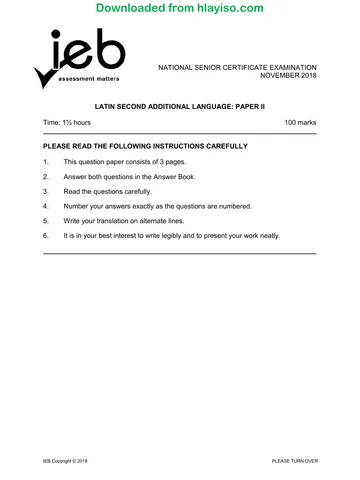
NATIONAL SENIOR CERTIFICATE EXAMINATION
NOVEMBER 2019
LATIN SECOND ADDITIONAL LANGUAGE: PAPER I
MARKING GUIDELINES
Time: 3 hours 200 marks
These marking guidelines are prepared for use by examiners and sub-examiners,
all of whom are required to attend a standardisation meeting to ensure that the
guidelines are consistently interpreted and applied in the marking of candidates'
scripts.
The IEB will not enter into any discussions or correspondence about any marking
guidelines. It is acknowledged that there may be different views about some
matters of emphasis or detail in the guidelines. It is also recognised that,
without the benefit of attendance at a standardisation meeting, there may be
different interpretations of the application of the marking guidelines.
IEB Copyright © 2019 PLEASE TURN OVER
You're offline
Skip to contentMemorandum View all
Latin SAL P1 Memo 2019 hlayiso.com
Latin SAL · Grade 12 · 2019. Memorandum, 15 pages. Read online or download the PDF.
- Subject
- Latin SAL
- Grade
- Grade 12
- Document type
- Memorandum
- Year
- 2019
- Paper
- 1
- Publisher
- IEB
- Pages
- 15
- File size
- 350.0 KB
Loading document…
Loading document…
1 of 15
Document textSearch extracted text and jump to a page.
Downloaded from hlayiso.com
NATIONAL SENIOR CERTIFICATE: LATIN SECOND ADDITIONAL LANGUAGE: PAPER I – Page 2 of 15
MARKING GUIDELINES
SECTION A PROSE SET TEXTS
QUESTION 1 RHETORIC
1.1 nihilne te nocturnum praesidium Palatii, [moverunt]
nihil urbis vigiliae, nihil timor populi,
nihil concursus bonorum omnium,
nihil hic munitissimus habendi senatus locus,
nihil horum ora vultusque moverunt?
patere tua consilia non sentis,
constrictam iam horum omnium scientia teneri coniurationem tuam
non vides?
quid proxima, quid superiore nocte egeris,
ubi fueris, quos convocaveris, quid consilii ceperis,
quem nostrum ignorare arbitraris?
1.2 (a) The Senate
(b) Catiline
(c) After the passing of the senatus consultum ultimum in October, Cicero
had had the Palatine and other important sites put under guard.
(d) any two apt phrases: pupils must state who the hearers were; then
choose any two of the underlined phrases, and show that they
understand their effect.
5 pupil recognises that the senate is under threat; choice of phrases
is perfectly apt; effect of each phrase clearly described.
4 pupil recognises that the senate is under threat; choice of phrases
is apt; effect of each phrase clearly described.
3 pupil recognises that the senate is under threat; choice of phrases
is apt; effect of each phrase understood moderately well.
1–2 pupil recognises that the senate is under threat; choice of phrases
inaccurate or phrases are incomplete or too long; effect of each
phrase not fully understood.
1.3 (a) Repetition of "nihil" to emphasise the absolute inhumanity of Catiline;
starts with the garrisons on the Palatine Hill, then moves from the city
and its people to the senate-house and the senators, then their actual
faces and expressions. This would have the effect of making them feel
personally identified and targeted, both by Cicero and by Catiline.
(b) The questions are phrased as statements, and are rhetorical: they
would persuade the hearers that Catiline did in fact have no
compunction about endangering Rome or its people.
1.4 (a) Attempted assassination of Cicero on 7 Nov by two conspirators
pretending to make a morning call on him.
(b) It was Cicero's practice to edit all his speeches before publishing
them; this speech was far more rowdy and chaotic than it appears
here; it was a violent shouting match between Cicero and the
supporters of Catiline.
1.5 Convinced that he would be arrested, he left the city that same night.
IEB Copyright © 2019 PLEASE TURN OVER
Downloaded from hlayiso.com
NATIONAL SENIOR CERTIFICATE: LATIN SECOND ADDITIONAL LANGUAGE: PAPER I – Page 3 of 15
MARKING GUIDELINES
QUESTION 1 RHETORIC (cont)
Read the passage below, and answer the questions which follow it.
1.6 atque ego ut vidi,
quos maximo furore et scelere inflammatos sciebam,
eos nobiscum esse et Romae remansisse,
in eo omnes dies noctesque consumpsi,
ut, quid agerent, quid molirentur, sentirem ac viderem,
ut, quoniam auribus vestris
propter incredibilem magnitudinem sceleris
minorem fidem faceret oratio mea,
rem ita comprehenderem,
ut tum demum animis saluti vestrae provideretis,
cum oculis maleficium ipsum videretis.
1.7 (a) The conspirators
(b) The conspirators in Rome tried to get support from a deputation of
the Allobroges, who were preparing to leave Rome to go back to
Gaul. The plotters gave the Allobroges letters for Catiline, which they
agreed to deliver to him. One of their number informed a prominent
Roman, and he informed Cicero, who arranged for the Allobroges to
be stopped and searched at the Milvian Bridge. The letter to Catiline
proved that Cicero's suspicions were well-founded.
1.8 (a) Any suitable phrase from each extract: apt choice. (1 + 1)
(b) Clear, accurate explanation of what each phrase reveals. (2 × 3)
1.9 … ut, quoniam auribus vestris propter incredibilem magnitudinem
sceleris minorem fidem faceret oratio mea,…
Contrast between "incredibilem magnitudinem sceleris" and "minorem
fidem" enhanced by word-order; tone is self-deprecating.
"oratio mea" at end reinforces impression of his humility.
(One aspect well-explained, or both less well-explained = 3 marks)
1.10 ut, quid agerent, quid molirentur, sentirem ac viderem,
Use of similar verbs, with the second in each case being slightly stronger
and more definite in "quid agerent, … quid molirentur" and "sentirem …
viderem" emphasises Cicero's careful investigation and his certainty that
there was indeed a threat to Rome's safety.
IEB Copyright © 2019 PLEASE TURN OVER
Downloaded from hlayiso.com
NATIONAL SENIOR CERTIFICATE: LATIN SECOND ADDITIONAL LANGUAGE: PAPER I – Page 4 of 15
MARKING GUIDELINES
QUESTION 2 HISTORIOGRAPHY
2.1 procedere inde agmen coepit
iam nihil ne hostibus quidem [temptantibus]
praeter parva furta per occasionem.
ceterum iter multo quam in adscensu fuerat – [difficilius fuit;]
ut pleraque Alpium ab Italia sicut breviora ita arrectiora sunt –
omnis enim ferme via praeceps, angusta, lubrica erat,
ut neque sustinere se ab lapsu possent
nec qui paulum titubassent haerere adflicti vestigio suo,
aliique super alios et iumenta in homines occiderent.
2.2 Answer should include end of First Punic War and Hamilcar's anger; theft of
Sardinia and Corsica; Hannibal's oath of perpetual enmity to Rome; his
wish to avenge the wrongs done to his father.
2.3 (a) The Gauls who attacked and looted the marching column as it
marched over the Alps.
(b) Ambushes; theft of baggage; rolling rocks down onto the paths
2.4 Loyal to Hannibal: despite their exhaustion, they continue.
Journey is much more difficult on the way down: they are portrayed as
being hardy, brave, and tough, and determined to continue.
2.5 He does not merely demonise Hannibal, but attempts to give him credit
where it is due.
He tries to write in an unbiased way.
He shows the hardships endured by Hannibal as well as his heroism, and
also the foolishness of certain Roman leaders.
IEB Copyright © 2019 PLEASE TURN OVER
Downloaded from hlayiso.com
NATIONAL SENIOR CERTIFICATE: LATIN SECOND ADDITIONAL LANGUAGE: PAPER I – Page 5 of 15
MARKING GUIDELINES
QUESTION 2 HISTORIOGRAPHY (cont)
Read the passage below, and answer the questions which follow it.
2.6 cum hoc equite, cum hoc pedite pugnaturi estis;
reliquias extremas hostis, non hostem habetis,
ac nihil magis vereor
quam ne cui, vos cum pugnaveritis,
Alpes vicisse Hannibalem videantur.
sed ita forsitan decuit,
cum foederum ruptore duce ac populo
deos ipsos sine ulla humana ope
committere ac profligare bellum,
nos, qui secundum deos violati sumus,
commissum ac profligatum conficere."
2.7 (a) Publius Cornelius Scipio, the Roman commander
(b) River Ticinus; before the first meeting of the Carthaginians and the
Romans
2.8 Apt choice: (1)
Clear explanation and understanding. (2)
2.9 In the actual battle which followed, Hannibal made it clear that his army was
superior, and his tactics and strategies outclassed those of the Romans.
Scipio's army was inexperienced and new to him. In this speech he boosts
their confidence – as it turns out, to little avail, as the battle was won
convincingly by the Carthaginians.
2.10 (a) Hannibal and the Carthaginian people
(b) By invading Italy, Hannibal was seen to be breaking the treaty drawn
up at the end of the First Punic War, in which Hamilcar had been
forced to concede defeat.
2.11 4 insightful and comprehensive
3 accurate observations, not comprehensive
2 some understanding, little evidence
1 superficial statement, poor evidence
2.12 (a) Accurately chosen phrases
(b) Clear understanding and description of actual outcome and how it
differed from the prediction.
IEB Copyright © 2019 PLEASE TURN OVER
Downloaded from hlayiso.com
NATIONAL SENIOR CERTIFICATE: LATIN SECOND ADDITIONAL LANGUAGE: PAPER I – Page 6 of 15
MARKING GUIDELINES
SECTION B POETRY SET TEXTS
QUESTION 3 EPIC
Read the passage below, and answer the questions which follow it.
3.1 aut quid iam misero mihi denique restat,
cui neque apud Danaos usquam locus,
et super ipsi Dardanidae infensi poenas
cum sanguine poscunt?'
quo gemitu conversi animi
compressus et omnis impetus.
hortamur fari quo sanguine cretus,
quidve ferat; memoret quae sit fiducia capto.
3.2 See end
3.3 (a) Aeneas; shipwrecked on shores of Carthage; to Dido, queen of
Carthage, who has asked him to tell his tale.
(b) Sinon's pretended distraction, and his lack of armour, suggest that
he is a helpless victim.
(c) Aeneas is both angry and wretched. The words "insidias", "crimine"
describe the actions of the Greeks as treacherous; the juxtaposition
of "uno" and "omnis" highlights how the actions of Sinon, the
deceiver, reflect the actions of all the Greeks.
3.4 (a) To make the Trojans' trust in him seem less culpable, less foolish;
their pietas would have been believable, would have driven them to
have pity for a man who had been abused by their enemy.
(b) The rhetorical questions underline the fact that he seems to be
doomed; he has no home, no support.
(c) The speaker here is Sinon, who has been sent to trick the Trojans
into trusting him and accepting the wooden horse. Their trust and
sympathy for his plight, which reveals their essential piety, is what
leads to their own downfall.
IEB Copyright © 2019 PLEASE TURN OVER
Downloaded from hlayiso.com
NATIONAL SENIOR CERTIFICATE: LATIN SECOND ADDITIONAL LANGUAGE: PAPER I – Page 7 of 15
MARKING GUIDELINES
QUESTION 3 EPIC (cont)
3.5 "iamque dies infanda aderat;
mihi sacra parari et salsae fruges
et circum tempora vittae.
eripui, fateor, leto me et vincula rupi,
limosoque lacu per noctem obscurus in ulva delitui
dum vela darent, si forte dedissent.
nec mihi iam patriam antiquam spes ulla videndi,
nec dulcis natos exoptatumque parentem,
quos illi fors et poenas ob nostra reposcent
effugia, et culpam hanc miserorum morte piabunt.
3.6 (a) This is the story told by Sinon, who has persuaded the Trojans to
accept his tale of woe.
(b) He is about to be put to death in a sacrifice.
(c) The Trojans, who, according to Vergil, have a strong sense of pietas
and honour, would have felt strongly about his seeing his fatherland
and his family again.
(d) Romans would have felt a patriotic connection to Aeneas and the
Trojans, since Aeneas, descended from Venus, was the purported
founder of Rome, and connected Rome to the glorious past of
Greece and Troy. (2)
Romans would have recognised the themes of honour and betrayal,
and of Aeneas's pietas throughout the Aeneid is exemplary; the
Roman readers would have treated this as an example of how they
should behave. (2)
3.7 Repetition of the word "miserere" emphasises the need for the Trojans
(and, by association, the Romans) to have pity on the victim of injustice;
reference to "intemerata fides" which is, according to Vergil not a common
quality, would have evoked strong support; stressed position of "usquam",
"intemerata", "laborum…tantorum", all add to the effect of stressing the
importance of "unstained good faith" and the pity for Sinon who has
endured such great suffering.
3.8 See end
3.9 Repetition of "d" gives an effect of darkness, gloom.
Alliteration of "m" in "miserorum morte" – sound of mourning.
3.10 Slow rhythm of spondees reflects the wretchedness of Sinon's fate.
IEB Copyright © 2019 PLEASE TURN OVER
Downloaded from hlayiso.com
NATIONAL SENIOR CERTIFICATE: LATIN SECOND ADDITIONAL LANGUAGE: PAPER I – Page 8 of 15
MARKING GUIDELINES
QUESTION 4 ELEGIAC AND LYRIC
Read the passage below, and answer the questions which follow it.
4.1 nam quid agas cum te furiosus cogat
et idem fortior?
'unde venis?' exclamat
'cuius aceto, cuius conche tumes?
quis tecum sectile porrum sutor
et elixir vervecis labra comedit?
nil mihi respondes?
aut dic aut accipe calcem.
ede ubi consistas,
in qua te quaero proseucha?'
dicere si temptes aliquid tacitusve recedas,
tandumdem est …
4.2 (a) Drunkenness and dangers of the night in Rome
(b) The drunken bully, who picks fights with strangers, and seems to
need to fight before he can sleep. (2) + two apt phrases (2)
(c) Juvenal's poor man, who sees his own way home by candle-light,
and cannot afford a retinue of slaves. (2) + two apt phrases (2)
4.3 (a) "in qua te quaero proseucha" suggests that the bully expects the
poor man to be found in some synagogue.
(b) Repeated "c" and "qu" sounds in the words "dic aut accipe calcem"
and "in qua te quaero" reflect the violence of the kicking / attack and
the vehemence of the insulting speech.
Questions are short and repetitive: "cuius…cuius", seemingly without
a break between them. This makes them seem almost like
accusations.
In "nil nihi respondes?" the question is phrased like a statement, and
it is followed directly by an aggressively short command: "aut dic aur
accipe calcem". (2)
Stress on first and last words in the lines: "nil …calcem"; "ede …
proseucha", and ""cuius…porrum" emphasise the bully's aggressive
attitude.
(c) tantumdem est – resignation, despair
quid agas – frustration
4.4 See end
4.5 Repeated spondees – slow, heavy – threatening
IEB Copyright © 2019 PLEASE TURN OVER
Downloaded from hlayiso.com
NATIONAL SENIOR CERTIFICATE: LATIN SECOND ADDITIONAL LANGUAGE: PAPER I – Page 9 of 15
MARKING GUIDELINES
QUESTION 4 ELEGIAC AND LYRIC (cont)
Read the passage below, and answer the questions which follow it.
4.6 ergo ubi purpurea porrectum in veste locavit agrestem
veluti succinctus cursitat hospes
continuatque dapes nec non verniliter
ipsis fungitur officiis,
praelambens omne quod affert.
ille cubans gaudet mutata sorte
bonisque rebus agit laetum convivam,
cum subito ingens valvarum strepitus
lectis excussit utrumque.
4.7 Luxurious lifestyle of the rich – country mouse has lots of food, wealthy
traveller has a great retinue of slaves. (3)
City life is dangerous – things can fall on your head as you walk home;
vicious dogs cause mice to flee for their lives. (3)
4.8 Martial is happy with his life in the country, and he rebuts Quintilian's
criticism of his laid-back lifestyle. (1)
Horace agrees with Martial, that life in the country, away from the pressures
of city life, is preferable to town-living. (2)
Juvenal comments negatively on the dangers of city life, but claims that a
poor man has a worse time than a wealthy person. (1)
4.9 See end
4.10 3 accurate and fully appropriate, clear explanation
2 accurate, clear explanation
1 not entirely apt, unclear explanation
½ an attempt
4.11 Repetition of harsh "str" and "exc" sounds reflects the crashing of the doors. (2)
"lectis excussit": Idea of the mice being knocked out of their couches by the
noise is amusing and also vivid. (2)
IEB Copyright © 2019 PLEASE TURN OVER
Downloaded from hlayiso.com
NATIONAL SENIOR CERTIFICATE: LATIN SECOND ADDITIONAL LANGUAGE: PAPER I – Page 10 of 15
MARKING GUIDELINES
SECTION C
EITHER:
Answer TWO questions from this section. (Be sure to answer only the questions based
on the genres that you have studied)
OR
Question 9 – Translation of sentences from English to Latin.
QUESTION 5 RHETORIC
Read the passages below, which, if you answered Section A Question 1, you have
translated. Then answer the questions which follow it.
5.1 gerundive attraction
5.2 (a) urbis (line 1) objective genitive
(b) nocte (line 4) abl time when
(c) nostrum (line 5) partitive genitive / genitive of the whole
5.3 State and explain the case of each of the following nouns and pronouns:
(a) scelere (line 1) ablative means/ instrument
(b) eos (line 1) accusative in acc + infin Indirect Statement
(c) Romae (line 2) locative showing place where
5.4 State and explain the mood of each of the following verbs:
(a) molirentur (line 3) Subjunctive Ind Q
(b) sentirem (line 3) Subjunctive purpose clause
(c) videretis (line 5) Subjunctive Cum clause – temporal in historic
sequence
IEB Copyright © 2019 PLEASE TURN OVER
Downloaded from hlayiso.com
NATIONAL SENIOR CERTIFICATE: LATIN SECOND ADDITIONAL LANGUAGE: PAPER I – Page 11 of 15
MARKING GUIDELINES
QUESTION 6 HISTORIOGRAPHY
Read the passages below, which, if you answered Section A Question 2, you have
translated. Then answer the questions which follow it.
6.1 State and explain the case of each of the following nouns :
(a) hostibus … temptantibus (lines 1–2) abl abs
(b) multo (line 2) abl measure of difference
(c) vestigio (line 5) abl place where
6.2 State and account for the mood of the following verbs:
(a) procedere (line 1) prolative infinitive
(b) sunt (line 3) indicative in a clause introd by "ut" -as
(b) possent (line 5) subjunctive result clause
6.3 State and explain the case of each of the following nouns :
(a) equite (line 1) ablative of accompaniment
(b) foederum (line 3) objective genitive
(c) deos (line 4) accusative in Acc + infin Indirect statement
6.4 State and account for the mood of:
videantur (line 3) subjunctive in a neg clause after a verb of fearing
IEB Copyright © 2019 PLEASE TURN OVER
Downloaded from hlayiso.com
NATIONAL SENIOR CERTIFICATE: LATIN SECOND ADDITIONAL LANGUAGE: PAPER I – Page 12 of 15
MARKING GUIDELINES
QUESTION 7 EPIC
7.1 From the extract, find an example of each of the following:
(a) a perfect participle conversi / compressus
(b) a deponent verb hortamur
7.2 State and account for the mood of each of the following verbs:
(a) fari (line 6) prolative infinitive
(b) ferat (line 7) Subjunctive Ind Q
(c) memoret (line 7) Subjunctive Ind Command
7.3 Explain the construction used in the word "dies infanda" (line 1) gerundive
of obligation.
7.4 Explain the construction used in "parari" (line 1) historic infinitive
7.5 State and explain the case of each of the following words:
(a) leto (line 3) abl separation
(b) lacu (line 4) abl place where
(c) culpam (line 9) acc direct object
(d) miserorum (line 9) subjective gen
IEB Copyright © 2019 PLEASE TURN OVER
Downloaded from hlayiso.com
NATIONAL SENIOR CERTIFICATE: LATIN SECOND ADDITIONAL LANGUAGE: PAPER I – Page 13 of 15
MARKING GUIDELINES
QUESTION 8 ELEGIAC AND LYRIC
8.1 State and explain the mood of each of the following verbs:
(a) agas (line 1) subjunctive deliberative
(b) cogat (line 1) subjunctive cum causal
(c) dic (line 5) imperative command
(d) consistas (line 6) Subjunctive Ind Q
8.2 State and explain the case of each of the following words:
(a) aceto (line 2) abl means
(b) mihi (line 5) Dat Ind Object
8.3 From the extract, find an example of a comparative adjective.
fortior
8.4 From the extract, find and write down an example of a present participle.
praelambens / cubans
8.5 State and explain the case of each of the following words:
(a) veste (line 1) abl place where
(b) officiis (line 4) abl foll fungitur
(c) lectis (line 7) abl separation
IEB Copyright © 2019 PLEASE TURN OVER
Downloaded from hlayiso.com
NATIONAL SENIOR CERTIFICATE: LATIN SECOND ADDITIONAL LANGUAGE: PAPER I – Page 14 of 15
MARKING GUIDELINES
QUESTION 9 SENTENCES FOR TRANSLATION INTO LATIN
9.1 Quod/quia/quoniam (1) eis (2) imperavit ne (2) nocte (1) abirent (3)
/ eos (2) vetuerat (2) nocte (1) abire (3)
/ eos (2) prohibuerat (2) nocte abire (3)
in urbe (2) totam noctem (2) manebant (3)
9.2 His (1) omnibus (1) auditis (3) eum (1) de consillis (2)
Postquam haec (1) omnia (1) audita sunt (3) certiorem fecerunt (3)
Cum haec (1) omnia (1) audita essent (3)
9.3 Tot (1) pericula (2) in viis (1) ut (1) magnopere (1) timebat (2)
Romae (1) erant (2)
9.4 Quamquam pater meus (2) habet (2) plures (2) tamen emere (2)
Quamvis (1) servos multos (2) habeat (2) volebat (2)
Cum
9.5 Si (1) viri / homines (2) fugissent, (3) non vulnerati (2) essent (3)
Total: 200 marks
IEB Copyright © 2019 PLEASE TURN OVER
Downloaded from hlayiso.com
NATIONAL SENIOR CERTIFICATE: LATIN SECOND ADDITIONAL LANGUAGE: PAPER I – Page 15 of 15
MARKING GUIDELINES
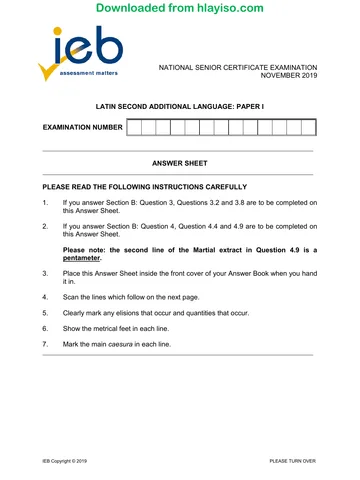
ANSWER SHEET MARKING GUIDELINE
IEB Copyright © 2019
Recommended for this subject
Published documents with matching subject and grade metadata.
Related documents
Matched using subject, grade, language, document type and exam metadata.
More from Grade 12 Latin SAL
Explore more published documents in this catalogue.