Downloaded from hlayiso.com
NATIONAL SENIOR CERTIFICATE EXAMINATION
NOVEMBER 2018
LATIN SECOND ADDITIONAL LANGUAGE: PAPER I
Time: 3 hours 200 marks
PLEASE READ THE FOLLOWING INSTRUCTIONS CAREFULLY
1. This question paper consists of 19 pages and an Answer Sheet of 2 pages.
Please check that your question paper is complete.
2. Please ensure that you fill in your examination number accurately, both on your
Answer Book(s) and on your Answer Sheet.
DO NOT ATTEMPT TO ANSWER QUESTIONS ON SETWORK THAT YOU HAVE NOT
STUDIED.
3. Note that there are two options in Section A (Prose):
Answer EITHER Question 1 – Rhetoric, or Question 2 – Historiography;
And two options in Section B (Poetry):
Answer EITHER Question 3 – Epic, or Question 4 – Elegiac and Lyric.
4. In Section C, the options are set out clearly on page 14.
5. Read the questions carefully.
6. Number your answers exactly as the questions are numbered.
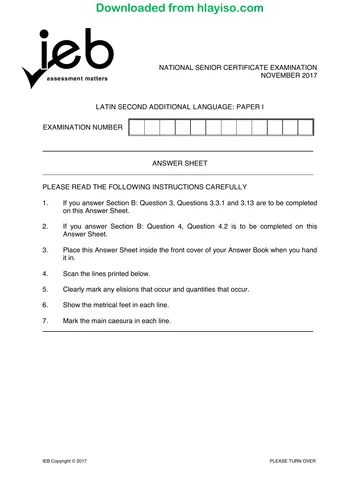
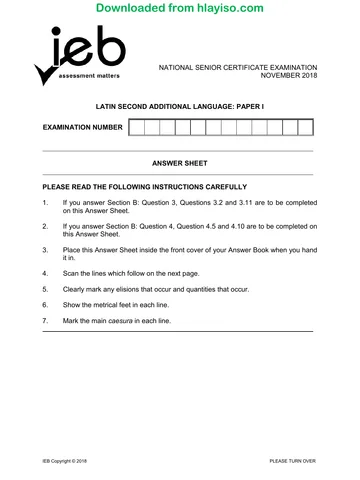
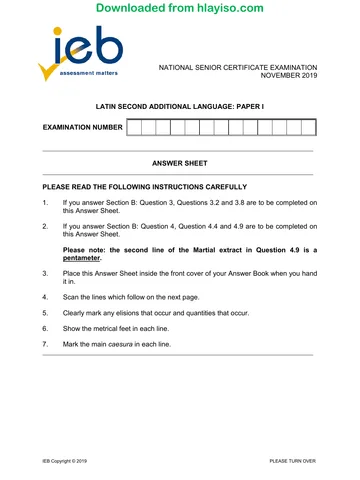
7. Scansion: answers must be completed on the Answer Sheet provided, according to
the instructions.
Please ensure that you hand in the Scansion Answer Sheet together with your
Answer Book.
8. It is in your own interest to write legibly and to present your work neatly.
IEB Copyright © 2018 PLEASE TURN OVER
You're offline
Skip to contentQuestion paper View all
Latin SAL P1 2018 hlayiso.com
Latin SAL · Grade 12 · 2018. Question paper, 19 pages. Read online or download the PDF.
- Subject
- Latin SAL
- Grade
- Grade 12
- Document type
- Question paper
- Year
- 2018
- Paper
- 1
- Publisher
- IEB
- Pages
- 19
- File size
- 258.8 KB
Loading document…
Loading document…
1 of 19
Document textSearch extracted text and jump to a page.
Downloaded from hlayiso.com
NATIONAL SENIOR CERTIFICATE: LATIN SECOND ADDITIONAL LANGUAGE: PAPER I Page 2 of 19
SECTION A PROSE SET TEXTS
Answer either question 1 (Rhetoric – Cicero) or Question 2 (Historiography – Livy).
Be sure to answer only the genre that you have studied.
QUESTION 1 RHETORIC
Read the passage below, and answer the questions which follow it.
castra sunt in Italia contra populum Romanum in Etruriae faucibus collocata, crescit in
dies singulos hostium numerus; eorum autem castrorum imperatorem ducemque
hostium intra moenia atque adeo in senatu videmus intestinam aliquam cotidie
perniciem rei publicae molientem. si te iam, Catilina, comprehendi, si interfici iussero,
credo, erit verendum mihi, ne non potius hoc omnes boni serius a me quam quisquam 5
crudelius factum esse dicat. verum ego hoc, quod iam pridem factum esse oportuit,
certa de causa nondum adducor ut faciam. tum denique interficiere, cum iam nemo
tam improbus, tam perditus, tam tui similis inveniri poterit, qui id non iure factum
esse fateatur.
[Source: Cicero In Catilinam I, 4–5]
1.1 Translate from "si te iam" to "fateatur" (lines 4 to 10), highlighted in bold.
Write your translation on alternate lines. (18)
1.2 (a) To which group of people is Cicero referring in the phrase "hostium
numerus" (line 2)? (2)
(b) How would his use of the word "hostium" have positioned his
audience to perceive this group? (2)
1.3 (a) Describe briefly how Cicero (elsewhere in the In Catilinam) portrays
the nature of this group of people, and their motives. (2)
(b) What evidence is there (elsewhere in the In Catilinam) to suggest
that Cicero might have labelled them unfairly? (4)
1.4 Considering the long-term effects of Cicero's conflict with Catiline, explain
why his statement "credo, erit verendum mihi" (line 5) might have been
seen as ominous. (4)
1.5 Comment on how the diction, repetition, and word-order of the final
sentence of this extract contribute to its effectiveness. (4)
IEB Copyright © 2018
Downloaded from hlayiso.com
NATIONAL SENIOR CERTIFICATE: LATIN SECOND ADDITIONAL LANGUAGE: PAPER I Page 3 of 19
Read the passage below, and answer the questions which follow it.
quae cum ita sint, patres conscripti, vobis populi Romani praesidia non desunt; vos ne
populo Romano deesse videamini, providete. habetis consulem ex plurimis periculis et
insidiis atque ex media morte non ad vitam suam, sed ad salutem vestram reservatum.
omnes ordines ad conservandam rem publicam mente, voluntate, studio, virtute, voce,
consentiunt. obsessa facibus et telis impiae coniurationis vobis supplex manus tendit 5
patria communis, vobis se, vobis vitam omnium civium, vobis arcem et Capitolium, vobis
aras Penatium, vobis illum ignem Vestae sempiternum, vobis omnium deorum templa
atque delubra, vobis muros atque urbis tecta commendat. praeterea de vestra vita, de
coniugum vestrarum atque liberorum anima, de fortunis omnium, de sedibus, de focis
vestris hodierno die vobis iudicandum est. 10
[Source: Cicero In Catilinam IV, 18–19]
1.6 Translate from "quae" to "reservatum" (lines 1–3), and from "praeterea" to
"iudicandum est" (lines 8–10), highlighted in bold.
Write your translation on alternate lines. (22)
1.7 In this section of the text, Cicero appeals to the senators' sense of honour
and pietas. By quoting and explaining two phrases, show how he does this. (4)
1.8 (a) Why did Cicero at first hesitate to carry out the actions which the
senatus consultum ultimum of 21 October sanctioned, and then
change his mind at a later date? (4)
(b) Describe the actions which were taken against the conspirators after
this speech was delivered. (4)
1.9 Habetis consulem ex plurimis periculis et insidiis atque ex media
morte non ad vitam suam, sed ad salutem vestram reservatum.
(a) To whom does the word "consulem" (line 2) refer? (1)
(b) In the light of your answer to 1.9 (a), what impression does the
second sentence of this text (given above) create of Cicero himself?
Support your answer by referring to the text. (3)
1.10 (a) What effect does Cicero achieve by his use of personification in lines
5–8 (obsessa … commendat)? (3)
(b) How does Cicero reinforce this impression by his use of repetition in
lines 5–8 (obsessa … commendat)? (3)
[80]
IEB Copyright © 2018 PLEASE TURN OVER
Downloaded from hlayiso.com
NATIONAL SENIOR CERTIFICATE: LATIN SECOND ADDITIONAL LANGUAGE: PAPER I Page 4 of 19
QUESTION 2 HISTORIOGRAPHY
Read the passage below, and answer the questions which follow it.
"erit igitur in hoc certamine is vobis illisque animus qui victoribus et victis esse
solet. nec nunc illi quia audent sed quia necesse est pugnaturi sunt, qui plures paene
perierint quam supersint; nisi creditis, qui exercitu incolumi pugnam detractavere, eos
duabus partibus peditum equitumque in transitu Alpium amissis plus spei nactos esse.
at enim pauci quidem sunt sed vigentes animis corporibusque, quorum robora ac vires 5
vix sustinere vis ulla possit. effigies immo, umbrae hominum, fame, frigore, inluvie,
squalore enecti, contusi ac debilitati inter saxa rupesque; ad hoc praeusti artus, nive
rigentes nervi, membra torrida gelu, quassata fractaque arma, claudi ac debiles equi."
[Source: Livy Ab Urbe Condita 21. 40]
2.1 Translate from "erit" to "possit" (lines 1 to 6), highlighted in bold.
Write your translation on alternate lines. (20)
2.2 (a) Identify the speaker of this extract, and outline his purpose. (3)
(b) To whom do the words "vobis" and "illis" (line 1) refer? (2)
2.3 (a) Before which battle were the words above supposed to have been
uttered? (1)
(b) What were the results of this battle? (2)
(c) What role was played by the younger Scipio, and why was this
important? (2)
2.4 Explain the effect, in this context, of the words "at" and "immo". (3)
2.5 How does Livy use asyndeton and word-order in the last sentence of this
extract to good effect? (4)
2.6 Livy intended his Ab Urbe Condita to "commemorate the deeds of the
foremost people of the world" and to write about "the infinite variety of
human experience".
How does the style and content of this extract reflect his aims? (5)
IEB Copyright © 2018
Downloaded from hlayiso.com
NATIONAL SENIOR CERTIFICATE: LATIN SECOND ADDITIONAL LANGUAGE: PAPER I Page 5 of 19
Read the passage below, and answer the questions which follow it.
Hannibali nimis laeta res est visa maiorque quam ut eam statim capere animo posset.
itaque voluntatem se laudare Maharbalis ait; ad consilium pensandum temporis opus
esse. tum Maharbal: "non omnia nimirum eidem di dedere. vincere scis, Hannibal;
victoria uti nescis." mora eius diei satis creditur saluti fuisse urbi atque imperio.
postero die ubi primum inluxit, ad spolia legenda foedamque etiam hostibus 5
spectandam stragem insistunt. iacebant tot Romanorum milia, pedites passim
equitesque, ut quem cuique fors aut pugna iunxerat aut fuga; adsurgentes quidam ex
strage media cruenti, quos stricta matutino frigore excitaverant vulnera, ab hoste
oppressi sunt; quosdam et iacentes vivos succisis feminibus poplitibusque invenerunt,
nudantes cervicem iugulumque et reliquum sanguinem iubentes haurire; inventi quidam 10
sunt mersis in effossam terram capitibus quod ipsos fecisse foveas obruentes ora
superiecta humo interclusisse spiritum apparebat.
[Source: Livy Ab Urbe Condita 22.51]
2.7 Translate from "Hannibali" to "insistunt" (lines 1–6), highlighted in bold.
Write your translation on alternate lines. (20)
2.8 What function did Maharbal perform in Hannibal's army? (1)
2.9 (a) Describe briefly the events of the battle which led to the scenes of
carnage which Livy describes in this extract. (4)
(b) How does Livy's description of the actions of the Numidian cavalry
during the battle attempt to demonise the Carthaginians? (5)
2.10 In lines 9–12, Livy describes a series of small scenes viewed by the
Carthaginians.
How does the description, together with the verbal ordering using repetition
of forms of the word "quidam" (lines 9–12) contribute to the vividness of the
description of the battlefield? (4)
2.11 Livy's style has been called more appropriate for a dramatist or a poet than
for an historian.
From lines 6–14, choose two phrases to use as evidence which either
confirms or disproves this statement.
Justify and explain your choice of evidence. (4)
[80]
80 marks
IEB Copyright © 2018 PLEASE TURN OVER
Downloaded from hlayiso.com
NATIONAL SENIOR CERTIFICATE: LATIN SECOND ADDITIONAL LANGUAGE: PAPER I Page 6 of 19
SECTION B POETRY SET TEXTS
Answer either Question 3 (Epic – Virgil) or Question 4 (Elegiac and Lyric).
Be sure to answer only the genre that you have studied.
QUESTION 3 EPIC
Read the passage below, and answer the questions which follow it.
primus ibi ante omnis magna comitante caterva
Laocoon ardens summa decurrit ab arce,
et procul 'o miseri, quae tanta insania, cives?
creditis avectos hostis? aut ulla putatis
dona carere dolis Danaum? sic notus Ulixes? 44
aut hoc inclusi ligno occultantur Achivi,
aut haec in nostros fabricata est machina muros,
inspectura domos venturaque desuper urbi,
aut aliquis latet error; equo ne credite, Teucri.
quidquid id est, timeo Danaos et dona ferentis.'
sic fatus validis ingentem viribus hastam 50
in latus inque feri curvam compagibus alvum
contorsit. stetit illa tremens, uteroque recusso
insonuere cavae gemitumque dedere cavernae.
et, si fata deum, si mens non laeva fuisset,
impulerat ferro Argolicas foedare latebras, 55
Troiaque nunc staret, Priamique arx alta maneres.
[Source: Virgil Aeneid II, lines 40–56]
3.1 Translate from "creditis" to "Teucri" (lines 43–48), highlighted in bold.
Write your translation on alternate lines. (12)
3.2 Scan lines 40 and 41 ("primus... arce") on the Answer Sheet provided,
marking elisions and quantities, and showing the metrical feet and the main
caesura in each line. (5)
Please remember to place the completed Answer Sheet inside the front
cover of your Answer Book.
IEB Copyright © 2018
Downloaded from hlayiso.com
NATIONAL SENIOR CERTIFICATE: LATIN SECOND ADDITIONAL LANGUAGE: PAPER I Page 7 of 19
3.3 (a) In which work of literature would one be able to read the original
story of the fall of Troy? Write down both the name of the author, and
the title. (2)
(b) For what main purpose was the original story retold by Virgil? (3)
(c) Name the two speakers in this extract. (2)
3.4 From the extract above, find and write down three phrases which show how
Virgil portrays the Greeks in a less-than-heroic light.
Explain and justify each of your chosen phrases. (6)
3.5 What is the effect of the rhetorical questions in this extract? (2)
IEB Copyright © 2018 PLEASE TURN OVER
Downloaded from hlayiso.com
NATIONAL SENIOR CERTIFICATE: LATIN SECOND ADDITIONAL LANGUAGE: PAPER I Page 8 of 19
Read the passage below, and answer the questions which follow it.
nos delubra deum miseri, quibus ultimus esset
ille dies, festa velamus fronde per urbem.
vertitur interea caelum et ruit Oceano nox 250
involvens umbra magna terramque polumque
Myrmidonumque dolos; fusi per moenia Teucri
conticuere; sopor fessos complectitur artus.
et iam Argiva phalanx instructis navibus ibat
a Tenedo tacitae per amica silentia lunae 255
litora nota petens, flammas cum regia puppis
extulerat, fatisque deum defensus iniquis
inclusos utero Danaos et pinea furtim
laxat claustra Sinon. illos patefactus ad auras
reddit equus, laetique cavo se robore promunt 260
Thessandrus Sthenelusque duces et dirus Ulixes,
demissum lapsi per funem, Acamasque Thoasque
Pelidesque Neoptolemus primusque Machaon
et Menelaus et ipse doli fabricator Epeos.
invadunt urbem somno vinoque sepultam; 265
caeduntur vigiles, portisque patentibus omnis
accipiunt socios atque agmina conscia iungunt.
[Source: Virgil Aeneid II, lines 248–267]
3.6 Translate from "et iam" to "Sinon" (lines 254 to 259) and from "invadunt" to
"iungunt" (lines 265 to 267) highlighted in bold.
Write your translation on alternate lines. (18)
3.7 In the last three lines of the previous extract, and again in this extract, Virgil
refers to the involvement of the gods in the outcome of the Trojan War.
(a) In what ways do the gods' actions affect Troy's fate? (2)
(b) In accepting the will of the gods, Aeneas is forced to come to terms
with certain aspects of pietas. Explain how his actions during the
Greek onslaught on Troy are at odds with what the gods require him
to do. (5)
IEB Copyright © 2018
Downloaded from hlayiso.com
NATIONAL SENIOR CERTIFICATE: LATIN SECOND ADDITIONAL LANGUAGE: PAPER I Page 9 of 19
3.8 (a) How does Virgil use alliteration and word-order in lines 248–9 to
foreshadow the terrible fate that is about to befall Troy? (3)
(b) How does the rhythm of line 251 create a sense of foreboding? (2)
3.9 (a) To what do the words "Myrmidonum dolos" in line 252 refer? (1)
(b) Briefly sum up Sinon's explanation for the gift given to the Trojans. (5)
3.10 (a) How does Virgil's imagery in line 255 create a tone of calm
peacefulness? (2)
(b) What effect does Virgil achieve by including the list of names in lines
261–264? (2)
3.11 Scan lines 265 and 267 ("invadunt ... sepultam" and "accipiunt ... iungunt")
on the Answer Sheet provided, marking elisions and quantities, and
showing the metrical feet and the main caesura in each line. (5)
Please remember to place the completed Answer Sheet inside the
front cover of your Answer Book.
3.12 Explain how the rhythm and imagery in line 265 enhance its meaning. (3)
[80]
IEB Copyright © 2018 PLEASE TURN OVER
Downloaded from hlayiso.com
NATIONAL SENIOR CERTIFICATE: LATIN SECOND ADDITIONAL LANGUAGE: PAPER I Page 10 of 19
QUESTION 4 ELEGIAC AND LYRIC
Read the passage below, and answer the questions which follow it.
forte puer comitum seductus ab agmine fido
dixerat 'ecquis adest?' et 'adest' responderat Echo.
hic stupet, utque aciem partes dimittit in omnes,
voce 'veni' magna clamat; vocat illa vocantem.
respicit et rursus nullo veniente 'quid' inquit 20
'me fugis?' et totidem, quot dixit, verba recepit.
perstat et alternae deceptus imagine vocis,
'huc coeamus' ait nullique libentius umquam
responsura sono 'coeamus' rettulit Echo
et verbis favet ipsa suis egressaque silva 25
ibat, ut iniceret sperato bracchia collo.
ille fugit fugiensque 'manus complexibus aufer;
ante' ait 'emoriar, quam sit tibi copia nostri'.
[Source: Ovid Metamorphoses]
4.1 Translate from "perstat" to "collo" (lines 22 to 26), highlighted in bold.
Write your translation on alternate lines. (14)
4.2 Both of the characters in this story are isolated, but for different reasons.
For each of the two main characters, suggest two phrases of your own to
show how they complement each other. (4)
4.3 (a) How does Ovid use repetition and word-order in line 19 to make the
scene he describes more vivid? (4)
(b) In lines 16, 17, and 18, Ovid uses word-order and repetition to
emphasise Narcissus' distance from his friends, and closeness to
Echo.
Quote an example of word-order, and one of repetition, and explain how
each is effective. (4)
(c) From lines 23–28, choose two phrases which describe Echo's emotional
response to Narcissus; explain how your chosen phrases position the
reader to perceive her. (4)
4.4 (a) With which of the two main characters do you think Ovid
sympathised more greatly?
Give reasons for your answer by referring to Ovid's portrayal of each
of the two. (4)
IEB Copyright © 2018
Downloaded from hlayiso.com
NATIONAL SENIOR CERTIFICATE: LATIN SECOND ADDITIONAL LANGUAGE: PAPER I Page 11 of 19
(b) In the extract above, Ovid portrays a series of emotional changes,
from initial attraction to revulsion.
Choose and write down in order five words which could be used to
summarise the progress of the encounter; briefly explain why you
chose each one. (5)
4.5 Scan lines 27 and 28 ("ille ... nostri") on the Answer Sheet provided,
marking elisions and quantities, and showing the metrical feet and the main
caesura in each line. (5)
Please remember to place the completed Answer Sheet inside the front cover of
your Answer Book.
IEB Copyright © 2018 PLEASE TURN OVER
Downloaded from hlayiso.com
NATIONAL SENIOR CERTIFICATE: LATIN SECOND ADDITIONAL LANGUAGE: PAPER I Page 12 of 19
Read the passage below, and answer the questions which follow it.
vade salutatum pro me, liber: ire iuberis
ad Proculi nitidos, officiose, lares.
quaeris iter? dicam. vicinum Castora canae
transibis Vestae virgineamque domum;
inde sacro veneranda petes Palatia clivo, 5
plurima qua summi fulget imago ducis.
nec te detineat miri radiata colossi
quae Rhodium moles vincere gaudet opus.
flecte vias hac qua madidi sunt tecta Lyaei
et Cybeles picto stat Corybante tholus. 10
protinus a laeva clari tibi fronte Penates
atriaque excelsae sunt adeunda domus.
hanc pete: ne metuas fastus limenque superbum:
nulla magis toto ianua poste patet,
nec propior quam Phoebus amet doctaeque sorores. 15
si dicet "quare non tamen ipse venit?"
sic licet excuses "quia, qualiacumque leguntur
ista, salutator scribere non potuit."
[Source: Martial Epigrams I.70]
4.6 Translate from "quaeris" to "tholus" (lines 3 to 10), highlighted in bold.
Write your translation on alternate lines. (16)
4.7 What does this poem show about the relationship between Martial and
Proculus?
Give a reason for your answer. (2)
4.8 In this poem, Martial delivers a subtle tongue-in-cheek reprimand to
Proculus, and perhaps a satirical comment on the life of a writer.
Explain the "sting in the tail" of this poem. (3)
4.9 If Martial ends his epigram with a gentle reprimand, he certainly
compensates for this elsewhere in the poem.
(a) From lines 9–15, choose and write down two phrases by which
Martial flatters Proculus. (2)
(b) Justify your choice of each one. (4)
IEB Copyright © 2018
Downloaded from hlayiso.com
NATIONAL SENIOR CERTIFICATE: LATIN SECOND ADDITIONAL LANGUAGE: PAPER I Page 13 of 19
4.10 Scan lines 14 and 16 ("nulla ... patet" and "si ... venit") on the Answer Sheet
provided, marking elisions and quantities, and showing the metrical feet and
the main caesura in each line. (5)
Please remember to place the completed Answer Sheet inside the
front cover of your Answer Book.
4.11 Many readers have praised Martial's descriptions of places. Choose any
two descriptions of places along the route, which you think give the reader a
vivid picture of a part of Rome. Explain why you chose each one. (4)
[80]
80 marks
IEB Copyright © 2018 PLEASE TURN OVER
Downloaded from hlayiso.com
NATIONAL SENIOR CERTIFICATE: LATIN SECOND ADDITIONAL LANGUAGE: PAPER I Page 14 of 19
SECTION C
EITHER:
Answer TWO questions from this section (be sure to answer only the questions based on
the genres that you have studied)
OR
Question 9 – Translation of sentences from English to Latin.
QUESTION 5 RHETORIC
Read the passages below, which, if you answered Section A Question 1, you have
translated. Then answer the questions which follow it.
si te iam, Catilina, comprehendi, si interfici iussero, credo, erit verendum mihi, ne
non potius hoc omnes boni serius a me quam quisquam crudelius factum esse
dicat. verum ego hoc, quod iam pridem factum esse oportuit, certa de causa
nondum adducor ut faciam. tum denique interficiere, cum iam nemo tam
improbus, tam perditus, tam tui similis inveniri poterit, qui id non iure factum 5
esse fateatur.
[Source: Cicero In Catilinam I, 4–5]
5.1 Explain the construction of "erit verendum" (line 1). (2)
5.2 From the extract, find and write down a conditional sentence. State and
explain the mood of each of the verbs in the sentence. (3)
5.3 State and explain the case of each of the following nouns:
(a) mihi (line 1) (2)
(a) tui (line 5) (2)
5.4 State and explain the mood of each of the following verbs:
(a) dicat (line 3) (2)
(b) faciam (line 4) (2)
(c) interficiere (line 4) (2)
(d) inveniri (line 5) (2)
IEB Copyright © 2018
Downloaded from hlayiso.com
NATIONAL SENIOR CERTIFICATE: LATIN SECOND ADDITIONAL LANGUAGE: PAPER I Page 15 of 19
quae cum ita sint, patres conscripti, vobis populi Romani praesidia non desunt; vos ne
populo Romano deesse videamini, providete. habetis consulem ex plurimis periculis et
insidiis atque ex media morte non ad vitam suam, sed ad salutem vestram reservatum.
praeterea de vestra vita, de coniugum vestrarum atque liberorum anima, de fortunis
omnium, de sedibus, de focis vestris hodierno die vobis iudicandum est. 5
[Source: Cicero In Catilinam IV, 18–19]
5.5 Give a reason for the use of the subjunctive mood in each of the following
verbs:
(a) sint (line 1) (1)
(b) videamini (line 2) (1)
5.6 What part of speech is "reservatum" (line 3)? (1)
[20]
IEB Copyright © 2018 PLEASE TURN OVER
Downloaded from hlayiso.com
NATIONAL SENIOR CERTIFICATE: LATIN SECOND ADDITIONAL LANGUAGE: PAPER I Page 16 of 19
QUESTION 6 HISTORIOGRAPHY
Read the passages below, which, if you answered Section A Question 2, you have
translated. Then answer the questions which follow it.
"erit igitur in hoc certamine is vobis illisque animus qui victoribus et victis esse solet.
nec nunc illi quia audent sed quia necesse est pugnaturi sunt, qui plures paene
perierint quam supersint; nisi creditis, qui exercitu incolumi pugnam detractavere, eos
duabus partibus peditum equitumque in transitu Alpium amissis plus spei nactos esse.
at enim pauci quidem sunt sed vigentes animis corporibusque, quorum robora ac vires 5
vix sustinere vis ulla possit."
[Source: Livy Ab Urbe Condita 21. 40]
6.1 State and explain the case of each of the following nouns:
(a) victoribus (line 1) (2)
(b) exercitu (line 3) (2)
(c) Alpium (line 4) (2)
(d) spei (line 4) (2)
(e) animis (line 5) (2)
6.2 What part of speech is "nactos esse" (line 4)? (1)
6.3 State and account for the mood of the following verbs:
(a) audent (line 2) (2)
(b) sustinere (line 6) (2)
6.4 Name the antecedent of the relative pronoun "qui" in line 3 (1)
Hannibali nimis laeta res est visa maiorque quam ut eam statim capere animo posset.
itaque voluntatem se laudare Maharbalis ait; ad consilium pensandum temporis opus
esse. tum Maharbal: "non omnia nimirum eidem di dedere. vincere scis, Hannibal;
victoria uti nescis." mora eius diei satis creditur saluti fuisse urbi atque imperio.
postero die ubi primum inluxit, ad spolia legenda foedamque etiam hostibus 5
spectandam stragem insistunt.
[Source: Livy Ab Urbe Condita 22.51]
6.5 Explain the construction of "ad spolia legenda" (line 5) (2)
6.6 Explain the two uses of the dative case in the phrase "saluti [fuisse] urbi"
(line 4). (2)
[20]
IEB Copyright © 2018
Downloaded from hlayiso.com
NATIONAL SENIOR CERTIFICATE: LATIN SECOND ADDITIONAL LANGUAGE: PAPER I Page 17 of 19
QUESTION 7 EPIC
Read the passages below, which, if you answered Section B, Question 3, you have
translated. Then answer the questions which follow it.
creditis avectos hostis? aut ulla putatis
dona carere dolis Danaum? sic notus Ulixes?
aut hoc inclusi ligno occultantur Achivi,
aut haec in nostros fabricata est machina muros,
inspectura domos venturaque desuper urbi, 5
aut aliquis latet error; equo ne credite, Teucri.
[Source: Virgil Aeneid II, lines 40–56]
7.1 From the extract, find an example of each of the following:
(a) a future participle (1)
(b) a present infinitive (1)
7.2 State and explain the case of each of the following nouns:
(a) dolis (line 2) (2)
(b) equo (line 6) (2)
(c) Teucri (line 6) (2)
7.3 State and explain the mood of "credite" (line 6) (2)
7.4 Explain the construction used in "avectos hostis" (line 1) (2)
et iam Argiva phalanx instructis navibus ibat
a Tenedo tacitae per amica silentia lunae
litora nota petens, flammas cum regia puppis
extulerat, fatisque deum defensus iniquis
inclusos utero Danaos et pinea furtim 5
laxat claustra Sinon.
[Source: Virgil Aeneid II, lines 254–267]
7.5 State and explain the case of each of the following phrases:
(a) instructis navibus (line 1) (2)
(b) fatis (line 4) (2)
(c) deum (line 4) (2)
(d) inclusos Danaos (line 5) (2)
[20]
IEB Copyright © 2018 PLEASE TURN OVER
Downloaded from hlayiso.com
NATIONAL SENIOR CERTIFICATE: LATIN SECOND ADDITIONAL LANGUAGE: PAPER I Page 18 of 19
QUESTION 8 ELEGIAC AND LYRIC
Read the passages below, which, if you answered Section B, Question 4, you have
translated. Then answer the questions which follow it.
perstat et alternae deceptus imagine vocis,
'huc coeamus' ait nullique libentius umquam
responsura sono 'coeamus' rettulit Echo
et verbis favet ipsa suis egressaque silva
ibat, ut iniceret sperato bracchia collo. 5
[Source: Ovid Metamorphoses]
8.1 From the extract, find an example of each of the following:
(a) a perfect participle (1)
(b) a comparative adverb (1)
8.2 State and explain the case of each of the following words:
(a) deceptus (line 1) (2)
(b) imagine (line 1) (2)
(c) nulli (line 2) (2)
(d) verbis (line 4) (2)
(e) silva (line 4) (2)
8.3 State and explain the mood of "coeamus" (line 3) (2)
8.4 State and explain the mood of "iniceret" (line 5) (2)
quaeris iter? dicam. vicinum Castora canae
transibis Vestae virgineamque domum;
inde sacro veneranda petes Palatia clivo,
plurima qua summi fulget imago ducis.
nec te detineat miri radiata colossi 5
quae Rhodium moles vincere gaudet opus.
flecte vias hac qua madidi sunt tecta Lyaei
et Cybeles picto stat Corybante tholus.
[Source: Martial Epigrams I.70]
8.5 State and explain the case of each of the following phrases:
(a) Vestae (line 2) (2)
(b) ducis (line 4) (2)
[20]
IEB Copyright © 2018
Downloaded from hlayiso.com
NATIONAL SENIOR CERTIFICATE: LATIN SECOND ADDITIONAL LANGUAGE: PAPER I Page 19 of 19
QUESTION 9 SENTENCES FOR TRANSLATION INTO LATIN
ANSWER THIS QUESTION ONLY IF YOU HAVE NOT ANSWERED ANY
OTHER QUESTIONS IN SECTION C.
Translate the following sentences into Latin. Pay attention to correct word-order
and accidence.
9.1 We did not order them to sail to the island themselves. (9)
9.2 After all these things had been done, the emperor arrived. (7)
9.3 They informed their master that the messenger had been killed. (6)
9.4 Since he does not wish to stay, let him depart at once. (7)
9.5 Although we were afraid that they would follow us, we still set out at
midnight. (11)
[40]
40 marks
Total: 200 marks
IEB Copyright © 2018
Recommended for this subject
Published documents with matching subject and grade metadata.
Related documents
Matched using subject, grade, language, document type and exam metadata.
More from Grade 12 Latin SAL
Explore more published documents in this catalogue.