Downloaded from hlayiso.com
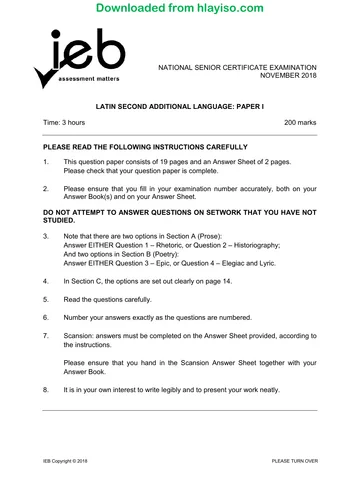
NATIONAL SENIOR CERTIFICATE EXAMINATION
NOVEMBER 2018
LATIN SECOND ADDITIONAL LANGUAGE: PAPER I
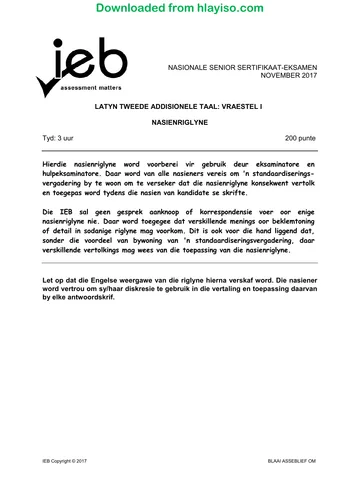
MARKING GUIDELINES
Time: 3 hours 200 marks
These marking guidelines are prepared for use by examiners and sub-examiners,
all of whom are required to attend a standardisation meeting to ensure that the
guidelines are consistently interpreted and applied in the marking of candidates'
scripts.
The IEB will not enter into any discussions or correspondence about any marking
guidelines. It is acknowledged that there may be different views about some
matters of emphasis or detail in the guidelines. It is also recognised that,
without the benefit of attendance at a standardisation meeting, there may be
different interpretations of the application of the marking guidelines.
IEB Copyright © 2018 PLEASE TURN OVER
You're offline
Skip to contentMemorandum View all
Latin SAL P1 Memo 2018 hlayiso.com
Latin SAL · Grade 12 · 2018. Memorandum, 13 pages. Read online or download the PDF.
- Subject
- Latin SAL
- Grade
- Grade 12
- Document type
- Memorandum
- Year
- 2018
- Paper
- 1
- Publisher
- IEB
- Pages
- 13
- File size
- 349.9 KB
Loading document…
Loading document…
1 of 13
Document textSearch extracted text and jump to a page.
Downloaded from hlayiso.com
NATIONAL SENIOR CERTIFICATE: LATIN SECOND ADDITIONAL LANGUAGE: PAPER I – Page 2 of 13
MARKING GUIDELINES
SECTION A PROSE SET TEXTS
QUESTION 1 RHETORIC
1.1 si te iam, Catilina, comprehendi, si interfici iussero,
credo, erit verendum mihi,
ne non potius hoc omnes boni serius a me
quam quisquam crudelius factum esse dicat.
Verum ego hoc, quod iam pridem factum esse oportuit,
certa de causa nondum adducor ut faciam.
Tum denique interficiere, cum iam nemo tam improbus,
tam perditus, tam tui similis inveniri poterit,
qui id non iure factum esse fateatur.
1.2 (a) Catiline's followers, those involved in the plot to overthrow Rome's
government; seditious individuals seen as posing a threat to safety
and security.
(b) Perceived as people hostile to the safety of the state and therefore
warranting a strong response.
1.3 (a) Stupid, spiritless, cheats, parricides, will-forgers, hooligans,
spendthrifts, debauchees, criminal degenerates, given to drinking
and womanising.
(b) Catiline was a politician; he had support from among many who were
disgusted with the corruption among the senatorial class; they felt
their ambitions had been obstructed; many senators pursued lives of
luxury and excess; many of his followers were people who had been
penalised for supporting the wrong side in the last civil war by having
their land confiscated.
1.4 In 58 BC, Clodius, Tribunus Plebis, proposed a law sending anyone into
exile who had put to death a Roman citizen without giving him recourse to
the people's assembly. This was clearly aimed at Cicero, a long-time enemy
of Clodius. Catiline and his followers were portrayed as martyrs for the
popular cause, murdered by a conservative faction in the senate.
Despite having been declared pater patriae after Catiline's conspiracy had
been ended, Cicero was later forced into exile.
1.5 tam...tam...tam repeated, each time with a stronger/longer phrase following.
Climax is "tam tui similis", making similarity to Catiline worse than
debauchery and depravity.
IEB Copyright © 2018 PLEASE TURN OVER
Downloaded from hlayiso.com
NATIONAL SENIOR CERTIFICATE: LATIN SECOND ADDITIONAL LANGUAGE: PAPER I – Page 3 of 13
MARKING GUIDELINES
1.6 quae cum ita sint, patres conscripti,
vobis populi Romani praesidia non desunt;
vos ne populo Romano deesse videamini, providete.
Habetis consulem ex plurimis periculis et insidiis
atque ex media morte non ad vitam suam,
sed ad salutem vestram reservatum.
praeterea de vestra vita,
de coniugum vestrarum atque liberorum anima,
de fortunis omnium, de sedibus, de focis vestris
hodierno die vobis iudicandum est.
1.7 Choice of two apt phrases: 1 + 1 (e.g. impiae coniurationis; supples manus)
Explanations 1 +1
1.8 (a) Concerned about possible accusations of abuse of power; certain
conspirators were senators; wanted more proof.
Assassination attempt changed his mind.
For full marks, answer must show full understanding of
situation
(b) Arrest of letter-writers, Lentulus (ex-consul); role of Allobroges;
admission of guilt; conspirators were put to death with full agreement
of senate.
1.9 Habetis consulem ex plurimis periculis et insidiis atque ex media
morte non ad vitam suam, sed ad salutem vestram reservatum.
(a) Cicero
(b) Heroic, (ex media morte); selfless (non ad vitam suam) saviour of the
state (ad salutem vestram); dutiful and "pius".
1.10 (a) Impression of united people, state is compared to a single desperate
person pleading for help to the senate: i.e. "vobis" for its very
existence, for its Lares, Penates, etc.
(b) Repetition of "vobis" emphasises that the people depend heavily on
the senators ("vobis"). They entrust their entire safety to the senate.
"Vobis" makes it personal, almost a moral obligation.
IEB Copyright © 2018 PLEASE TURN OVER
Downloaded from hlayiso.com
NATIONAL SENIOR CERTIFICATE: LATIN SECOND ADDITIONAL LANGUAGE: PAPER I – Page 4 of 13
MARKING GUIDELINES
QUESTION 2 HISTORIOGRAPHY
2.1 "erit igitur in hoc certamine is
vobis illisque animus qui victoribus et victis esse solet.
nec nunc illi quia audent sed quia necesse est pugnaturi sunt,
qui plures paene perierint quam supersint;
nisi creditis, qui exercitu incolumi pugnam detractavere,
eos duabus partibus peditum equitumque in transitu Alpium amissis
plus spei nactos esse.
at enim pauci quidem sunt sed vigentes animis corporibusque,
quorum robora ac vires vix sustinere vis ulla possit.
2.2 (a) Publius Cornelius Scipio (elder) – to encourage his new and
inexperienced troops.
(b) The Romans and the Carthaginian army respectively.
2.3 (a) The battle at the River Ticinus.
(b) The Carthaginians won by a huge margin; Scipio was almost killed.
(c) He rescued his father, who was surrounded by the enemy. Had
Scipio (elder) been killed or injured, this would have created a worse
crisis than the actual defeat.
2.4 They show that the opposite is about to be proved: that Hannibal's men are
as good as dead already.
2.5 He piles up adjectives and images, creating a more and more horrific
depiction of the dire straits the Carthaginians are in: pupils should give clear
indication that they understand the phrases, e.g. from being "umbrae
hominum" to having almost nothing to fight with "quassata fractaque arma".
2.6 Scipio described as the heroic quintessential Roman leader, encouraging
his troops, (give e.g.); Hannibal here painted as a brave but tragic figure.
Variety of human experience: Livy depicts the hardships endured by the
Carthaginians vividly. (give e.g.)
Pupil should refer both to content and to style, providing evidence from the
text.
5 clear and comprehensive; comment on style and content; apt support from text
4 clear and correct; apt support
3 clear, mostly correct
2 muddled, some accurate observations
1 poor, muddled, little understanding
IEB Copyright © 2018 PLEASE TURN OVER
Downloaded from hlayiso.com
NATIONAL SENIOR CERTIFICATE: LATIN SECOND ADDITIONAL LANGUAGE: PAPER I – Page 5 of 13
MARKING GUIDELINES
2.7 Hannibali nimis laeta res est visa
maiorque quam ut eam statim capere animo posset.
itaque voluntatem se laudare Maharbalis ait;
ad consilium pensandum temporis opus esse.
tum Maharbal: "non omnia nimirum eidem di dedere.
vincere scis, Hannibal; victoria uti nescis."
mora eius diei satis creditur saluti fuisse urbi atque imperio.
postero die ubi primum inluxit, ad spolia legenda
foedamque etiam hostibus spectandam stragem insistunt.
2.8 He was the leader of the cavalry.
2.9 (a) Carthaginian cavalry on flanks, then after driving off the Roman
cavalry, retreated behind the Roman line. (1)
Hannibal's infantry moved backwards in the centre of the line,
creating a semicircle. (1)
Then Carthaginians started to attack from the sides; pincer
movement. (1)
Carthaginian cavalry returned from the rear; Romans surrounded. (1)
(b) Livy claims that the cavalry treacherously pretended to throw down
their weapons, leading the Romans to believe they were
surrendering;
They went around the back of the Roman line, as prisoners of war
might do; they attacked the Romans from behind, slitting their
tendons so that they could no longer walk.
In other words, this was an act of vile trickery.
5 clear and insightful understanding and explanation of Livy's version
4 accurate but good understanding of how Livy has represented the events
3 fairly accurate but clear understanding of how Livy has represented the events
2 some understanding
1 superficial or muddled statement
2.10 "quidam" in various forms serves to turn the reader's attention this way and
that, as if looking at the scenes on the battlefield. (1) The scenes are
piteous and horrific; (1) we feel almost as if we are there along with the
Carthaginians, watching the scenes unfold. (2)
2.11
4 insightful and comprehensive; apt choice of two phrases
3 accurate observations, not comprehensive; apt choice of one phrase
2 some understanding, little evidence; apt choice of one phrase
1 superficial statement, poor evidence; choice of phrases poor
IEB Copyright © 2018 PLEASE TURN OVER
Downloaded from hlayiso.com
NATIONAL SENIOR CERTIFICATE: LATIN SECOND ADDITIONAL LANGUAGE: PAPER I – Page 6 of 13
MARKING GUIDELINES
SECTION B POETRY SET TEXTS
QUESTION 3 EPIC
3.1 creditis avectos hostis?
aut ulla putatis dona carere dolis Danaum?
sic notus Ulixes?
aut hoc inclusi ligno occultantur Achivi,
aut haec in nostros fabricata est machina muros,
inspectura domos venturaque desuper urbi,
aut aliquis latet error;
equo ne credite, Teucri.
3.2 See end
3.3 (a) The Iliad, Homer
(b) Link Rome's history and Rome's founding (2) to the illustrious
past (1) of Greece and Troy
(c) Laocoon, Aeneas
3.4 Any three: eg dolis Danaum
occultantur Achivi
timeo danaos et dona ferentes
Mark according to clear justification given 3 + 3 = 6
3.5 Show Laocoon's desperation, (1) disbelief at the Trojans' gullibility (1)
3.6 et iam Argiva phalanx instructis navibus ibat
a Tenedo tacitae per amica silentia lunae
litora nota petens, flammas cum regia puppis extulerat,
fatisque deum defensus iniquis
inclusos utero Danaos et pinea furtim
laxat claustra Sinon.
invadunt urbem somno vinoque sepultam;
caeduntur vigiles, portisque patentibus omnis
accipiunt socios atque agmina conscia iungunt.
3.7 (a) The gods have ordained that Aeneas must survive, and leave Troy to
found Rome.
IEB Copyright © 2018 PLEASE TURN OVER
Downloaded from hlayiso.com
NATIONAL SENIOR CERTIFICATE: LATIN SECOND ADDITIONAL LANGUAGE: PAPER I – Page 7 of 13
MARKING GUIDELINES
(b) He at first takes up arms heroically to defend his city against the
Greeks. Venus intervenes to persuade him that he must flee from
Troy with his family. Creusa, his wife, is killed; her ghost appears to
him to assure him that he must leave Troy. Thus pietas means
obeying the will of the gods, even when it is at odds with his own
instinctive beliefs and purposes.
3.8 (a) Juxtaposition and antithesis of miseri/festa; also ultimus esset/ille
dies festa. Explain how meanings contrast.
delubra deum alliteration – "d" is gloomy sound; reflects tragic
outcome.
(b) Repeated spondees in the description of the turning sky which
remorselessly brings the fate of the Trojans give a slow, gloomy
sound, effect of foreboding.
3.9 (a) The Trojan horse.
(b) Sinon claims to hate the Greeks; statue stolen from temple of
Pallas, which is central to Troy's safety; Horse is Minerva's gift,
an atonement for their wrongdoing; Greeks have fled, knowing their
quest is useless.
3.10 (a) Moon is personified as a silent friend, helping their secret plan.
(b) Large group shows that all the major Greek heroes are in league
against Troy; actual names make the account more credible.
3.11 See end
3.12 The town is sepultam – buried in sleep – foreshadowing its destruction and
death.
Slow spondees echo the remorseless approach and the town's
somnolence.
IEB Copyright © 2018 PLEASE TURN OVER
Downloaded from hlayiso.com
NATIONAL SENIOR CERTIFICATE: LATIN SECOND ADDITIONAL LANGUAGE: PAPER I – Page 8 of 13
MARKING GUIDELINES
QUESTION 4 ELEGIAC AND LYRIC
4.1 perstat et alternae deceptus imagine vocis,
'huc coeamus' ait
nullique libentius umquam responsura sono
'coeamus' rettulit Echo
et verbis favet ipsa suis
egressaque silva ibat,
ut iniceret sperato bracchia collo.
4.2 Narcissus: Echo:
self-absorbed desperate to be acknowledged
lacks empathy a tragic figure, punished by the gods
Not "narcissistic"
4.3 (a) Repetition of the "v" sound and of variants of "voco" and "vox",
put close together, recreate the idea of the echoing voice.
(b) Separation of words, e.g. "comitum ... ab agmine" parallels the
meaning.
Closeness of "ecquis adest" et "adest" shows how close Echo is to
him – she is present, but not visible.
(c) Any two + effect 2 + 2 = 4
4.4 (a)
4 insightful and comprehensive, well supported
3 accurate observations, not comprehensive; some support
2 some understanding, little evidence
1 superficial statement, poor evidence
4.4 (b)
5 clear and insightful progression explained well; accurate word-choice
4 clear progression, accurate word-choice, explained clearly
3 progression not entirely clear or accurate; fair understanding shown
2 some idea of the changes in emotion; some errors
1 Poor understanding, but some limited insight
4.5 See end
IEB Copyright © 2018 PLEASE TURN OVER
Downloaded from hlayiso.com
NATIONAL SENIOR CERTIFICATE: LATIN SECOND ADDITIONAL LANGUAGE: PAPER I – Page 9 of 13
MARKING GUIDELINES
4.6 quaeris iter? dicam.
vicinum Castora canae transibis
Vestae virgineamque domum;
inde sacro veneranda petes Palatia clivo,
plurima qua summi fulget imago ducis.
nec te detineat miri radiata colossi
quae Rhodium moles vincere gaudet opus.
flecte vias hac qua madidi sunt tecta Lyaei
et Cybeles picto stat Corybante tholus.
4.7 Proculus = patron; Martial expected to greet him every morning.
4.8 It is impossible to write the poetry/you wish me to write/if I am always
travelling to and from your house.
4.9 (a) Accurate and insightful choice of phrases.
(b) Clear explanation and justification of chosen phrases 2 + 2.
4.10 See end
4.11
4 both descriptions insightfully and accurate, well supported
3 accurate observations, not comprehensive; some support
2 some understanding, little evidence
1 superficial statement, poor evidence
IEB Copyright © 2018 PLEASE TURN OVER
Downloaded from hlayiso.com
NATIONAL SENIOR CERTIFICATE: LATIN SECOND ADDITIONAL LANGUAGE: PAPER I – Page 10 of 13
MARKING GUIDELINES
SECTION C
QUESTION 5 RHETORIC
5.1 gerundive of obligation
5.2 comprehendi indicative Open condition future tense
iussero indicative
erit verendum indicative
5.3 (a) dative of agent
(b) genitive with "similis"
5.4 (a) dicat (line 3) subjunctive in a clause following a verb of fearing
(b) faciam (line 4) subjunctive in purpose/indirect command
(c) interficiere (line 4) indicative statement
(d) inveniri (line 5) prolative infinitive
5.5 (a) sint (line 1) cum causal
(b) videamini (line 2) purpose/indirect command
5.6 past participle
IEB Copyright © 2018 PLEASE TURN OVER
Downloaded from hlayiso.com
NATIONAL SENIOR CERTIFICATE: LATIN SECOND ADDITIONAL LANGUAGE: PAPER I – Page 11 of 13
MARKING GUIDELINES
QUESTION 6 HISTORIOGRAPHY
6.1 (a) dative of possession
(b) ablative absolute/attendant circumstances
(c) objective genitive
(d) partitive genitive
(e) ablative of respect
6.2 perfect infinitive
6.3 (a) indicative causal clause with quia
(b) prolative infinitive
6.4 illi
6.5 gerundive attraction
6.6 predicative dative; dative of advantage
QUESTION 7 EPIC
7.1 (a) ventura/inspectura
(b) carere
7.2 (a) ablative of separation
(b) dative with "credite"
(c) vocative – address
7.3 imperative – direct command
7.4 accusative and infinitive – indirect statement
7.5 (a) ablative absolute
(b) ablative of means or instrument
(c) subjective genitive
(d) accusative direct object
IEB Copyright © 2018 PLEASE TURN OVER
Downloaded from hlayiso.com
NATIONAL SENIOR CERTIFICATE: LATIN SECOND ADDITIONAL LANGUAGE: PAPER I – Page 12 of 13
MARKING GUIDELINES
QUESTION 8 ELEGIAC AND LYRIC
8.1 (a) deceptus/egressa/sperato
(b) libentius
8.2 (a) nominative agreeing with the subject
(b) ablative of means
(c) dative of indirect object
(d) dative with "favet"
(e) ablative of separation/place from which
8.3 jussive or hortative subjunctive
8.4 subjunctive in a purpose clause
8.5 (a) genitive of possession
(b) genitive of description/definition
QUESTION 9 SENTENCES FOR TRANSLATION INTO LATIN
9.1 Eos 1 ipsos1 non1 iussimus 2 ad insulam 1 navigare 3
Eis 1 ipsis 1 non 1 imperavimus 2 ut 1 ad insulam 1 navigarent 2
9.2 His 1 omnibus 1 factis 2 imperator 1 advenit 2
Postquam haec 1 omnia 1 facta sunt 2
Cum haec 1 omnia 1 facta essent 2
9.3 Dominum (suum) 1 certiorem fecerunt 2
Domino (suo) 1 dixerunt 2 nuntium 1 necatum esse 2
9.4 Cum 1 manere 1 nolit, 2 statim 1 discedat.2 / abeat 2
Quoniam 1 nonvult
9.5 Cum 1 timeremus 2
Quamvis 1 timeremus 2 ne 1 nos 1 sequerentur 2 media nocte 1 tamen 1
Quamquam 1 timebamus 2
profecti sumus 2
Total: 200 marks
IEB Copyright © 2018 PLEASE TURN OVER
Downloaded from hlayiso.com
NATIONAL SENIOR CERTIFICATE: LATIN SECOND ADDITIONAL LANGUAGE: PAPER I – Page 13 of 13
MARKING GUIDELINES
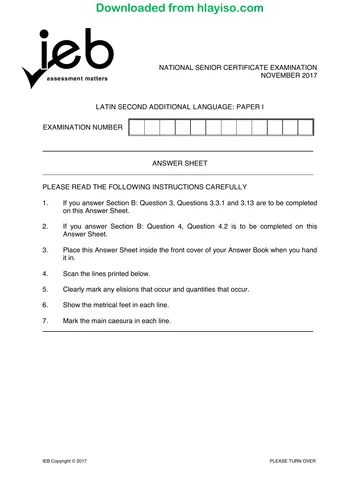
ANSWER SHEET MARKING GUIDELINE
IEB Copyright © 2018
Recommended for this subject
Published documents with matching subject and grade metadata.
Related documents
Matched using subject, grade, language, document type and exam metadata.
More from Grade 12 Latin SAL
Explore more published documents in this catalogue.