
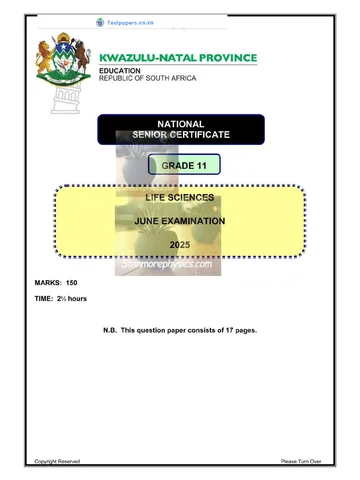
NATIONAL
SENIOR CERTIFICATE
GRADE 11
NOVEMBER 2025
LIFE SCIENCES P1
MARKS: 150
TIME: 2½ hours
This question paper consists of 16 pages.
Skip to contentAll 2025 papers 
View all

Life Sciences Grade 11 P1 Eastern Cape November 2025 QP
Grade 11 Life Sciences Paper 1 question paper from the Eastern Cape November Exam 2025 (English), 16 pages. Read online or download the free PDF.
Life Sciences · Grade 11 · Eastern Cape November Exam · 2025 · English. Question paper, 16 pages. Read online or download the PDF.
- Subject
- Life Sciences
- Grade
- Grade 11
- Language
- English
- Document type
- Question paper
- Year
- 2025
- Exam period
- Eastern Cape November Exam
- Paper
- 1
- Curriculum
- CAPS
- Pages
- 16
- File size
- 1.3 MB
Free to read online, no sign-up needed
Loading document…
Loading document…
1 of 16
This exam
Eastern Cape November Exam 2025
- Paper 1Question paperMemo
- Paper 2Question paper · EngMemo · Afr
- Other filesQuestion paperMemo
Questions in this paper
Document textSearch extracted text and jump to a page.
2 LIFE SCIENCES P1 (EC/NOVEMBER 2025)
INSTRUCTIONS AND INFORMATION
Read the following instructions carefully before answering the questions.
1. Answer ALL the questions.
2. Write ALL the answers in the ANSWER BOOK provided.
3. Start the answer to EACH question at the top of a NEW page.
4. Number the answers correctly according to the numbering system used in this
question paper.
5. Present your answers according to the instructions of each question.
6. Do ALL drawings in pencil and label them in blue or black ink.
7. Draw diagrams, tables or flow charts ONLY when asked to do so.
8. The diagrams in this question paper are NOT necessarily drawn to scale.
9. Do NOT use graph paper.
10. You must use a non-programmable calculator, protractor and a compass, where
necessary.
11. All calculations to be rounded off to TWO decimal spaces.
12. Write neatly and legibly.
Copyright reserved Please turn over
(EC/NOVEMBER 2025) LIFE SCIENCES P1 3
SECTION A
QUESTION 1
1.1 Various options are provided as possible answers to the following questions.
Choose the answer and write only the letter (A–D) next to the question
numbers (1.1.1 to 1.1.10) in the ANSWER BOOK, for example 1.1.11 D.
1.1.1 The structure which prevents the food bolus from entering the trachea
when swallowing:
A Epiglottis
B Tongue
C Glottis
D Teeth
1.1.2 A function of the kidney:
A CO2 homeostasis
B Breakdown of bile pigments
C Blood pH homeostasis
D Deamination
1.1.3 The part of the alimentary canal in which the villus is found:
A Oesophagus
B Large intestine
C Stomach
D Small intestine
1.1.4 Factor(s) which facilitate oxygen absorption into the human body:
A Air breathed in has less oxygen than air breathed out
B Alveoli having thick walls for oxygen storage and a large surface
area
C There are few alveoli in each lung
D The concentration of oxygen in the blood is lower than in the
alveoli
Copyright reserved Please turn over
4 LIFE SCIENCES P1 (EC/NOVEMBER 2025)
1.1.5 A cross-section of a dicot leaf is shown below.
Epidermis
X
Which type of cell is expected to be found at layer X?
A B C D
1.1.6 The table below shows the composition of four air samples.
AIR SAMPLE O2 % CO2% N2 %
P 21 0,04 78
Q 16 4,04 78
R 4 0,40 39
S 20 4,00 39
Which air sample represents inspired air and which air sample
represents expired air?
INSPIRED AIR EXPIRED AIR
A S R
B P S
C P Q
D Q S
Copyright reserved Please turn over
(EC/NOVEMBER 2025) LIFE SCIENCES P1 5
1.1.7 Substances which are removed from the blood during tubular
secretion.
A Water, sodium ions and hormones
B Glucose and sodium ions
C Undigested food and creatine
D Hormones, urea and creatine
1.1.8 The correct path that urine takes through the excretory system
A Kidney → urethra → bladder → ureter
B Kidney → ureter → bladder → urethra
C Bladder → kidney → ureter → urethra
D Ureter → kidney → urethra → bladder
1.1.9 Osmoregulation is the way the body controls the amount of water and
salts it contains.
Consider the table below. What is most likely to happen in the body on
a cold day when a person drinks a lot of water?
UREA RENAL TUBULE URINE VOLUME
CONCENTRATION PERMEABILITY
A Low Permeable High
B High Impermeable Low
C Low Impermeable Low
D High Permeable High
1.1.10 The inside of the trachea (windpipe) is lined with a special tissue called
ciliated columnar epithelium. This tissue has tiny hair-like structures
called cilia.
What is the main function of the cilia in the trachea (windpipe)?
A Increase surface area for gaseous exchange
B Help gases move quickly because they are close to blood
vessels
C Trap dirt and pathogenic (harmful) microbes (germs)
D Excrete metabolic waste products (10 x 2) (20)
Copyright reserved Please turn over
6 LIFE SCIENCES P1 (EC/NOVEMBER 2025)
1.2 Give the correct biological term for each of the following descriptions. Write
only the term next to the question numbers (1.2.1 to 1.2.8) in the ANSWER
BOOK.
1.2.1 Process of taking air into and expelling it from the lungs
1.2.2 The hormone which assists in the regulation of sodium ions
1.2.3 Large flat and uneven teeth used for grinding and crushing food
1.2.4 Region which connects the nasal cavity with larynx and leads into the
trachea and the oesophagus
1.2.5 Release of a useful substance (enzymes, saliva) from cells or
glands
1.2.6 Semi-liquid mass of partially digested food which has gone through
mechanical and chemical digestive processes of the stomach
1.2.7 Folded portion of the nephron between the loop of Henle and the
collecting tubule
1.2.8 Process which requires no energy to move water from a region of high
water potential to a region of low water potential (8)
1.3 Indicate whether each of the descriptions in COLUMN Ι, applies to A ONLY, B
ONLY, BOTH A and B, or NONE of the items in COLUMN ΙΙ. Write A only, B
only, both A and B, or NONE next to the question numbers (1.3.1. to 1.3.4) in
the ANSWER BOOK.
COLUMN I COLUMN II
1.3.1 Part(s) of the chloroplast in which A: Thylakoid
chlorophyll is located B: Lamellae
1.3.2 Cell(s) which make up the surface of A: Compound columnar
the villus B: Goblet
1.3.3 Structure(s) which assist in keeping A: Circular muscle
the trachea open B: Epiglottis
1.3.4 A part of the blood circulatory A: Convoluted tubules
system of the kidney B: Renal calyxes
(4 x 2) (8)
Copyright reserved Please turn over
(EC/NOVEMBER 2025) LIFE SCIENCES P1 7
1.4 A macroscopic diagram of the kidney is shown below.
F A
B
C
E
D
1.4.1 Identify the label and state the name of the …
(a) cup-shaped structure which surrounds the renal papillae and
funnels urine. (2)
(b) part that has layers of fat (adipose tissue) to protect the kidney
from mechanical injury. (2)
(c) part that collects urine from the calyces and channels it into the
ureter. (2)
1.4.2 Explain why part D appears darker red or brown compared to part A. (1)
Copyright reserved Please turn over
8 LIFE SCIENCES P1 (EC/NOVEMBER 2025)
1.5 Negative feedback mechanisms are essential processes which ensure
homeostasis. A simple negative feedback loop with its components is shown
below.
Stimulus
Restore
Homeostasis Receptor
/ Imbalance
Control
Effector
Center
1.5.1 Define the term homeostasis. (2)
1.5.2 Carbon dioxide regulation is an important example of a negative
feedback mechanism.
When the level of carbon dioxide in the human body becomes too high
which part of the body acts as the:
(a) Receptor (1)
(b) Effector (2)
1.5.3 Give TWO reasons why it is important for carbon dioxide levels in the
blood not to remain high. (2)
[50]
TOTAL SECTION A: 50
Copyright reserved Please turn over
(EC/NOVEMBER 2025) LIFE SCIENCES P1 9
SECTION B
QUESTION 2
2.1 Study the organelle below that is found in a cell.
A
B
2.1.1 Identify the organelle shown above. (1)
2.1.2 State TWO visible reasons for the answer given to QUESTION 2.1.1. (2)
2.1.3 Beside their locations, tabulate TWO differences between the processes
which occur at A and B. (5)
2.1.4 List TWO biological importances of the process which occurs within the
given organelle. (2)
2.1.5 Describe ONE visible structural feature within the organelle that makes
it suitable for its primary function. (2)
Copyright reserved Please turn over
10 LIFE SCIENCES P1 (EC/NOVEMBER 2025)
2.2 Read the extract below and answer the questions that follow.
GREENHOUSES HELP GROW FOOD EVEN WHEN THE WEATHER IS
UNFAVOURABLE
In Russia, winters are very cold and the time for growing food is short.
Greenhouses give a safe and warm space for growing vegetables all year
round, even when it is −25 °C outside. In places like Siberia, people can now
grow local vegetables instead of buying them from other countries. Russian
greenhouses use clean energy from the sun (solar) and the earth (geothermal).
Greenhouses also help people get jobs and support local businesses.
2.2.1 List ONE benefit of greenhouse systems on the local community. (1)
2.2.2 Explain how Russian greenhouses are energy efficient. (2)
2.2.3 The best temperature for growing plants in a greenhouse is 28 °C.
Outside, the temperature is −25 °C.
(a) Give TWO ways to keep the temperature warm inside the
greenhouse when it is very cold outside. (2)
(b) Calculate the percentage difference in temperature between
outside (−25 °C) and inside (28 °C) the greenhouse. (3)
2.2.4 Greenhouses use UV-A and UV-B light bulbs when there is not enough
sunlight.
(a) Briefly discuss the relationship between light intensity and the
photosynthetic rate of plants. (3)
(b) Explain ONE limiting factor of light intensity in plants. (2)
Copyright reserved Please turn over
(EC/NOVEMBER 2025) LIFE SCIENCES P1 11
2.3 Cellular respiration is a 3-phase process in which ATP is formed. A schematic
representation of this process is given below.
Electrons carried
via NADH X
Process A
Process A Process B
Y
ATP
ATP ATP
2.3.1 Identify:
(a) Process A (1)
(b) Reactant X (1)
(c) Product Y (1)
2.3.2 Is process A an anabolic or catabolic process?
Give ONE reason for the answer. (2)
2.3.3 Between A and B, which process produces more ATP?
Give a reason for the answer. (2)
2.3.4 Describe the events of the Krebs cycle. (4)
2.3.5 An athlete complained about muscle cramps after running a marathon
for four and a half hours.
Using your understanding of cellular respiration, explain why this has
occurred. (3)
Copyright reserved Please turn over
12 LIFE SCIENCES P1 (EC/NOVEMBER 2025)
2.4 A scientist investigated how photosynthesis and respiration affect carbon dioxide
levels in water. The experiment used pondweed (a plant) and a pond snail (an
animal).
Experimental design:
• The apparatus was left in a well-lit room for 5 days.
• After 5 days, the scientist completely covered the boiling tube with black
paper.
• A data logger was used to record carbon dioxide (CO₂) levels every day for
15 days.
• The results are shown in the table below.
CARBON DIOXIDE
TIME IN CONCENTRATION
DAYS IN ARBITRARY
UNITS
0 5
1 5
Data logger 2 5
3 5
Rubber plug 4 5
5 5
6 5,3
7 5,4
8 5,5
Pondweed
9 6,4
10 6,5
Pond snail
11 6,5
12 6,6
13 6,8
14 7,1
15 7,4
2.4.1 Identify the dependent variable of the investigation. (1)
2.4.2 State a suitable control for the investigation. (2)
2.4.3 Account for the carbon dioxide concentration between day 0 and day 5. (2)
2.4.4 Suggest a reason why carbon dioxide concentration increased after
day 5. (2)
2.4.5 The snail died on day 10. Explain why this happened. (2)
2.4.6 State a suitable conclusion for the investigation. (2)
[50]
Copyright reserved Please turn over
(EC/NOVEMBER 2025) LIFE SCIENCES P1 13
QUESTION 3
3.1 Below is a diagram of some parts of the digestive system.
A
B
F
C
D
E
3.1.1 Provide suitable labels for:
(a) Tube A (1)
(b) Vein C (1)
3.1.2 Explain THREE ways structure E is adapted for its function. (6)
3.1.3 Distinguish between the physical and chemical digestion which occur
simultaneously in structure B. (4)
3.1.4 Explain why fat absorption is still possible, despite structure F being
surgically removed. (2)
Copyright reserved Please turn over
14 LIFE SCIENCES P1 (EC/NOVEMBER 2025)
3.2 The diagram below shows one of the five phases of human nutrition.
3.2.1 Based on the diagram above, name the phase of human nutrition
shown. Also, name the enzyme responsible for breaking down proteins
during this phase. (2)
3.2.2 Where in the human body will the enzyme mentioned in
QUESTION 3.2.1 be produced? (1)
3.2.3 During which phase of human nutrition will proteins be formed in the
human body? (1)
3.2.4 Identify and discuss the final phase of human nutrition. Mention the
structure(s) involved and their biological importance. (3)
3.3 Bread is masticated in the human mouth.
3.3.1 Explain the importance of mastication in human nutrition. (2)
3.3.2 Explain why bread tastes sweeter after a short period of time in the
mouth. (2)
Copyright reserved Please turn over
(EC/NOVEMBER 2025) LIFE SCIENCES P1 15
3.4 The diagram below shows an alveolus, a small, hollow, air-filled sac located in
the lungs.
A
3.4.1 Identify the type of movement represented by A. (1)
3.4.2 Identify and describe TWO visible features of the alveolus that make it
an effective gaseous exchange surface. (4)
3.4.3 List TWO ways in which oxygen is transported in the body. (2)
3.4.4 Describe how a bullet wound to the chest could affect effective ventilation
of the lungs. (5)
Copyright reserved Please turn over
16 LIFE SCIENCES P1 (EC/NOVEMBER 2025)
3.5 The diagram below shows a nephron.
B
A
C
D
E
F
3.5.1 List TWO letters from the nephron diagram that are located in the renal
cortex. (2)
3.5.2 Identify and discuss TWO significant processes which occur between
the renal tubule and network F. (4)
3.5.3 Bartter syndrome is a rare genetic disorder which causes ineffective
reabsorption of sodium ions, despite aldosterone’s secretion. Sodium
pumps are also unable to actively pump sodium out.
(a) Identify and write down the name of the part Bartter syndrome will
most likely affect. (2)
(b) Discuss how Bartter syndrome will negatively affect
osmoregulation. (5)
[50]
TOTAL SECTION B: 50
GRAND TOTAL: 150
Copyright reserved Please turn over
Study this subject
Recommended for this subject
Memorandum
Life Sciences Grade 11 P1 Eastern Cape November 2023 Memo
Question paper
Life Sciences Grade 11 P1 Eastern Cape November 2018 QP
Question paper
Life Sciences Grade 11 P1 Eastern Cape November 2016 QP
Memorandum
Life Sciences Grade 11 P2 Eastern Cape November 2024 Memo
Memorandum
Life Sciences Grade 11 P1 2020 Memo (Eng)
Memorandum
Life Sciences Grade 11 P1 2020 Memo (Eng)
More from Grade 11 Life Sciences
Annual teaching plan
Gr 11 Life Sci ATP 2023 24
Question paper and memo
Life Sciences Grade 11 KZN June 2025 Paper & Memo
Question paper and memo
Life Sciences Grade 11 Eastern Cape June 2024 Paper & Memo
Question paper and memo
Life Sciences Grade 11 KZN June 2024 Paper & Memo
Question paper and memo
Life Sciences Grade 11 March Test 2023 Paper & Memo
Question paper and memo