
Downloaded from hlayiso.com
NATIONAL SENIOR CERTIFICATE EXAMINATION
NOVEMBER 2017
LIFE SCIENCES: PAPER II
MARKING GUIDELINES
Time: 2 hours 100 marks
These marking guidelines are prepared for use by examiners and sub-examiners,
all of whom are required to attend a standardisation meeting to ensure that the
guidelines are consistently interpreted and applied in the marking of candidates'
scripts.
The IEB will not enter into any discussions or correspondence about any marking
guidelines. It is acknowledged that there may be different views about some
matters of emphasis or detail in the guidelines. It is also recognised that,
without the benefit of attendance at a standardisation meeting, there may be
different interpretations of the application of the marking guidelines.
IEB Copyright © 2017 PLEASE TURN OVER
Skip to contentMemorandum 


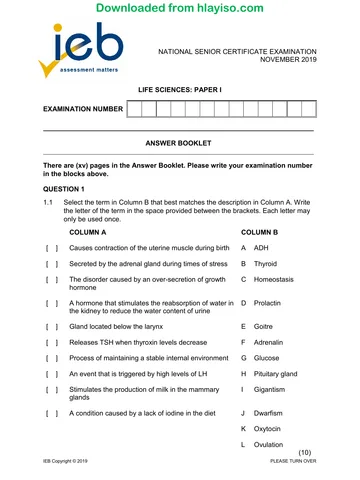
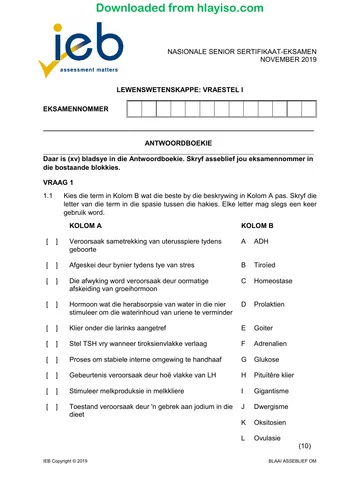
View all





Life Sciences Grade 12 IEB Paper 2 2017 Memo
IEB Grade 12 Life Sciences Paper 2 memorandum from the 2017, 10 pages. Read online or get the free PDF download, question paper linked when available.
Publisher: IEB
Life Sciences · Grade 12 · 2017. Memorandum, 10 pages. Read online or download the PDF.
- Subject
- Life Sciences
- Grade
- Grade 12
- Document type
- Memorandum
- Year
- 2017
- Paper
- 2
- Publisher
- IEB
- Curriculum
- IEB
- Pages
- 10
- File size
- 291.8 KB
Loading document…
Loading document…
1 of 10
Document textSearch extracted text and jump to a page.
Downloaded from hlayiso.com
NATIONAL SENIOR CERTIFICATE: LIFE SCIENCES: PAPER II – MARKING GUIDELINES Page 2 of 10
SECTION A
QUESTION 1
1.1 Correct terms
1.1.1 Parental care – option 1
1.1.2 Allopatric speciation – option 2
1.1.3 Convergent evolution – option 2
1.1.4 Continental drift – option 2
1.2 1.2.1 500–600 (accept range)
1.2.2 2 050–2 250 (accept range)
1.3 morphological characteristics can evolve at an incredibly uneven pace
sometimes completely out of step with genetic changes/speciation seems to
occur in bouts and not steadily over time/speciation has been record
breaking 1 550 species in relatively short time (10 million years).
1.4 1.4.1 • Cichlids possess two sets of jaws
• one in the mouth, (to suck, scrape or bite off bits of food)
• the second set of jaws are adapted in the throat
• to crush, slice or pierce the food
• greater feeding options
• the two sets of jaws are finely adapted to a type of food/very
versatile/adaptable
• allows each species to occupy its own very specific ecological
niche; (4 optional facts)
• hundreds of species can coexist without directly competing/if
these cichlids had tried to exploit the same food resources, most
would have been driven to extinction
1.4.2 Summary of piscivorous cichlids and the types of food they eat
Type/group Feeding
Type of food Type of food
of cichlids specialisation
Piscivores Whole fish Consume whole fish –
Scales Eat scales from sides Approach from behind and
Scale Eaters
of other cichlids grab mouthful of scales
Eggs or young Dislodge young from Ram mouth of mouth
Paedophages of mouth mouth brooders and brooder and dislodge eggs
brooders eat their eggs or young and young
Carnivorous Insects and Eating insects and –
cichlids shrimp shrimp
Small and Crush and process Large molars to crush
Crushers thin-shelled small and thin-shelled shells
molluscs molluscs
Heading = column headings =
5 groups of piscivorous cichlids = linked to correct type of food
(sliding scale: 5 correct =; 4 correct =; 3 correct = ; 2 to 1 correct =)
Alt answer: Heading = column headings =
Max 3 correct =; 2 to 1 correct =) (4)
IEB Copyright © 2017 PLEASE TURN OVER
Downloaded from hlayiso.com
NATIONAL SENIOR CERTIFICATE: LIFE SCIENCES: PAPER II – MARKING GUIDELINES Page 3 of 10
1.5 Cichlids in Lake Victoria are genetically very close to one another;
evolutionary adaptations can and did evolve many times; independently of
one another; example of convergent evolution; mtDNA indicates
relatedness
1.6 Survival of the fittest example:
Bower builders (nest-builders) – many male African cichlid fish build a pit or
sand castle on a lake bottom; to attract females; females pick the largest
nest/bower; strongest males can move most stones; males compete with
one another to fertilise the most eggs; carry on their genes in offspring.
Not survival of the fittest example:
Bright colouration of males; owing to preferences of the females; female
cichlids are often a drab grey or brown; example of sexual selection; rather
than pressure for physical survival/survival of the strongest; the different
colours of otherwise identical fish serve as a barrier; separating distinct
species; e.g. a female of a species that prefers yellow males will not mate
with a red one.
1.7 1.7.1 inbreeding/selective breeding/artificial selection/cross breeding
1.7.2 decrease in gene pool/genetic diversity/decrease in homozygosity;
increase in genetic abnormalities/less resistant to disease
(Relate to term given 1.7.1.)
QUESTION 2
2.1 State whether the following statements are True or False.
2.1.1 True
2.1.2 False
2.1.3 False
2.1.4 True
2.1.5 False
2.2 H. naledi braincases were tiny/560 cubic centimetres for the males/465 for
the females far less than H. erectus's average of 900 cubic centimetres
bigger brain in H. erectus indicates closer to modern humans/more
evolved species/greater cognitive/thinking ability
(2 facts for comparison + 1 for evolutionary implication )
2.3 Berger invited many scientists from different countries; many were young
scientists; usually only scientists closest collaborators are given access to
the bones; to help him analyse the bones of H. naledi quickly; could take
years, even decades to investigate the findings; Berger's team spent 6
weeks; would let him be known in his field; give all scientists access to the
newest discovery; mystery of human origins so important to unravel that all
scientists need new information.
(How = + Why =)
IEB Copyright © 2017 PLEASE TURN OVER
Downloaded from hlayiso.com
NATIONAL SENIOR CERTIFICATE: LIFE SCIENCES: PAPER II – MARKING GUIDELINES Page 4 of 10
2.4 primitive above, modern below = mixture of more advanced Homo features and
more primitive Australopithecine features
Primitive above: H. naledi's hand displays curved fingers, a clue that the
species had retained an ability to climb in trees and on rocks; the shoulders
were apish too; the widely flaring blades of the pelvis were as primitive as
Lucy's; proportionately long arms; small braincase.
Modern below: the bottom of the pelvis looked like a modern human's;
The feet are virtually indistinguishable from modern humans longer legs;
ridges for strong muscle attachment.
(Accept other relevant structural differences (1 = explanation + 2 =
primitive above + 2 = modern below))
2.5 2.5.1 C A B (1)
2.5.2 Toes are all in line in H.naledi and human foot – no divergent big toe
as in Little Foot (accept other relevant answers)
2.5.3 Enabled upright posture; freed hands; to manipulate objects/
environment/make tools; allowed walking/running gait/over long
distances; less surface area exposed to sun therefore cooler.
(Other suitable advantages of bipedalism)
2.6 Australopithecus africanus 2,3-million-year-old fossil
Homo naledi (unknown- closer to humans than H.
erectus) (H. erectus + 2 mya – 100 000
years)
Australopithecus sediba two million years ago
Homo sapiens o mya
3 m.y.a. 2 m.y.a. 1 m.y.a. Today
A. Sediba
H. Sapiens
A. africanus H. naledi
Heading
Timeline correct (3 m.y.a → today)
Placing of: A. africanus
A. sediba
H. naledi
H. sapiens
IEB Copyright © 2017 PLEASE TURN OVER
Downloaded from hlayiso.com
NATIONAL SENIOR CERTIFICATE: LIFE SCIENCES: PAPER II – MARKING GUIDELINES Page 5 of 10
SECTION B
QUESTION 3 ESSAY
The rapid evolution of antibiotic resistance in bacteria will lead to the extinction of
modern Homo sapiens (humans).
Summary of facts contained in sources to develop argument.
Antibiotic resistance will Antibiotic resistance will
lead to extinction of modern NOT lead to extinction of
humans modern humans
A Blog = not • Bacteria continually evolve A
reliable/valid, to adapt to new antibiotics.
etc.
B • Developing antibiotics to B • New antibiotics developed
combat disease all the time.
inadvertently leads to • Scientists understand how
bacterial resistance. bacteria evolve.
• Bacteria evolve very
quickly.
• Magic bullet (penicillin)
analogy no longer holds;
need magic shotgun =
much more effective
treatment.
C • Not even on to human trials C • Shu Lam, a 25-year-old
yet, only mice. PhD student, has
• UN declared resistant developed a polymer that
bacteria threat to global can kill six different
health. superbug strains without
• Hospital superbugs. antibiotics, simply by
• Gonorrhoea. ripping apart their cell
walls.
• "A breakthrough that could
change the face of modern
medicine".
• Antibiotics, which "poison"
bacteria, can also affect
healthy cells in the area.
• The polymers that Lam
has designed don't seem
to affect healthy cells at
all.
IEB Copyright © 2017 PLEASE TURN OVER
Downloaded from hlayiso.com
NATIONAL SENIOR CERTIFICATE: LIFE SCIENCES: PAPER II – MARKING GUIDELINES Page 6 of 10
D Credible = BBC • Drug resistant infections D
Medical will kill an extra 10 million
correspondent people a year worldwide.
• More than currently die
from cancer.
• Huge population decrease
by 2050 unless action is
taken.
• Drug resistant infections
are currently implicated in
700,000 deaths each year.
• The costs would spiral to
$100trillion.
• Overuse of antibiotics
causes resistance to
spread through
communities.
E • Sweden acknowledged E • Sweden has
urgent threat of antibiotic acknowledged the urgent
resistant bacteria. threat to public health of
• Methods only successful in antibiotic resistance and
0–4 yrs. implemented effective
programs.
• For many years has
worked hard to reduce the
impact of antibiotic
overuse.
• Antibiotic use in Sweden
has been reduced by 50%
in children under the age
of four.
• Clear link between
antibiotic resistance and
consumption made
Sweden draw up national
treatment
recommendations on how
and when to use
antibiotics.
IEB Copyright © 2017 PLEASE TURN OVER
Downloaded from hlayiso.com
NATIONAL SENIOR CERTIFICATE: LIFE SCIENCES: PAPER II – MARKING GUIDELINES Page 7 of 10
F • The development of new F • Six new drugs approved in
antibiotics by the 2014.
pharmaceutical industry
has essentially stalled due
to economic obstacles.
• Of the 18 largest
pharmaceutical companies,
15 abandoned the antibiotic
field.
• Antibiotic research has
been scaled back as a
result of funding cuts due to
the economic crisis.
• Antibiotic development is
no longer considered to be
an economically wise
investment for the
pharmaceutical industry.
• Because antibiotics are
used for relatively short
periods and are often
curative, antibiotics are not
as profitable as drugs that
treat chronic conditions.
• Decline in development and
approval for antibiotic
development in last 30
years.
G • Trials not yet started for G • Bacteriophages control the
resistant bacteria. number of bacteria and
• Clinical trials very recent. maintain ecological
balances in nature.
• Each bacteriophage
infects only a few bacterial
species or types,
potentially making them
real precision-guided
"smart weapons" in the
battle against bacterial
infections.
• They can be used against
antibiotic-resistant
bacteria.
• First clinical trials with
phage therapy have
recently been carried out.
• Bacteriophages were
identified already in 1896
and were studied closely in
the 1920s.
IEB Copyright © 2017 PLEASE TURN OVER
Downloaded from hlayiso.com
NATIONAL SENIOR CERTIFICATE: LIFE SCIENCES: PAPER II – MARKING GUIDELINES Page 8 of 10
• At that time, phage therapy
was used to treat both
animal and human
infections – such as
cholera and bubonic
plague in India, often with
good results so promising
research.
H • Only potential sources; will H • New antibiotic teixobactin.
take years to develop. • Prevent some bacterial
resistance up to 30 years.
• Natural microbes in
environment may provide
new drugs.
Own Knowledge • Colistinin example • Nature of evolution –
• XDR TB survival of the fittest
• Hospital superbug difficult humans will outpace
to combat evolving bacteria.
• CRISPR-CAS 9 can
destroy resistant bacteria
or reprogram bacteria to
not have resistance to
antibiotics.
• Natural population control
mechanisms to reduce
humans to carrying
capacity, not all humans
will die.
Total: 100 marks
IEB Copyright © 2017 PLEASE TURN OVER
Downloaded from hlayiso.com
NATIONAL SENIOR CERTIFICATE: LIFE SCIENCES: PAPER II – MARKING GUIDELINES Page 9 of 10
Note: Essay should be 2½ to 3 pages in length.
Time allocation suggestion: Reading of sources 10 min.; Planning 10 min.; Writing essay 40 min.
Possible mark
1 mark 2 marks 3 marks 4 marks
(40)
• Decision given • Decision given • Decision given
• Key points present for • Key points developed for • Key points developed for
Planning and against the and against the and against the
argument argument argument 6
×2 • Source references
identified (e.g. Source
A/own information)
• Vague • Clear decision made
Decision • Changed position within 2
essay
• Up to ¼ of potential • Up to ½ of potential • Up to ¾ of potential • Source detail – very
Use of knowledge detail in sources used to detail in sources used to detail in sources used to close to full potential
from sources 8
support argument support argument support argument used to support
×2
argument
• Some facts given • Many facts given beyond • Some facts given • Many facts given beyond
beyond the source to the source to support beyond the source to the source to support
Use of own
support argument argument support argument argument 4
knowledge
• Facts integrated into the • Facts integrated into the
argument argument
• Repetition mostly • Repetition mostly
avoided avoided
• Some minor digression • Some minor digression
Content Relevance • Supporting argument • Supporting argument 2
relevant relevant
• Quality of source
extracts acknowledged
IEB Copyright © 2017 PLEASE TURN OVER
Downloaded from hlayiso.com
NATIONAL SENIOR CERTIFICATE: LIFE SCIENCES: PAPER II – MARKING GUIDELINES Page 10 of 10
• Writing consists of facts • Maximum if no clear • Supports the position • Strongly supports a clear
with little linkage or decision in support • Reasoning is clear position
reasoning • Reasoning correct, but • Minor errors in flow • Reasoning is very clear
Quality of argument • Reasoning incorrect hard to follow • Linkage sometimes and succinct
supporting
• Ordinary: some linkage missed • Flow is logical 8
decision
×2 evident • Compelling with regular
linkage
• Well-integrated
argument
Possible mark
1 mark 2 marks 3 marks 4 marks
(40)
• One to two counter • Three to four counter • Integration of one to two • Integration of three to
Fairness – counter opinions given from the opinions given from the counter opinions from four counter opinions
opinions to 4
sources sources the sources into from the sources into
decision
argument argument
• Writing is almost • Tone, language, • Tone is consistent and • Tone is mature and
unintelligible terminology weak suited to scientific suited to scientific
• Tone, language, • Introduction and language language
terminology unscientific conclusion present • Good and appropriate • Excellent and
and very weak language and appropriate language
Presentation 4
• Introduction and/or terminology and terminology
conclusion not present • Mostly appropriate • Correct paragraphing
paragraphing with good transitions
• Introduction and • Interesting introduction,
conclusion have merit satisfying conclusion
Scientific merit Essay shows academic rigour, accurate reasoning, insight and cohesiveness. 2
IEB Copyright © 2017
Study this subject
Revise the topics in this paper, then practise them question by question.
- Grade 12 Life Sciences notes
CAPS revision notes with worked examples.
- Life Sciences questions by topic
Past exam questions sorted by CAPS topic, with memos where available.
- Grade 12 Life Sciences quizzes
Short topic quizzes with instant feedback.
- All Grade 12 Life Sciences past papers
Past papers by year, with memos where available.
- Grade 12 IEB past papers
More Life Sciences and other subjects in this collection.
Recommended for this subject
More papers and memos for this grade and subject.
MemorandumIEB
Life Sciences Grade 12 IEB Paper 1 2019 Memo
MemorandumIEB
Life Sciences Grade 12 IEB Paper 2 2019 Memo
MemorandumIEB
Life Sciences Grade 12 IEB Paper 3 2019 Memo
MemorandumIEB
Life Sciences Grade 12 IEB Paper 1 2019 Memo
MemorandumIEB
Life Sciences Grade 12 IEB Paper 1 2019 Memo (Afrikaans)
MemorandumIEB
Life Sciences Grade 12 IEB Paper 1 2018 Memo
Related documents
Question paperIEB
Life Sciences Grade 12 IEB Paper 2 2017 Question Paper
MemorandumIEB
Life Sciences Grade 12 IEB Paper 1 2017 Memo
MemorandumIEB
Life Sciences Grade 12 IEB Paper 3 2017 Memo
MemorandumIEB
Life Sciences Grade 12 IEB Paper 1 2017 Memo
MemorandumIEB
Life Sciences Grade 12 IEB Paper 2 2018 Memo
MemorandumIEB
Life Sciences Grade 12 IEB Paper 2 2016 Memo
More from Grade 12 Life Sciences
Question paperIEB
Life Sciences Grade 12 IEB Paper 1 2019 Question Paper
Question paperIEB
Life Sciences Grade 12 IEB P1 2019 Question Paper (Afrikaans)
Question paperIEB
Life Sciences Grade 12 IEB P1 2019 Question Paper (Afrikaans)
Question paperIEB
Life Sciences Grade 12 IEB Paper 2 2019 Question Paper
Question paperIEB
Life Sciences Grade 12 IEB P2 2019 Question Paper (Afrikaans)
Question paperIEB