
Downloaded from hlayiso.com
NATIONAL SENIOR CERTIFICATE EXAMINATION
NOVEMBER 2019
LIFE SCIENCES: PAPER I
EXAMINATION NUMBER
ANSWER BOOKLET
There are (xv) pages in the Answer Booklet. Please write your examination number
in the blocks above.
QUESTION 1
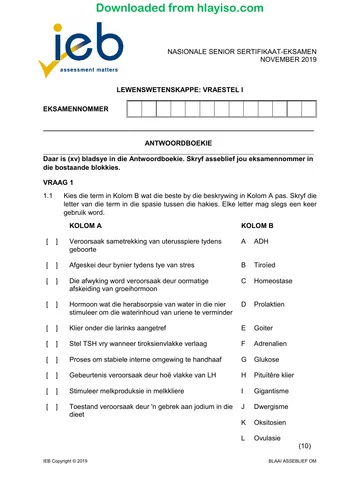
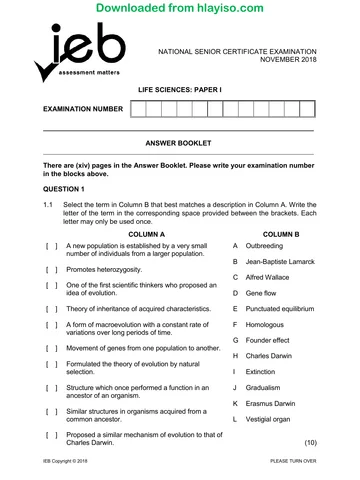
1.1 Select the term in Column B that best matches the description in Column A. Write
the letter of the term in the space provided between the brackets. Each letter may
only be used once.
COLUMN A COLUMN B
[ ] Causes contraction of the uterine muscle during birth A ADH
[ ] Secreted by the adrenal gland during times of stress B Thyroid
[ ] The disorder caused by an over-secretion of growth C Homeostasis
hormone
[ ] A hormone that stimulates the reabsorption of water in D Prolactin
the kidney to reduce the water content of urine
[ ] Gland located below the larynx E Goitre
[ ] Releases TSH when thyroxin levels decrease F Adrenalin
[ ] Process of maintaining a stable internal environment G Glucose
[ ] An event that is triggered by high levels of LH H Pituitary gland
[ ] Stimulates the production of milk in the mammary I Gigantism
glands
[ ] A condition caused by a lack of iodine in the diet J Dwarfism
K Oxytocin
L Ovulation
(10)
IEB Copyright © 2019 PLEASE TURN OVER
Skip to contentMemorandum 





View all



Life Sciences Grade 12 IEB Paper 1 2019 Memo
IEB Grade 12 Life Sciences Paper 1 memorandum from the 2019, 15 pages. Read online or get the free PDF download, question paper linked when available.
Publisher: IEB
Life Sciences · Grade 12 · 2019. Memorandum, 15 pages. Read online or download the PDF.
- Subject
- Life Sciences
- Grade
- Grade 12
- Document type
- Memorandum
- Year
- 2019
- Paper
- 1
- Publisher
- IEB
- Curriculum
- IEB
- Pages
- 15
- File size
- 1.0 MB
Loading document…
Loading document…
1 of 15
Document textSearch extracted text and jump to a page.
Downloaded from hlayiso.com
NATIONAL SENIOR CERTIFICATE: LIFE SCIENCES: PAPER I – ANSWER BOOKLET Page ii of xv
1.2 Seven multiple-choice questions are asked below. Choose the most correct answer
to each question and write the letter of your choice in the table below.
Question 1.2.1 1.2.2 1.2.3 1.2.4 1.2.5 1.2.6 1.2.7
Answer
1.2.1 Which of the following descriptions are true of sexual reproduction in
organisms?
(i) produces clones of the parent
(ii) allows for evolution to take place
(iii) always involves internal fertilization
(iv) a slower rate of reproduction
(v) involves the process of meiosis
A (i), (ii), (iii), (iv) and (v)
B (i), (ii), (iii) and (v)
C (ii), (iv) and (v)
D (ii), (iii), (iv) and (v) (2)
Use the diagram of a longitudinal section through a pea flower below to answer
questions 1.2.2 and 1.2.3.
1
2
3
4
5
6
[Adapted from: <http://www.uq.edu.au>]
IEB Copyright © 2019
Downloaded from hlayiso.com
NATIONAL SENIOR CERTIFICATE: LIFE SCIENCES: PAPER I – ANSWER BOOKLET Page iii of xv
1.2.2 Identify the number/s (from the diagram) of structure/s that contain the
gametes.
A 3 and 4
B 2 and 3
C 4 and 5
D 2 only (1)
1.2.3 Identify the number from the diagram that indicates the structure that
develops into the seed.
A 3
B 4
C 6
D 2 (1)
1.2.4 The following diagram illustrates a method used by Mendel when
investigating inheritance in pea plants.
STEP 1 STEP 2 STEP 3
Z
Flower A Flower B Flower A
[Adapted: <https://www.sciencelearn.org>]
The purpose of removing the structures labelled Z from flower A was to:
A prevent self-pollination in flower A.
B allow self-pollination in flower A.
C prevent meiosis from occurring in flower A.
D prevent fertilization from occurring in flower A. (1)
1.2.5 The data collected by Mendel when crossing pea plants can be regarded as
reliable because:
A he only collected his data from the F1 generation.
B he had a thorough knowledge of genes and chromosomes.
C he did not start his experiment with pure breeding plants.
D he obtained results from collecting data from 21 000 plants. (1)
IEB Copyright © 2019 PLEASE TURN OVER
Downloaded from hlayiso.com
NATIONAL SENIOR CERTIFICATE: LIFE SCIENCES: PAPER I – ANSWER BOOKLET Page iv of xv
1.2.6 Which statement is a correct deduction that can be made from Mendel's
work on pea plants?
A A blend of parents' traits will be seen in their offspring.
B Polygenic inheritance results from more than two alleles.
C Genes come in pairs and are inherited as distinct units.
D The laws of inheritance are applicable only to plants. (1)
1.2.7 In pea plant flowers, the colour purple is dominant over the colour white.
When Mendel crossed two purple-flowered pea plants, he obtained the
following ratio of plants in the offspring:
705 purple flowers : 224 white flowers.
The genotypes of the parents are:
A homozygous dominant and heterozygous
B both heterozygous
C homozygous recessive and heterozygous
D homozygous recessive and homozygous dominant (2)
1.3 The micrograph below shows a section through an umbilical cord of a 14-week-old
human foetus.
A
Umbilical
arteries
Umbilical
vein
B
[Adapted from: <https://embryology.med.unsw.edu.au>]
1.3.1 Is this micrograph showing a cross/transverse section or a longitudinal
section of the umbilical cord?
(1)
1.3.2 State TWO functions of the blood vessels in the umbilical cord.
(2)
IEB Copyright © 2019
Downloaded from hlayiso.com
NATIONAL SENIOR CERTIFICATE: LIFE SCIENCES: PAPER I – ANSWER BOOKLET Page v of xv
1.3.3 Suggest a reason why some parents choose to store the blood from their
baby's umbilical cord.
(2)
1.3.4 The actual length from A to B is 5 mm. Calculate the magnification of the
micrograph. Show your working.
(3)
IEB Copyright © 2019 PLEASE TURN OVER
Downloaded from hlayiso.com
NATIONAL SENIOR CERTIFICATE: LIFE SCIENCES: PAPER I – ANSWER BOOKLET Page vi of xv
1.4 The diagram below shows a developing human foetus.
A
B
C
D
[Adapted: <https://waeconline.org.ng>]
1.4.1 Provide labels for A to D.
A: _________________________________________________________
B: _________________________________________________________
C: _________________________________________________________
D: _________________________________________________________
(4)
1.4.2 Draw the umbilical cord on the diagram to show its correct position. (2)
1.4.3 State the biological importance of B.
(2)
IEB Copyright © 2019
Downloaded from hlayiso.com
NATIONAL SENIOR CERTIFICATE: LIFE SCIENCES: PAPER I – ANSWER BOOKLET Page vii of xv
1.5 DNA is often referred to as the "molecule of life".
1.5.1 Explain why this statement can be regarded as correct.
(2)
1.5.2 Draw and label the basic structure of a DNA nucleotide in the space below.
(4)
1.5.3 In a section of a DNA molecule there are 16 nucleotides. There are three
adenine nitrogen bases in the section of DNA. Calculate the number of
guanine nitrogen bases present. Show all working.
(3)
IEB Copyright © 2019 PLEASE TURN OVER
Downloaded from hlayiso.com
NATIONAL SENIOR CERTIFICATE: LIFE SCIENCES: PAPER I – ANSWER BOOKLET Page viii of xv
1.6 The diagram below shows part of the process of protein synthesis.
DNA P
Q
[Adapted: <https://za.pinterest.com>]
1.6.1 Provide labels for the following structures:
N: _________________________________________________________
Z: _________________________________________________________
P: _________________________________________________________
(3)
1.6.2 Name the process occurring at Q.
(1)
1.6.3 Name the enzyme that catalyses the process occurring at Q.
(1)
IEB Copyright © 2019
Downloaded from hlayiso.com
NATIONAL SENIOR CERTIFICATE: LIFE SCIENCES: PAPER I – ANSWER BOOKLET Page ix of xv
1.6.4 Molecule N shown in the diagram codes for the following sequence of amino
acids:
Ser – Gly – Thr
(a) Where does the process of joining amino acids into a polypeptide
chain occur in the cell?
(1)
(b) Identify the bond that holds the adjacent amino acids together.
(1)
(c) If Z on the diagram on the previous page codes for Ser, write down
the nucleotide sequence that codes for Gly.
(1)
(d) A point mutation occurred during the formation of molecule N.
Molecule N now codes for the following sequence of amino acids:
Ser – Val – Thr
If GUC codes for Val, identify the type of mutation and explain exactly
what change in the DNA occurred that led to the mutation.
(2)
IEB Copyright © 2019 PLEASE TURN OVER
Downloaded from hlayiso.com
NATIONAL SENIOR CERTIFICATE: LIFE SCIENCES: PAPER I – ANSWER BOOKLET Page x of xv
1.7 Read the text below and use the information provided to complete the table on the
next page.
Using eDNA to identify shark species
Humans shed tens of thousands of skin cells every hour, leaving them everywhere they
go. Contained in each of these cells is an individual's entire set of DNA. Sharks are no
different and scientists have begun to collect bottles of water from the ocean to find cells
as clues of a species' presence in an area. This is called "environmental DNA", or "eDNA".
The cells or genetic material from sharks can come from:
• natural shedding of skin
• tissue separated from the body by injury
• cells released into the water during reproduction
• decomposition of dead sharks
Environmental DNA complements rather than replaces other sampling methods in the
identification of shark species.
Two of the sampling methods used by scientists to identify different shark species are:
environmental DNA (eDNA) from sea water, and observations from human divers
studying sharks.
The results of their sampling in a particular area is shown in the table below.
Table showing the results of shark identification using two different sampling methods
Shark name eDNA Diver
Bull shark
Great hammerhead
Copper shark
Silvertip shark
Sharptooth lemon shark
Zebra shark
Tawny nurse shark
Scalloped hammerhead
Tiger shark
[Adapted: <https://fishbio.com> and <https://www.sciencenews.org>]
IEB Copyright © 2019
Downloaded from hlayiso.com
NATIONAL SENIOR CERTIFICATE: LIFE SCIENCES: PAPER I – ANSWER BOOKLET Page xi of xv
The six statements in the table below refer to the information on the previous page.
For each statement, decide whether:
A the statement is supported by the information in the article.
B the statement is contradicted by the information in the article.
C the statement is neither supported nor contradicted by the information in the
article.
Statement A, B or C
1.7.1 eDNA from sharks can be sourced from
reproductive cells found in sea water.
1.7.2 Collection of eDNA from sharks requires direct
contact with the shark.
1.7.3 The zebra shark was identified using only one
method of sampling.
1.7.4 The lack of eDNA from the tiger shark indicates
that the shark was never in the area.
1.7.5 eDNA can replace other methods of identifying
sharks.
1.7.6 According to the results in the table, using eDNA is
more effective than using human divers to identify
the presence of sharks.
(6)
IEB Copyright © 2019 PLEASE TURN OVER
Downloaded from hlayiso.com
NATIONAL SENIOR CERTIFICATE: LIFE SCIENCES: PAPER I – ANSWER BOOKLET Page xii of xv
1.8 Study the following table which consists of rows with two items (numbered 1 and 2)
in the first column and a term in the second column. Decide which item(s) relate
to the term.
Write down your choice in the space provided in the Answer column, making use
of the following codes:
A only item 1 relates to the term
B only item 2 relates to the term
C both items 1 and 2 relate to the term
D neither item 1 nor item 2 relates to the term
Item Term Answer
1. Used as a vector to carry foreign genetic Plasmid
material into another cell
2. Circular DNA strand
1. Production of insulin in bacterial cells Gene therapy
2. Introduction of normal genes into cells to
replace defective genes
1. Cell having more than two sets of paired Cloning
chromosomes
2. Producing exact genetic copies
1. A powerful tool for editing sections of DNA CRISPR
2. Used only in gamete cells
1. Determining the genomes in many different Human Genome
species Project
2. Altering of human genome by transferring
genes from another organism
(5)
IEB Copyright © 2019
Downloaded from hlayiso.com
NATIONAL SENIOR CERTIFICATE: LIFE SCIENCES: PAPER I – ANSWER BOOKLET Page xiii of xv
1.9 The micrographs below depict the phases of meiosis in a cell. The micrographs are
in the correct order.
A B C D
E F G H
[Adapted: <http://www.macmillanhighered.com>]
Select the letter of the diagram that best matches the description in the table below.
Description Letter of diagram
Crossing over is occurring.
DNA replication is taking place.
Chromatids have separated and are moving to
opposite poles.
Haploid gametes are formed.
Homologous chromosomes separate and move
away from one another.
(5)
IEB Copyright © 2019 PLEASE TURN OVER
Downloaded from hlayiso.com
NATIONAL SENIOR CERTIFICATE: LIFE SCIENCES: PAPER I – ANSWER BOOKLET Page xiv of xv
1.10 A national park in Kenya covering an area of 2 200 km2 was divided into quadrats.
Each quadrat has an area of 20 km2. Eight quadrats were randomly chosen for
observation. Helicopters were used to fly over the quadrats and the numbers of
observed elephants were counted.
The numbers of elephants counted in each quadrat is shown below:
Quadrat
1 2 3 4 5 6 7 8
number
Number of
4 1 3 2 0 1 3 6
elephants
1.10.1 Calculate the estimated size of the elephant population in the national park.
Show all working.
(4)
1.10.2 Why was observing and counting the elephants from a helicopter a suitable
sampling measure to use?
(1)
IEB Copyright © 2019
Downloaded from hlayiso.com
NATIONAL SENIOR CERTIFICATE: LIFE SCIENCES: PAPER I – ANSWER BOOKLET Page xv of xv
1.10.3 Why is it important to take random samples when calculating population
sizes?
(2)
1.10.4 Explain the meaning of the following terms with reference to elephants:
(a) viviparous
(1)
(b) K-strategist
(2)
[80]
IEB Copyright © 2019
Study this subject
Revise the topics in this paper, then practise them question by question.
- Grade 12 Life Sciences notes
CAPS revision notes with worked examples.
- Life Sciences questions by topic
Past exam questions sorted by CAPS topic, with memos where available.
- Grade 12 Life Sciences quizzes
Short topic quizzes with instant feedback.
- All Grade 12 Life Sciences past papers
Past papers by year, with memos where available.
- Grade 12 IEB past papers
More Life Sciences and other subjects in this collection.
Recommended for this subject
More papers and memos for this grade and subject.
MemorandumIEB
Life Sciences Grade 12 IEB Paper 1 2019 Memo
MemorandumIEB
Life Sciences Grade 12 IEB Paper 2 2019 Memo
MemorandumIEB
Life Sciences Grade 12 IEB Paper 3 2019 Memo
MemorandumIEB
Life Sciences Grade 12 IEB Paper 1 2019 Memo (Afrikaans)
MemorandumIEB
Life Sciences Grade 12 IEB Paper 1 2018 Memo
MemorandumIEB
Life Sciences Grade 12 IEB Paper 2 2018 Memo
Related documents
Question paperIEB
Life Sciences Grade 12 IEB Paper 1 2019 Question Paper
Question paperIEB
Life Sciences Grade 12 IEB P1 2019 Question Paper (Afrikaans)
Question paperIEB
Life Sciences Grade 12 IEB P1 2019 Question Paper (Afrikaans)
MemorandumIEB
Life Sciences Grade 12 IEB Paper 1 2018 Memo
MemorandumIEB
Life Sciences Grade 12 IEB Paper 1 2017 Memo
MemorandumIEB
Life Sciences Grade 12 IEB Paper 1 2017 Memo
More from Grade 12 Life Sciences
Question paperIEB
Life Sciences Grade 12 IEB Paper 2 2019 Question Paper
Question paperIEB
Life Sciences Grade 12 IEB P2 2019 Question Paper (Afrikaans)
Question paperIEB
Life Sciences Grade 12 IEB P2 2019 Question Paper (Afrikaans)
Question paperIEB
Life Sciences Grade 12 IEB Paper 3 2019 Question Paper
Question paperIEB
Life Sciences Grade 12 IEB P3 2019 Question Paper (Afrikaans)
Question paperIEB