
Downloaded from hlayiso.com
NATIONAL SENIOR CERTIFICATE EXAMINATION
NOVEMBER 2019
LIFE SCIENCES: PAPER I
MARKING GUIDELINES
Time: 3 hours 200 marks
These marking guidelines are prepared for use by examiners and sub-examiners,
all of whom are required to attend a standardisation meeting to ensure that the
guidelines are consistently interpreted and applied in the marking of candidates'
scripts.
The IEB will not enter into any discussions or correspondence about any marking
guidelines. It is acknowledged that there may be different views about some
matters of emphasis or detail in the guidelines. It is also recognised that,
without the benefit of attendance at a standardisation meeting, there may be
different interpretations of the application of the marking guidelines.
IEB Copyright © 2019 PLEASE TURN OVER
Skip to contentMemorandum 




View all


Life Sciences Grade 12 IEB Paper 1 2019 Memo
IEB Grade 12 Life Sciences Paper 1 memorandum from the 2019, 10 pages. Read online or get the free PDF download, question paper linked when available.
Publisher: IEB
Life Sciences · Grade 12 · 2019. Memorandum, 10 pages. Read online or download the PDF.
- Subject
- Life Sciences
- Grade
- Grade 12
- Document type
- Memorandum
- Year
- 2019
- Paper
- 1
- Publisher
- IEB
- Curriculum
- IEB
- Pages
- 10
- File size
- 195.0 KB
Loading document…
Loading document…
1 of 10
Document textSearch extracted text and jump to a page.
Downloaded from hlayiso.com
NATIONAL SENIOR CERTIFICATE: LIFE SCIENCES: PAPER I – MARKING GUIDELINES Page 2 of 10
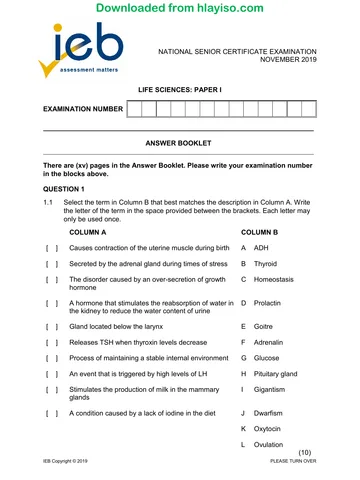
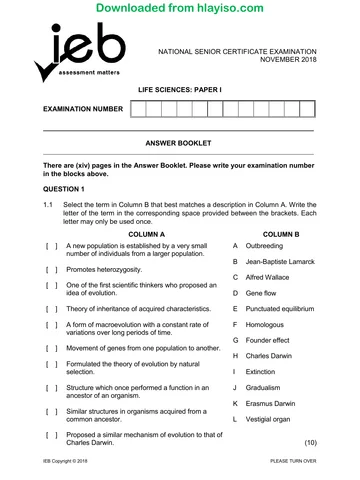
QUESTION 1
1.1
[K] causes contraction of the uterine muscle during A ADH
birth
[F] secreted by the adrenal gland during times of B thyroid
stress
[I] the disorder caused by an over-secretion of C homeostasis
growth hormone
[A] a hormone that stimulates the reabsorption of D prolactin
water in the kidney to reduce the water content of
urine
[B] gland located below the larynx E goitre
[H] releases TSH when thyroxin levels decrease F adrenalin
[C] process of maintaining a stable internal G glucose
environment
[ L] an event that is triggered by high levels of LH H pituitary gland
[D] stimulates the production of milk in the mammary I gigantism
glands
[E] a condition caused by a lack of iodine in the diet J dwarfism
K oxytocin
L ovulation
1.2
Question 1.2.1 1.2.2 1.2.3 1.2.4 1.2.5 1.2.6 1.2.7
Answer C A B A D C B
1.3 1.3.1 cross / transverse
1.3.2 transports nutrients / glucose transports O2 transports CO2 transports
urea / waste products (any 2)
1.3.3 obtain stem cells for medical use to treat disease later on / treat
genetic disorders / store for later medical use Accept other suitable
answers, e.g. stem cells are undifferentiated.
1.3.4 distance on page = 50 mm Divide 50 mm by 5 mm = x10
Check answer on final printed copy.
Acceptable range: 47-54 (mm)
Magnification range: 9.4–10.8
If given measurement in cm (correctly measured) then max 1 mark.
IEB Copyright © 2019 PLEASE TURN OVER
Downloaded from hlayiso.com
NATIONAL SENIOR CERTIFICATE: LIFE SCIENCES: PAPER I – MARKING GUIDELINES Page 3 of 10
1.4 1.4.1 A – uterus/ myometrium
B – amniotic fluid/ amniotic cavity
C – cervix
D – vagina
1.4.2 on diagram: extend from placenta to centre of abdominal area of
foetus
1.4.3 acts as shock absorber/ protects foetus from mechanical impact
maintains foetal temperature allows free/ easy movement of foetus
allows symmetrical musculoskeletal development (due to pressure of
fluid) foetus practises breathing movements by inhaling liquid
practises swallowing of liquid swallowing amniotic fluid helps in
formation of gastrointestinal tract prevent dehydration (any 2)
1.5 1.5.1 carries genetic code for making proteins proteins critical to control
metabolism can replicate itself to pass genetic code onto daughter
cells / carries hereditary information to continue species all living
organisms contain DNA (max 1 mark) (any 2)
1.5.2 Structure of one DNA nucleotide
Phosphate
Base
attached to
sugar
(Deoxyribose/ (Nitrogenous)
pentose) base OR
sugar A / T/ G / C
(shape of molecule not important) If more than one nucleotide was
drawn, then max one mark if base attached to sugar shown
1.5.3 3 adenine = 3 thymine total of 6. 16 – 6 = 10 guanine and cytosine
Therefore 5 guanine Reasoning process marked
1.6 1.6.1 N – mRNA / messenger RNA Z – codon / triplet / 3 bases
P – nuclear membrane / double nuclear membrane
1.6.2 transcription
1.6.3 polymerase / RNA polymerase
IEB Copyright © 2019 PLEASE TURN OVER
Downloaded from hlayiso.com
NATIONAL SENIOR CERTIFICATE: LIFE SCIENCES: PAPER I – MARKING GUIDELINES Page 4 of 10
1.6.4 (a) ribosome / cytoplasm
(b) peptide
(c) GGC
(d) substitution C was replaced with an A
1.7
Statement A, B or C
1.7.1 eDNA from sharks can be sourced from reproductive A
cells.
1.7.2 Collection of eDNA from sharks requires direct contact B
with the shark.
1.7.3 The zebra shark was identified using only one method B
of sampling.
1.7.4 The lack of eDNA from the tiger shark indicates that the C
shark was never in the area.
1.7.5 eDNA can replace other methods of identifying sharks. B
1.7.6 According to the results in the table, using eDNA is A
more effective than using human divers to identify the
presence of sharks.
1.8
Item Term Answer
1. Used as a vector to carry foreign genetic Plasmid
material into another cell C
2. Circular DNA strand
1. Production of insulin in bacterial cells Gene therapy
2. Introduction of normal genes into cells to B
replace defective genes
1. Cell having more than two sets of paired Cloning
chromosomes B
2. Producing exact genetic copies
1. A powerful tool for editing sections of CRISPR
DNA A
2. Used only in gamete cells
1. Determining the genomes in many Human Genome
different species Project D
2. Altering of human genome by
transferring genes from another
organism
IEB Copyright © 2019 PLEASE TURN OVER
Downloaded from hlayiso.com
NATIONAL SENIOR CERTIFICATE: LIFE SCIENCES: PAPER I – MARKING GUIDELINES Page 5 of 10
1.9
Description Letter of diagram
Crossing over is occurring. B/C
DNA replication is taking place. A
Chromatids have separated and are moving to G
opposite poles.
Haploid gametes are formed. H
Homologous chromosomes separate and move D
away from one another.
1.10 1.10.1 Total number of elephants counted = 20
20 / 8 = 2,5 average number of elephants / quadrat
2,5 × 2 200 / 20 = 275
1.10.2 large enough to view / few of them / easy to see
1.10.3 gives a representative sample allows drawing of conclusion
The population is not distributed evenly shows no bias true
reflection/ better or more accurate estimation, etc.
1.10.4 (a) development of young inside body of mother / young born
alive rather than from eggs placenta nourishes young
(b) produce fewer offspring extensive parental care most young
survive to adulthood late onset of maturity long gestation
period of elephants (max 2)
IEB Copyright © 2019 PLEASE TURN OVER
Downloaded from hlayiso.com
NATIONAL SENIOR CERTIFICATE: LIFE SCIENCES: PAPER I – MARKING GUIDELINES Page 6 of 10
QUESTION 2
2.1 2.1.1 uterus / lining of uterus
2.1.2 place where embryo is implanted / nourishes embryo / forms
placenta
2.1.3 breaks down and leaves body as menstrual flow
2.1.4 During the course of the menstrual cycle the endometrium thickens.
2.1.5 oestrogen progesterone
2.1.6 Every woman's menstrual cycle may differ in length / illness or stress
can affect menstrual cycle therefore ovulation may occur at different
times / days data has been calculated from an average (any two)
2.1.7 test normal / natural menstrual cycle / oral contraceptives contain
hormones / progesterone / oestrogen that would affect menstrual
cycle / endometrium thickness
2.1.8 volunteers used participants give informed consent study should not
affect health / dignity participants remain anonymous women tested
for pregnancy first Accept other reasonable suggestions e.g. they
should not be harmed women must be aware of parameters of the
study (max 2)
2.1.9 dealing with human subjects/ living organism right to have privacy
respected have right to decide whether to be involved in study
sensitive tests so respect dignity Accept other reasonable
suggestions (max 2)
2.1.10 endometrium would get thicker / remain thick / would not break down
/ become more vascular
2.2 2.2.1 testosterone
2.2.2 Males also have a (shared) responsibility for contraception not all
women can safely use hormonal contraceptives can create a
platform for gender equality Accept other reasonable suggestions
e.g. it stops sperm / gamete production / effective temporary
(reversible) measure / another alternative male contraception (more
choice)
2.2.3 safety in use, e.g. safety trials effectiveness as contraceptive side-
effects determined Accept other reasonable suggestions, e.g. does
sperm production return to normal when stop using does not protect
men from STIs
2.2.4 Flow diagram to show negative feedback in sperm production
low testosterone pituitary gland releases more LH (ICSH) and
FSH more testosterone released sperm production stimulated
(any 4 points in correct order ) arrows in flow diagram heading
IEB Copyright © 2019 PLEASE TURN OVER
Downloaded from hlayiso.com
NATIONAL SENIOR CERTIFICATE: LIFE SCIENCES: PAPER I – MARKING GUIDELINES Page 7 of 10
2.2.5 condom mechanical barrier, traps sperm, placed over penis during
intercourse OR vasectomy prevents sperm release by cutting sperm
duct / vas deferens OR withdrawal remove penis before ejaculation
2.3 2.3.1 produce sperm / gametes / spermatogenesis
2.3.2 as age increases the larger the testis volume the greater the length
of seminiferous tubules
2.3.3 440 – 460 m Check answer on final printed copy
2.3.4 Yes sudden increase in testis size / seminiferous tubules
No, at age 10–12 testis size/ volume/ seminiferous tubules increases
2.3.5 penis enlarges growth of pubic hair deepening of voice growth in
body size hair growth on face / underarms enlargement of skeletal
muscles and broadening of shoulders acne (max 2)
QUESTION 3
3.1 3.1.1 8
3.1.2 males have a Y chromosome or X and Y chromosome females have
only X chromosomes
3.1.3 Diagram showing chromosomes of gamete (heading)
4 chromosomes in total (no matter shape or size)
all 4 chromosomes correct shape and size
(proportion) / 2 – 3 chromosomes drawn with
correct shape and size
chromosomes single stranded
3.2 P1 XRY x XrXr (can mark parent genotypes in Punnett square)
XR Y
Xr XR Xr Xr Y
Xr XRXr Xr Y
F1 1 red-eyed female : 1 white-eyed male
If parent genotypes incorrect, carry error through and give 2 marks
for Punnett square if done correctly with that error. If one error in the
Punnett square, then one mark can be awarded. No marks for ratio.
IEB Copyright © 2019 PLEASE TURN OVER
Downloaded from hlayiso.com
NATIONAL SENIOR CERTIFICATE: LIFE SCIENCES: PAPER I – MARKING GUIDELINES Page 8 of 10
3.3 3.3.1 (a) complete genetic material / complement / set of genes of a
cell or organism
(b) mutation only affecting one nucleotide
3.3.2 X-rays / radiation
3.3.3 If genetic mutations occur in sex cells of parent these can be passed
to embryo / foetus / offspring would be found in all cells of embryo /
foetus / offspring
3.3.4 exposure subjected to / presence of X-ray radiation
3.3.5 X-rays can also cause mutations in human DNA humans should only
be exposed for a short time when doing X-rays developing foetus
protected during X-rays sex organs protected during X-rays people
working with X-ray equipment need to be protected mutations in
DNA can result in disease. (max 4)
3.4 3.4.1 pancreas
3.4.2 glucagon insulin
3.4.3 transport hormones to target organs / deliver nutrients and oxygen to
endocrine cells (max 2)
3.4.4 (a) when glucose levels are high detected by glucose meter
sends message to pump insulin delivered into body / blood
glucose levels decrease to normal / set point insulin no longer
delivered when glucose levels low detected by meter insulin
withheld (5 points in correct order)
(b) small therefore easy to carry less visible for self-conscious
teenagers constant monitoring of blood important for busy /
active teenagers irresponsible teenagers fixed and automatic
Accept any reasonable suggestions, e.g. low maintenance
teenagers are always eating (max 4)
3.4.5 good (healthy) diet exercise lose weight vigilant of symptoms reduce
stress (max 2)
QUESTION 4
4.1 4.1.1 greater number of (rows of) kernels larger head / cob softer kernels
larger kernels (max 2)
4.1.2 natural variation present humans cross-bred plants that had
desirable traits only offspring showing these traits used in next cross-
breeding carried out over many generations
4.2 4.2.1 has genetic material/ DNA from another organism in its genome or
foreign DNA or DNA not found naturally
IEB Copyright © 2019 PLEASE TURN OVER
Downloaded from hlayiso.com
NATIONAL SENIOR CERTIFICATE: LIFE SCIENCES: PAPER I – MARKING GUIDELINES Page 9 of 10
4.2.2 May answer yes or no
YES:
• may have health side effects negatively impacting human health
• reduces choice of eating GM food people have right of choice
• playing God as transferring genes from one organism to another
• crop may cross-pollinate with other plants producing pest
resistant weeds
• destroys biodiversity as removing insect from food chain
• Allergens introduced long term health effects not known
Accept other reasonable suggestions
NO:
• Transferred genes made of same components as other genetic
material no foreign material
• Many trials conducted before releasing to the public making it
safe for human consumption
• kills off pest / caterpillar eating maize increasing yield
• reduces spraying of insecticides making it healthier for human
consumption
• using a natural toxin not adding new chemicals to ecosystem
when growing
• only kills targeted insect making it safe for use
Accept other reasonable suggestions
3 × points with explanation for each
4.3 4.3.1 hunting as a pack hierarchy of individuals / high-ranking and low-
ranking individuals co-operative decision making dogs gather
together (max 2)
4.3.2 dominant breeding pair / alpha male and female prevent other
members from breeding, fittest genes passed to offspring raising
pups a group activity increasing pup survival rate care of sick / old a
group activity increasing chances of living longer more numbers
better chance of fending off predators
Feed the pups/ elderly/ injured first increases survival
(2 × points each point discussed)
4.4 4.4.1 diurnal live in herds adults have large horns used for protection (max 2)
4.4.2 interspecific
4.4.3 food / grass water predators disease space availability of mates (max 3)
IEB Copyright © 2019 PLEASE TURN OVER
Downloaded from hlayiso.com
NATIONAL SENIOR CERTIFICATE: LIFE SCIENCES: PAPER I – MARKING GUIDELINES Page 10 of 10
4.4.4 (a) population decrease more prone to predation at night / less
access to water
(b) reduce hunting allow hikers only at certain times of day / year
strict hiking trails reduce agricultural impact by having more
reserves limited hunting season Accept other reasonable
suggestions, e.g. limiting visitors to the area (max 2)
4.4.5 C more bands in similar positions / more bands in common
4.5 less developed
Two reasons: typical pyramid-shaped (triangular) graph high birth rate small
numbers of elderly broad base and narrow apex low life expectancy
4.6 4.6.1 resource / substance found in natural environment / required for
growth / survival
4.6.2 population increasing exponentially able to circumvent environmental
resistance Accept other reasonable suggestions
4.6.3 population will continue to increase will eventually run out of
resources causing our extinction surpass carrying capacity
environmental resistance will increase (max 2)
Total: 200 marks
IEB Copyright © 2019
Study this subject
Revise the topics in this paper, then practise them question by question.
- Grade 12 Life Sciences notes
CAPS revision notes with worked examples.
- Life Sciences questions by topic
Past exam questions sorted by CAPS topic, with memos where available.
- Grade 12 Life Sciences quizzes
Short topic quizzes with instant feedback.
- All Grade 12 Life Sciences past papers
Past papers by year, with memos where available.
- Grade 12 IEB past papers
More Life Sciences and other subjects in this collection.
Recommended for this subject
More papers and memos for this grade and subject.
MemorandumIEB
Life Sciences Grade 12 IEB Paper 2 2019 Memo
MemorandumIEB
Life Sciences Grade 12 IEB Paper 3 2019 Memo
MemorandumIEB
Life Sciences Grade 12 IEB Paper 1 2019 Memo
MemorandumIEB
Life Sciences Grade 12 IEB Paper 1 2019 Memo (Afrikaans)
MemorandumIEB
Life Sciences Grade 12 IEB Paper 1 2018 Memo
MemorandumIEB
Life Sciences Grade 12 IEB Paper 2 2018 Memo
Related documents
Question paperIEB
Life Sciences Grade 12 IEB Paper 1 2019 Question Paper
Question paperIEB
Life Sciences Grade 12 IEB P1 2019 Question Paper (Afrikaans)
Question paperIEB
Life Sciences Grade 12 IEB P1 2019 Question Paper (Afrikaans)
MemorandumIEB
Life Sciences Grade 12 IEB Paper 1 2018 Memo
MemorandumIEB
Life Sciences Grade 12 IEB Paper 1 2017 Memo
MemorandumIEB
Life Sciences Grade 12 IEB Paper 1 2017 Memo
More from Grade 12 Life Sciences
Question paperIEB
Life Sciences Grade 12 IEB Paper 2 2019 Question Paper
Question paperIEB
Life Sciences Grade 12 IEB P2 2019 Question Paper (Afrikaans)
Question paperIEB
Life Sciences Grade 12 IEB P2 2019 Question Paper (Afrikaans)
Question paperIEB
Life Sciences Grade 12 IEB Paper 3 2019 Question Paper
Question paperIEB
Life Sciences Grade 12 IEB P3 2019 Question Paper (Afrikaans)
Question paperIEB