
Downloaded from hlayiso.com
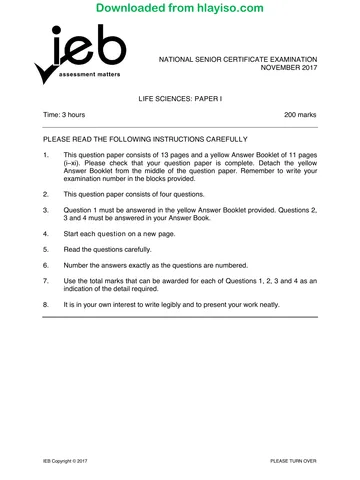
NATIONAL SENIOR CERTIFICATE EXAMINATION
NOVEMBER 2017
LIFE SCIENCES: PAPER I
MARKING GUIDELINES
Time: 3 hours 200 marks
These marking guidelines are prepared for use by examiners and sub-examiners,
all of whom are required to attend a standardisation meeting to ensure that the
guidelines are consistently interpreted and applied in the marking of candidates'
scripts.
The IEB will not enter into any discussions or correspondence about any marking
guidelines. It is acknowledged that there may be different views about some
matters of emphasis or detail in the guidelines. It is also recognised that,
without the benefit of attendance at a standardisation meeting, there may be
different interpretations of the application of the marking guidelines.
IEB Copyright © 2017
Skip to contentMemorandum 


View all





Life Sciences Grade 12 IEB Paper 1 2017 Memo
IEB Grade 12 Life Sciences Paper 1 memorandum from the 2017, 9 pages. Read online or get the free PDF download, question paper linked when available.
Publisher: IEB
Life Sciences · Grade 12 · 2017. Memorandum, 9 pages. Read online or download the PDF.
- Subject
- Life Sciences
- Grade
- Grade 12
- Document type
- Memorandum
- Year
- 2017
- Paper
- 1
- Publisher
- IEB
- Curriculum
- IEB
- Pages
- 9
- File size
- 186.9 KB
Loading document…
Loading document…
1 of 9
Document textSearch extracted text and jump to a page.
Downloaded from hlayiso.com
NATIONAL SENIOR CERTIFICATE: LIFE SCIENCES: PAPER I – MARKING GUIDELINES Page 2 of 9
QUESTION 1
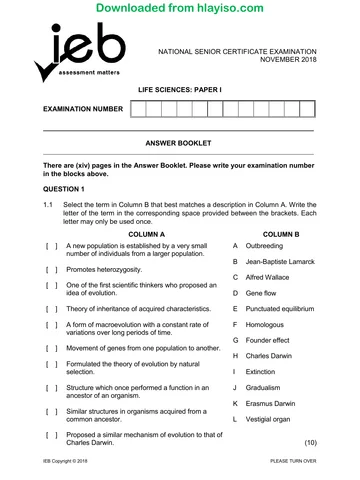
1.1
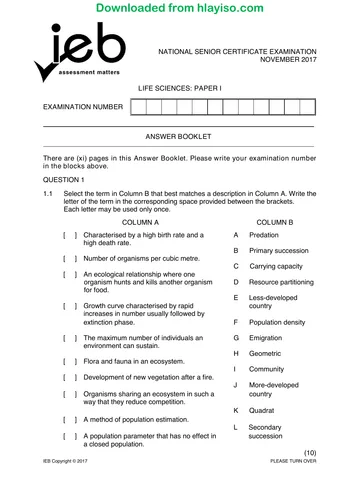
COLUMN A COLUMN B
[E] Characterised by a high birth rate and a A Predation
high death rate.
B Primary succession
[F] Number of organisms per cubic metre.
C Carrying capacity
[A] An ecological relationship where one
organism hunts and kills another organism D Resource partitioning
for food.
E Less-developed
[H] Growth curve characterised by rapid country
increases in number usually followed by
extinction phase. F Population density
[C] The maximum number of individuals an G Emigration
environment can sustain.
H Geometric
[I] Flora and fauna in an ecosystem.
I Community
[L] Development of new vegetation after a fire.
J More-developed
[D] Organisms sharing an ecosystem in such a country
way that they reduce competition.
K Quadrat
[K] A method of population estimation.
L Secondary
[G] A population parameter that has no effect in succession
a closed population.
1.2
Question 1.2.1 1.2.2 1.2.3 1.2.4 1.2.5 1.2.6
Answer B D A C A B
1.3
Statement A, B or C
1.3.1 Alcohol is also responsible for low birthweight in
C
newborn babies
1.3.2 Smoking during pregnancy increases the chance of low
A
birthweight babies.
1.3.3 All low birthweight babies have mothers who smoke. B
1.3.4 There are more babies born whose birthweight is 2 000–
A
2 499 g than babies whose birthweight is 1 000–1 499 g.
1.3.5 Smoking during pregnancy can cause brain damage to
C
the child.
IEB Copyright © 2017 PLEASE TURN OVER
Downloaded from hlayiso.com
NATIONAL SENIOR CERTIFICATE: LIFE SCIENCES: PAPER I – MARKING GUIDELINES Page 3 of 9
1.4 1.4.1 1. Tail/contractile fibres/axoneme/flagellum
2. Middle piece/neck/mid piece
3. Head
4. Acrosome
5. Nucleus
6. Mitochondrion (or plural) Mitochondrial spiral or coil
1.4.2 1 and 6/2
1.4.3 To swim to/reach/move to egg quickly / whilst egg/sperm are viable
1.4.4 (a) Water/Saline solution/fructose/no caffeine/mucous/alkaline
fluid/fluid from reproductive accessory glands
(b) To compare (implied) with experiment to ensure that it is the
caffeine/ independent variable causing the effect.
1.4.5 (a) Caffeine (or no caffeine/amount or concentration)
(b) Sperm motility
(c) Number of sperm/amt of fluid/person donating sperm/time in
petri dish/ age or freshness of sperm, pH, etc.
1.4.6 The acrosome needs to burst to dissolve membrane so that nucleus
can enter/penetrate/combine with the ovum/fuse with egg
1.5 1.5.1
Item Term Answer
1. TT Heterozygous B
2. Tt
1. Different forms of the same gene Alleles A
2. Identical forms of a gene
1. Non-coding DNA of an organism Genome D
2. Photograph of all the chromosomes
1. Homologous chromosomes are different in size Autosome B
2. Homologous chromosomes are the same size
1. Only expressed in phenotype if in homozygous form Recessive C
2. Suppressed by a dominant gene
1.5.2 (a) P (any letter capitalized) = allele for Polydactyly/affected and
p (lower case of same letter) = allele for normal/unaffected
(any letter but must be cap for Polydactyly)
(b)
Individual Genotype
1 pp
2 Pp
4 Pp
IEB Copyright © 2017 PLEASE TURN OVER
Downloaded from hlayiso.com
NATIONAL SENIOR CERTIFICATE: LIFE SCIENCES: PAPER I – MARKING GUIDELINES Page 4 of 9
(c)
Individual Gender Phenotype
3 Male Polydactyly/affected
5 Female Normal/unaffected
(d) A mutation on a non-sex (1-22) chromosome which
suppresses a normal/recessive gene expression. /can be
expressed if only 1 gene is present/expressed in the
heterozygous
(e) P genotypes Pp × pp
p p (method mark)
(1 mistake =1, 2 or more
P Pp Pp =0)
gametes – (method
p pp pp
mark)
F1 genotype 1 Pp : 1 pp (accept percentages and fractions)
(assume the 1) (if only 1:1 can get mark if Punnet square is
correct)
F1 phenotype 1 Polydactyly /affected : 1 normal/unaffected
(assume the 1)
1.6 1.6.1 P = MC/R
= 23 × 29 / 11
= between 60 – 61 (60.6 accepted)
1.6.2 Only mark first 3
Make sure tags don't harm rats
Make sure tags are securely on/can't fall off
Make sure tags are not too conspicuous/affect recapture or
predation
Tags don’t affect motility
Tags don’t affect behaviour
Technician wears gloves to not leave human smell behind
Technicians need to protect themselves from picking up disease/
being bitten
1.6.3 (a) A – very rapid steep/exponential/accelerating growth as there
are abundant resources/name resource/favourable conditions
for reproduction/below carrying capacity/ little environmental
resistance.
B – slower growth/decelerated as resources are starting to be
limiting or name one resource/ approaching carrying capacity./
environmental resistance increasing/ conditions unfavourable
for reproduction/increased competition
(b) food/space/build-up of toxins/disease/predation/shelter/
water/competition
IEB Copyright © 2017 PLEASE TURN OVER
Downloaded from hlayiso.com
NATIONAL SENIOR CERTIFICATE: LIFE SCIENCES: PAPER I – MARKING GUIDELINES Page 5 of 9
QUESTION 2
2.1 2.1.1 DNA unwinds H bonds break /sugar-phosphate backbones move
apart. Free (RNA ) nucleotides link onto corresponding bases S-P
(backbone) links/joins up by dehydration synthesis. mRNA detaches
from DNA.
If continue to describe translation max 3
2.1.2 mRNA moves to ribosome where codons are read tRNA links
anticodon onto corresponding codon bringing with it a specific amino
acid link up to form peptide bonds of a protein thus the sequence of
codons determines the sequence of amino acids.
2.1.3 Tyr – Pro – Asp (If sequence is incorrect -1)
2.2 2.2.1 Ligase
2.2.2 Yeast reproduces quickly and thus makes many copies of the
desired gene
Cheap
Simple eukaryotic cell-similar to humans
Readily available
Unicellular so simple mitotic division
Asexually – offspring identical
2.2.3 DNA which has had foreign DNA/DNA from another organism
inserted into it / DNA which has had foreign genes mixed with other
genes.
2.2.4 HB antigen (desired) gene isolated/extracted
Extract plasmid
Host DNA plasmid cut open
Insertion of HB gene into host DNA plasmid
(Recombinant) plasmid put into yeast cell
Yeast cell cultivated in fermentation tank copies made of yeast/ yeast
reproducing
HB antigen extracted from tank/HB antigen produced /HB vaccine
formed
Any order/sequence accepted
2.3 2.3.1 Cells blood/DNA/saliva/sperm/from criminal left at scene
DNA Profile created DNA tested/DNA fingerprint produced
Match to DNA in database/suspect
7−8
2.3.2 6 9 × 3 000 = 180 –270
100
2.3.3 Using DNA technology increases the success rates in the fight
against crime/suspected arrests/suspect convicted/suspects
identified. If question or aim (max 1)
2.3.4 (17–19%) – (6–9%) = 8–13%
2.3.5 SUPPORTING - increase success rate in fight against crime
IEB Copyright © 2017 PLEASE TURN OVER
Downloaded from hlayiso.com
NATIONAL SENIOR CERTIFICATE: LIFE SCIENCES: PAPER I – MARKING GUIDELINES Page 6 of 9
- will prevent reoffenders from going undetected
- will allow criminals to be identified from crime
scene evidence paternity/lost children/
identification of dead/establish ancestry (first 2)
OPPOSING - very expensive
- invasion of privacy /infringe on individual rights (must only
refer to collection process)
- other, more pressing needs in the country
- technical process compromised/human error/
contamination
- hacking into system to swap identities (first 2)
2.3.6 DNA can be used to put you in/get you out of jail/in criminal court.
DNA can be opened and altered/DNA can be unlocked by
technology/DNA can open gates to understanding /
2.4 b, c, d [both correct (2)/only 1 correct (1)/2 correct plus 1 incorrect (1)/3
correct plus 1 incorrect (1)] (include a = subtract 1 if more than 2 options
given)
QUESTION 3
3.1 3.1.1 A group of organisms of the same species occupying a definable
area close enough for random interbreeding.
3.1.2 Shark nets /Baited hooks (culling) /Poaching /Overfishing / Limited
genetic diversity.
3.1.3 Reduction in smaller fish causing decline in the Cape Seal population
which is prey of great white shark.
3.1.4 Loss of hybrid vigour as no new genes coming into gene pool.
Shrinking gene pool/small gene pool/become genetically similar This
makes them more prone to disease/genetic mutations finding
expression. Inability to adapt to changing environment
3.1.5 Census needs to count each individual or mark recapture requires a
sample, which is very hard to find as sharks live deep under sea, so
difficult to find and have large territory so impossible to cover whole
area. Move fast/time consuming/mark recapture less expensive or
resource/reliability of counting because no tagging
IEB Copyright © 2017 PLEASE TURN OVER
Downloaded from hlayiso.com
NATIONAL SENIOR CERTIFICATE: LIFE SCIENCES: PAPER I – MARKING GUIDELINES Page 7 of 9
3.1.6 Declare protected areas where no fishing allowed.
Lift shark nets and find other methods to protect bathers.
Introduce new individuals to existing populations to allow gene flow.
Start shark breeding programmes.
Start seal breeding programmes
Greater consequences for shark fishing - legislation
Education programmes about extinction
(Mark only first 2)
3.2 3.2.1 Predation/Predator-prey
3.2.2 (a) A dotted line
(b) Lower numbers and graph lags behind prey graph or prey has
higher numbers and peaks/drops before predator
3.3 3.3.1 (a) 1-2 billion
(b) 10–11 billion
3.3.2 Increase food production (from GMO) improved agriculture / food
preservation
Find cures for disease/better medical care vaccines
Build high-rise buildings Area cleared
Better sanitation
Desalination of water
Better utilisation of non-renewable energy sources
3.3.3 We need to slow down population growth before it is too late/ If we
continue to grow at such a rapid rate/exponentially otherwise we will
hit extinction phase/many people will die/we will not be able to
provide food for everyone.
3.4 3.4.1 r-strategist
3.4.2 By producing so many young there is a good chance that at least
some will survive
(No parental care) so parents can protect/feed themselves better
ensuring survival
Less energy expenditure in developing offspring so can invest energy
in other survival strategies/reproduce again
(First 2)
3.5 3.5.1 Non-coding DNA because coding DNA is almost identical or non-
coding is unique as it codes for essential hormones/enzymes etc.
whereas non-coding DNA has no purposeful sequence
3.5.2 DNA sample extracted from horns PCR to amplify samples of
DNA DNA profile/fingerprint created for rhino compared to
rhODIS/rhino DNA database if match is found then criminals can
be arrested/criminals convicted or used in court
IEB Copyright © 2017 PLEASE TURN OVER
Downloaded from hlayiso.com
NATIONAL SENIOR CERTIFICATE: LIFE SCIENCES: PAPER I – MARKING GUIDELINES Page 8 of 9
QUESTION 4
4.1 4.1.1
Letter of Name of flower part Letter of pear part
flower part
G none/blank/
A Petal corolla
not present
C Ovule/ovum/egg F
Ovary/ovary wall/ E
D
receptacle/carpals
4.1.2 (a) Genetically Modified Organism genetically modified
(b) They would need to locate/the gene that coded for the
enzyme, that caused the browning process and the prevent
expression silence/remove of the gene/silence the gene/
deactivate the gene.
4.2 4.2.1 FSH
4.2.2 follicle ruptured/Ovulation occurred on day 14 so the follicle no longer
contained the ovum (egg)
4.2.3 (a) From days 5–14 (25) the follicle secretes oestrogen
From days 15–25 the follicle secretes progesterone
(First 2 hormones marked)
(b) Oestrogen – causes endometrium to build up/development of
secondary sexual characteristics or specific one/stimulates
release of LH/inhibit FSH
Progesterone – maintenance of endometrium/vascularisation
and glandularisation of endometrium prepares uterus for
pregnancy. Inhibits FSH and LH.
4.3 4.3.1 They allow for erection of penis, which enables sperm to be placed
deep inside female body increasing chances of successful
fertilisation.
4.3.2
Component Importance
Fluid/water Allow sperm to swim
Sugar/Sucrose/fructose Provide energy for sperm to swim
(seminal fluid)
Alkaline/buffer/mucous Neutralise vaginal acidity/acidity in urethra
(prostate fluid)
Lubricant/mucous (cowpers/ Allow penis to penetrate vagina/ viscosity –
pre-ejaculatory fluid) sperm stick
IEB Copyright © 2017 PLEASE TURN OVER
Downloaded from hlayiso.com
NATIONAL SENIOR CERTIFICATE: LIFE SCIENCES: PAPER I – MARKING GUIDELINES Page 9 of 9
Sperm/gametes Provides genetic material for fertilisation/ to
fuse with ovum (egg)/carry male
chromosomes
prostaglandin Muscular contraction
Enzymes/ protein Penetrate
Prostate fluid Neutralise vaginal acidity/acidity in urethra
Cowpers fluid Allow penis to penetrate vagina/ viscosity –
sperm stick
Seminal fluid Provide fluid and energy for sperm to swim
Vitamin and minerals Nourish the sperm
4.4 4.4.1 Hormone 1: Glucagon
Hormone 2: Insulin
4.4.2 Islets of Langerhans in the Pancreas
4.4.3 Hormone 2 causes glucose in blood to be absorbed by liver/body
cells and converted into glycogen lowers blood sugar level
4.4.4 (a) Type 2 the cells are insulin resistant whereas in Type 1 the
body does not produce insulin insulin dependant / beta cells
are destroyed/ not enough insulin
(b) The way that people live – their habits e.g. Poor diet/lack of
exercise causes this type to develop
Total: 200 marks
IEB Copyright © 2017
Study this subject
Revise the topics in this paper, then practise them question by question.
- Grade 12 Life Sciences notes
CAPS revision notes with worked examples.
- Life Sciences questions by topic
Past exam questions sorted by CAPS topic, with memos where available.
- Grade 12 Life Sciences quizzes
Short topic quizzes with instant feedback.
- All Grade 12 Life Sciences past papers
Past papers by year, with memos where available.
- Grade 12 IEB past papers
More Life Sciences and other subjects in this collection.
Recommended for this subject
More papers and memos for this grade and subject.
MemorandumIEB
Life Sciences Grade 12 IEB Paper 1 2019 Memo
MemorandumIEB
Life Sciences Grade 12 IEB Paper 2 2019 Memo
MemorandumIEB
Life Sciences Grade 12 IEB Paper 3 2019 Memo
MemorandumIEB
Life Sciences Grade 12 IEB Paper 1 2019 Memo
MemorandumIEB
Life Sciences Grade 12 IEB Paper 1 2019 Memo (Afrikaans)
MemorandumIEB
Life Sciences Grade 12 IEB Paper 1 2018 Memo
Related documents
MemorandumIEB
Life Sciences Grade 12 IEB Paper 1 2017 Memo
Question paperIEB
Life Sciences Grade 12 IEB Paper 1 2017 Question Paper
MemorandumIEB
Life Sciences Grade 12 IEB Paper 2 2017 Memo
MemorandumIEB
Life Sciences Grade 12 IEB Paper 3 2017 Memo
MemorandumIEB
Life Sciences Grade 12 IEB Paper 1 2018 Memo
MemorandumIEB
Life Sciences Grade 12 IEB Paper 1 2016 Memo
More from Grade 12 Life Sciences
Question paperIEB
Life Sciences Grade 12 IEB Paper 1 2019 Question Paper
Question paperIEB
Life Sciences Grade 12 IEB P1 2019 Question Paper (Afrikaans)
Question paperIEB
Life Sciences Grade 12 IEB P1 2019 Question Paper (Afrikaans)
Question paperIEB
Life Sciences Grade 12 IEB Paper 2 2019 Question Paper
Question paperIEB
Life Sciences Grade 12 IEB P2 2019 Question Paper (Afrikaans)
Question paperIEB