
Downloaded from hlayiso.com
NATIONAL SENIOR CERTIFICATE EXAMINATION
NOVEMBER 2016
LIFE SCIENCES: PAPER I
MARKING GUIDELINES
Time: 3 hours 200 marks
These marking guidelines are prepared for use by examiners and sub-examiners,
all of whom are required to attend a standardisation meeting to ensure that the
guidelines are consistently interpreted and applied in the marking of candidates'
scripts.
The IEB will not enter into any discussions or correspondence about any marking
guidelines. It is acknowledged that there may be different views about some
matters of emphasis or detail in the guidelines. It is also recognised that,
without the benefit of attendance at a standardisation meeting, there may be
different interpretations of the application of the marking guidelines.
IEB Copyright © 2016 PLEASE TURN OVER
Skip to contentMemorandum 


View all





Life Sciences Grade 12 IEB Paper 1 2016 Memo
IEB Grade 12 Life Sciences Paper 1 memorandum from the 2016, 10 pages. Read online or get the free PDF download, question paper linked when available.
Publisher: IEB
Life Sciences · Grade 12 · 2016. Memorandum, 10 pages. Read online or download the PDF.
- Subject
- Life Sciences
- Grade
- Grade 12
- Document type
- Memorandum
- Year
- 2016
- Paper
- 1
- Publisher
- IEB
- Curriculum
- IEB
- Pages
- 10
- File size
- 217.8 KB
Loading document…
Loading document…
1 of 10
Document textSearch extracted text and jump to a page.
Downloaded from hlayiso.com
NATIONAL SENIOR CERTIFICATE: LIFE SCIENCES: PAPER I – MARKING GUIDELINES Page 2 of 10
QUESTION 1
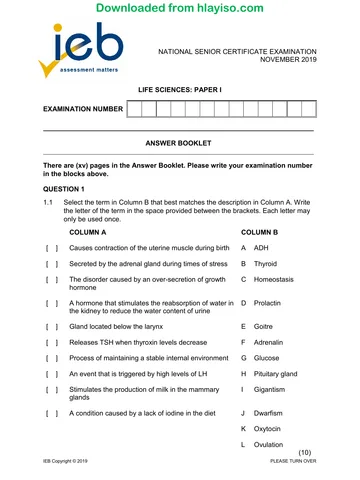
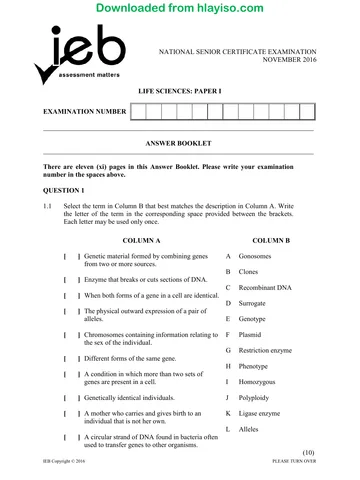
1.1 COLUMN A COLUMN B
[C] Genetic material formed by combining genes A Gonosomes
from two or more sources.
B Clones
[G] Enzyme that breaks or cuts sections of DNA.
C Recombinant DNA
[I] When both forms of a gene in a cell are identical.
[H] The physical outward expression of a pair of D Surrogate
alleles.
E Genotype
[A] Chromosomes containing information relating to
the sex of the individual. F Plasmid
[L] Different forms of the same gene. G Restriction enzyme
[J] A condition in which more than two sets of H Phenotype
genes are present in a cell.
I Homozygous
[B] Genetically identical individuals.
J Polyploidy
[D] A mother who carries and gives birth to an
individual that is not her own. K Ligase enzyme
[F] A circular strand of DNA found in bacteria often L Alleles
used to transfer genes to other organisms.
1.2 1.2.1 1.2.2 1.2.3 1.2.4 1.2.5 1.2.6
D (1) B (2) A (1) A (1) C (1) D (2)
1.3 STATEMENT A, B OR C
1.3.1 Infertility can be due to problems in both women and
C
men.
1.3.2 The majority of fertility problems in women are due to
B
endometriosis.
1.3.3 The single largest contributing factor to female infertility
A
relates to ovulation.
1.3.4 Stress contributes to female infertility. C
1.3.5 There may be factors affecting female fertility that are not
A
mentioned in the pie chart above.
IEB Copyright © 2016 PLEASE TURN OVER
Downloaded from hlayiso.com
NATIONAL SENIOR CERTIFICATE: LIFE SCIENCES: PAPER I – MARKING GUIDELINES Page 3 of 10
1.4 1.4.1 A: TSH B: Thyroxine
1.4.2 Increases/stimulates metabolic rate/rate of cellular respiration.
1.4.3 (a) Negative feedback mechanism/homeostasis.
(b) Increased levels of thyroxine inhibit production of TSH so that no
more thyroxine will be produced.
1.4.4 Growth Hormone/Somatotrophin, LH, FSH, Prolactin, MSH, ACTH,
Oxytocin, ADH, ICSH (only mark first two)
1.5 1.5.1 Diploid
1.5.2 STRUCTURES NUMBER PRESENT
Chromosomes 4
Homologous pairs 2
Bivalents 0
1.5.3 Diagram of a cell on Metaphase II
Two chromosomes
Double threaded
One long and one short
Lined up on equator
Single file
1.6 1.6.1 ITEM ANSWER
1. Oviparous
D
2. Viviparous
1. Sexual reproduction
A
2. Asexual reproduction
1. External fertilisation
B
2. Internal fertilisation
1. Courtship behaviour absent
B
2. Courtship behaviour present
1. Evidence of parental care
A
2. No parental care evident
1.6.2 Reproductive strategies are (structural, functional and behavioural)
adaptations/mechanisms that improve the chances of successful
fertilisation/survival of offspring.
IEB Copyright © 2016 PLEASE TURN OVER
Downloaded from hlayiso.com
NATIONAL SENIOR CERTIFICATE: LIFE SCIENCES: PAPER I – MARKING GUIDELINES Page 4 of 10
1.6.3 Parental care: by carrying the babies on her back she protects them from
predation ensuring that greater numbers survive.
Courtship/mating dance: ensures species specific mating and ensures that the
fittest individuals are selected, which benefits the species.
Internal fertilisation/female takes sperm into her body: increases the chances
of fertilisation by protecting gametes and embryos from dangers of
predation/dehydration.
Ovoviviparity/the eggs are held inside the female body until they hatch
inside the body. This protects eggs from predation/dehydration./Eggs are
nourished by own yolk.
520
1.7 1.7.1 ×100 = 65%
800
1.7.2 Cultivar 1/2/3/4/5 has the greatest reproductive success./Cultivar which have
most flowers will produce more apples. (concise statement)
1.7.3 (a) Independent: Variety/Cultivar
(b) Dependent: reproductive success/number of flowers that develop into
fruit/number of fruit that develop.
1.7.4 These results are not valid as the following controlled variables were not
standardised:
• Age of trees was not standardised
• Conditions were different
• Location was not identical
• Exposure to pollinators was not standardised
OR
These results are valid:
• The trees all belonged to the same species
• All trees were grown in Western Cape
• The same number of trees was selected
• Random sampling
1.7.5 Use third column because all that matters is how much fruit you
collect/because reproductive success can be determined by how much fruit
you collect.
OR
Use column 4 because plants with higher reproductive success are better
adapted to local conditions.
OR
Difficult to determine because we do not know which apples sell best or
how much it costs to grow each cultivar.
IEB Copyright © 2016 PLEASE TURN OVER
Downloaded from hlayiso.com
NATIONAL SENIOR CERTIFICATE: LIFE SCIENCES: PAPER I – MARKING GUIDELINES Page 5 of 10
Which part of the
Labelled
1.7.6 Name Function flower did it
part
originate from?
Protection/nourishment
of
A Seed Ovule
embryo/continuation
of species.
Flesh/fruit/swollen Aid in dispersal of
B Ovary/receptacle
ovary wall seed.
QUESTION 2
2.1 2.1.1 Protein synthesis
2.1.2 (a) C
(b) B
(c) A
2.1.3 C E D A B or C E A B D or CEADB (2 or 0)
2.1.4 UCG/GAU/UAC
2.2 2.2.1 (a) 12
(b) 12
(c) 4
(d) 2
(e) 4
(f) 2
2.2.2 (a) To map out/sequence/identify location of all the genes in the human
genome/to work out the base pair of all genes in the human genome.
(b) Enabled the development of gene therapy/treatment in the treatment
of genetic conditions.
Allowed for the identification of faulty genes in a human genome
and thus assists in diagnosing causes of certain diseases/conditions.
Assists doctors in selecting correct medicines to treat certain
patients.
Study how genes influence human development.
Develop new drugs to treat genetic diseases.
Provide insight into human origins and evolution.
2.3 2.3.1 Type 1 = Insertion
Type 2 = Deletion
Type 3 = Substitution
IEB Copyright © 2016 PLEASE TURN OVER
Downloaded from hlayiso.com
NATIONAL SENIOR CERTIFICATE: LIFE SCIENCES: PAPER I – MARKING GUIDELINES Page 6 of 10
2.3.2 The wrong amino acid would be inserted so incorrect protein would be
made.
2.3.3 • Beneficial mutation.
• The individuals who carried this mutation would be selected for as they
were better adapted to the changing condition/have an advantage.
• They would thus survive and pass on their genes to the next generation
causing species to evolve/change over time to form a new species.
• Those who did not have favourable mutation would die under
unfavourable conditions. (max 4)
OR
• Harmful mutation.
• The individuals who carried this mutation would die out as they were
less adapted to the changing condition/were at a disadvantage.
• They would thus not pass on their genes to the next generation.
• Those who did not have unfavourable mutation would survive.
• Direction/pathway of speciation changes/altered as gene pool would
change (although this event alone is not enough to cause speciation).
(max 4)
2.3.4 (a) Parent Genotypes: Nn x Nn
N n gametes
N NN Nn combinations
n Nn nn
F1 genotype: 1 NN: 2 Nn: 1 nn
F1 phenotype: 1 Normal: 2 carriers: 1 Tay-Sachs sufferer
or 3 normal: 1 sufferer
(b) Don't start a family. (no mark)
The odds are too high of having a Tay-Sachs baby. Too much
heartache when dies./Very expensive to have a sick baby as there are
medical costs, etc.
OR
Yes, try for a baby. (no mark)
Only 25% chance of getting disease worth trying as odds are in your
favour.
Medical advances every day. Might find a cure, etc.
Do IVF but only select 'healthy' embryos for implantation.
(c) (i) It amplifies the DNA/makes millions of copies of the
required DNA.
(ii) It allows sufficient DNA purpose of DNA analysis/to be
produced for testing in a short period of time, thus allowing
for quicker/speedier diagnosis .
IEB Copyright © 2016 PLEASE TURN OVER
Downloaded from hlayiso.com
NATIONAL SENIOR CERTIFICATE: LIFE SCIENCES: PAPER I – MARKING GUIDELINES Page 7 of 10
QUESTION 3
3.1 3.1.1 (a) False
(b) False
(c) True
(d) False
3.1.2 Membrane barrier prevents many micro-organisms from entering foetal
blood.
Membrane prevents mixing of maternal and foetal blood, which may be
different types.
Prevents high pressure of maternal blood from entering delicate foetal
vessels.
Secretes progesterone to prevent detachment from endometrium/keep
anchored to uterus.
(mark first 2)
3.1.3 Table comparing blood in maternal arteries and blood in the umbilical
arteries.
Maternal Arteries Umbilical Arteries
Amt of Oxygen High Low
Amt of CO2 Low High
Amt of Nutrients High Low
Amt of Metabolic waste Low High
Table format complete.
(Design of table may vary but must be comparative points. Only mark
first 3. If points aren't matching up, only mark 1 side of table.)
3.1.4 (a) As the placenta detaches from the wall there will not be a fresh blood
supply/oxygen supply so baby dies./Mother will lose lots of blood
and could die.
(b) Caesarean section involves cutting the abdominal and uterine wall to
deliver baby.
Vaginal delivery is non-surgical and involves the mother pushing the
baby out through the vagina.
(c) Birth defects/cerebral palsy can result from this condition. Parents
might try to sue the doctor even though it is not his/her fault.
3.2 3.2.1 A: Birth control pill/injection/patch/implant.
B: Sterilisation/Tubal ligation.
C: Vasectomy/Sperm plug.
D: Condom/Coitus interruptus/Abstinence/Female condom/withdrawal.
E: Diaphragm/Dutch Cap/Spermicides.
F: IUD/Copper T/Morning-after pill/loop/mirena.
IEB Copyright © 2016 PLEASE TURN OVER
Downloaded from hlayiso.com
NATIONAL SENIOR CERTIFICATE: LIFE SCIENCES: PAPER I – MARKING GUIDELINES Page 8 of 10
3.2.2 Type Advantage Disadvantage
Usually permanent can't
Sterilisation (male or Permanent – no need to
reverse if change your
female) take daily
mind/requires operation
Very safe if used
Affects hormone levels so
correctly/no
Contraceptive Pill can have side effects/have
interruption of sex/
to remember to take daily
available free at clinics
Protects against
Can burst/leak/interrupts
Condom STIs/Cheap/free at
sex/reduced sensation
clinics
Woman can insert prior Can become dislodged
Diaphragm/Dutch Cap to sex/no hormones during sex/consultation
involved with DR required
Not very reliable unless
Spermicide Cheap and easy to use
used with another method
Stays in for many years Can cause bleeding or
IUD/Copper T so no need for daily discomfort/Ethical issues
contraception (killing of life)
Don't have to
remember
Injection/Patch/Implant Side effects
daily/woman has
control/injection – free
No need for
Coitus interruptus Not reliable
contraceptive devices
Guarantee of no
Abstinence No sex
pregnancy or STIs
1 advantage and 1 disadvantage of 1 type of contraception (mark
independently of Question 3.2.1.)
Advantage of all these methods is prevention of pregnancy
3.2.3 FSH is released from pituitary gland, which causes maturation of follicle/
primary follicle to develop into a Graafian follicle. The pituitary then
releases luteinizing hormone, which causes the egg to be released from
Graafian follicle/ovulation.
3.2.4 (a) Sperm is just the male gamete, whereas semen includes male
gametes and fluids released into the sperm ducts along the way.
(b) Fertilisation involves fusion of egg and sperm whereas implantation
involves the embryo becoming embedded in the endometrium.
(c) Cervix is neck of uterus/junction of vagina and uterus whereas
vagina is the receiving chamber open to exterior/birth canal/where
penis enters to deposit sperm.
(d) Conception involves the formation of a new life/fusion of egg and
sperm/start of pregnancy whereas contraception is a method used to
prevent formation of a new life/fusion of egg and sperm.
IEB Copyright © 2016 PLEASE TURN OVER
Downloaded from hlayiso.com
NATIONAL SENIOR CERTIFICATE: LIFE SCIENCES: PAPER I – MARKING GUIDELINES Page 9 of 10
QUESTION 4
4.1 4.1.1 107 per 100 000 population
4.1.2 Graph A shows that the effectiveness of chloroquine had dropped from 30%
in 1976 to almost 0% in 1980.
Graph B shows that by 1980 the number of malaria deaths was rising from
107 per 100 000 to about 120 per 100 000.
4.1.3 Within the population of Plasmodium there was variation. Some individuals
were more resistant to CQ than others. The individuals that were least
resistant would have died when CQ was administered leaving the more
resistant variety to survive and reproduce and pass on their resistant genes to
their offspring. Over time the population changed to becoming more and
more resistant to CQ. (max 6)
4.1.4 (a) Asexual reproduction involves a mitotic process where new
individuals give rise to new individuals without gamete formation
and fusion/type of reproduction that leads to no variation.
Sexual reproduction involves meiosis and the production of haploid
gametes that fuse together to form a new individual/type of
reproduction that leads to variation.
(b) Sexual reproduction because it would result in variation through
crossing over/variety in gametes, which is necessary for natural
selection. Asexual reproduction leads to clones which have no
variation.
4.2 4.2.1 Find fossils/Study the anatomy of fossils/date fossils/establish evolutionary
relationships between fossils/classification of fossils.
4.2.2 H. naledi
4.2.3 Foramen magnum situated further forward under the skull.
4.2.4 Mrs Ples/Australopithecus africanus OR Little Foot/Australopithecus
prometheus.
4.2.5 It is rich in fossils that are hominids/hominins and evidence suggests that
this might have been the birthplace of modern man/ancestral hominins.
4.2.6 When Homo erectus moved up north out of Africa to Europe a group stayed
behind in Africa. They evolved further and then moved up to Europe in a
second wave of migration dominating all Homo species that were in Europe.
IEB Copyright © 2016 PLEASE TURN OVER
Downloaded from hlayiso.com
NATIONAL SENIOR CERTIFICATE: LIFE SCIENCES: PAPER I – MARKING GUIDELINES Page 10 of 10
4.3 4.3.1 Allopatric speciation/Separation by Geographical Isolation
4.3.2 Two ancestral populations because separated by geographical barrier. no
gene flow Genetic variation/mutations occurred in each population.
Environmental conditions on either side were slightly different. Natural
selection occurred favouring certain genotypes, which were thus passed on
to next generations. These differences became more pronounced until the
two groups were so different that they were unable to reproduce.
4.3.3 Divergent evolution/Adaptive Radiation because they come from the same
ancestral species but have changed to suit their specific environments.
4.3.4 (a) Behavioural isolation/their courtship was different/snapped instead of
mating.
(b) Organisms might breed at different times of the year so when one
species is fertile the other species is not.
Organisms might have developed structures that do not allow
copulation between the two species.
Organisms might require different environmental conditions for
mating, e.g. in water or on land and so they will be unable to mate.
Adaptation to different pollinators so unable to transfer pollen
effectively.
(Accept examples)
Total: 200 marks
IEB Copyright © 2016
Study this subject
Revise the topics in this paper, then practise them question by question.
- Grade 12 Life Sciences notes
CAPS revision notes with worked examples.
- Life Sciences questions by topic
Past exam questions sorted by CAPS topic, with memos where available.
- Grade 12 Life Sciences quizzes
Short topic quizzes with instant feedback.
- All Grade 12 Life Sciences past papers
Past papers by year, with memos where available.
- Grade 12 IEB past papers
More Life Sciences and other subjects in this collection.
Recommended for this subject
More papers and memos for this grade and subject.
MemorandumIEB
Life Sciences Grade 12 IEB Paper 1 2019 Memo
MemorandumIEB
Life Sciences Grade 12 IEB Paper 2 2019 Memo
MemorandumIEB
Life Sciences Grade 12 IEB Paper 3 2019 Memo
MemorandumIEB
Life Sciences Grade 12 IEB Paper 1 2019 Memo
MemorandumIEB
Life Sciences Grade 12 IEB Paper 1 2019 Memo (Afrikaans)
MemorandumIEB
Life Sciences Grade 12 IEB Paper 1 2018 Memo
Related documents
Question paperIEB
Life Sciences Grade 12 IEB Paper 1 2016 Question Paper
Question paperIEB
Life Sciences Grade 12 IEB Paper 1 2016 Question Paper
MemorandumIEB
Life Sciences Grade 12 IEB Paper 2 2016 Memo
MemorandumIEB
Life Sciences Grade 12 IEB Paper 3 2016 Memo
MemorandumIEB
Life Sciences Grade 12 IEB Paper 1 2018 Memo
MemorandumIEB
Life Sciences Grade 12 IEB Paper 1 2017 Memo
More from Grade 12 Life Sciences
Question paperIEB
Life Sciences Grade 12 IEB Paper 1 2019 Question Paper
Question paperIEB
Life Sciences Grade 12 IEB P1 2019 Question Paper (Afrikaans)
Question paperIEB
Life Sciences Grade 12 IEB P1 2019 Question Paper (Afrikaans)
Question paperIEB
Life Sciences Grade 12 IEB Paper 2 2019 Question Paper
Question paperIEB
Life Sciences Grade 12 IEB P2 2019 Question Paper (Afrikaans)
Question paperIEB