
Downloaded from hlayiso.com
NATIONAL SENIOR CERTIFICATE EXAMINATION
NOVEMBER 2016
LIFE SCIENCES: PAPER I
Time: 3 hours 200 marks
PLEASE READ THE FOLLOWING INSTRUCTIONS CAREFULLY
1. This question paper consists of 11 pages and a yellow Answer Booklet of 11 pages (i–xi).
Please check that your question paper is complete. Detach the yellow Answer Booklet from
the middle of the question paper. Remember to write your examination number in the
blocks provided.
2. This question paper consists of four questions.
3. Question 1 must be answered in the yellow Answer Booklet provided. Questions 2, 3 and 4
must be answered in your Answer Book.
4. Read the questions carefully.
5. Number the answers exactly as the questions are numbered.
6. Use the total marks that can be awarded for each of Questions 1, 2, 3 and 4 as an indication
of the detail required.
7. It is in your own interest to write legibly and to present your work neatly.
IEB Copyright © 2016 PLEASE TURN OVER
Skip to contentQuestion paper 





View all


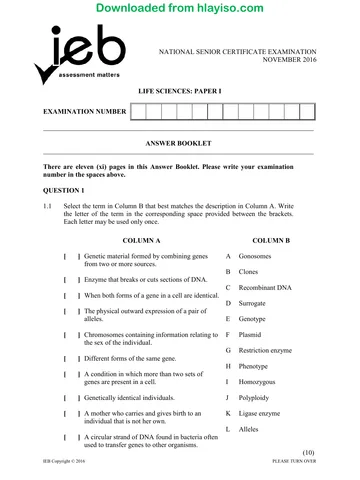
Life Sciences Grade 12 IEB Paper 1 2016 Question Paper
IEB Grade 12 Life Sciences Paper 1 question paper from the 2016, 11 pages. Read online or get the free PDF download, memo linked when available.
Publisher: IEB
Life Sciences · Grade 12 · 2016. Question paper, 11 pages. Read online or download the PDF.
- Subject
- Life Sciences
- Grade
- Grade 12
- Document type
- Question paper
- Year
- 2016
- Paper
- 1
- Publisher
- IEB
- Curriculum
- IEB
- Pages
- 11
- File size
- 626.6 KB
Loading document…
Loading document…
1 of 11
Document textSearch extracted text and jump to a page.
Downloaded from hlayiso.com
NATIONAL SENIOR CERTIFICATE: LIFE SCIENCES: PAPER I Page 2 of 11
QUESTION 2
2.1 Study the diagram below and answer the questions that follow:
[Adapted from: <http://image.slidesharecdn.com>]
2.1.1 Name the overall process occurring in the diagram above. (1)
2.1.2 Give the letter that represents:
(a) transcription (1)
(b) a polypeptide chain (1)
(c) codon–anticodon linkage (1)
2.1.3 Using the letters A–E in the diagram above, place the letters in the correct
sequence from start to finish. (2)
2.1.4 If a particular DNA nucleotide base coding sequence was AGC-CTA-ATG,
write the sequence on the corresponding mRNA molecule. (There is no
need to draw the nucleotides. Just list the bases in the correct sequence.) (3)
IEB Copyright © 2016
Downloaded from hlayiso.com
NATIONAL SENIOR CERTIFICATE: LIFE SCIENCES: PAPER I Page 3 of 11
2.2 A Grade 12 Life Sciences teacher sets a task for her students to build a model of a
section of double-stranded, helix-shaped DNA. The DNA strand that they must
build should only code for the two amino acids: histidine and tyrosine.
They were to use:
• Liquorice Allsorts to represent the sugars.
• Wine Gums to represent the phosphates.
• Pink Jelly Tots to represent thymine.
• Green Jelly Tots to represent cytosine.
• Yellow Jelly Tots to represent adenine.
• Red Jelly Tots to represent guanine.
She gave them a table of mRNA codons with their respective amino acids:
mRNA Codons and Amino Acids
mRNA Codon Amino Acid
UAC Tyrosine
AGU Serine
GAC Aspartic acid
GAG Glutamine
CAU Histidine
CUA Leucine
2.2.1 How many of each of the following sweets are needed to build this portion
of DNA?
(a) Liquorice Allsorts (1)
(b) Wine Gums (1)
(c) Pink Jelly Tots (1)
(d) Green Jelly Tots (1)
(e) Yellow Jelly Tots (1)
(f) Red Jelly Tots (1)
2.2.2 The Human Genome Project was launched in 1990 and finally completed
and published in 2003.
(a) What was the main aim of the Human Genome Project? (2)
(b) Discuss TWO ways in which the information gained from the
Human Genome Project has been useful to society. (4)
IEB Copyright © 2016 PLEASE TURN OVER
Downloaded from hlayiso.com
NATIONAL SENIOR CERTIFICATE: LIFE SCIENCES: PAPER I Page 4 of 11
2.3 A gene mutation is a permanent alteration in the DNA sequence that makes up a
gene. Study the diagrams below that show three types of mutations, and answer the
questions that follow:
[Adapted from: <http://image.slidesharecdn.com>]
2.3.1 Name the three specific types of mutation illustrated in the diagrams above.
Be sure to link the names to the diagrams, e.g. Type 1 is a ... mutation. (3)
2.3.2 What possible effect would a Type 3 mutation have on the protein coded for
if this type of mutation occurred in a coding region of DNA? (1)
2.3.3 The effect of any of these mutations might be neutral, harmful or beneficial.
Which ONE of these effects could possibly contribute to speciation?
Explain your answer. (4)
IEB Copyright © 2016
Downloaded from hlayiso.com
NATIONAL SENIOR CERTIFICATE: LIFE SCIENCES: PAPER I Page 5 of 11
2.3.4 Read the following extract and answer the questions that follow:
Tay-Sachs disease is a rare, inherited, autosomal, recessive, human
genetic disorder caused by a point mutation on chromosome 15. It
causes a progressive deterioration of nerve cells and of mental and
physical abilities that begins at around 7 months of age and usually
results in death by the age of four.
[Adapted from: <https://en.wikipedia.org>]
Rachel and Jonathan want to start a family but they are very anxious
because they have both had relatives and ancestors who have died from
Tay-Sachs disease. They decide to visit a genetic counsellor to help them to
decide whether they should have children or not. She suggests that they do
genetic screening to see whether or not they carry the gene for this fatal
disease. The results of the genetic screening show that they are both carriers
of the disease.
(a) Using the key N for a normal gene and n for a gene coding for Tay-
Sachs disease, draw a genetic diagram to show the probability of
Rachel and Jonathan having a child with Tay-Sachs disease. Include
the following in your answer:
• parental genotypes,
• a genetic cross or Punnet diagram,
• the ratio of the possible genotypes and phenotypes of the
offspring. (6)
(b) What advice would you give to Rachel and Jonathan about whether
or not to start a family? Give ONE reason to support your advice. (2)
(c) The genetic screening that Jonathan and Rachel had involved a
process known as Polymerase Chain Reaction (PCR).
(i) What role does this process play in the genetic screening
procedure? (1)
(ii) Explain the significance of this process. (2)
[40]
IEB Copyright © 2016 PLEASE TURN OVER
Downloaded from hlayiso.com
NATIONAL SENIOR CERTIFICATE: LIFE SCIENCES: PAPER I Page 6 of 11
QUESTION 3
3.1 The placenta is essential for the healthy development of the embryo and foetus.
Study the diagram below and answer the questions that follow:
[Source: <http://www.megapixl.com>]
3.1.1 State whether the following statements concerning the placenta are TRUE
or FALSE:
(a) The placenta is composed of foetal tissue only. (1)
(b) No micro-organisms can cross the maternal/foetal barrier. (1)
(c) The umbilical cord links the foetus to the placenta. (1)
(d) The placenta is expelled at the start of labour. (1)
3.1.2 Explain TWO ways in which the placenta protects the foetus. (2)
3.1.3 In the form of a table, compare the composition of the blood in the maternal
arteries with the blood in the umbilical arteries.
You must include THREE differences in your table. (8)
IEB Copyright © 2016
Downloaded from hlayiso.com
NATIONAL SENIOR CERTIFICATE: LIFE SCIENCES: PAPER I Page 7 of 11
3.1.4 If the placenta detaches from the uterine wall before the baby is born a very
serious condition known as Placental Abruption occurs. The diagrams
below illustrate this condition.
[Source: <http://www.michigancerebralpalsyattorneys.com>]
(a) Why do you think this condition is described as 'very serious'?
Explain. (2)
(b) If the pregnant woman with this condition can get to a hospital
quickly, the doctor will deliver the baby immediately either by
caesarean section or by natural vaginal delivery.
What is the difference between these two methods of delivery? (2)
(c) If you look at the source of this picture, you will see that it was
published on a website for attorneys (lawyers). Suggest ONE reason
why this image was published on their website. (2)
IEB Copyright © 2016 PLEASE TURN OVER
Downloaded from hlayiso.com
NATIONAL SENIOR CERTIFICATE: LIFE SCIENCES: PAPER I Page 8 of 11
3.2 Study the flow diagram below representing the development, movement and
fertilisation of male and female gametes. The letters A–F represent different
methods of contraception.
[Adapted from: Campbells Biology 9th ed. (Pearson)]
3.2.1 Name ONE possible method of contraception indicated by each of the
letters A–F. (6)
3.2.2 Choose any ONE of the methods of contraception named in Question 3.2.1,
and discuss ONE advantage and ONE disadvantage of the method. (2)
3.2.3 Discuss the 'development of the egg' from the start of the menstrual cycle
until the egg is released to be 'transported along the oviduct', including the
pituitary hormones involved in the process. (4)
3.2.4 Explain the difference between the following terms:
(a) sperm and semen (2)
(b) fertilisation and implantation (2)
(c) cervix and vagina (2)
(d) conception and contraception (2)
[40]
IEB Copyright © 2016
Downloaded from hlayiso.com
NATIONAL SENIOR CERTIFICATE: LIFE SCIENCES: PAPER I Page 9 of 11
QUESTION 4
4.1 Study the following text and graphs about drug resistance in Plasmodium:
Malaria continues to be a disease which causes an enormous number of deaths
in Africa. Human malaria is caused by a parasite belonging to the genus
Plasmodium. The life cycle of Plasmodium involves sexual and asexual
reproductive stages.
The discovery of Chloroquine (CQ) in the 1930s revolutionised malaria
treatments. CQ was the most widely-used drug from the early 1950s until the
1980s. During that time, the Plasmodium parasite developed resistance to CQ.
While some parasites remained sensitive to CQ, it seemed that the resistant
types had developed an ability to excrete the CQ from their systems at a very
rapid rate, preventing the drug from affecting them.
Scientists thus had to develop new drugs to treat malaria, as CQ is not always
effective.
[Adapted from: <http://www.nature.com/scitable/knowledge>]
GRAPH A: Declining response GRAPH B: Malaria mortality rate in
to antimalarial drugs Africa over time
[Adapted from: The Southeast Journal of
Tropical Medicine and Public Health, Mekong
Malaria, Volume 30, Supplement 4, page 68,
1999] [Adapted from: <https://s3.amazonaws.com>]
4.1.1 According to Graph B, how many malaria deaths were there in 1970? (2)
4.1.2 Provide TWO pieces of evidence from the graphs above indicating that by
1980 the drug Chloroquine was no longer effective in treating malaria. (4)
4.1.3 According to Darwin's theory of Evolution by Natural Selection, explain
how Plasmodium developed resistance to Chloroquine. (6)
4.1.4 (a) The article explains that Plasmodium undergoes both asexual and
sexual reproduction. Explain the difference between these two
terms. (2)
(b) Which of the two types of reproduction mentioned in (a) above
would most likely contribute to the evolution of drug-resistant
Plasmodium? Explain your answer. (2)
IEB Copyright © 2016 PLEASE TURN OVER
Downloaded from hlayiso.com
NATIONAL SENIOR CERTIFICATE: LIFE SCIENCES: PAPER I Page 10 of 11
4.2 In 2012, the scientific world was abuzz with news that palaeontologist Professor
Lee Berger of the University of the Witwatersrand had discovered a new species of
hominin, which was named Australopithecus sediba. Three years later, in 2015,
another discovery was announced by Professor Berger: a hominin species never
seen before.
This new species was named Homo naledi. Both of these hominin fossils were
found in an area of South Africa known as the 'Cradle of Humankind'.
Australopithecus Prof. Lee Berger Homo naledi
sediba
[Source: <https://upload. [Source: <http://ewn.co.za>] [Source: <http://cdn4.
wikemedia.org>] sci-news.com>]
4.2.1 State TWO functions that a palaeontologist would perform. (2)
4.2.2 Which of these two fossils is thought to be more closely related to modern
humans? (1)
4.2.3 When Professor Berger examined the skulls of these fossils, how would he
have determined that these hominins were bipedal? Describe the feature that
would have provided evidence for this. (2)
4.2.4 Name one other famous hominin fossil that was found in the 'Cradle of
Humankind'. (1)
4.2.5 Why do you think this area was named the 'Cradle of Humankind'? (2)
4.2.6 Explain the 'Out of Africa' hypothesis on the origin of modern humans. (5)
IEB Copyright © 2016
Downloaded from hlayiso.com
NATIONAL SENIOR CERTIFICATE: LIFE SCIENCES: PAPER I Page 11 of 11
4.3 Study the text and images below and answer the questions that follow:
Approximately 3 million years ago, a geological event caused a mass of land to
form, joining North and South America. This land mass is known as the Panama
Isthmus. It separates the Pacific Ocean from the Atlantic Ocean.
A scientist studying the marine biology of the area found that shrimp on one side
of the isthmus appeared very similar to those on the other side, having once
been members of the same population. But when she put males and females
from different sides of the isthmus together, they snapped aggressively instead
of courting and mating.
[Adapted from: <http://www.pbs.org/wgbh/evolution>]
[Adapted from: (Not drawn to scale)
<http://www.lahistoriaconmapas.com>] [Source: <http://www.shmoop.com/speciation>]
4.3.1 What type of speciation caused the shrimp on either side of the Panama
Isthmus to become different species? (1)
4.3.2 Describe this speciation event. (4)
4.3.3 Is this an example of convergent or divergent evolution? Explain. (3)
4.3.4 (a) When they were placed together, what reproductive isolating
mechanism prevented gene flow between the two groups of
shrimps? (1)
(b) Describe ONE other type of reproductive isolating mechanism that
you have studied. (2)
[40]
Total: 200 marks
IEB Copyright © 2016
Study this subject
Revise the topics in this paper, then practise them question by question.
- Grade 12 Life Sciences notes
CAPS revision notes with worked examples.
- Life Sciences questions by topic
Past exam questions sorted by CAPS topic, with memos where available.
- Grade 12 Life Sciences quizzes
Short topic quizzes with instant feedback.
- All Grade 12 Life Sciences past papers
Past papers by year, with memos where available.
- Grade 12 IEB past papers
More Life Sciences and other subjects in this collection.
Recommended for this subject
More papers and memos for this grade and subject.
Question paperIEB
Life Sciences Grade 12 IEB Paper 1 2019 Question Paper
Question paperIEB
Life Sciences Grade 12 IEB P1 2019 Question Paper (Afrikaans)
Question paperIEB
Life Sciences Grade 12 IEB P1 2019 Question Paper (Afrikaans)
Question paperIEB
Life Sciences Grade 12 IEB Paper 2 2019 Question Paper
Question paperIEB
Life Sciences Grade 12 IEB P2 2019 Question Paper (Afrikaans)
Question paperIEB
Life Sciences Grade 12 IEB P2 2019 Question Paper (Afrikaans)
Related documents
Question paperIEB
Life Sciences Grade 12 IEB Paper 1 2016 Question Paper
MemorandumIEB
Life Sciences Grade 12 IEB Paper 1 2016 Memo
Question paperIEB
Life Sciences Grade 12 IEB Paper 2 2016 Question Paper
Question paperIEB
Life Sciences Grade 12 IEB Paper 3 2016 Question Paper
Question paperIEB
Life Sciences Grade 12 IEB Paper 1 2018 Question Paper
Question paperIEB
Life Sciences Grade 12 IEB Paper 1 2017 Question Paper
More from Grade 12 Life Sciences
MemorandumIEB
Life Sciences Grade 12 IEB Paper 1 2019 Memo
MemorandumIEB
Life Sciences Grade 12 IEB Paper 2 2019 Memo
Question paperIEB
Life Sciences Grade 12 IEB Paper 3 2019 Question Paper
Question paperIEB
Life Sciences Grade 12 IEB P3 2019 Question Paper (Afrikaans)
Question paperIEB
Life Sciences Grade 12 IEB P3 2019 Question Paper (Afrikaans)
MemorandumIEB