
Downloaded from hlayiso.com
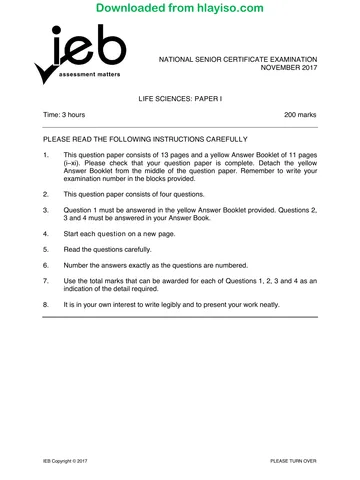
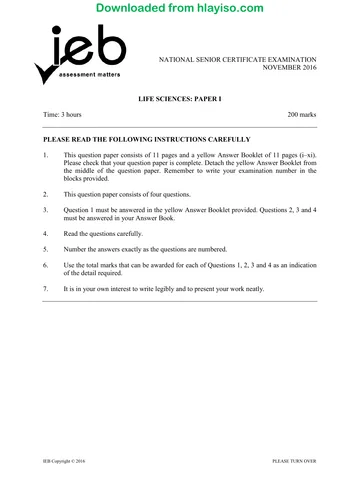
NATIONAL SENIOR CERTIFICATE EXAMINATION
NOVEMBER 2018
LIFE SCIENCES: PAPER I
Time: 3 hours 200 marks
PLEASE READ THE FOLLOWING INSTRUCTIONS CAREFULLY
1. This question paper consists of 14 pages and a yellow Answer Booklet of 14 pages
(i–xiv). Please check that your question paper is complete. Detach the yellow
Answer Booklet from the middle of the question paper. Remember to write your
examination number in the blocks provided.
2. This question paper consists of four questions.
3. Question 1 must be answered in the yellow Answer Booklet provided. Questions 2,
3 and 4 must be answered in your Answer Book.
4. Start each question on a new page.
5. Read the questions carefully.
6. Number the answers exactly as the questions are numbered.
7. Use the total marks that can be awarded for each of Questions 1, 2, 3 and 4 as an
indication of the detail required.
8. It is in your own interest to write legibly and to present your work neatly.
IEB Copyright © 2018 PLEASE TURN OVER
Skip to contentQuestion paper 





View all

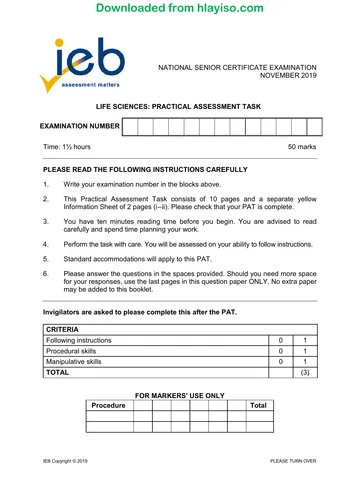
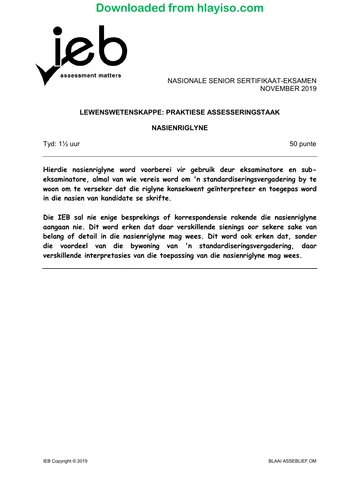

Life Sciences Grade 12 IEB Paper 1 2018 Question Paper
IEB Grade 12 Life Sciences Paper 1 question paper from the 2018, 14 pages. Read online or get the free PDF download, memo linked when available.
Publisher: IEB
Life Sciences · Grade 12 · 2018. Question paper, 14 pages. Read online or download the PDF.
- Subject
- Life Sciences
- Grade
- Grade 12
- Document type
- Question paper
- Year
- 2018
- Paper
- 1
- Publisher
- IEB
- Curriculum
- IEB
- Pages
- 14
- File size
- 2.0 MB
Loading document…
Loading document…
1 of 14
Document textSearch extracted text and jump to a page.
Downloaded from hlayiso.com
NATIONAL SENIOR CERTIFICATE: LIFE SCIENCES: PAPER I Page 2 of 14
QUESTION 2
2.1 Read the article below. Use the information in the text and your own
knowledge to answer the questions that follow:
In 1924 Raymond Dart examined a fossil of a skull found in a limestone quarry at
Taung, a small town situated in the North West Province of South Africa. After
more than a month of patient chipping, he managed to reveal the skull's face. Its
cranial capacity was 405 cm3.
Dart with the Taung Child
[Source: <https://en.wikipedia.org>]
He judged the skull to be that of a juvenile (young) individual and it came to be
known as the Taung Child. Dart was convinced even then that he had made the
"early human find" of the century.
In a paper published in the journal Nature, he argued that the Taung Child
represented a missing link between apes and humans since it combined
humanlike teeth and upright posture with a small cranial capacity.
However, the global scientific community were very critical of Dart's theory due
to its belief that humans originated in Europe. The discovery in England of
another fossil known as Piltdown Man in 1912 supported this view that humans
originated in Europe. Its large braincase and apelike jaw and teeth were exactly
what these scientists expected to find from a "missing link".
Piltdown Man was revealed to be a hoax in 1953 when scientists at the
University of Oxford in the United Kingdom, using the then-new technique of
fluorine dating revealed that Piltdown Man's bones were not all the same age.
Further analysis revealed they were a combination of carefully carved and
stained human and ape bones.
[Adapted: <http://www.sciencemag.org> and <http://www.macroevolution.net>]
2.1.1 Provide the scientific name of the Taung Child. (1)
2.1.2 Dart was able to determine from the skull that it had an upright
posture. What feature of the skull would indicate it was bipedal? (2)
IEB Copyright © 2018
Downloaded from hlayiso.com
NATIONAL SENIOR CERTIFICATE: LIFE SCIENCES: PAPER I Page 3 of 14
2.1.3 Explain THREE advantages that bipedalism would provide for a
hominid such as the Taung Child. (3)
2.1.4 State TWO ways in which the teeth of an ape differ from the human-
like teeth of the Taung Child. (2)
2.1.5 Suggest how Dart was able to determine the cranial capacity of the
Taung Child. (2)
2.1.6 How did the discovery of Piltdown Man contradict Dart's theory that
the Taung Child was a missing link between apes and humans?
Provide TWO ways. (2)
2.1.7 The scientists made an error in not considering Dart's proposal.
Discuss how this example could lead to better practices in the
scientific community. (4)
2.2 The latest research suggests that modern humans, Homo sapiens,
originated in Africa. Homo sapiens then dispersed to other regions as
shown in the map below. This is known as the Out of Africa hypothesis.
Out of Africa hypothesis
[Source: <https://www.sciencenews.org>]
2.2.1 Explain TWO lines of evidence that scientists have used to support
this hypothesis. (4)
2.2.2 If Homo sapiens left Africa 200 000 years ago, calculate how long it
took them to migrate to Europe. Show all working. (2)
IEB Copyright © 2018 PLEASE TURN OVER
Downloaded from hlayiso.com
NATIONAL SENIOR CERTIFICATE: LIFE SCIENCES: PAPER I Page 4 of 14
2.2.3 Discuss TWO characteristic features of Homo sapiens that enabled
them to survive in new and unpredictable environments. (4)
2.2.4 Briefly outline the alternative hypothesis that describes how modern
humans spread across the world. (2)
2.3 Australopithecus sediba was discovered in August 2008 by Professor Lee
Berger and his son. The announcement of its discovery was only made to
the public in April 2010.
Image of the fossil skeleton of Australopithecus sediba
[Adapted: By Prof Berger – Own work, CC BY-SA 3.0]
2.3.1 Where in South Africa was this fossil discovered? (1)
2.3.2 Suggest TWO possible reasons for the gap in time between the date
of discovery and the date on which its discovery was made public. (2)
2.3.3 Explain one significance of the discovery of Australopithecus sediba
to our understanding of human evolution. (2)
2.3.4 State one social or economic benefit to South Africa of the discovery
of this fossil. (1)
IEB Copyright © 2018
Downloaded from hlayiso.com
NATIONAL SENIOR CERTIFICATE: LIFE SCIENCES: PAPER I Page 5 of 14
2.4 Study the diagrams A and B below. They illustrate the concepts of
convergent and divergent evolution.
Diagram A Diagram B
Mole Whale
Falcon Bat
Ancestral Ancestral Ancestral
mammal bird mammal
[Adapted:<https://www.wpclipart.com>] [Adapted: <https://sites.google.com>]
Match the diagrams A and B to each type of evolution and explain why it is
an appropriate representation. (6)
[40]
IEB Copyright © 2018 PLEASE TURN OVER
Downloaded from hlayiso.com
NATIONAL SENIOR CERTIFICATE: LIFE SCIENCES: PAPER I Page 6 of 14
QUESTION 3
3.1 Read the article below and use the information in the text and your own
knowledge to answer the questions that follow:
The construction of a dam in central Brazil has resulted in fast evolution of
lizards in the region. In just 15 years, the lizards' heads have grown larger—an
adaptation that allows them to eat a range of termites of different sizes.
In 1996, the dam flooded a series of valleys in Brazil creating nearly 300 islands
out of what was once high ground. The hilltops that became islands were once
home to a variety of lizards that eat termites. Many of the area's largest lizard
species disappeared from the new islands, probably because there wasn't
enough food to support their energy needs. But a small, dragonfly-sized lizard
called Gymnodactylus amarali (a termite eater once common across the flooded
area) was able to survive. Larger termites, which had previously been eaten by
the larger lizards, were now available to these lizards.
But there was a problem: the lizards had small heads, only 1 cm wide, and some
of the termites were nearly the same size. However, some of the individual
lizards were lucky enough to have slightly larger heads and were able to eat the
termites.
When scientists compared the island lizards with their mainland relatives—
separated by only 15 years and a short stretch of water—the researchers found
the island lizards had heads that were about four percent larger.
Image of Gymnodactylus amarali
[Source: <http://theconversation.com>]
[Adapted:<http://www.atlasobscura.com>]
3.1.1 When the dam flooded the valleys, why were the larger lizard species
unable to survive on the newly formed islands? (1)
3.1.2 What type of competition existed between the larger lizard species
and Gymnodactylus amarali? (1)
3.1.3 Using the theory of natural selection, explain how the lizards with
larger sized heads were able to evolve in 15 years. (5)
3.1.4 Could the island lizards be regarded as a different species to the
mainland lizards? Explain your answer. (2)
IEB Copyright © 2018
Downloaded from hlayiso.com
NATIONAL SENIOR CERTIFICATE: LIFE SCIENCES: PAPER I Page 7 of 14
3.1.5 Is the change in lizard head size an example of macroevolution or
microevolution? Explain your answer. (3)
3.2 Read the article below. Use the information in the text and your own
knowledge to answer the questions that follow:
Swertia chirayita is a medicinal herb that grows at high altitudes in India. The
herb is used by indigenous population groups in many ways for medicinal
purposes, e.g. the treatment of hepatitis, inflammation and digestive diseases.
Overuse in traditional medicine has resulted in the plant now being on the verge
of extinction in the wild.
Scientists conducted an investigation using the seeds of the herb to determine
their suitability for storage in a seed bank. They stored the seeds at three
different temperatures: room temperature, 4°C and –15°C.
They also stored the seeds for different lengths of time. Scientists then
measured the effect of both temperature and storage time on germination.
The results of the investigation are shown in the graph below.
Graph showing the effect of temperature and storage time on the germination
of Swertia chirayita seeds
[Adapted: <https://www.ncbi.nlm.nih.gov>]
3.2.1 What was the highest percentage germination of the seeds? (1)
IEB Copyright © 2018 PLEASE TURN OVER
Downloaded from hlayiso.com
NATIONAL SENIOR CERTIFICATE: LIFE SCIENCES: PAPER I Page 8 of 14
3.2.2 For how many months had the seeds been stored at –15°C when
germination was at 70%? (2)
3.2.3 Based on the results shown in this graph, what would be the best
temperature for storing the seeds? (2)
3.2.4 What is a seed bank? (1)
3.2.5 Using the information provided in the text, give TWO reasons why it
is necessary to place the seeds of this herb in a seed bank. (2)
3.2.6 Explain the relationship between storage time and germination rate
as seen in the graph. (2)
3.2.7 Name and explain a method of asexual reproduction that could be
used to produce many plants in a short space of time. (4)
3.3 A patient was suffering from abnormally low levels of blood glucose and an
enlarged liver. After an overnight fast* a biopsy of his liver was taken. A
biopsy is a sample of tissue taken from the body in order to examine it more
closely. A biopsy was also taken from a healthy subject of the same age.
The electron micrographs below show the liver tissue of the patient and a
healthy subject.
The dark granules in the electron micrographs are glycogen granules.
Micrographs of liver tissue from the patient and a healthy subject
glycogen
Patient Healthy subject
[Adapted: <http://david-bender.co.uk>]
* fast = no food taken in for 8 hours
IEB Copyright © 2018
Downloaded from hlayiso.com
NATIONAL SENIOR CERTIFICATE: LIFE SCIENCES: PAPER I Page 9 of 14
3.3.1 What difference is noted between the liver tissues of the patient and
of the healthy subject? (2)
3.3.2 Why was a liver biopsy of the healthy subject also taken? (2)
3.3.3 (a) Which hormone is responsible for the storage of glycogen in
the liver? (1)
(b) Use a flow diagram to explain the process of how glycogen
comes to be stored in the liver. (7)
3.3.4 Two symptoms of the patient were an enlarged liver and abnormally
low blood glucose. Use the micrographs on page 8 to explain a
possible reason for each of the symptoms shown by the patient. (2)
[40]
IEB Copyright © 2018 PLEASE TURN OVER
Downloaded from hlayiso.com
NATIONAL SENIOR CERTIFICATE: LIFE SCIENCES: PAPER I Page 10 of 14
QUESTION 4
4.1 Provide labels for structures A–D in the diagram below. (Write A–D in your
Answer Book with the appropriate label.)
Diagram of male reproductive organs
[Adapted: <http://anatomybody101.org>]
(4)
4.2 Medical Male Circumcision (MMC) is the full removal of the foreskin
performed by a qualified doctor or healthcare worker. MMC is offered free of
charge from government clinics and hospitals.
4.2.1 Where on the body is the foreskin located? (1)
4.2.2 State whether the following statements regarding MMC are TRUE or
FALSE.
(a) Less chance of transmitting STIs to sexual partner.
(b) Unlikely to become infected if performed in a hospital.
(c) Leads to reduction in fertility in men. (3)
IEB Copyright © 2018
Downloaded from hlayiso.com
NATIONAL SENIOR CERTIFICATE: LIFE SCIENCES: PAPER I Page 11 of 14
4.3 The diagram below shows how the release of testosterone is controlled by
negative feedback.
Diagram showing hormonal control of testosterone levels
[Adapted from: <http://www.usapowerlifting.com>]
4.3.1 Name the organ that secretes testosterone. (1)
4.3.2 State TWO functions of testosterone. (2)
4.3.3 Anabolic steroids contain synthetic forms of testosterone. Male
athletes who take anabolic steroids may experience a decrease in
fertility. Use the information provided in the diagram above to explain
how this can occur. (5)
4.3.4 The following extract was taken from a news report.
Studies completed in South African schools indicated the high use of
steroids by school boys. Nearly two thirds of male steroid users wanted
"to look good" while just less than a third were taking steroids to
improve sports performances. In the sporting context, pressure from
coaches, peers and parents can be significant reasons for steroid use.
[Source: <https://www.iol.co.za>]
Provide THREE reasons why testing for steroids should be made
compulsory for all school boys. (3)
IEB Copyright © 2018 PLEASE TURN OVER
Downloaded from hlayiso.com
NATIONAL SENIOR CERTIFICATE: LIFE SCIENCES: PAPER I Page 12 of 14
4.4 How does the image below reflect an understanding of the ecological
footprint of developed and developing countries?
[Source: <http://www.seppo.net>]
(6)
IEB Copyright © 2018
Downloaded from hlayiso.com
NATIONAL SENIOR CERTIFICATE: LIFE SCIENCES: PAPER I Page 13 of 14
4.5 A long term study of succession was conducted on abandoned agricultural
crop fields. The first stage of succession was characterised by colonisation
of annual plant species on bare ground and nutrient poor soils. These
annual species had short lifespans (one growing season), rapid maturity,
and produced numerous small easily dispersed seeds. The annuals were
then quickly replaced in dominance in the next year by plants and grasses.
Diagram showing the succession of plant species on abandoned crop fields
[Source: <http://www.physicalgeography.net>]
4.5.1 (a) Identify the type of succession referred to in the text. (1)
(b) Give a reason for your answer in Question 4.5.1 (a). (1)
4.5.2 Use the diagram to identify the type of plant present in the climax
community. (1)
4.5.3 State TWO density dependent factors that would limit the population
size of the plants in the climax community. (2)
4.5.4 Use the information provided in the text and your own knowledge to
explain whether it is possible for agricultural land to be converted into
a nature reserve to conserve wildlife. (3)
IEB Copyright © 2018 PLEASE TURN OVER
Downloaded from hlayiso.com
NATIONAL SENIOR CERTIFICATE: LIFE SCIENCES: PAPER I Page 14 of 14
4.5.5 Study the table below and answer the questions that follow:
Table showing a comparison of plant, community and ecosystem
characteristics between early and late stages of succession
Early stages of Late stages of
Characteristic
succession succession
Plant life span (i) (ii)
Seed dispersal characteristics of
Well dispersed Poorly dispersed
dominant plants
Average plant size Small Large
[Adapted: <http://www.physicalgeography.net>]
(a) Provide the term to describe the plants in the early stages of
succession. (1)
(b) Differentiate between the terms "community" and "ecosystem". (2)
(c) The plant life span in the early stages and late stages of
succession has not been filled in on the table. State what the
life span should be for plants in both stages of succession at
(i) and (ii). (2)
(d) Plants in the early stages of succession have seeds that are
well dispersed. Give TWO advantages of this characteristic. (2)
[40]
Total: 200 marks
IEB Copyright © 2018
Study this subject
Revise the topics in this paper, then practise them question by question.
- Grade 12 Life Sciences notes
CAPS revision notes with worked examples.
- Life Sciences questions by topic
Past exam questions sorted by CAPS topic, with memos where available.
- Grade 12 Life Sciences quizzes
Short topic quizzes with instant feedback.
- All Grade 12 Life Sciences past papers
Past papers by year, with memos where available.
- Grade 12 IEB past papers
More Life Sciences and other subjects in this collection.
Recommended for this subject
More papers and memos for this grade and subject.
Question paperIEB
Life Sciences Grade 12 IEB Paper 1 2019 Question Paper
Question paperIEB
Life Sciences Grade 12 IEB P1 2019 Question Paper (Afrikaans)
Question paperIEB
Life Sciences Grade 12 IEB P1 2019 Question Paper (Afrikaans)
Question paperIEB
Life Sciences Grade 12 IEB Paper 2 2019 Question Paper
Question paperIEB
Life Sciences Grade 12 IEB P2 2019 Question Paper (Afrikaans)
Question paperIEB
Life Sciences Grade 12 IEB P2 2019 Question Paper (Afrikaans)
Related documents
MemorandumIEB
Life Sciences Grade 12 IEB Paper 1 2018 Memo
MemorandumIEB
Life Sciences Grade 12 IEB Paper 1 2018 Memo
Question paperIEB
Life Sciences Grade 12 IEB Paper 2 2018 Question Paper
Question paperIEB
Life Sciences Grade 12 IEB Paper 3 2018 Question Paper
Question paperIEB
Life Sciences Grade 12 IEB Paper 1 2017 Question Paper
Question paperIEB
Life Sciences Grade 12 IEB Paper 1 2016 Question Paper
More from Grade 12 Life Sciences
MemorandumIEB
Life Sciences Grade 12 IEB Paper 1 2019 Memo
MemorandumIEB
Life Sciences Grade 12 IEB Paper 2 2019 Memo
Question paperIEB
Life Sciences Grade 12 IEB Paper 3 2019 Question Paper
Question paperIEB
Life Sciences Grade 12 IEB P3 2019 Question Paper (Afrikaans)
Question paperIEB
Life Sciences Grade 12 IEB P3 2019 Question Paper (Afrikaans)
MemorandumIEB