
Downloaded from hlayiso.com
NATIONAL SENIOR CERTIFICATE EXAMINATION
NOVEMBER 2018
LIFE SCIENCES: PAPER I
MARKING GUIDELINES
Time: 3 hours 200 marks
These marking guidelines are prepared for use by examiners and sub-examiners,
all of whom are required to attend a standardisation meeting to ensure that the
guidelines are consistently interpreted and applied in the marking of candidates'
scripts.
The IEB will not enter into any discussions or correspondence about any marking
guidelines. It is acknowledged that there may be different views about some
matters of emphasis or detail in the guidelines. It is also recognised that,
without the benefit of attendance at a standardisation meeting, there may be
different interpretations of the application of the marking guidelines.
IEB Copyright © 2018 PLEASE TURN OVER
Skip to contentMemorandum 


View all





Life Sciences Grade 12 IEB Paper 1 2018 Memo
IEB Grade 12 Life Sciences Paper 1 memorandum from the 2018, 10 pages. Read online or get the free PDF download, question paper linked when available.
Publisher: IEB
Life Sciences · Grade 12 · 2018. Memorandum, 10 pages. Read online or download the PDF.
- Subject
- Life Sciences
- Grade
- Grade 12
- Document type
- Memorandum
- Year
- 2018
- Paper
- 1
- Publisher
- IEB
- Curriculum
- IEB
- Pages
- 10
- File size
- 442.4 KB
Loading document…
Loading document…
1 of 10
Document textSearch extracted text and jump to a page.
Downloaded from hlayiso.com
NATIONAL SENIOR CERTIFICATE: LIFE SCIENCES: PAPER I – MARKING GUIDELINES Page 2 of 10
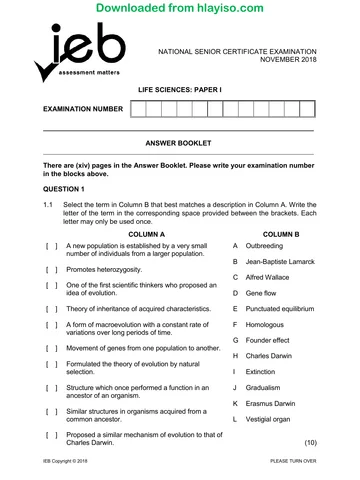
QUESTION 1
1.1
COLUMN A COLUMN B
[G] A new population is established by a very small A Outbreeding
number of individuals from a larger population.
B Jean-Baptiste Lamarck
[A] Promotes heterozygosity.
C Alfred Wallace
[K] One of the first scientific thinkers who proposed an
idea of evolution. D Gene flow
[B] Theory of inheritance of acquired characteristics. E Punctuated equilibrium
[J] A form of macroevolution with a constant rate of F Homologous
variations over long periods of time.
G Founder effect
[D] Movement of genes from one population to another.
H Charles Darwin
[H] Formulated the theory of evolution by natural
selection. I Extinction
[L] Structure which once performed a function in an J Gradualism
ancestor of an organism.
K Erasmus Darwin
[F] Similar structures in organisms acquired from a
common ancestor. L Vestigial organ
[C] Proposed a similar mechanism of evolution to that of
Charles Darwin.
1.2
Question 1.2.1 1.2.2 1.2.3 1.2.4 1.2.5 1.2.6
Answer C C B B A B
1.3 1.3.1 1 mm = 22-24 mm A to B = 10-15 mm 10 mm × 1 mm / 23 mm =
0,42 – 0,68 mm (Accept range)
(Check final question paper for measurements)
1.3.2 (a) Time/mya different time periods.
(b) 0,4 mm
(Check final question paper for measurements)
(c) Drill hole gets bigger over time / the younger the fossil
Increase till 250 mya; slight decrease till 200 mya; increase till
50 mya.
(Accept other reasonable answers.)
IEB Copyright © 2018 PLEASE TURN OVER
Downloaded from hlayiso.com
NATIONAL SENIOR CERTIFICATE: LIFE SCIENCES: PAPER I – MARKING GUIDELINES Page 3 of 10
(d) Thicker shells/ better camouflaged/ harder shell
(Accept other reasonable answers)
(e) Used 7000 / large sample shells can calculate average /more
data removes influence of outliers published in journal
therefore peer reviewed / results repeatable
.
(f) Graph line lower lags behind prey.
1.4
Statement A, B or C
1.4.1 South Africa has more cases of FAS than the rest of A/C
the world.
1.4.2 Abnormalities caused by foetal alcohol syndrome are B
reversible.
1.4.3 FAS can be prevented by avoiding alcohol during A
pregnancy.
1.4.4 Children with FAS have physical abnormalities and A
intellectual disabilities.
1.4.5 FAS largely affects poverty stricken areas. C
1.5
Item Term Answer
1. Permanent contraception for female IUD B
2. Inserted into the uterus
1. Prevents STIs Male condom A
2. Chemical barrier
1. Tracking fertile days in the menstrual Rhythm method A
cycle
2. Prevents embryo implantation
1. Foreskin is removed Vasectomy D
2. The fallopian tubes are tied off
1. Prevents ovulation Contraceptive pill C
2. Contains reproductive hormones
IEB Copyright © 2018 PLEASE TURN OVER
Downloaded from hlayiso.com
NATIONAL SENIOR CERTIFICATE: LIFE SCIENCES: PAPER I – MARKING GUIDELINES Page 4 of 10
1.6 1.6.1 Label on diagram.
1.6.2
Correct
Term/Description
letter
(a) Mature Graafian follicle C
(b) Ovulation D
(c) Corpus luteum E
(d) Releases oestrogen at the start of the menstrual B
cycle.
(e) Starts developing as a result of FSH release. A
(f) Produces a hormone to inhibit FSH production E
after ovulation.
(g) Remains in place if fertilisation does occur. E
(h) Occurs due to a surge in LH. D
1.7 1.7.1
Description Label number(s)
Diagram A Diagram B
Place where fertilisation takes place. 3 11
Place where the male reproductive
6 9
cells are deposited.
Organ which protects a developing
4
foetus.
Structure where meiosis takes place. 2 8 / 11
Structure which develops into the fruit. 12
1.7.2 Heading: Differences between sexual and asexual reproduction.
Sexual Asexual (column headings)
Production of gametes No production of gametes
Results in variation Clones of parent
Slower process Faster process
Requires larger input of energy More energy efficient
Pollination/Pollinators required No pollination
Requires sexual reproductive Any vegetative part
structures e.g. flower
Usually 2 parents One parent
Construction of table format
(Accept other relevant differences)
IEB Copyright © 2018 PLEASE TURN OVER
Downloaded from hlayiso.com
NATIONAL SENIOR CERTIFICATE: LIFE SCIENCES: PAPER I – MARKING GUIDELINES Page 5 of 10
1.8 1.8.1 Heading
Y – axis: growth hormone concentration
X – axis: age
Units included in axis headings (ng/ml)
Scale (check y-axis carefully)
Plotted correctly (all 6 correct, 3–5 points correct)
Line graph
1.8.2 Pituitary / hypophysis.
1.8.3 Hormones transported in blood to target organs.
1.8.4 Puberty/adolescence occurring growth spurt.
1.8.5 (a) 50–60 years.
(b) Old age all processes slow down / growth plates closed /
growth in height ceased / renewal of tissues slows.
1.8.6 (a) Acromegaly
(b) Enlarged (flat) bones of hands/feet/face; coarsening of skin
enlarged or protruding tongue/ thickening of soft tissues/
enlarged heart.
IEB Copyright © 2018 PLEASE TURN OVER
Downloaded from hlayiso.com
NATIONAL SENIOR CERTIFICATE: LIFE SCIENCES: PAPER I – MARKING GUIDELINES Page 6 of 10
QUESTION 2
2.1 2.1.1 Australopithecus africanus.
2.1.2 Foramen magnum (or described) towards centre of skull (descriptions
meaning the same).
2.1.3 Freed hands able to carry tools / weapons whilst moving / carry
offspring to safety; cover large distances / with little energy
expenditure); see predators / source of food easily; live in a greater
variety of biomes, e.g. forest and savannah increased cooling.
2.1.4 Ape's teeth would be larger; pronounced canines; U shape of dental
arch gap in upper jaw for canines (diastema).
2.1.5 Measuring the volume of the brain-cast; which was a model of actual
brain size / using cranium of skull; determining volume (Accept any
suitable measurement of volume) description of how volume measured
use a endocranial cast.
2.1.6 Belief that early humans originated in Europe/ England had a larger
brain; and more apelike jaw/teeth.
2.1.7 Open minded about new evidence; rather than sticking to preconceived
ideas; allowing many scientists to examine evidence to reduce chance
of hoax / mistakes made by scientists; prevent societal views to slant
their ideas on science; collaboration more important than competition as
human evolution largely an unknown field.
2.2 2.2.1 mtDNA / genetic evidence modern Africans have largest number of
variations
Fossil evidence oldest Homo sapiens fossils found in Africa
archaeological evidence oldest evidence of symbolic thought found
in Africa / e.g. Art (Blombos Cave);
burial of dead (Klasies Cave, Border Cave);
tools/artefacts (Pinnacle Cave, Blombos)
(line of evidence explained) × 2
2.2.2 200 000 – 45 000 = 155 000 years.
2.2.3 Larger brain enabled to plan ahead / communication; use of fire source
of warmth in inhospitable areas / defence against prey / social
organisation bipedalism cover large distances pronounced chin to allow
for more space for tongue for communication.
(List two characteristics and explain how each enabled them to survive.
Accept any reasonable answers)
2.2.4 Multiregional Homo sapiens evolved independently in separate regions
from Homo erectus / Homo neanderthalensis.
IEB Copyright © 2018 PLEASE TURN OVER
Downloaded from hlayiso.com
NATIONAL SENIOR CERTIFICATE: LIFE SCIENCES: PAPER I – MARKING GUIDELINES Page 7 of 10
2.3 2.3.1 Cradle of Humankind/ Malapa.
2.3.2 Allows time for scientists to study fossils; to identify species time
needed to remove fossil from rock; to collect many specimens; peer
review requires time; dating to confirm ages.
2.3.3 Transitional fossil explanation of specific feature, e.g. long arms, /
arched feet / showing characteristics of both Homo and
Australopithecus / new species fills gap in evolutionary record
/explanation of human evolution.
2.3.4 Increased tourism / South Africa on map to find good fossils / enhances
scientific understanding of human evolution in the public. (Any
reasonable explanation)
2.4 A – divergent common ancestor shows species evolve differences
homologous structure explained.
B – convergent parent species not closely related show similarities in
form / analogous structure explained.
IEB Copyright © 2018 PLEASE TURN OVER
Downloaded from hlayiso.com
NATIONAL SENIOR CERTIFICATE: LIFE SCIENCES: PAPER I – MARKING GUIDELINES Page 8 of 10
QUESTION 3
3.1 3.1.1 Not enough food available.
3.1.2 Interspecific.
3.1.3 Variation in head size lizards with larger heads able to access more
food greater chance of surviving and reproducing genes/traits for larger
heads passed to offspring over time population had a greater number of
larger head individuals.
3.1.4 YES: as geographically isolated / allopatric speciation therefore
reproductively isolated / cannot interbreed / produce viable offspring
OR NO: not enough time to accumulate changes /only head size has
changed can still interbreed when reintroduced.
3.1.5 Microevolution small changes / only change in head size in short period
of time / small scale in small population.
3.2 3.2.1 96–99(%)
3.2.2 11/12/13 months
3.2.3 4 °C
3.2.4 Storage facility for seeds / place to preserve seeds.
3.2.5 Verge of extinction; used by locals for medicinal purposes; overuse.
3.2.6 The longer the seeds are stored less likely they are to germinate.
3.2.7 Cuttings / vegetative propagation remove a piece of plant, place in
water add growth hormones / and allow growth of roots, plant it out /
tissue culture/ cloning/micropropogation remove small number of cells
from plant place in growth medium add growth hormones allow callus to
develop and growth of plantlet plant it out. (name one explanation)
3.3 3.3.1 Patient has more glycogen granules / healthy subject has less glycogen
granules has more dark patches – only or healthy has less dark
patches.
3.3.2 Used as a comparison /control to show state of healthy liver.
3.3.3 (a) Insulin
(b) Heading arrows high blood glucose levels insulin released
from beta cells (pancreas/ islets of Langerhans) insulin
travels in blood to liver membrane of liver cells more
permeable to glucose glucose absorbed converted to
glycogen. (any 5 sequential steps)
IEB Copyright © 2018 PLEASE TURN OVER
Downloaded from hlayiso.com
NATIONAL SENIOR CERTIFICATE: LIFE SCIENCES: PAPER I – MARKING GUIDELINES Page 9 of 10
3.3.4 Enlarged liver – excess glycogen stored and no glucagon secreted to
convert glycogen to glucose low blood glucose – no / low secretion of
glucagon to convert glycogen to glucose enzyme needed to release
glucose from glycogen missing.
Accept any reasonable answer for each symptom.
QUESTION 4
4.1 A – prostate gland B – vas deferens / sperm duct
C – urethra D – scrotum
4.2 4.2.1 Tip of penis
4.2.2 (a) True
(b) True
(c) False
4.3 4.3.1 Testes
4.3.2 Rapid physical growth in puberty; development of secondary sexual
characteristics; regulate secretion of LH and FSH; sex drive; sperm
production.
4.3.3 High levels of testosterone in blood inhibits secretion of LH and FSH
from pituitary gland acts on testes stop secreting testosterone
resulting in less sperm production.
(5 good facts sequentially)
4.3.4 Unfair advantage reduce pressure from coaches and parents to take
steroids reduce peer pressure to take steroids steroids have serious
side-effects, e.g. lowers fertility, disrupts secretion of reproductive
hormones steroid side-effects more pronounced in adolescents high
levels of aggression testing acts as a deterrent highlight the dangers of
taking steroids.
4.4 Larger footprint / image on right in developed countries use more natural
resources / ecological debtor to sustain lifestyle represented by larger figure
in cartoon indicates greed using more land more negative impact. Smaller
footprint / image on left in developing countries no shoes/ thinner figure
suggests lack of use of resources / ecological creditor. (Accept any
reasonable suggestions.)
4.5 4.5.1 (a) Secondary.
(b) Started with soil / not bare rock / soil present / plants grew
here before / no lichens and moss / annual plants first
colonisers.
4.5.2 Hardwood trees.
4.5.3 Living space; sunlight; water; soil nutrients; increase in competition;
increase in diseases; pests.
IEB Copyright © 2018 PLEASE TURN OVER
Downloaded from hlayiso.com
NATIONAL SENIOR CERTIFICATE: LIFE SCIENCES: PAPER I – MARKING GUIDELINES Page 10 of 10
4.5.4 YES – long term with changing plant communities increase in
nutrients in soil would come animals increase in food increase in
shelter.
OR NO – long period of time before climax community / stable
community pioneer community has low biodiversity seeds from crops
present lead to different communities.
4.5.5 (a) Pioneer coloniser.
(b) Community – group of populations/species in an area.
Ecosystem includes interaction with environment / groups of
communities interacting with each other.
(c) (i) Early – short one growing season / 2 – 12 months.
(ii) Late – longer more than a year.
(d) Reduces competition with parent plants lifespan of early stage
plants short if dispersed widely better coverage of new areas.
Total: 200 marks
IEB Copyright © 2018
Study this subject
Revise the topics in this paper, then practise them question by question.
- Grade 12 Life Sciences notes
CAPS revision notes with worked examples.
- Life Sciences questions by topic
Past exam questions sorted by CAPS topic, with memos where available.
- Grade 12 Life Sciences quizzes
Short topic quizzes with instant feedback.
- All Grade 12 Life Sciences past papers
Past papers by year, with memos where available.
- Grade 12 IEB past papers
More Life Sciences and other subjects in this collection.
Recommended for this subject
More papers and memos for this grade and subject.
MemorandumIEB
Life Sciences Grade 12 IEB Paper 1 2019 Memo
MemorandumIEB
Life Sciences Grade 12 IEB Paper 2 2019 Memo
MemorandumIEB
Life Sciences Grade 12 IEB Paper 3 2019 Memo
MemorandumIEB
Life Sciences Grade 12 IEB Paper 1 2019 Memo
MemorandumIEB
Life Sciences Grade 12 IEB Paper 1 2019 Memo (Afrikaans)
MemorandumIEB
Life Sciences Grade 12 IEB Paper 2 2018 Memo
Related documents
MemorandumIEB
Life Sciences Grade 12 IEB Paper 1 2018 Memo
Question paperIEB
Life Sciences Grade 12 IEB Paper 1 2018 Question Paper
MemorandumIEB
Life Sciences Grade 12 IEB Paper 3 2018 Memo
MemorandumIEB
Life Sciences Grade 12 IEB Paper 1 2017 Memo
MemorandumIEB
Life Sciences Grade 12 IEB Paper 1 2017 Memo
MemorandumIEB
Life Sciences Grade 12 IEB Paper 1 2016 Memo
More from Grade 12 Life Sciences
Question paperIEB
Life Sciences Grade 12 IEB Paper 1 2019 Question Paper
Question paperIEB
Life Sciences Grade 12 IEB P1 2019 Question Paper (Afrikaans)
Question paperIEB
Life Sciences Grade 12 IEB P1 2019 Question Paper (Afrikaans)
Question paperIEB
Life Sciences Grade 12 IEB Paper 2 2019 Question Paper
Question paperIEB
Life Sciences Grade 12 IEB P2 2019 Question Paper (Afrikaans)
Question paperIEB