
Downloaded from hlayiso.com
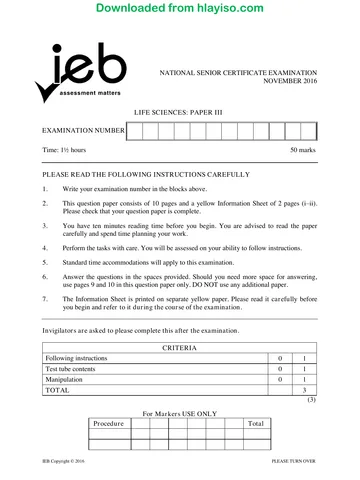
NATIONAL SENIOR CERTIFICATE EXAMINATION
NOVEMBER 2016
LIFE SCIENCES: PAPER III
MARKING GUIDELINES
Time: 1½ hours 50 marks
These marking guidelines are prepared for use by examiners and sub-examiners,
all of whom are required to attend a standardisation meeting to ensure that the
guidelines are consistently interpreted and applied in the marking of candidates'
scripts.
The IEB will not enter into any discussions or correspondence about any marking
guidelines. It is acknowledged that there may be different views about some
matters of emphasis or detail in the guidelines. It is also recognised that,
without the benefit of attendance at a standardisation meeting, there may be
different interpretations of the application of the marking guidelines.
IEB Copyright © 2016 PLEASE TURN OVER
Skip to contentMemorandum 


View all





Life Sciences Grade 12 IEB Paper 3 2016 Memo
IEB Grade 12 Life Sciences Paper 3 memorandum from the 2016, 5 pages. Read online or get the free PDF download, question paper linked when available.
Publisher: IEB
Life Sciences · Grade 12 · 2016. Memorandum, 5 pages. Read online or download the PDF.
- Subject
- Life Sciences
- Grade
- Grade 12
- Document type
- Memorandum
- Year
- 2016
- Paper
- 3
- Publisher
- IEB
- Curriculum
- IEB
- Pages
- 5
- File size
- 287.4 KB
Loading document…
Loading document…
1 of 5
Document textSearch extracted text and jump to a page.
Downloaded from hlayiso.com
NATIONAL SENIOR CERTIFICATE: LIFE SCIENCES: PAPER III – MARKING GUIDELINES Page 2 of 5
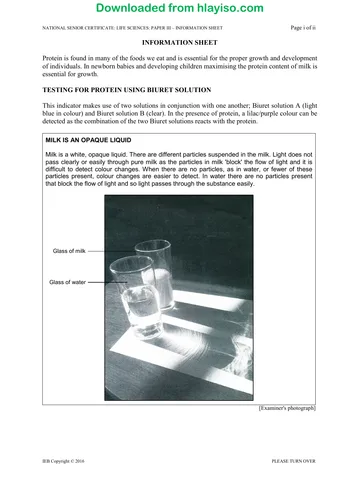
9. Table to show the colour of a variety of solutions/liquids when indicators (A and B)
or Biuret are added.
Test tube Colour (when indicators are added)
A Light blue
B Purple to lilac
C Slight tinge of purple/lilac in a very 'milky' mixture
D Light blue
Layout of table (neat and in columns and rows) with both correct column headings
(Descriptions of colour blue for A and D) (and more purple/lilac in B than in C).
10. Sediment/solid/ precipitate in test tube D with blue layer on the top.
A, B and C – unchanged. (check what is written in the table)
11. A and D do not contain protein.
B and C do contain protein (refer back to table).
12. (Contents of the test tube/various liquids or different solutions) added to the test
tubes.
13. Presence or absence of protein/colour change (only 1 mark)
14. Test tube Protein in the test tube (%)
A 0
B 5 (30/6)
C 30
D 0
NOTE: Both A and D recorded 0
No units (%) in the body of the table
15. 15.1 More protein in C as it is pure milk. We have shown in A that there is no
protein in water and B is diluted milk so less protein than in C. (C most and
B less). This question asks where you expect to have more protein present.
15.2 No. The colour in B is more purple/lilac than in C as there is less milk (with
particles in) to blur/obscure the indicator and colour change.
16. The colour/shade of purple/lilac would be in between what was observed in test
tubes B and C.
OR
In between B and C.
Lighter than B but darker than C.
17. Measured length or width of PB (… mm/length of scale bar in mm) × 15 µm
= ... µm method may differ to calculate (or (3 fits in × 15 = between 42–48 µm)
IEB Copyright © 2016 PLEASE TURN OVER
Downloaded from hlayiso.com
NATIONAL SENIOR CERTIFICATE: LIFE SCIENCES: PAPER III – MARKING GUIDELINES Page 3 of 5
18. Heading: (bar graph to show) the protein content in (gram/100 cal of) different foods.
12
11
10
9
8
Protein content g/100 cal
7
6
5
4
3
2
1
0
Tofu Soybeans Quinoa Lentils
Complete heading
Bar graph
Spaces between bars equal
Label y-axis (protein content in gram/100 cal)
Scale on y-axis correct
Names of foods on x-axis/key
Accuracy (maximum 3 if do a line graph) Histogram only 4/6
IEB Copyright © 2016 PLEASE TURN OVER
Downloaded from hlayiso.com
NATIONAL SENIOR CERTIFICATE: LIFE SCIENCES: PAPER III – MARKING GUIDELINES Page 4 of 5
PART 2 EXPERIMENTAL DESIGN
19.1 Rennet added to milk will cause the milk to coagulate. Statement
THE DESIGN MUST SPEAK TO THE HYPOTHESIS
19.2 To investigate whether milk in the presence of Rennet will coagulate and form
lumps.
OR
To determine if adding Rennet will cause the milk to coagulate and form lumps.
19.3 (1) Take two identical test tubes.
(2) Mark one test tube A and the other B.
(3) Using a 10 ml syringe add 30 ml of milk to both A and B.
(4) Add 4 drops of lemon juice to both test tubes A and B.
(5) Into A add 4 drops of Rennet.
(One test tube has Rennet and the other test tube no Rennet.) THIS IS A
CRUCIAL POINT THAT NEEDS TO BE IN THE DESIGN.
(6) Take a 250 ml beaker and to it add 200 ml water that is at a temperature of
70 oC (water bath).
(7) Place both test tubes in the water bath for 10 minutes/set time.
(8) Remove the test tubes from the water bath and tilt to the side to observe for
small lumps/coagulation.
(9) Record your observations in a table.
(10) Repeat the investigation to verify your findings.
IEB Copyright © 2016 PLEASE TURN OVER
Downloaded from hlayiso.com
NATIONAL SENIOR CERTIFICATE: LIFE SCIENCES: PAPER III – MARKING GUIDELINES Page 5 of 5
Use the attached rubric for assessment for Question 1.3.
Method Rubric Criteria 5 4 3 2 1 0
L Layout – appearance Layout meets criteria Layout is untidy and
of method below: hard to read.
neat and tidy and OR
bulleted/numbered. Method is not formatted
correctly with bullet
points or numbers.
A Aim – Method relates Method clearly tests an Method relates to the Method does not relate
to prescribed aim that relates to the prescribed aim given, to the prescribed aim or
experiment. prescribed experiment but is a little confusing achieve the desired
and achieves the and does not achieve result. Method given is
required result. the required result. the same as the given
experiment.
M Method – This needs All 5 criteria given An original experiment An original experiment An original experiment An original experiment None of the 5 criteria
to be appropriate and below are met: provided. provided. provided. provided. are met.
relevant to the aim, 1. An original OR
clearly logical and experiment Plus 3 of 5 criteria are Plus 2 of 5 criteria are Plus 1 of 5 criteria is Method a copy of the
sequential. If apparatus provided. met. met. met. original, given
is given in the 2. Equipment is experiment.
examination paper, the appropriate and
method should resemble used correctly.
the one given in the 3. Measuring of
marking guidelines. solutions, reagents
and marking of
equipment are
explained and this
assists in the
control of
variables.
4. Instructions are
scientifically valid
and ordered.
5. Instructions are
complete to
produce
measurable results
that are recorded.
Total: 50 marks
IEB Copyright © 2016
Study this subject
Revise the topics in this paper, then practise them question by question.
- Grade 12 Life Sciences notes
CAPS revision notes with worked examples.
- Life Sciences questions by topic
Past exam questions sorted by CAPS topic, with memos where available.
- Grade 12 Life Sciences quizzes
Short topic quizzes with instant feedback.
- All Grade 12 Life Sciences past papers
Past papers by year, with memos where available.
- Grade 12 IEB past papers
More Life Sciences and other subjects in this collection.
Recommended for this subject
More papers and memos for this grade and subject.
MemorandumIEB
Life Sciences Grade 12 IEB Paper 1 2019 Memo
MemorandumIEB
Life Sciences Grade 12 IEB Paper 2 2019 Memo
MemorandumIEB
Life Sciences Grade 12 IEB Paper 3 2019 Memo
MemorandumIEB
Life Sciences Grade 12 IEB Paper 1 2019 Memo
MemorandumIEB
Life Sciences Grade 12 IEB Paper 1 2019 Memo (Afrikaans)
MemorandumIEB
Life Sciences Grade 12 IEB Paper 1 2018 Memo
Related documents
Question paperIEB
Life Sciences Grade 12 IEB Paper 3 2016 Question Paper
Information sheetIEB
Life Sciences Grade 12 IEB Paper 3 2016 Information Sheet
MemorandumIEB
Life Sciences Grade 12 IEB Paper 1 2016 Memo
MemorandumIEB
Life Sciences Grade 12 IEB Paper 2 2016 Memo
MemorandumIEB
Life Sciences Grade 12 IEB Paper 3 2018 Memo
MemorandumIEB
Life Sciences Grade 12 IEB Paper 3 2017 Memo
More from Grade 12 Life Sciences
Question paperIEB
Life Sciences Grade 12 IEB Paper 1 2019 Question Paper
Question paperIEB
Life Sciences Grade 12 IEB P1 2019 Question Paper (Afrikaans)
Question paperIEB
Life Sciences Grade 12 IEB P1 2019 Question Paper (Afrikaans)
Question paperIEB
Life Sciences Grade 12 IEB Paper 2 2019 Question Paper
Question paperIEB
Life Sciences Grade 12 IEB P2 2019 Question Paper (Afrikaans)
Question paperIEB