
Downloaded from hlayiso.com
NATIONAL SENIOR CERTIFICATE EXAMINATION
NOVEMBER 2017
LIFE SCIENCES: PAPER III
EXAMINATION NUMBER
Time: 1½ hours 50 marks
PLEASE READ THE FOLLOWING INSTRUCTIONS CAREFULLY
1. Write your examination number in the blocks above.
2. This question paper consists of 10 pages and a yellow Information Sheet of
2 pages (i – ii). Please check that your question paper is complete.
3. You have ten minutes reading time before you begin. You are advised to read
carefully and spend time planning your work.
4. Perform the tasks with care. You will be assessed on your ability to follow instructions.
5. Standard accommodations will apply to this examination.
6. Please answer the questions in the spaces provided. Should you need more space
for your responses, use the last page in this question paper ONLY. Anything extra
included with this booklet as you have received it will not be marked.
7. The Information Sheet is printed on separate yellow paper. Please read it carefully
before you begin and refer to it during the course of the examination.
Invigilators are asked to please complete this after the examination.
CRITERIA
Following instructions 0 1
Test-tube contents 0 1
Recording 0 1
TOTAL (3)
(3)
For Markers' USE ONLY
Procedure Total
IEB Copyright © 2017 PLEASE TURN OVER
Skip to contentQuestion paper 





View all


Life Sciences Grade 12 IEB Paper 3 2017 Question Paper
IEB Grade 12 Life Sciences Paper 3 question paper from the 2017, 10 pages. Read online or get the free PDF download, memo linked when available.
Publisher: IEB
Life Sciences · Grade 12 · 2017. Question paper, 10 pages. Read online or download the PDF.
- Subject
- Life Sciences
- Grade
- Grade 12
- Document type
- Question paper
- Year
- 2017
- Paper
- 3
- Publisher
- IEB
- Curriculum
- IEB
- Pages
- 10
- File size
- 467.3 KB
Loading document…
Loading document…
1 of 10
Document textSearch extracted text and jump to a page.
Downloaded from hlayiso.com
NATIONAL SENIOR CERTIFICATE: LIFE SCIENCES: PAPER III Page 2 of 10
Please read the Information Sheet very carefully before you start. There are
two parts to this question paper: Part 1 – the Investigation and Part 2 –
Experimental design.
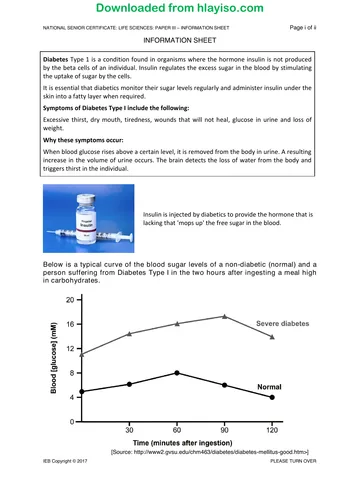
Diabetics use the levels of sugar in the blood or urine as an indicator of the
state of their insulin 'load'. High sugar levels indicate that they need to
administer or inject more insulin. Various techniques to measure the
presence of glucose in a sample of urine are available to sufferers of
diabetes.
You are going to investigate the presence of sugar in different samples of
urine* using an indicator.
Before you begin your investigation, please make sure that you have the following
equipment at your workstation:
four identical test tubes in a test-tube rack
50 ml distilled water
two empty polystyrene or plastic cups
200 ml of tap water in a cup (for cleaning)
permanent marking pen
10 ml syringe
3 ml syringe
5 ml measuring spoon
access to indicator X
access to indicator Y
thermometer
250 ml beaker or container to hold boiling water
three 'urine samples'* collected from different individuals just before this
investigation began. They are clearly marked Sample A, Sample B and
Sample C.
access to boiling water in a kettle or urn
wall clock or timing device
A4 sheet of white paper
*the samples provided in this investigation are not real urine; they have been prepared to simulate
real urine.
IEB Copyright © 2017
Downloaded from hlayiso.com
NATIONAL SENIOR CERTIFICATE: LIFE SCIENCES: PAPER III Page 3 of 10
PART 1 INVESTIGATION
1.1 Label the empty test tubes A to D using the marking pen.
1.2 Into test tube A, using a syringe, add 20 ml of Sample A.
1.3 Clean your 20 ml syringe using the tap water you have on your bench.
1.4 Into test tube B, using the cleaned syringe, add 20 ml of Sample B.
1.5 Clean your syringe using the tap water you have on your bench.
1.6 Into test tube C, using the cleaned syringe, add 20 ml of Sample C.
1.7 Into test tube D, using a clean syringe, add 20 ml of distilled water.
1.8 Using the 3 ml syringe, add 3 ml of Indicator X to each test tube, A to D.
CALL THE INVIGILATOR
1.9 Record the temperature of the contents of test tube A here. Do this whilst
the invigilator observes you recording the temperature. (1)
1.10 Gently swirl the test tubes and keep note of the initial colour in each test-
tube.
1.11 Place the four marked test tubes in the empty 250 ml beaker or container.
1.12 Collect approximately 150 ml of BOILING WATER from the urn or kettle in
a plastic measuring jug provided and immediately add to the beaker or
container holding the four test tubes.
NOTE: the boiling water acts as a water bath for the test tubes. The heat
from the water will allow the indicator to react with the samples in the test
tubes to indicate the glucose concentration.
1.13 Wait five minutes and keep note of the colour changes in the test-tube
contents AFTER heating.
IEB Copyright © 2017 PLEASE TURN OVER
Downloaded from hlayiso.com
NATIONAL SENIOR CERTIFICATE: LIFE SCIENCES: PAPER III Page 4 of 10
1.14 In the space below, draw up a suitable table, with a meaningful table
heading. In the table, record your observations of content colour both
BEFORE and AFTER heating.
(6)
1.15 Identify the independent variable in this investigation.
(2)
1.16 Identify the dependent variable in this investigation.
(2)
IEB Copyright © 2017
Downloaded from hlayiso.com
NATIONAL SENIOR CERTIFICATE: LIFE SCIENCES: PAPER III Page 5 of 10
1.17 What is the purpose of the distilled water in test-tube D?
(2)
1.18 Identify TWO controlled or fixed variables in this investigation and state how
these variables were controlled.
(4)
1.19 Write a conclusion to explain your observations in your table regarding the
sugar content of the samples of 'urine'. Your conclusion needs to include
information on all FOUR test-tubes AND needs to relate to the health of the
individual who could produce such a sample of 'urine'.
(4)
IEB Copyright © 2017 PLEASE TURN OVER
Downloaded from hlayiso.com
NATIONAL SENIOR CERTIFICATE: LIFE SCIENCES: PAPER III Page 6 of 10
1.20 With reference to the Information Sheet, suggest a possible reason for the
presence of glucose in the urine of an individual.
(2)
1.21 Blood glucose concentration is a far more reliable indication of an
individual's health than measuring the glucose levels found in urine. Below
is a graph indicating the changes in two different people's blood glucose
levels over a 23-hour period. Examine this graph and answer the questions
that follow.
[Source: <http://www.phlaunt.com/diabetes/43067769.php>]
1.21.1 According to the above graph, who is most likely to be suffering
from diabetes?
(1)
1.21.2 What is the maximum blood glucose concentration/level recorded
on the graph above?
(1)
IEB Copyright © 2017
Downloaded from hlayiso.com
NATIONAL SENIOR CERTIFICATE: LIFE SCIENCES: PAPER III Page 7 of 10
1.21.3 One of the individuals in the graph had an afternoon sugar snack.
Who had the snack and how do you know this?
(2)
1.21.4 Was qualitative or quantitative data collected in order to plot this
graph? Explain.
(2)
1.22 A micrograph of a portion of human pancreas shown below gives details of
the Beta (β) cells found in the pancreas that produce the hormone insulin.
These Beta (β) cells are found grouped or clustered in a group of cells
within the pancreatic tissue (shown as darkened) called an Islet of
Langerhans.
This micrograph has been magnified 300x. Calculate the real length of this
single Islet of Langerhans, using the line drawn on the micrograph as your
magnified length of the structure.
Show all working out of the real size in the space given alongside the
micrograph.
(3)
[Source: Ciba-Geigy]
IEB Copyright © 2017 PLEASE TURN OVER
Downloaded from hlayiso.com
NATIONAL SENIOR CERTIFICATE: LIFE SCIENCES: PAPER III Page 8 of 10
PART 2 EXPERIMENTAL DESIGN
The indicator used to detect the simple reducing sugar glucose in the previous
investigation is called Benedict's solution. In the presence of glucose
concentrations above 30 mg/litre, a brick-red/orange colour is detected.
Benedict's is not effective when used on sugars such as lactose (sugar in milk)
or sucrose (cane sugar).
Design a simple experiment to demonstrate the above information.
Use laboratory equipment and chemicals that you would find in the school
laboratory.
2.1 Formulate a hypothesis for this experiment that you are designing.
(3)
2.2 State the aim of this experiment.
(2)
2.3 State the independent variable used in this investigation.
(2)
IEB Copyright © 2017
Downloaded from hlayiso.com
NATIONAL SENIOR CERTIFICATE: LIFE SCIENCES: PAPER III Page 9 of 10
2.4 Outline your own method below using numbered points.
(8)
Total: 50 marks
IEB Copyright © 2017 PLEASE TURN OVER
Downloaded from hlayiso.com
NATIONAL SENIOR CERTIFICATE: LIFE SCIENCES: PAPER III Page 10 of 10
ADDITIONAL PAGE (use only if necessary)
IEB Copyright © 2017
Study this subject
Revise the topics in this paper, then practise them question by question.
- Grade 12 Life Sciences notes
CAPS revision notes with worked examples.
- Life Sciences questions by topic
Past exam questions sorted by CAPS topic, with memos where available.
- Grade 12 Life Sciences quizzes
Short topic quizzes with instant feedback.
- All Grade 12 Life Sciences past papers
Past papers by year, with memos where available.
- Grade 12 IEB past papers
More Life Sciences and other subjects in this collection.
Recommended for this subject
More papers and memos for this grade and subject.
Question paperIEB
Life Sciences Grade 12 IEB Paper 1 2019 Question Paper
Question paperIEB
Life Sciences Grade 12 IEB P1 2019 Question Paper (Afrikaans)
Question paperIEB
Life Sciences Grade 12 IEB P1 2019 Question Paper (Afrikaans)
Question paperIEB
Life Sciences Grade 12 IEB Paper 2 2019 Question Paper
Question paperIEB
Life Sciences Grade 12 IEB P2 2019 Question Paper (Afrikaans)
Question paperIEB
Life Sciences Grade 12 IEB P2 2019 Question Paper (Afrikaans)
Related documents
MemorandumIEB
Life Sciences Grade 12 IEB Paper 3 2017 Memo
Information sheetIEB
Life Sciences Grade 12 IEB Paper 3 2017 Information Sheet
Question paperIEB
Life Sciences Grade 12 IEB Paper 1 2017 Question Paper
Question paperIEB
Life Sciences Grade 12 IEB Paper 2 2017 Question Paper
Question paperIEB
Life Sciences Grade 12 IEB Paper 3 2019 Question Paper
Question paperIEB
Life Sciences Grade 12 IEB P3 2019 Question Paper (Afrikaans)
More from Grade 12 Life Sciences
MemorandumIEB
Life Sciences Grade 12 IEB Paper 1 2019 Memo
MemorandumIEB
Life Sciences Grade 12 IEB Paper 2 2019 Memo
Question paperIEB
Life Sciences Grade 12 IEB P3 2019 Question Paper (Afrikaans)
MemorandumIEB
Life Sciences Grade 12 IEB Paper 3 2019 Memo
MemorandumIEB
Life Sciences Grade 12 IEB Paper 1 2019 Memo
MemorandumIEB