
Downloaded from hlayiso.com
testpapers.co.za
Skip to contentAll 2017 papers 
View all
Physical Sciences Grade 10 P1 March Test 2017 Paper & Memo
Grade 10 Physical Sciences Paper 1 question paper and memo from the March Test 2017, 10 pages. Read online or get the free PDF download.
Physical Sciences · Grade 10 · March Test · 2017. Question paper and memorandum, 10 pages. Read online or download the PDF.
- Subject
- Physical Sciences
- Grade
- Grade 10
- Document type
- Question paper and memo
- Year
- 2017
- Exam period
- March Test
- Paper
- 1
- Curriculum
- CAPS
- Pages
- 10
- File size
- 379.1 KB
Free to read online, no sign-up needed
Loading document…
Loading document…
1 of 10
This exam
March Test 2017
- Paper 1Paper and memo
- Paper 2Paper and memo
Document textSearch extracted text and jump to a page.
Downloaded from hlayiso.com, ., commonest
NSC — Grade 10
Physical Science (P1)
INSTRUCTIONS AND INFORMATION
1. Write your name in the appropriate spaces on the ANSWER BOOK.
2. Answer ALL the questions in the ANSWER BOOK.
3. You may use a non-programmable calculator.
4, You may use appropriate mathematical instruments.
5. Number the answers correctly according to the numbering system used in this
question paper.
6. You are advised to use the attached data sheets.
7. Give brief motivations, discussions, et cetera where required.
8. Round off your answers to a minimum of 2 decimal places.
Copyright Reserved Please Turn Over
Downloaded from hlayiso.com
Physical Science (P1) March 2017 Common Test
NSC - Grade 10
QUESTION 1: MULTIPLE CHOICE QUESTIONS
Four options are provided as possible answers to the following questions.
Each question has only ONE correct answer. Choose the answer and write only
the letter (A — D) next to the question number (1.1 — 1.3) in the ANSWER BOOK,
for example 1.4 C.
1.1. The maximum displacement of a particle from its equilibrium position along a
wave train is best described as its...
wavelength.
pitch.
amplitude.
frequency. (2)
vuOD>Y
1.2 Sound travels...
A fastest through solids.
B faster through air than water.
Cc faster through water than air.
D. faster through water than solids. (2)
1.3. When moving in a vacuum, all electromagnetic waves have the same ...
A amplitude.
B frequency.
Cc speed.
2) wavelength. (2)
2x3= [6]
Copyright Reserved Please Turn Over
~~ Downloaded from hlayiso.com
Physical Science (P1) Nsc- orate 40
QUESTION 2
Two pulses A and B move towards each other through the same piece of rubber
tubing. Pulse A is moving to the left with amplitude of +7 cm and pulse B is moving
to the right with an amplitude of -10 cm. The pulses meet at point C.
(Assume that all energy is conserved).
2.1 Whatis a pulse?
2.2 State the principle of superposition of waves.
2.3. Draw a labelled diagram to show the pulses at point C.
2.4 What type of interference takes place at point C?
2.5 Calculate the resultant amplitude at the meeting point (point C).
2.6 What is the amplitude and direction of pulse A after passing point C?
March 2017 Common Test
(2)
(2)
(3)
(1)
(2)
{11]
Copyright Reserved Please Turn Over
Downloaded from hlayiso.com
Physical Science (P1)
NSC — Grade 10
QUESTION 3
Study the wave motion produced by a water wave.
Ce
wr
J
La]
—
|
hm
3.1. What type of wave is a water wave?
-3.2 Using the diagram, identify a point:
3.2.1 that is a crest.
3.2.2 where the particles of water are at rest.
3.2.3 that is In phase with point F.
3.2.4 that indicates a complete wave cycle with point R.
3.3. In what direction is a particle at B about to move?
3.4 How many wave cycles are shown in the diagram above?
3.5 A water wave passes a point at a rate of 5 complete wave cycles per second.
If the wavelength is 75 mm, calculate the:
3.5.1 frequency of the wave.
3.5.2 peed of the wave.
3.5.3 distance covered by the wave in 4 minutes.
Copyright Reserved Please Turn Over
March 2017 Common Test
(1)
(1)
(1)
(1)
(1)
(4)
(4)
[16]
Downloaded from hlayiso.cony
NSC ~ Grade 10
Physical Science (P1) rch 2017 Common Test
QUESTION 4
A sound wave produced by a piano is represented in DIAGRAM 1 below.
DIVGRAM 1
B
A A A
4.1. What type of a wave is a sound wave? (1)
4.2 What is indicated by:
4.2.1 A? (1)
4.2.2 B? (1)
4.3 Apiano produces a musical sound with a frequency of 440 Hz,
4.3.1 How long will it take to produce one complete wave cycle? (2)
After a while, the listener realises that the pitch of the sound note is higher.
4.3.2 Has the FREQUENCY or the AMPLITUDE of the sound changed?
Give a reason. (2)
[7]
Copyright Reserved Please Turn Over
Downloaded from hlayiso.com
Physical Science (P1) March 2017 Common Test
NSC — Grade 10
QUESTION 5
The diagram below represents the electromagnetic spectrum.
ato Microwaves Infrared Visible light | Ultraviolet X-Rays oe
Red Violet
5.1 Name the type of electromagnetic radiation that:
5.1.1 has the longest wavelength (1)
5.1.2 is used in the treatment of some cancers (1)
5.1.3. is used to send a signal from the remote control to the Television. (1)
5.2 A photon of electromagnetic radiation has a wavelength of 400 nm.
5.2.1 Define a photon. (1)
5.2.2 Calculate the frequency of this radiation. (3)
5.2.3 Determine the energy of a photon of this radiation. (3)
[10}
TOTAL MARKS: [50]
Copyright Reserved Please Turn Over
Downloaded from hlayiso.com
Physical Science (P1) 8 March 2017 Common Test
NSC - Grade 10
DATA FOR PHYSICAL SCIENCES GRADE 10
PAPER 1 (PHYSICS)
GEGEWENS VIR FISIESE WETENSKAPPE GRAAD 10
VRAESTEL 1 (FISIKA)
TABLE 1: PHYSICAL CONSTANTS/TABEL 1: FISIESE KONSTANTES
NAME/NAAM SYMBOL/SIMBOOL VALUE/WAARDE
TABLE 2: FORMULAE/TABEL 2: FORMULES
WAVES, SOUND AND LIGHT/GOLWE, KLANK EN LIG
1
ve=fA Ta
f
Ax
= E=hf
"it
c=fA E=ho
x
Copyright Reserved
48nQ win | aseald . penlesey wBuAdoD ‘JOAQ UM | BSEAIq} _ _ ~ penesay 1uAdos,
8 tu “saBed y Jo S]SISUOD WNpUeIOWOEW SIUL “SN
PS @) A WMO pW 9%
” () supe-=(Ol-)+(U+) oz
a a) / Souslepeyul engonyseq —y°Z
a (e)
AY WOE 309 85M] asso - a
£ Wi g@esing T 2
ro) x Vasing| “><
ha we] ¥ ALVOdILYAS
we YOINAS TVNOILYN
xo} ez
Dd aeewenepessesessccues
@ 009 “awuQ owes 21 ds ot
gS @uy Adnoso yeuy sesind omy jo sépmuluue oun jo uns oIesqe5e 241 rad : L102 HOUVIA
ae) (2) Ay uunpau e ul eouequNysip ajBuls YZ WAGNYHOWSIN
Cc 4IS3L NOWIWO:
= z NOWSaND S31 2
fo}
[9]
(an) @ PRD SE I 9ST
(2) vz
ay a Vord4v HLNOS 40 oIanday
@ yoo uoneonps jo Jusupedeg jeyen-ninzemy
uoleonpy
- NOLLSAND
~ 388 | WOUND 2 LOZ WUeEW, z nN 9SN bd Sequels jeaishyg
> It ane ot aayyin
2
Downloaded from hlayiso.com
AON WNL eSBAld peniasey 16uAdog
OS :SMUVIN TWLOL
for]
{e)
A> PerOlX r= 2 POL X LB =
«OLX 00h 7 pOEXG'LX OL XE9'9= |
A OLXEx 0b x E99 ~ ”wea
xX. q HO 77's woy Ajennisod wey €'7'S
Ay
) pp ZHnOLXGZ=4
ip 6OLXO07X4= 20h XE
ANKLER TES
{y) 7 Wy ul punoy ABreus jo eyed 17g
zs
0) Pp pareuul 1's
() yp Skerx Jo shes ewes, ZG
@) A SOKEM OEY LEG
rs
SNOLLSaND
174
@ / “youd euy seybiy ap Aouenbey. ayy seyBiy OuL
7 fouenbary Tey
@ PZ Se OLX LE =
Ow _
=
2
cyF L ley
er
a AUBUENEM TTP
(Lt) puossedWog 1Zr
te
(0) /7 “enemjeupnybuo] 7
ySe, VOWED 1102 UOTE.
¥ NOILSSNO
umpuesowsiy — ISN
¥ be Seousbs feotstyd
J0NQ Wh ase
foul
()
)
(0)
(1)
a)
(1)
()
“Ly
a)
w
“ yS0 YOWWOD Lb0Z HOE
AwOE = XV
09 X 7 “
Aw 7SLE0
We A EGE
fog 7
7 Su g7e'o =
PSELVOX AG =
ANXLEA TFS
AFHG=h LSE
se
P/ SOpAD SAEMG'Z HE
yspremdj) fe
sa VTE
AM CTE
At @ze
cH LTE
we
7 @AWM OSIOASUBI] = LE
€ NOILSSND
uinpuesowey — SN
£ . 1 seouanig jearsfyg
Study this subject
Recommended for this subject
Question paper and memo
Physical Sciences Grade 10 P2 March Test 2017 Paper & Memo
Question paper and memo
Physical Sciences Grade 10 P1 2017 QP & Memo
Question paper and memo
Physical Sciences Grade 10 P1 March Test 2019 Paper & Memo
Question paper and memo
Physical Sciences Grade 10 P1 March Test 2016 Paper & Memo
Memorandum
Physical Sciences Grade 10 P1 Gauteng June 2017 Memo (Afr)
Question paper
Physical Sciences Grade 10 P1 Gauteng June 2017 QP (Afr)
More from Grade 10 Physical Sciences
Question paper
Physical Sciences Grade 10 P2 November Mock Exam 2 2026 QP
Annual teaching plan
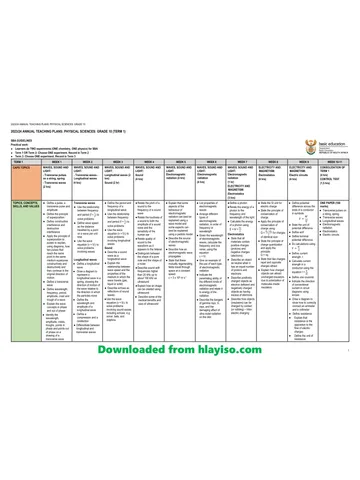
Gr 10 Phys Sci ATP 2023 24
Question paper
Physical Sciences Grade 10 Eastern Cape March Test 2025 QP
Memorandum
Physical Sciences Grade 10 P2 Gauteng June 2024 Memo (Eng)
Question paper
Physical Sciences Grade 10 P1 Gauteng June 2024 QP (Afr)
Question paper