
education
MPUMALANGA PROVINCE
REPUBLIC OF SOUTH AFRICA
EHLANZENI DISTRICT
PHYSICAL SCIENCES
GRADE 12
PHYSICS & CHEMISTRY (P1 & P2)
MARCH CONTROL TEST
2025
MARKS: 100
TIME: 2 hours
This question paper consists of 12 pages including data sheets
Copyright reserved Please turn over
Skip to contentAll 2025 papers 




View all

Physical Sciences Grade 12 P1 Mpumalanga March Test 2025 QP
Grade 12 Physical Sciences Paper 1 question paper from the Mpumalanga March Test 2025, 12 pages. Read online or download the free PDF.
Physical Sciences · Grade 12 · Mpumalanga March Test · 2025. Question paper, 12 pages. Read online or download the PDF.
- Subject
- Physical Sciences
- Grade
- Grade 12
- Document type
- Question paper
- Year
- 2025
- Exam period
- Mpumalanga March Test
- Paper
- 1
- Curriculum
- CAPS
- Pages
- 12
- File size
- 1.7 MB
Free to read online, no sign-up needed
Loading document…
Loading document…
1 of 12
This exam
Mpumalanga March Test 2025
- Paper 1Question paperMemo
- Other filesQuestion paperMemo
Questions in this paper
Document textSearch extracted text and jump to a page.
Physical Sciences 2 March/Ehlanzeni 2025
Grade 12
INSTRUCTIONS AND INFORMATION
1. Write your name in the appropriate space on the FOLIO PAPER.
2. This question paper consists of SEVEN questions. Answer ALL the questions in the
FOLIO PAPER.
3. Start EACH question on a NEW page in the FOLIO PAPER.
4. Number the answers correctly according to the numbering system used in this question
paper.
5. Leave ONE line between two sub questions, for example between QUESTION 2.1 and
QUESTION 2.2.
6. You may use a non-programmable calculator.
7. You may use appropriate mathematical instruments.
8. You are advised to use the attached DATA SHEETS.
9. Show ALL formulae and substitutions in ALL calculations.
10. Round off your final numerical answers to a MINIMUM of TWO decimal places.
11. Give brief motivations, discussions, et cetera where required.
12. Write neatly and legibly.
Copyright reserved Please turn over
Physical Sciences 3 March/Ehlanzeni 2025
Grade 12
QUESTION 1 : MULTIPLE-CHOICE QUESTIONS
Four options are provided as possible answers to the following questions. Each question has
only ONE correct answer. Choose the answer and write only the letter (A — D) next to the
question number (1.1 — 1.4) in the ANSWER BOOK, for example, 1.5 E.
1.1 Impulse is equal to the ...
A rate of change in momentum of an object.
B change in momentum of an object.
Cc Net force acting on the object.
D Product of mass and velocity of an object. (2)
1.2 Aballis thrown vertically upwards. Which ONE of the following physical quantities of the
ball has a ZERO value at its highest point?
Kinetic energy
Acceleration
Weight
0 Oo DBD >
Potential energy (2)
1.3. The magnitude of the gravitational force exerted by one body on another body is F.
When the distance between the centres of the two bodies is HALVED and the mass of
one body is DOUBLED, the magnitude of the gravitational force, in terms of F, will now
be...
A 1
qF
Bote
Cc 2F
D 8F (2)
Copyright reserved Please turn over
Physical Sciences
4
Grade 12
March/Ehlanzeni 2025
1.4. Which ONE of the following organic compounds has NO structural isomers?
A Propan-1-ol
B Propanal
Cc Propane
D
Propanoic acid.
Copyright reserved
Please turn over
Physical Sciences 5 March/Ehlanzeni 2025
Grade 12
QUESTION 2
Two objects, P, and Q, of masses, m kg and 5 kg respectively are joined by a light inextensible
string running over a frictionless pulley. When a force of 21 Nis exeted on the 5 kg as shown
in the diadram below, the two objects REMAIN STATIONARY. Ignore the effects of air friction.
P Q
mkg << 60° aL..-.. 5kg
C i] |
F=21N
The coefficient of STATIC FRICTION between the surface of the table and object, P, is 0,25.
2.1 State Newton’s first law of motion in words. (2)
2.2 Write down the:
2.2.1 Magnitude of the net force acting on the 5 kg object. (1)
2.2.2 Direction of TENDENCY of motion of object, P, would move when a force greater
than 21 N pulls the 5 kg. Choose EAST or WEST. (1)
2.3 Draw a labelled FREE-BODY diagram indicating all the forces acting on object, P. (4)
2.4 Draw a labelled FORCE diagram indicating all the forces acting on object, Q. (3)
2.5 Calculate the:
2.5.1 Magnitude of the tension in the string. (3)
2.5.2 Mass of object, P. (3)
2.6 If the magnitude of the force exerted on the 5 kg is now increased to be greater than 21
N. What will happen to the magnitude of the acceleration of the 5 kg? Write down
INCREASES, DECREASES or REMAINS THE SAME. Explain the answer. (2)
[19]
Copyright reserved Please turn over
Physical Sciences 6 March/Ehlanzeni 2025
Grade 12
QUESTION 3
A ball is thrown vertically upwards from the edge (top) of a building and bounces a few times
as it hits the ground. The displace-time graph below describes the motion of the ball from the
time it is thrown, up to a certain time T (maximum height). The motion of the ball is observed
from the point of launch. Ignore the effects of air friction.
Displacement (m)
v
3.1 Define the term free fall. (2)
3.2 Write down the:
3.2.1 Height above the ground from where the ball was thrown upwards. (1)
3.2.2 Acceleration of the ball at t = 0,6 s. (2)
3.3 Calculate the:
3.3.1 Velocity at which the ball is thrown upwards. (3)
3.3.2 Maximum height the ball reached above the ground after the SECOND bounce. (2)
3.3.3 Velocity at which the ball leaves the ground after the FIRST bounce. (3)
3.3.4 Numerical value of time, t, shown on the graph. (5)
Copyright reserved Please turn over
Physical Sciences 7 March/Ehlanzeni 2025
Grade 12
3.4 Draw avelocity-time graph for the motion of the ball from the instant it is thrown upwards
until it reaches its maximum height after the first bounce (time, t).
Indicate the following on the graph:
¢ Initial velocity of the ball.
¢ Velocity at which it leaves the ground after the first bounce.
e Time taken to reach maximum height for the first time.
(4)
[22]
QUESTION 4
Trolley, P, of mass 2 000 g travels at 4 m-s" east and collides with trolley, Q, of mass m kg
which is moving at 3 m-s' west. The TOTAL KINETIC ENERGY of the two trolleys before the
collision is 38,5 J. Ignore all frictional effects and consider the system isolated.
4m-s 3m-s!
lee lee!
The change in momentum of trolley, P, immediately after the collision is 12,5 kg-s' west.
4.1 Explain what is meant by an isolated system (in Physics). (2)
4.2 Calculate the:
4.2.1 Mass of trolley, Q. (2)
4.2.2 Speed of trolley, P, immediately after the collision. (3)
4.2.3 Velocity of trolley, Q, immediately after the collision. (3)
4.3 How does the magnitude of the impulse on trolley, P, compare to the impulse on trolley,
Q, immediately after the collision? Write down GREATER THAN, LESS THAN or
EQUAL TO. Explain the answer. (2)
[12]
Copyright reserved Please turn over
Physical Sciences 8 March/Ehlanzeni 2025
Grade 12
QUESTION 5
The letters A to D in the table below represent four organic compounds with different
functional groups. Use the table to answer the questions that follow.
i
A H—C—H B Propanoic acid
1
H-C-H
c Hon H | H D CHs(CHz)2CHs
H—C—C—C—C—C—H
oe |
H BH | H
H—-C-H
H
5.1 Define the term functional group.
5.2 For organic compound, A, write down:
5.2.1 Its CONDENSED STRUCTURAL FORMULA.
5.2.2 The IUPAC name of its POSITIONAL ISOMER.
5.3 For organic compound, C, write down the:
5.3.1 Type of alkyl halide (halo-alkane). Give a reason for the answer.
5.3.2 IUPAC name.
5.4. For compound, D:
5.4.1. Draw the STRUCTURAL FORMULA of its functional group.
Copyright reserved Please turn over
Physical Sciences 9 March/Ehlanzeni 2025
Grade 12
5.4.2 Write down a balanced chemical equation using molecular formula for the
complete combustion of compound, D.
5.5 For compound, B:
5.5.1 Name given to its functional group. (1)
5.5.2 Draw its STRUCTURAL FORMULA. (2)
[18]
Copyright reserved Please turn over
10 March/Ehlanzeni 2025
Grade 12
Physical Sciences
QUESTION 6
During a practical investigation the boiling points of four organic compounds (P, Q, R and S)
were determined and boiling points of compound, R and S were recorded in the table below.
COMPOUND STRUCTURAL FORMULA BOILING POINT (°C)
P H H H H
rttt lt, ;
had
Q H H Br H
vttt lt ;
hae
R H
H—t—H
OH | H 108
n—¢—¢—d_4
Had
Ss OH H H H
wet tly 117,7
AAAS
6.1 Define the term boiling point. (2)
6.2 Compound, R and S have different boiling points as shown in the table.
6.2.1 Write down the name of the type of intermolecular force responsible for this
difference in boiling points of the two compounds. (1)
6.2.2 Which compound (R or S) will have aLOWER VAPOUR PRESSURE? Use the
table to give a reason for the answer. (2)
6.3. The boiling points of compound, P and Q are compared. Which compound (P or Q) has
Copyright reserved
a higher boiling point? Explain the answer.
Please turn over
Physical Sciences 11 March/Ehlanzeni 2025
Grade 12
QUESTION 7
The flow diagram below shows various organic reactions using CH2CH: as a starting reactant.
A, and B represent different organic compounds and P, Q and R represent inorganic
compounds.
CH2CH2
‘A
ot
ae 2
Zia
8/5
a
oo
Compound A Rs CoHeO
orn
Be
Compound B
7.1 For reaction 1, write down:
7.1.1 The type of reaction. (1)
7.1.2 One reaction condition. (1)
7.1.3 A balanced chemical equation for the reaction USING STRUCTURAL
FORMULA.
(3)
7.2 For reaction 2, write down the:
7.2.1 Type of reaction. (1)
7.2.2 Homologous series to which compound B belongs to. (1)
7.2.3 CHEMICAL NAME of the inorganic product formed during this reaction. (1)
7.3 For reaction 3, write down the:
7.3.1 Type of addition reaction. (1)
7.3.2 IUPAC NAME of the organic product formed. (2)
7.4 Write down the type of reaction represented by reaction 6. (1)
[12]
GRAND TOTAL: 100
Copyright reserved Please turn over
Physical Sciences 12 March/Ehlanzeni 2025
Grade 12
DATA FOR PHYSICAL SCIENCES GRADE 12
PAPER 1 (PHYSICS)
GEGEWENS VIR FISIESE WETENSKAPPE GRAAD 12
VRAESTEL 1 (FISIKA)
TABLE 1: PHYSICAL CONSTANTS/TABEL 1: FISIESE KONSTANTES
NAME/NAAM SYMBOL/SIMBOOL VALUE/WAARDE
TABLE 2: FORMULAE/TABEL 2: FORMULES
MOTION/BEWEGING
Vp =Vj + aAt Ax =v, At +4adt? or/of Ay =v,At + at?
v, =v, + 2aAx orof v,? =v,? +2aay | dx -(“ -_ Jas or/of Ay = (“Jas
FORCE/KRAG
Fig =Ma p=mv
f,°™ =p,N f, =y,.N
ive my w-mg
F= oe 2 orlof F= ou g-cu or/of g-cN
Copyright reserved
Study this subject
Recommended for this subject
Question paper
Physical Sciences Grade 12 Mpumalanga March Test 2025 QP
Question paper
Physical Sciences Grade 12 P1 Mpumalanga June 2025 QP
Memorandum
Physical Sciences Grade 12 Mpumalanga March Test 2025 Memo
Memorandum
Physical Sciences Grade 12 P1 Eastern Cape Mock 2025 Memo
Memorandum
Physical Sciences Grade 12 Paper 1 Limpopo June 2025 Memo
Memorandum
Physical Sciences Grade 12 Paper 1 Limpopo Mock 2025 Memo
More from Grade 12 Physical Sciences
Memorandum
Physical Sciences Grade 12 P2 Eastern Cape June 2025 Memo
Memorandum
Physical Sciences Grade 12 Paper 2 Limpopo June 2025 Memo
Question paper
Physical Sciences Grade 12 P2 North West Mock 2025 QP
Question paper
Physical Sciences Grade 12 P2 NSC June 2025 QP (Eng)
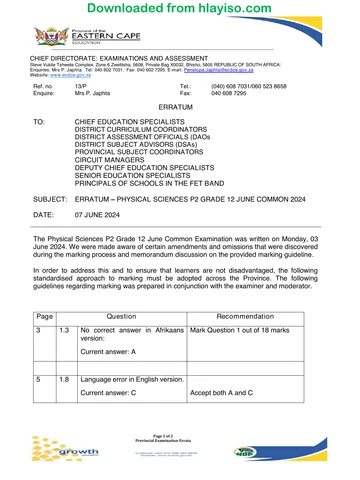
Errata
Physical Sciences Grade 12 P2 Eastern Cape June 2024 Errata
Question paper