
Downloaded from hlayiso.com
SENIOR CERTIFICATE EXAMINATIONS/
NATIONAL SENIOR CERTIFICATE EXAMINATIONS
TECHNICAL SCIENCES P1
2023
MARKS: 150
TIME: 3 hours
This question paper consists of 17 pages and 3 data sheets.
Copyright reserved Please turn over
Skip to contentAll 2023 papers 

View all
Technical Sciences Grade 12 P1 NSC June 2023 QP (Eng)
Grade 12 Technical Sciences Paper 1 question paper from the NSC June Exam 2023 (English), 20 pages. Read online or download the free PDF.
Technical Sciences · Grade 12 · NSC June Exam · 2023. Question paper, 20 pages. Read online or download the PDF.
- Subject
- Technical Sciences
- Grade
- Grade 12
- Document type
- Question paper
- Year
- 2023
- Exam period
- NSC June Exam
- Paper
- 1
- Curriculum
- CAPS
- Pages
- 20
- File size
- 813.7 KB
Free to read online, no sign-up needed
Loading document…
Loading document…
1 of 20
This exam
NSC June Exam 2023
Questions in this paper
Document textSearch extracted text and jump to a page.
Downloaded from hlayiso.com
Technical Sciences/P1 2 DBE/2023
SC/NSC
INSTRUCTIONS AND INFORMATION
1. Write your centre number and examination number in the appropriate spaces
on the ANSWER BOOK.
2. This question paper consists of TEN questions. Answer ALL the questions in
the ANSWER BOOK.
3. Start EACH question on a NEW page in the ANSWER BOOK.
4. Number the answers correctly according to the numbering system used in this
question paper.
5. Leave ONE line between two subquestions, e.g. between QUESTION 2.1 and
QUESTION 2.2.
6. You may use a non-programmable calculator.
7. You may use appropriate mathematical instruments.
8. You are advised to use the attached DATA SHEETS.
9. Show ALL formulae and substitutions in ALL calculations.
10. Round off your FINAL numerical answers to a minimum of TWO decimal
places.
11. Give brief motivations, discussions, etc. where required.
12. Write neatly and legibly.
Copyright reserved Please turn over
Downloaded from hlayiso.com
Technical Sciences/P1 3 DBE/2023
SC/NSC
QUESTION 1: MULTIPLE-CHOICE QUESTIONS
Various options are provided as possible answers to the following questions. Choose
the answer and write only the letter (A–D) next to the question numbers (1.1 to 1.10) in
the ANSWER BOOK, e.g. 1.11 D.
1.1 The property of a body to resist any change in its state of motion or rest is …
A mass.
B force.
C inertia.
D acceleration. (2)
1.2
1.1 The diagram below shows forces F1 and F2 that are applied on an object
placed on a frictionless surface. The object accelerates to the left.
F1 F2
Which ONE of the following statements is CORRECT?
A F1 = F2
B F1 > F2
C F1 < F2
D F1 + F2 = 0 (2)
1.3 In physics, an isolated system is defined as a system in which …
A the net external force acting on it is zero.
B the net external forces acting on it is greater than zero.
C only energy remains constant.
D only matter remains constant. (2)
Copyright reserved Please turn over
Downloaded from hlayiso.com
Technical Sciences/P1 4 DBE/2023
SC/NSC
1.4 The graph below represents the work done on an object versus time taken.
Work done
Time
Which ONE of the following physical quantities is represented by the gradient
of the graph?
A Potential energy
B Momentum
C Power
D Kinetic energy (2)
1.5 Which ONE of the following statements about Hooke's law is CORRECT?
Stress is …
A directly proportional to strain when the elastic limit is not exceeded.
B inversely proportional to strain when the elastic limit is exceeded.
C directly proportional to strain when the elastic limit is exceeded.
D inversely proportional to strain when the elastic limit is not exceeded. (2)
1.6 Pressure is measured in …
A joules.
B watts.
C pascal.
D metres. (2)
Copyright reserved Please turn over
Downloaded from hlayiso.com
Technical Sciences/P1 5 DBE/2023
SC/NSC
1.7 Dispersion of light is the ...
A bending of a light ray as it passes between media of different optical
densities.
B change in direction of a light ray as it hits a barrier.
C spreading out of light as it passes around the edges of a small hole.
D breaking of white light into its component colours. (2)
1.8 Which ONE of the following units are used to measure frequency?
A Second
B Decibel
C Hertz
D Joule (2)
1.9 The capacitance in a capacitor will increase when ...
A a dielectric with a higher dielectric constant is used
B a dielectric with a lower dielectric constant is used.
C the distance between the plates increases.
D the distance between the plates decreases. (2)
1.10 A device that converts electric energy into mechanical energy is a ...
A generator.
B capacitor.
C transformer.
D motor. (2)
[20]
Copyright reserved Please turn over
Downloaded from hlayiso.com
Technical Sciences/P1 6 DBE/2023
SC/NSC
QUESTION 2 (Start on a new page.)
2.1 Passengers sitting in a bus observe that they move forward when the bus
slows down to a stop and that they move backward when it accelerates from
rest.
2.1.1 Use physics law or principles to explain this observation as
experienced by the passengers in the bus. (2)
2.1.2 Name and state the physics law or principle that you applied in your
answer to QUESTION 2.1.1. (3)
2.2 A caravan of mass 900 kg is pulled by a car of mass 1 300 kg along a straight
level smooth road by means of a light inextensible rope.
10 500 N
The effects of friction are ignored.
2.2.1 Draw a labelled free-body diagram of all the forces acting on the car. (4)
2.2.2 Calculate the acceleration of the system. (4)
2.2.3 Calculate the magnitude of the tension in the rope between the
caravan and the car. (2)
2.3 Workers are loading equipment into a freight elevator at the top floor of a
building. However, they overload the elevator and the worn-out cable snaps.
The mass of the loaded elevator at the time of the accident is 1 600 kg. As the
elevator falls, the guide rails exert a constant retarding force of 3 700 N on the
elevator.
Calculate the:
2.3.1 Resultant force on the falling elevator (3)
2.3.2 Acceleration of the elevator while falling downwards (3)
Copyright reserved Please turn over
Downloaded from hlayiso.com
Technical Sciences/P1 7 DBE/2023
SC/NSC
2.4 An apple falls freely from a tree.
2.4.1 State Newton's Third Law in words. (2)
2.4.2 Write down the action-reaction forces when the apple falls. (2)
[25]
Copyright reserved Please turn over
Downloaded from hlayiso.com
Technical Sciences/P1 8 DBE/2023
SC/NSC
QUESTION 3 (Start on a new page.)
The diagram below shows two rugby players, A and B, running towards each other in a
rugby match.
Player A with a mass of 100 kg is running at a speed of 5 m∙s-1 to the right and
player B with a mass of 75 kg is running at a speed of 4 m∙s -1 to the left, as shown
below. Ignore the effects of ALL forms of friction.
BEFORE
100 kg 75 kg
5 m∙s-1 4 m∙s-1
A
B
AFTER
3.1 Define the term momentum in words. (2)
3.2 After making contact with each other, the two players move together.
3.2.1 Calculate the velocity of the players after making contact with each
other. (4)
3.2.2 Name and state the physics law or principle you have applied in the
calculation of your answer to QUESTION 3.2.1. (3)
Copyright reserved Please turn over
Downloaded from hlayiso.com
Technical Sciences/P1 9 DBE/2023
SC/NSC
3.3 Graph A below shows the net force versus contact time for a hard squash ball
that rebounds off a brick wall. Study the graph carefully and then answer the
questions that follow.
Fnet (N)
0 1 2
∆t (s)
3.3.1 State Newton's Second Law of Motion in words, in terms of
momentum. (2)
3.3.2 Calculate the area under graph A. (3)
3.3.3 Write down the name of the physical quantity that is represented by
the area under the net force versus time graph. (1)
3.3.4 A softer squash ball of the same mass is now used and when it hits
the brick wall, it experiences the same change in momentum as the
hard squash ball.
In your ANSWER BOOK, redraw graph A and on the same set of
axes, draw an unscaled sketch graph of the net force versus time for
the softer squash ball. Label it graph B. (3)
3.4 Write down TWO design features in modern cars that apply the principle of
momentum and impulse to reduce the extent of injuries to passengers during
a collision. (2)
3.5 Explain how any ONE of the design features in QUESTION 3.4 can reduce
the extent of injuries. In your explanation, refer to TIME and NET FORCE or
FORCE OF IMPACT. (2)
[22]
Copyright reserved Please turn over
Downloaded from hlayiso.com
Technical Sciences/P1 10 DBE/2023
SC/NSC
QUESTION 4 (Start on a new page.)
A crane is lifting an object of mass 600 kg from point A to point B at a CONSTANT
SPEED to a vertical height of 25 m in two minutes, as shown in the diagram below.
Ignore the effects of air friction.
B
25 m
A
4.1 Calculate the:
4.1.1 Work done by the crane to move the object from A to B (3)
4.1.2 Power at which the crane operates (4)
4.2 Define the term gravitational potential energy in words. (2)
4.3 A construction worker stands on a scaffold and accidentally drops a brick of
mass 3 kg. The brick hits the ground with a speed of 7 m∙s-1. Ignore the
effects of air friction.
Calculate the:
4.3.1 Kinetic energy of the brick just before it hits the ground (3)
4.3.2 Height from which the brick was dropped (4)
[16]
Copyright reserved Please turn over
Downloaded from hlayiso.com
Technical Sciences/P1 11 DBE/2023
SC/NSC
QUESTION 5 (Start on a new page.)
A force, F1, of 200 N is applied on a small piston of a hydraulic system with a diameter
of 5,046 × 10-2 m. The area of a large piston, F2 , is 5,25 m2 , as shown in the diagram
below.
F1
F2
5.1 State Pascal's law in words. (2)
5.2 Calculate the force, F2, on the large piston. (5)
5.3 The distance between the two pistons is decreased by using a shorter pipe.
How will it affect the answer to QUESTION 5.2? Write only INCREASE,
DECREASE or REMAIN THE SAME. (1)
5.4 Write down TWO applications of hydraulic systems. (2)
5.5 The diagram below shows a steel rod of length 1 m and a diameter of 0,02 m.
A force, F, stretches the rod and produces a strain of 0,16 x 10⁻². Young's
modulus of steel is 2 × 10¹¹ Pa.
Calculate the:
5.5.1 Stress in the rod (3)
5.5.2 Force, F, applied on the rod (4)
[17]
Copyright reserved Please turn over
Downloaded from hlayiso.com
Technical Sciences/P1 12 DBE/2023
SC/NSC
QUESTION 6 (Start on a new page.)
6.1 A light ray strikes a reflective plane surface at an angle of 58° with the
surface.
A B
1 2
Surface
O
6.1.1 Define the term reflection. (2)
Label the following:
6.1.2 Light ray OB (1)
6.1.3 Angle 1 (1)
6.1.4 Angle 2 (1)
6.1.5 State the relationship between angle 1 and angle 2. (2)
6.2 The diagram below shows the path of a ray of red light striking a glass prism.
Study the diagram carefully and answer the questions that follow.
ray of red light
6.2.1 Name the phenomenon observed in the diagram. (1)
6.2.2 State TWO applications of the phenomenon in QUESTION 6.2.1. (2)
6.2.3 Write down TWO conditions for the phenomenon in
QUESTION 6.2.1. (2)
Copyright reserved Please turn over
Downloaded from hlayiso.com
Technical Sciences/P1 13 DBE/2023
SC/NSC
6.3 The ray diagram below shows an image of an object placed between F and
2F of a lens.
6.3.1 Name the type of lens used in the diagram. (1)
6.3.2 State TWO properties of the image formed by the lens in
QUESTION 6.3.1. (2)
6.3.3 Give TWO uses of the lens in QUESTION 6.3.1. (2)
6.3.4 Give a reason why NO IMAGE is formed when the object is placed
at F. (2)
[19]
Copyright reserved Please turn over
Downloaded from hlayiso.com
Technical Sciences/P1 14 DBE/2023
SC/NSC
QUESTION 7 (Start on a new page.)
A photon of electromagnetic radiation has a frequency of 2,4 GHz.
TYPE OF RADIATION WAVELENGTH (m)
Radio wave 10 to 104
Microwave 10-3 to 0,3
Infrared 8 x 10⁻⁷ to 3 x 10⁻⁵
Visible light 4 x 10⁻⁷ to 8 x 10⁻⁷
Ultraviolet ray 6 x 10⁻¹⁰ to 4 x 10⁻⁷
X-ray 1 x 10⁻¹⁰ to 3 x 10⁻⁸
Gamma ray 10-14 to 10-10
7.1 For this photon calculate the:
7.1.1 Energy (3)
7.1.2 Wavelength (3)
7.2 Use the table above to identify the type of radiation to which this photon
belongs. (1)
7.3 Give ONE use of the radiation in QUESTION 7.2. (1)
[8]
Copyright reserved Please turn over
Downloaded from hlayiso.com
Technical Sciences/P1 15 DBE/2023
SC/NSC
QUESTION 8 (Start on a new page.)
A parallel plate capacitor has a capacitance of 6 x 10-12 F and a charge of 0,3 x 10⁻⁶ C
on each one of the identical metal plates. The metal plates are 5 cm apart. The
dielectric material for this capacitor is air.
8.1 Define a capacitor. (2)
8.2 State the relationship between the capacitance of a capacitor and the charge. (2)
8.3 Calculate the:
8.3.1 Potential difference between the metal plates (3)
8.3.2 Area of each metal plate (3)
[10]
Copyright reserved Please turn over
Downloaded from hlayiso.com
Technical Sciences/P1 16 DBE/2023
SC/NSC
QUESTION 9 (Start on a new page.)
The circuit diagram below was used to investigate the relationship between the current
passing through resistor R and the potential difference across it at constant
temperature.
The results are shown in the graphs of current versus potential difference
below.
Graphs of current versus potential difference
0,8 A
0,6
Current (A)
B
0,4
0,2
0 0,5 1,0 1,5 2,0 2,5
Potential difference (V)
9.1 For this investigation, identify:
9.1.1 An independent variable (1)
9.1.2 A dependent variable (1)
9.2 Write down the conclusion that could be drawn from the shape of these
graphs. (2)
9.3 Use the information in graph A to calculate the power dissipated by resistor R
when the current is 0,6 A. (3)
9.4 How does the resistance of graph A compare to the resistance of graph B?
Write down only HIGHER THAN, LOWER THAN or EQUAL TO. (1)
9.5 Explain the answer to QUESTION 9.4. (2)
[10]
Copyright reserved Please turn over
Downloaded from hlayiso.com
Technical Sciences/P1 17 DBE/2023
SC/NSC
QUESTION 10 (Start on a new page.)
The diagram below represents a simplified diagram of an electronic device connected
to a light bulb.
How would EACH of the changes below affect the brightness of the bulb? Write down
only INCREASE, DECREASE or NO EFFECT.
10.1 A weaker magnet is used. (1)
10.2 A coil is rotated faster. (1)
10.3 The number of turns in the coil is increased. (1)
[3]
TOTAL: 150
Copyright reserved
Downloaded from hlayiso.com
Technical Sciences/P1 DBE/2023
SC/NSC
DATA FOR TECHNICAL SCIENCES GRADE 12
PAPER 1
GEGEWENS VIR TEGNIESE WETENSKAPPE GRAAD 12
VRAESTEL 1
TABLE 1: PHYSICAL CONSTANTS/TABEL 1: FISIESE KONSTANTES
NAME/NAAM SYMBOL/SIMBOOL VALUE/WAARDE
Acceleration due to gravity
g 9,8 m·s-2
Swaartekragversnelling
Speed of light in a vacuum
c 3,0 x 10⁸ m·s-1
Spoed van lig in 'n vakuum
Planck's constant
h 6,63 x 10⁻³⁴ J·s
Planck se konstante
Electron mass
me 9,11 x 10⁻³¹ kg
Elektronmassa
Permittivity of free space
ԑo 8,85 x 10⁻¹² F.m-1
Permatiwiteit van vrye spasie
TABLE 2: FORMULAE/TABEL 2: FORMULES
FORCE/KRAG
Fnet ma p mv
fs max = μsN fk = μk N
Fnet Δt = Δp
Fg mg
Δp = mv f - mvi
Δv L e
a MA = E I
Δt
WORK, ENERGY AND POWER/ARBEID, ENERGIE EN DRYWING
W Fx cos U mgh or/of EP mgh
1 1 W
K mv2 or/of Ek mv2 P
2 2 t
Pave = Fvave / Pgemid = Fvgemid ME = Ek + Ep
Copyright reserved
Downloaded from hlayiso.com
Technical Sciences/P1 DBE/2023
SC/NSC
ELASTICITY, VISCOSITY AND HYDRAULICS/ELASTISITEIT, VISKOSITEIT EN
HIDROULIKA
F
Δ
A ε
L
σ F1 F
K 2
ε A1 A 2
F
P= P = ρgh
A
ELECTROSTATICS/ELEKTROSTATIKA
Q V
C E
V d
εο Α κεο Α
C or/of C
d d
CURRENT ELECTRICITY/STROOMELEKTRISITEIT
V
R=
I
R s R1 R 2 ...
1 1 1 q =I t
...
R p R1 R 2
W = VQ W
P
Δt
W = VI t
P = VI
W = I2R t
P = I2R
V Δt2
W= V2
R P
R
Copyright reserved
Downloaded from hlayiso.com
Technical Sciences/P1 DBE/2023
SC/NSC
ELECTROMAGNETISM/ELEKTROMAGNETISME
BA Δ
ɛ =N
Δt
Vs Ns
Vp Np
WAVES, SOUND AND LIGHT/GOLWE, KLANK EN LIG
1
vf T
f
c
E hf or/of Eh
Copyright reserved
Study this subject
Recommended for this subject
Question paper
Technical Sciences Grade 12 P1 NSC June 2023 QP (Afr)
Question paper
Technical Sciences Grade 12 P2 NSC June 2023 QP (Eng)
Question paper
Technical Sciences Grade 12 P2 NSC June 2023 QP (Afr)
Question paper
Technical Sciences Grade 12 P1 Eastern Cape June 2023 QP
Question paper
Technical Sciences Grade 12 P1 Eastern Cape June 2023 QP
Question paper
Technical Sciences Grade 12 P1 Eastern Cape Mock 2023 QP
More from Grade 12 Technical Sciences
Memorandum
Technical Sciences Grade 12 P1 NSC November Mock 2026 Memo
Annual teaching plan
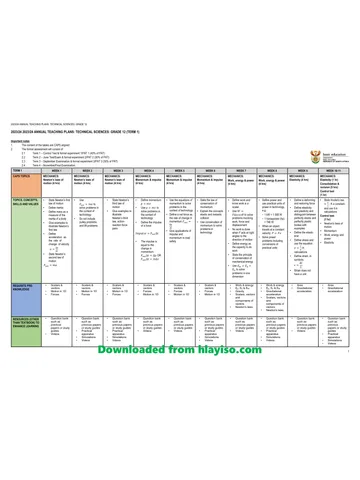
Gr 12 Tech Sci ATP 2023 24
Memorandum
Technical Sciences Grade 12 P1 Eastern Cape Mock 2025 Memo
Memorandum
Technical Sciences Grade 12 P2 Eastern Cape Mock 2025 Memo
Memorandum
Technical Sciences Grade 12 P1 Gauteng Mock 2025 Memo (Afr)
Memorandum