
Downloaded from hlayiso.com
NATIONAL
SENIOR CERTIFICATE
GRADE 12
ACCOUNTING
FEBRUARY/MARCH 2014
MEMORANDUM
MARKS: 300
MARKING PRINCIPLES:
1. Penalties for foreign items are applied only if the candidate is not losing marks elsewhere in the
question for that item (no foreign item penalty for misplaced item). No double penalty applied.
2. Full marks for correct answer. If answer incorrect, mark the workings provided.
3. If a pre-adjustment figure is shown as a final figure, allocate the part-mark for the working for that
figure (not the method mark for the answer).
4. Unless otherwise indicated, the positive or negative effect of any figure must be considered to award
the mark. If no + or – sign or bracket is provided, assume that the figure is positive.
5. Where indicated, part-marks may be awarded to differentiate between differing qualities of answers
from candidates.
6. This memorandum is not for public distribution, as certain items might imply incorrect treatment. The
adjustments made are due to nuances in certain questions.
7. Where penalties are applied, the marks for that section of the question cannot be a final negative.
8. Where method marks are awarded for operation, the marker must inspect the reasonableness of the
answer before awarding the mark.
9. In awarding method marks, ensure that candidates do not get full marks for any item that is incorrect
at least in part.
10. Codes: f=foreign item; p=placement/presentation.
This memorandum consists of 18 pages.
Copyright reserved Please turn over
Skip to contentAll 2014 papers 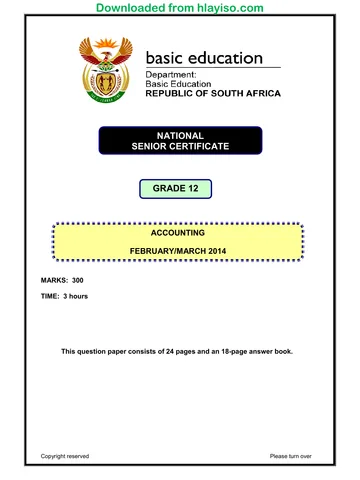
View all
Accounting Grade 12 Supplementary 2014 Memo (English)
Grade 12 Accounting memorandum from the Supplementary 2014 (English), 18 pages. Read online or get the free PDF download, question paper linked when available.
Accounting · Grade 12 · Supplementary · 2014. Memorandum, 18 pages. Read online or download the PDF.
- Subject
- Accounting
- Grade
- Grade 12
- Document type
- Memorandum
- Year
- 2014
- Exam period
- Supplementary
- Curriculum
- CAPS
- Pages
- 18
- File size
- 807.7 KB
Free to read online, no sign-up needed
Loading document…
Loading document…
1 of 18
This exam
Supplementary 2014
- Other filesQuestion paperAnswer bookMemo
Document textSearch extracted text and jump to a page.
Downloaded from hlayiso.com
Accounting 2 DBE/Feb.–Mar. 2014
NSC – Memorandum
QUESTION 1
1.1 CONCEPTS
1.1.1 Perpetual inventory system
1.1.2 VAT exempt
1.1.3 Zero rated VAT 6
1.2 INVENTORY VALUATION
1.2.1 Calculate the following on 31 May 2013:
Weighted-average value per box
R875 900 / 23 050
= R38
Value of the closing stock
3 350 x R38
= R127 300
Number of washing powder boxes missing
23 050 – 3 350 – 18 800 = 900
12
1.2.2 Division of duties plays an important part in preventing this
problem. Explain how Jakob should implement this in the
business with regard to stock.
Any valid answer Expected responses:
The person ordering should not be the person receiving the goods.
The person paying the supplier should also agree to the quantities
taken in stock.
The person doing the physical count should not be the person
ordering or controlling the stock (the count could be supervised by
the internal auditor).
Name ONE other strategy he could use and explain how he
should implement this strategy.
Any valid answer Expected responses:
Rotation of duties
Control the processing of documents – order note must tally with
invoices
Physical security of stock 4
Copyright reserved Please turn over
Downloaded from hlayiso.com
Accounting 3 DBE/Feb.–Mar. 2014
NSC – Memorandum
1.3 VAT
1.3.1 If VAT input is greater than VAT output, SARS for VAT will be
shown in the financial statements as a Trade and Other
(Payable/Receivable).
Receivables
2
1.3.2 The credit sales for October 2013 amounted to R120 000
(excluding VAT). Calculate the amount of VAT on the credit
sales.
R120 000 x 14/100 = R16 800
2
1.3.3 The total of the debit notes issued to suppliers for
merchandise returned to creditors indicates VAT of R1 120.
Determine the VAT-exclusive amount that must be posted to
the Trading Stock Account.
R1 120 x 100/14 = R8 000
2
1.3.4 Calculate the VAT paid if the total cash purchases for
October 2013 was R159 600 (including VAT).
R159 600 x 14/114 = R19 600
2
TOTAL
MARKS
30
Copyright reserved Please turn over
Downloaded from hlayiso.com
Accounting 4 DBE/Feb.–Mar. 2014
NSC – Memorandum
QUESTION 2
2.1 BANK RECONCILIATION STATEMENT AND INTERNAL CONTROL
2.1.1 Identify the items and the amounts that must be entered in the
Cash Receipts Journal (CRJ) and the Cash Payments Journal
(CPJ) for August 2013. List only the item number and the
amount. Do NOT give totals for each journal.
Cash Receipts Journal Cash Payments Journal
(CRJ) (CPJ)
Item number Amount Item number Amount
3 R2 000 2 R21 500
6 R540 4 R620
7 R14 000 5 R8 000 10
8 R3 600
2.1.2 BANK RECONCILIATION STATEMENT ON 31 AUGUST 2013
Debit Credit
Cr balance as per bank statement 42 000
Cr outstanding deposit 15 600
18 000
Cr amount wrongly debited 300
Dr outstanding cheques
2395 15 000
2418 8 450
2420 12 000
Dr balance as per bank account 40 450 13
75 900 75 900
Copyright reserved Please turn over
Downloaded from hlayiso.com
Accounting 5 DBE/Feb.–Mar. 2014
NSC – Memorandum
2.1.3 It is clear that the business is not controlling its cash properly.
What specific problems will the internal auditor include in his
report? Explain TWO of these problems, providing figures to
support your explanation, and give a possible solution for
each. Dismissal of employees is not an option at this stage.
Explanation (with figures) Possible solution
The physical security of Use cash in transit
depositing cash, R21 500 was service/two people to do
Problem 1 stolen. the depositing/ ask
customers to use
EFTs/change depositing
routines
Rolling of cash, deposits of Internal auditor must check
R34 800 (July) and R33 600 that the cashier is
Problem 2 (August) are several days old depositing cash
and are still not deposited at the daily/appoint a different
end of each month. person to do the depositing 6
2.2 DEBTORS' AGE ANALYSIS
2.2.1 The business is not controlling its debtors effectively. Give
ONE reason why you would agree with this statement. Refer to
figures in your answer.
• Only 25% (R23 500) of the outstanding balance is within the
30 days credit terms. 2
2.2.2 Anna is of the opinion that her debtors' clerk is not screening
(checking) the debtors properly before they start buying on
credit from her business.
Give TWO strategies that the debtors' clerk should follow
before allowing customers to open accounts.
Any two valid responses to explain screening
Expected responses:
• New debtors must provide ID documents and proof of
residence
• New debtors must provide three credit references which the
debtors clerk must check for good payment records
• Debtors must provide proof of income e.g. salary slip
4
TOTAL
MARKS
35
Copyright reserved Please turn over
Downloaded from hlayiso.com
Accounting 6 DBE/Feb.–Mar. 2014
NSC – Memorandum
QUESTION 3
3.1 INCOME STATEMENT FOR THE YEAR ENDED 31 DECEMBER 2013
Sales (4 220 700 - 850) 4 219 850
Cost of sales (1 100 720 – 680) (1 100 040)
Gross profit 7 3 119 810
12 860
Other income
Profit on sale of asset 12 500
360
Provision for bad debts adjustment (3 450 – 3 090)
Gross operating profit 3 3 132 670
(2 293 750)
Operating expenses
31 000
Sundry expenses
6 000
Bank charges
Audit fees 45 000
Directors fees (432 000 + 540 000) 972 000
Salaries and wages (940 000 + 9 000) 949 000
Employer’s contribution (103 400+ 90 + 900) 104 390
Rent expense (63 360 – 5 280) 58 080
Bad debts (2 790+ 540) 3 330
Depreciation (13 750 + 81 400 + 3 000 + 18 500) 116 650
Trading stock deficit (138 000– (82 000+ 47 700) 8 300
838 920
Operating profit 32
680
Interest income
839 600
Profit before interest expense
Interest expense (39 600)
800 000
Net profit before tax
Income tax for the year (240 000)
560 000 46
Net profit after tax 4
Copyright reserved Please turn over
Downloaded from hlayiso.com
Accounting 7 DBE/Feb.–Mar. 2014
NSC – Memorandum
3.2 FIXED ASSETS NOTE ON 31 DECEMBER 2013
FIXED/TANGIBLE ASSETS VEHICLES
Carrying value – 1 January 2013 309 100
Cost 489 500
Accumulated depreciation (180 400)
Movements
Additions at cost 0
Disposal at carrying value (35 750)
Depreciation (95 150)
Carrying value – 31 December 2013 178 200
Cost 407 000
Accumulated depreciation (228 800) 5
3.3 TRADE AND OTHER PAYABLES
Creditors (43 400 - 680) 42 720
Shareholders for dividends 84 000
SARS: PAYE (14 100 + 1 600) 15 700
Creditors for salaries 6 680
UIF (1 300 + 90 + 90) 1 480
Pension fund (14 500 + 630 + 900) 16 030
Accrued expenses 540 000
SARS: Income tax (240 000 – 224 000) 16 000
722 610 24
TOTAL
MARKS
75
Copyright reserved Please turn over
Downloaded from hlayiso.com
Accounting 8 DBE/Feb.–Mar. 2014
NSC – Memorandum
QUESTION 4
4.1 4.1.1 True
4.1.2 True
4.1.3 True
4.1.4 False 8
4.2 4.2.1 CASH GENERATED FROM OPERATIONS
980 000
Net profit before tax
Adjustment for:
36 000
Interest expense
200 000
Depreciation
Operating profit before changes in working 1 216 000
capital
(111 300)
Changes in working capital
(77 800)
Change in inventories
48 500
Change in trade and other receivables
(82 000)
Change in trade and other payables
Cash generated from operations 1 104 700 8
4.2.2 Calculate:
Taxation paid
R294 000 – R8 900 – R12 400 = R272 700
4
Dividends paid
R70 000 + (200 000 x 40/ 100 ) = R150 000
R80 000
4
Copyright reserved Please turn over
Downloaded from hlayiso.com
Accounting 9 DBE/Feb.–Mar. 2014
NSC – Memorandum
Fixed assets purchased
R3 350 000 + R200 000 + R165 000 – R2 000 000
= R1 715 000
5
4.2.3 Calculate the following financial indicators on 30 June 2013:
Solvency ratio
(R3 350 000 + R458 400) : (R400 000 + R504 400)
R3808400 : R904 400
= 4,2 : 1
5
Acid test ratio
(R458 400 – R316 900) : R504 400
R141 500
= 0,3 : 1
4
Return on average capital employed (ROTCE; use net profit
before tax in your calculation.)
R980 000 + R36 000 x 100 = 37 %
½ (R2 190 000 + R3 304 000) 1
5
Copyright reserved Please turn over
Downloaded from hlayiso.com
Accounting 10 DBE/Feb.–Mar. 2014
NSC – Memorandum
4.2.4 Calculate the minimum number of shares Gus must buy in
July 2013 to gain control of the company.
To control Gus must own at least :
50% x 450 000 = 225 000 + 1 = 225 001 shares
OR 225 000 + 100 = 225 100 shares
OR 51% x 450 000 = 229 500 shares
Number of shares required
225 001 – 108 000 = 117 001 shares
225 100 – 108 000 = 117 100 shares
229 500 – 108 000 = 121 500 shares 4
Gus wants to purchase the additional shares at R8,00 without
advertising the shares to the public. Give TWO reasons why
you would not approve of this arrangement.
Any TWO
• All shares must be advertised to the public as this is a public
company and it is a requirement of the Companies Act.
• He is only offering R8.00 while the market value is 1450 cents.
• This is an example of insider trading and it is a criminal
offence./Gus will be taking advantage of his position to enrich
himself.
• The value of R8.00 is below the net asset value of R12.10. 4
4.2.5 One of the directors feels that the company should also make
use of loans in the new financial year. Quote TWO financial
indicators (with figures) and explain each indicator to support
her opinion.
Financial indicator (with figures) Explanation
ROTCE:
• It has increased from 22% to 36,9%
• Company is positively geared as the ROTCE (37%) is greater
than the rate of borrowing (9%)
Debt/equity ratio:
• It has decreased from 0,3 : 1 to 0,1 : 1.
• Company has a low financial risk – this favours additional
borrowing (lowly geared) 4
4.2.6 The directors feel that the liquidity has deteriorated. Quote
THREE financial indicators (with figures) to support this
opinion.
Financial indicator (with figures) Explanation
The current ratio has decreased from 1,5 : 1 to 0,9 : 1.
The acid-test ratio has decreased from 0,9 : 1 to 0,3 : 1.
The stock turnover rate decreased from 15 times to 8 times. 6
Copyright reserved Please turn over
Downloaded from hlayiso.com
Accounting 11 DBE/Feb.–Mar. 2014
NSC – Memorandum
4.3 AUDIT REPORT
4.3.1 Is the audit report presented by Tshabalala & Associates
regarded as a qualified report, a disclaimer of opinion report
or an unqualified report?
Unqualified report
Give ONE reason. any valid response e.g.
The words “fairly present in all material respects” are used
The auditor has not identified any problem in his report. 2
4.3.2 Explain why the Companies Act makes it a requirement for
public companies to be audited by an independent auditor.
Give ONE reason.
Any ONE reason
o Unbiased view presented.
o Separation between management and ownership – interest of
shareholders are safeguarded. 2
4.3.3 To whom is this audit report addressed?
Shareholders
Give ONE reason.
They have appointed the external independent auditor at the
annual general meeting. 2
4.3.4 Senzo Tshabalala, a senior partner in Tshabalala &
Associates, wants to purchase shares in Bongi Limited, as he
sees it as an excellent investment opportunity. What advice
would you offer Senzo? Explain.
Excellent answer good answer satisfactory answer
o Conflict of interest.
o Senzo will not be regarded as an independent auditor as he
will become a shareholder in the company.
o The audit will have to be done by another auditing firm.
3
TOTAL
MARKS
70
Copyright reserved Please turn over
Downloaded from hlayiso.com
Accounting 12 DBE/Feb.–Mar. 2014
NSC – Memorandum
QUESTION 5
5.1 COST CONCEPTS
5.1.1 D
5.1.2 A
5.1.3 B 6
5.2 PRODUCTION COST STATEMENT
5.2.1 FACTORY OVERHEAD COSTS
Factory maintenance 19 404
Depreciation 32 390
Factory foreman’s salary (9 500 x 13) 123 500
Factory indirect material 35 730
Water and electricity (137 000 x ¾) 102 750
Rent Expense (296 000 x 18/ 30 ) or 60% 177 600
Insurance (30 000 x 70%) 21 000
Factory cleaning staff (52 x 950 x 1.1) 54 340
566 714 12
Copyright reserved Please turn over
Downloaded from hlayiso.com
Accounting 13 DBE/Feb.–Mar. 2014
NSC – Memorandum
5.2.2 PRODUCTION COST STATEMENTFOR YEAR ENDED
30 JUNE 2013
Direct material cost
(42 400 + 1 182 500 + 24 100 - 32 800 - 1 159 500
56 700)
Direct labour cost
[(6 400 x 12) x 7 + 589 470
(130 x 57) x 7]
PRIME COST 1 748 970
Factory overhead cost 566 714
TOTAL MANUFACTURING COST 2 315 684
Work in process (1 July 2012) 43 300
2 358 984
Work in process (30 June 2013) (33 000)
COST OF PRODUCTION OF FINISHED
2 325 984 17
GOODS
5.3 UNIT COSTS AND BREAK-EVEN POINT
5.3.1 Calculate the following:
Direct material cost per unit
756 000 ÷ 42 000 = R18,00
2
Factory overhead cost
42 000 x R9,00 = R378 000
2
Copyright reserved Please turn over
Downloaded from hlayiso.com
Accounting 14 DBE/Feb.–Mar. 2014
NSC – Memorandum
5.3.2 Give a possible reason for the change in unit costs in
each of the following cases:
Direct material cost per unit
Less wastage / more efficient production methods / better trained
employees / cheaper suppliers / bulk discounts.
One valid point
Factory overhead cost per unit
Economy of scale (more units produced)/ more efficient use of
consumables or electricity
One valid point
4
5.3.3 Calculate the break-even point for the year ended
31 August 2013. The break-even point for the previous
year was 23 064 units.
R567 000 .
R60 – (R15,50 + R7,50 + R18,00)
R41
= 29 842,1 OR 29 842 OR 29 843 units 4
Copyright reserved Please turn over
Downloaded from hlayiso.com
Accounting 15 DBE/Feb.–Mar. 2014
NSC – Memorandum
5.3.4 Explain whether the business should be satisfied with the
level of production achieved. Mention the break-even point in
your explanation.
The business would be satisfied because it produced 12 157
units more than the break-even point. (40.7%) 3
TOTAL
MARKS
50
Copyright reserved Please turn over
Downloaded from hlayiso.com
Accounting 16 DBE/Feb.–Mar. 2014
NSC – Memorandum
QUESTION 6
6.1 Complete the table by filling in only the amounts in the appropriate
columns.
EXAMPLE: The tenant will pay monthly rent of R6 000.
Amount in the Amount in the Projected
No. Cash Budget for May 2014 Income Statement for May 2014
RECEIPT PAYMENT INCOME EXPENSE
e.g. R6 000 R6 000
6.1.1 1 800 1 800
6.1.2 7 800
52 000 52 000 30 000
6.1.3 or
(22 000)
6.1.4 34 000 1 700 8
6.2 CASH BUDGET
6.2.1 Debtors' Collection Schedule
FEE INCOME
MONTHS APRIL 2014 MAY 2014
ON CREDIT
March (actual) R140 000 84 000
April (budgeted) R200 000 68 600 120 000
May (budgeted) R280 000 96 040
CASH FROM DEBTORS 152 600 216 040 5
6.2.2 Calculate A–D:
A 6 540 x 110/ 100 = 7 194
B 90 000 x 100/ 120 = 75 000
C 310 000 – 418 200 = (108 200)
D C + 280 000 = 171 800
6
Copyright reserved Please turn over
Downloaded from hlayiso.com
Accounting 17 DBE/Feb.–Mar. 2014
NSC – Memorandum
Calculate the amount of the loan on 1 April 2014.
4 400 x 100/ 11 x 12 = 480 000
3
Calculate the percentage increase in salaries on 1 May 2014.
(50 220 – 46 500) / 46 500 x 100 = 8%
3
6.2.3 Explain what you would mention to Molly about each of the
items listed below and give ONE point of advice in each case.
FUEL (PETROL):
COMMENT Over-budget / poor control of vehicles / possible
unforeseen increase in prices/wastage.
ADVICE Such increases in fuel prices must be
anticipated and considered in budgeting / look
at trends / wastage / monitor drivers by using
logbooks and tracking devices for distances.
COLLECTION FROM DEBTORS:
COMMENT Under-budget / not well controlled / not
according to expectations of the collection
policy.
ADVICE Ensure debtors adhere to policy by notifying
them of outstanding balances / SMS / interest
on overdue amounts / discount incentives / do
not allow further credit to debtors who do not
adhere to the required credit policy/increase the
discount given from 2% to 5%
ADVERTISING:
COMMENT Well controlled / amount spent as per budgeted
amount.
ADVICE Maintain the good budgeting ethics / but
consider the impact of advertising by increasing
this expense as fee income does not meet the
budget
6
Copyright reserved Please turn over
Downloaded from hlayiso.com
Accounting 18 DBE/Feb.–Mar. 2014
NSC – Memorandum
6.3 INTERNAL CONTROL
Identify a problem that Candice is faced with concerning each of her
products. State a different problem for each product. You must quote
figures to support your answer. Give a suitable solution to each problem
identified.
Product Problem (with figures) Solution
Cash collected shows that Improve control measures
cash has been stolen for cash collection.
Fruit juice [R29 610 – R28 800 = Cash register - only one
R810] person to handle cash
Too many items of chips Order only flavours in
(758) on hand/unsold. demand.
Reduce selling price of
Chips High comparative price items.
[R11] due to high mark-up
used [75%].
A number of chocolates Stricter control over sales of
have not been accounted. chocolates.
Possibly stolen [35 units] or Consider the area where
Chocolates they are being displayed.
Too much of stock losses Suitable storage facilities
[20 units] should be used for
chocolates.
9
TOTAL
MARKS
40
TOTAL: 300
Copyright reserved
Study this subject
Recommended for this subject
Question paper
Accounting Grade 12 Supplementary 2014 Question Paper (Eng)
Addendum
Accounting Grade 12 Eastern Cape June 2014 Addendum
Addendum
Accounting Grade 12 NSC November 2014 Addendum (Afrikaans)
Memorandum
Accounting Grade 12 Paper 2 NSC June 2025 Memo (Afrikaans)
Memorandum
Accounting Grade 12 P2 NSC November 2025 Memo (Afrikaans)
Memorandum
Accounting Grade 12 P1 Eastern Cape June 2024 Memo (English)
More from Grade 12 Accounting
Study guide
Accounting
Addendum
Accounting Grade 12 P1 Eastern Cape June 2025 Addendum (Eng)
Question paper
Accounting Grade 12 P1 Eastern Cape June 2025 QP (Afr)
Question paper
Accounting Grade 12 P1 Eastern Cape June 2025 QP (Eng)
Question paper
Accounting Grade 12 P2 Eastern Cape June 2025 QP (Eng)
Addendum