
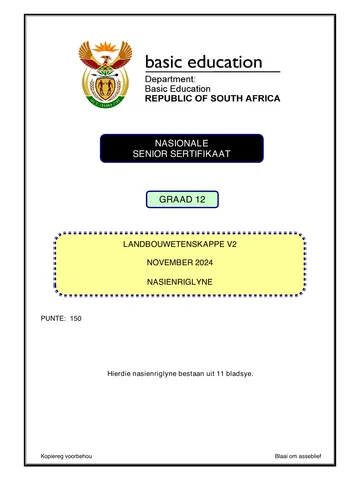
NATIONAL
SENIOR CERTIFICATE
GRADE 12
AGRICULTURAL SCIENCES P2
NOVEMBER 2024
MARKING GUIDELINES
MARKS: 150
These marking guidelines consist of 11 pages.
Copyright reserved Please turn over
Skip to contentQuestion paper 






View all



Agricultural Sciences Grade 12 P2 November 2024 NSC MG QP
Grade 12 Agricultural Sciences Paper 2 question paper from the November 2024 NSC MG, 11 pages. Read online or get the free PDF download, memo linked when available.
Agricultural Sciences · Grade 12 · November 2024 NSC MG · 2024. Question paper, 11 pages. Read online or download the PDF.
- Subject
- Agricultural Sciences
- Grade
- Grade 12
- Document type
- Question paper
- Year
- 2024
- Exam period
- November 2024 NSC MG
- Paper
- 2
- Curriculum
- CAPS
- Pages
- 11
- File size
- 342.9 KB
Loading document…
Loading document…
1 of 11
Document textSearch extracted text and jump to a page.
Agricultural Sciences/P2 2 DBE/November 2024
NSC – Marking Guidelines
SECTION A
QUESTION 1
1.1 1.1.1 A ✓✓
1.1.2 C ✓✓
1.1.3 D ✓✓
1.1.4 B ✓✓
1.1.5 C ✓✓
1.1.6 A ✓✓
1.1.7 B ✓✓
1.1.8 D ✓✓
1.1.9 B ✓✓
1.1.10 C ✓✓ (10 x 2) (20)
1.2
1.2.1 J ✓✓
1.2.2 A ✓✓
1.2.3 C ✓✓
1.2.4 G ✓✓
1.2.5 B ✓✓ (5 x 2) (10)
1.3
1.3.1 Strategic risk management ✓✓
1.3.2 Productivity ✓✓
1.3.3 Prepotency ✓✓
1.3.4 Biometrics ✓✓
1.3.5 Super weeds ✓✓ (5 x 2) (10)
1.4
1.4.1 Price determination ✓
1.4.2 Interest ✓
1.4.3 Recessive ✓
1.4.4 Upgrading ✓
1.4.5 Genetic modification/GM/engineering/manipulation ✓ (5 x 1) (5)
TOTAL SECTION A: 45
Copyright reserved Please turn over
Agricultural Sciences/P2 3 DBE/November 2024
NSC – Marking Guidelines
SECTION B
QUESTION 2: AGRICULTURAL MANAGEMENT AND MARKETING
2.1 Supply and demand
2.1.1 Identification of
(a) Illustration B ✓ (1)
(b) Illustration A ✓ (1)
2.1.2 Explanation of the law of demand
• The higher the price the lower the demand of products ✓✓
• The lower the price the higher the demand of products ✓✓
• The price is inversely proportional to the demand of products ✓✓
(Any 1) (2)
2.1.3 TWO factors influencing the supply except for price
• Production/labour/input costs ✓
• Technology ✓
• Subsidies/taxation ✓
• Possibilities of increasing the supply of products ✓
• Demand for the product ✓
• Environmental conditions/nature
• Availability of the product ✓
• Competitive products ✓
• Profit margin of the product ✓
• Stability of the product ✓
• Knowledge of the product/research ✓
• Political instability ✓
• Number of suppliers ✓
• Legislation ✓
• Seasonality of the product ✓ (Any 2) (2)
2.2 Price elasticity and inelasticity
2.2.1 The type of elasticity
(a) Graph A - Price elastic ✓ (1)
(b) Graph B - Price inelastic ✓ (1)
2.2.2 Reason
The change in price results in a huge change in quantity demanded ✓ (1)
2.2.3 TWO factors that led to elasticity
• Nature of the product ✓
• Availability of substitute product ✓
• Consumer's budget/income ✓
• Time period ✓ (Any 2) (2)
Copyright reserved Please turn over
Agricultural Sciences/P2 4 DBE/November 2024
NSC – Marking Guidelines
2.3 Marketing system
2.3.1 Identification of the marketing system
Free marketing ✓ (1)
2.3.2 TWO advantages of free marketing system to the buyer
• Buyers get good quality products ✓
• Elimination of agents leads to lower prices ✓
• Buyers can bargain ✓
• Buyers buy where they want ✓
• Convenient to buyers ✓ (Any 2) (2)
2.3.3 ONE economic term referring to the phenomenon
Price fixing ✓ (1)
2.3.4 TWO principles of agricultural co-operative
• Voluntary and open membership ✓
• Democratic member control ✓
• Equal economic participation by members ✓
• Autonomy and independence ✓
• Provision of education, training and information to members ✓
• Cooperation among cooperatives ✓
• Concern for community ✓
• Marketing is based on a pool system ✓
• Members have a single vote ✓
• Members are paid dividends/limited amount of their share capital ✓
• Only members may deliver products ✓ (Any 2) (2)
2.4 Entrepreneurship
2.4.1 Justification
The farmer saw an opportunity to start a business and took a risk ✓ (1)
2.4.2 TWO entrepreneurial success factors of the farmer
• Determination ✓
• Resilience ✓
• Passion ✓
• Opportunist ✓ (Any 2) (2)
2.4.3 ONE example
(a) Strength of the enterprise
• Good qualities of an entrepreneur ✓
• Owning one-hectare of land ✓ (Any 1) (1)
(b) Threat to the enterprise
• Break-ins ✓
• Scarcity of water ✓ (Any 1) (1)
Copyright reserved Please turn over
Agricultural Sciences/P2 5 DBE/November 2024
NSC – Marking Guidelines
2.5 Agricultural marketing chain
2.5.1 Types of an agricultural marketing chain
DIAGRAM A - Demand chain ✓ (1)
DIAGRAM B - Supply chain ✓ (1)
2.5.2 The type of an agricultural marketing chain
(a) DIAGRAM B ✓ (1)
(b) DIAGRAM A ✓ (1)
2.5.3 TWO ways used to streamline and improve the agri-business chain
• Use of cold storage and refrigerated transport ✓
• Grading and standardization of products ✓
• Marketing collectively by combining loads with other farmers ✓
• Processing of products closer to the farm ✓
• Improving road infrastructure to facilitate marketing ✓
• Improving access to market information ✓
• Availability of storage facilities ✓
• Providing access to finance ✓
• Improving cell phone and internet connectivity ✓ (Any 2) (2)
2.6 TWO roles of legislation in the effective marketing of agricultural products
• Promoting efficient marketing of agricultural products ✓
• Optimizing efficient marketing of agricultural products ✓
• Assists in making sure that there are minimum marketing interventions ✓
• Increasing market access to all participants ✓
• Enhancing the viability of the agricultural sector ✓
• Regulate/quality control on import/export products ✓
• Prevent unfair marketing practices/consumer exploitation ✓
• Ensures that product information is given in a simple language ✓
• Ensure that products comply with set standards/ensure product safety ✓
• Set and maintain national standards at processing sites ✓
• Regulate market agents and improve their functioning ✓
• Authorising the establishment and regulations for marketing ✓ (Any 2) (2)
2.7 Business plan
2.7.1 Name of the document
Business plan (1)
Copyright reserved Please turn over
Agricultural Sciences/P2 6 DBE/November 2024
NSC – Marking Guidelines
2.7.2 TWO reasons for developing a business plan
• Test the feasibility and economic viability of the business idea ✓
• Determine the financial needs ✓
• Repositioning the business to deal with changes in the market ✓
• Gain knowledge about marketing opportunities and competitors ✓
• Foresee problems which reduces risk ✓
• Guide daily operations/roles and responsibilities ✓
• Secure funding ✓
• Ensure effective business management ✓
• Mapping out objectives and goals ✓
• Provide guidelines for decision making ✓
• Provide timeframes for completion of projects ✓
• Provide information about the business ✓ (Any 2) (2)
2.7.3 TWO problems when drawing up a business plan
• Insufficient technical details ✓
• Unrealistic assumptions and projections/overambitious ✓
• Leaving gaps/being vague/errors/not authentic/too generic/
provision of too much unnecessary information ✓
• Hiding weaknesses and risks ✓
• Incomplete financials/forgetting to include the cash flow ✓
• Insufficient research ✓
• Using incorrect format ✓
• Not including information about suppliers of the business ✓
• Not highlighting potential competition ✓ (Any 2) (2)
[35]
QUESTION 3: PRODUCTION FACTORS
3.1 Land
3.1.1 Name of the production factor that appreciates the value
Land ✓ (1)
3.1.2 TWO economic functions of land
• Provides food ✓
• Provides space ✓
• Provides raw materials ✓
• Provides minerals ✓
• Serves as a collateral ✓ (Any 2) (2)
3.2 The law of diminishing returns
3.2.1 Deduction of the economic characteristic of land
The law of diminishing returns ✓ (1)
Copyright reserved Please turn over
Agricultural Sciences/P2 7 DBE/November 2024
NSC – Marking Guidelines
3.2.2 Comparison of maize production in response to increased fertiliser
application
(a) With increase in fertilizer application from 1 – 10kg maize
production increases at an increasing rate ✓ (1)
(b) With increase in fertilizer application from 15 – 20kg maize
production increases at a decreasing rate ✓ (1)
3.3 Duties performed by farm workers
3.3.1 Identification of the example of labour
(a) WORKER 1 - Casual worker ✓ (1)
(b) WORKER 2 - Seasonal worker ✓ (1)
3.3.2 Reason
Worker 2 performs repetitive tasks/work ✓ (1)
3.3.3 TWO ways to increase labour productivity
• Improve economic conditions of workers ✓
• Improve educational conditions/training ✓
• Improve working conditions ✓
• Improve living conditions ✓
• Addressing HIV/Aids ✓
• Managing labour/supervision ✓
• Efficient mechanisation ✓
• Proper planning ✓
• Involvement of workers in decision making ✓
• Motivation ✓ (Any 2) (2)
3.4 Contract of employment
3.4.1 Labour legislation
(a) Basic Conditions of Employment Act (Act 75 of 1997)
• Duration of contract: 01 February 2021 - retirement ✓
• Remuneration/Amount ✓
• Terms of employment/leave/working hours ✓
• Mode of payment ✓ (Any 1) (1)
(b) Occupational, Health and Safety Act (Act 85 of 1993)
Protective clothing ✓ (1)
3.4.2 TWO ways in which migration of labour will decrease production
• It leads to labour shortages ✓
• It leads to a shortage in skills/expertise/experience ✓ (Any 2) (2)
3.5 Capital
3.5.1 Identification of the types of capital
A - Fixed ✓ (1)
B - Movable ✓ (1)
3.5.2 Example of production capital/C
Seeds/fuel/feeds/wages/fertilizer/chemicals/transport costs ✓ (1)
Copyright reserved Please turn over
Agricultural Sciences/P2 8 DBE/November 2024
NSC – Marking Guidelines
3.5.3 Types of credit
(a) A - Long-term credit ✓ (1)
(b) C - Short-term credit ✓ (1)
3.5.4 ONE method of creating capital
• Production ✓
• Savings ✓
• Credit/loans ✓
• Grants/sponsors/donations ✓
• Inheritance/trust funds ✓
• Partnerships ✓ (Any 1) (1)
3.6 Income and expenses
3.6.1 Identification of the enterprise
(a) Highest income - B ✓ (1)
(b) Lowest expenses - C ✓ (1)
3.6.2 The financial record
Income statement ✓ (1)
3.6.3 Calculation of the profit or loss of enterprise A
Profit/loss = Total income – Total expenses ✓
= R30 000 – R50 000 ✓
= – R20 000/loss of R20 000 ✓ (3)
3.7 Problems associated with capital as a production factor.
3.7.1 Scarcity/shortage/expensive/costly ✓ (1)
3.7.2 Overcapitalisation ✓ (1)
3.8 Risk
3.8.1 TWO sources of risks
• Production risk ✓
• Technical risk ✓
• Financial/market and price risk ✓ (Any 2) (2)
3.8.2 Reason
• Production risk - Machinery breakdown/
environment poses a risk to production ✓
• Technical risk - Machinery breakdown ✓
• Financial/market and price risk - Loss of sales ✓ (Any 2) (2)
3.8.3 Identification of a risk management strategy
Diversification ✓ (1)
Copyright reserved Please turn over
Agricultural Sciences/P2 9 DBE/November 2024
NSC – Marking Guidelines
3.8.4 ONE management principle
• Planning ✓
• Organisation/coordination ✓
• Decision making ✓
• Implementation ✓
• Control ✓ (Any 1) (1)
[35]
QUESTION 4: BASIC AGRICULTURAL GENETICS
4.1 Monohybrid crossing
4.1.1 The fraction of the dented offspring
1/4 ✓ (1)
4.1.2 Calculation of the percentage of heterozygous spherical seeds
• = 2/4 x 100 ✓
• = 50% ✓ (2)
4.1.3 Phenotypic ratio of the F1 generation
3 spherical : 1 dented ✓ (1)
4.1.4 The number of offspring looking similar to the parents
• Phenotypically - 3 ✓
• Genotypically - 2 ✓ (Any 1) (1)
4.2 Patterns of inheritance
4.2.1 Identification of the patterns of inheritance
(a) B - Co-dominance ✓ (1)
(b) A - Incomplete dominance ✓ (1)
4.2.2 Justification of incomplete dominance
The offspring has an intermediate characteristic ✓ (1)
4.2.3 The genotype of the offspring in illustration B
RW ✓ (1)
4.3 Qualitative and quantitative characteristics
4.3.1 Height - Quantitative characteristics ✓ (1)
4.3.2 Horn conformation - Qualitative characteristics ✓ (1)
4.3.3 Milk Production - Quantitative characteristics ✓ (1)
4.4 Variation
4.4.1 Indication of the phenomenon
Variation ✓ (1)
4.4.2 The cause of variation
Genetic ✓ (1)
Copyright reserved Please turn over
Agricultural Sciences/P2 10 DBE/November 2024
NSC – Marking Guidelines
4.4.3 ONE cause of variation
• Meiosis/crossing over/random arrangement of chromosomes ✓
• Random fertilization ✓
• Mutation ✓ (Any 1) (1)
4.4.4 ONE importance of variation in breeding
• It forms the foundation of selection and breeding ✓
• To improve animal breeds/plant cultivars over time ✓
• To increase biodiversity ✓ (Any 1) (1)
4.5 Dihybrid crossing
4.5.1 ONE characteristic to be improved
• Leaf length ✓
• Seed colour ✓ (Any 1) (1)
4.5.2 Punnet square
Gametes PL PL
pl PpLl PpLl
pl PpLI PpLl
Marking rubric
Correct gametes of male parent ✓
Correct gametes of female parent ✓
Correct genotype of the offspring ✓
Completed punnet square and populated ✓ (4)
4.5.3 Indication of the law
The law of independent assortment ✓ (Any 1) (1)
4.6 Breeding system
4.6.1 Identification of the breeding system
(a) Cross breeding ✓ (1)
(b) Outcrossing ✓ (1)
4.6.2 ONE advantage of the crossbreds
• Crossbreds exhibit heterosis/hybrid vigour ✓
• Crossbreds are more resistant to diseases ✓
• Crossbreds have more vitality/fertility ✓
• Crossbreds perform better than their parents ✓
• More economic production/mass gain in relation to food intake is
higher ✓
• Better adaptability to environmental conditions ✓ (Any 1) (1)
4.6.3 ONE selection method
• Mass selection ✓
• Family selection ✓
• Pedigree selection ✓
• Progeny selection ✓ (Any 1) (1)
Copyright reserved Please turn over
Agricultural Sciences/P2 11 DBE/November 2024
NSC – Marking Guidelines
4.7 Technique used in plant breeding
4.7.1 The plant breeding technique
The use of bacterial carriers/Agrobacterium tumefaciens ✓ (1)
4.7.2 TWO potential environmental benefits of GM crops
• Reduce the need for chemical spraying/herbicides/pollution ✓
• Tolerant to extreme conditions (cold/drought/salinity) ✓
• Beneficial insects are not harmed ✓
• Allows for no tillage farming ✓ (Any 2) (2)
4.8 Line graph showing the yields of the GM maize and non-GM maize in the
different provinces
Y i eYield
l d o fofnGM
o n -and
G M non-GM
m a i z e maize
a n d GinMdifferent
m a i z e provinces
in provinces
12,000 Non-GM Maize GM Maize
10,000
Yield (kg/ha)
8,000
6,000
4,000
2,000
0
A B C D E
Province
CRITERIA/RUBRIC/MARKING GUIDELINES
• Correct heading with both variables ✓ (1)
• X-axis: Correctly calibrated and labelled (Province) ✓ (1)
• Y-axis: Correctly calibrated and labelled (Yield) ✓ (1)
• Correct units (kg/ha) ✓ (1)
• Combined line graph ✓ (1)
• Accuracy (80% + correctly plotted) ✓ (1)
[35]
TOTAL SECTION B: 105
GRAND TOTAL: 150
Copyright reserved
Study this subject
Revise the topics in this paper, then practise them question by question.
- Grade 12 Agricultural Sciences notes
CAPS revision notes with worked examples.
- Agricultural Sciences questions by topic
Past exam questions sorted by CAPS topic, with memos where available.
- Grade 12 Agricultural Sciences quizzes
Short topic quizzes with instant feedback.
- All Grade 12 Agricultural Sciences past papers
Past papers by year, with memos where available.
- Grade 12 past papers
More Agricultural Sciences and other subjects in this collection.
Recommended for this subject
More papers and memos for this grade and subject.
Question paper
Agricultural Sciences Grade 12 P1 NSC June 2025 QP (Eng)
Question paper
Agricultural Sciences Grade 12 Eastern Cape June 2024 QP (Afr)
Question paper
Agricultural Sciences Grade 12 P1 Eastern Cape Prelim 2024 QP
Question paper
Agricultural Sciences Grade 12 P1 Eastern Cape Prelim 2024 QP
Question paper
Agricultural Sciences Grade 12 P2 Eastern Cape Prelim 2024 QP
Question paper
Agricultural Sciences Grade 12 Gauteng June 2024 QP (Eng)
Related documents
Question paper
Agricultural Sciences Grade 12 P2 November 2024 NSC MG QP
Question paper
Agricultural Sciences Grade 12 P1 November 2024 NSC MG QP
Question paper
Agricultural Sciences Grade 12 P2 November 2024 NSC QP
Memorandum
Agricultural Sciences Grade 12 P2 Eastern Cape Prelim 2024 Memo
Question paper
Agricultural Sciences Grade 12 P1 November 2024 NSC QP
Question paper
Agricultural Sciences Grade 12 P2 Eastern Cape Mock 2023 QP (Afr)
More from Grade 12 Agricultural Sciences
Annual teaching plan
Gr 12 Agric Sci ATP 2023 24
Memorandum
Agricultural Sciences Grade 12 P2 Eastern Cape Mock 2025 Memo
Memorandum
Agricultural Sciences Grade 12 P2 NSC June 2025 Memo (English)
Memorandum
Agricultural Sciences Grade 12 Eastern Cape June 2024 Memo (Eng)
Memorandum
Agricultural Sciences Grade 12 Gauteng June 2024 Memo (Afrikaans)
Memorandum