
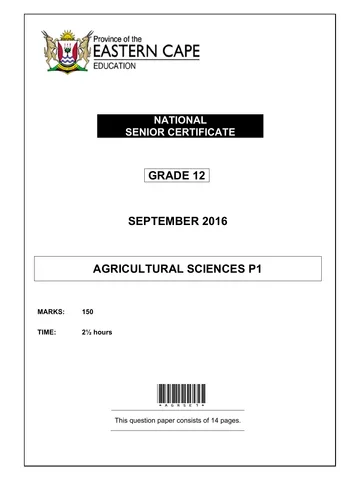
NATIONAL
SENIOR CERTIFICATE
GRADE 12
SEPTEMBER 2016
AGRICULTURAL SCIENCES P1
MEMORANDUM
MARKS: 150
This memorandum consists of 6 pages.
Skip to contentMemorandum 

View all
Agricultural Sciences Grade 12 P1 Eastern Cape Mock 2016 Memo
Grade 12 Agricultural Sciences Paper 1 memorandum from the Eastern Cape Mock Exam 2016, 6 pages. Read online or get the free PDF download, question paper linked when available.
Agricultural Sciences · Grade 12 · Eastern Cape Mock Exam · 2016. Memorandum, 6 pages. Read online or download the PDF.
- Subject
- Agricultural Sciences
- Grade
- Grade 12
- Document type
- Memorandum
- Year
- 2016
- Exam period
- Eastern Cape Mock Exam
- Paper
- 1
- Curriculum
- CAPS
- Pages
- 6
- File size
- 587.3 KB
Loading document…
Loading document…
1 of 6
Document textSearch extracted text and jump to a page.
2 AGRICULTURAL SCIENCES P1 (EC/SEPTEMBER 2016)
SECTION A
QUESTION 1
1.1 1.1.1 C √√
1.1.2 B √√
1.1.3 A √√
1.1.4 A √√
1.1.5 D √√
1.1.6 A √√
1.1.7 C √√
1.1.8 B √√
1.1.9 A √√
1.1.10 D √√ (10 x 2) (20)
1.2 1.2.1 None √√
1.2.2 B only √√
1.2.3 A only √√
1.2.4 B only √√
1.2.5 Both A and B √√ (5 x 2) (10)
1.3 1.3.1 Pancreas √√
1.3.2 Stock density √√
1.3.3 Virus √√
1.3.4 Impotence √√
1.3.5 Concentration √√ (5 x 2) (10)
1.4 1.4.1 Urea √
1.4.2 Conduction √
1.4.3 Mesoderm √
1.4.4 Posture √
1.4.5 Bulbo-urethral/Cowpers gland √ (5 x 1) (5)
TOTAL SECTION A: 45
SECTION B
QUESTION 2: ANIMAL NUTRITION
2.1 2.1.1 Non-ruminant/monogastric √ (1)
2.1.2 Single/Simple stomach/Monogastric √ (1)
2.2 2.2.1 C√ (1)
2.2.2 D√ (1)
2.2.3 F√ (1)
2.2.4 I√ (1)
2.2.5 E√ (1)
2.3 2.3.1 It is highly soluble than biuret. √ (1)
2.3.2 Avoid keeping the lick in rain. √ (1)
2.3.3 A mixture of 2 kg urea and 20 kg molasses be sprayed on grazing √
Use of premixed fodders/mixtures/stock licks √ (2)
Copyright reserved Please turn over
(EC/SEPTEMBER 2016) AGRICULTURAL SCIENCES P1 3
2.4 2.4.1 Only abomasum is functioning √
Rumen/reticulum/omasum still underdeveloped √
Oesophogal groove transport milk to the abomasum √ (Any 2 x 1) (2)
2.4.2 When the calf starts eating solid food/starts grazing √ (1)
2.4.3 Enable to digest cellulose √
Hydrolyse protein √
Synthesis of vitamins √
Synthesis of amino acids √ (Any 2 x 1) (2)
2.5 2.5.1 DE of 5 kg DM intake = Gross Energy – energy lost in faeces
= 92,5 J – 42,5 J√
= 50 J √ (2)
2.5.2 Nett energy = Metabolic energy – Energy lost as heat
Metabolic energy = 50 J – 18,5 J = 31,5 J √
Nett energy = Metabolic energy – Energy lost as heat
= 31,5 J – 9 J √
= 22,5 J √
NB: Learners may use different ways/formula to arrive at 22,5 J, e.g.
NE = GE – energy lost in faeces – energy lost in urine and gases – heat loss
OR
NE = DE – energy lost in urine + gases – heat loss (3)
2.6 Percentage of feed mixture
Ratio of Maize meal : peanut oilcake meal = 22 : 7,5
22 + 7,5 = 29,5 √
√
√ (3)
2.7 2.7.1 Concentrate requirement = kg/day
= 42 kg/cow/day √
= 42 kg × 30 days × 100 cows √
= 126 000 kg (126 tons) √ (3)
2.7.2 Feed supply = 650 kg × 30 × 6 = 117 000 kg √
Feed required = 100 × 60 kg × 30 = 180 000 kg p/month × 6
= 1 080 000 kg √
= Feed supply – Feed required
= 117 000 kg –1 080 000 kg
= -963 000/1 000 √
= -963 tons √ (4)
2.7.3 Not enough √ - pasture has a shortage of 963 tons √ (2)
2.8 2.8.1 Tranquillisers √ (1)
2.8.2 Antibiotics √ (1)
[35]
Copyright reserved Please turn over
4 AGRICULTURAL SCIENCES P1 (EC/SEPTEMBER 2016)
QUESTION 3: ANIMAL PRODUCTION, PROTECTION AND CONTROL
3.1 3.1.1 A Feeding shed √
B Holding pen √ (2)
3.1.2 (a) Holding pen / B √ (1)
(b) Feeding shed / A √ (1)
3.1.3 Give cows time to pick up their calves before moving √
Cows and calved should be moved slowly √
Avoid trying to work cows and calves with dogs √ (3)
3.2 3.2.1 To warn animals of your presence √ (1)
3.2.2 Makes them feel insecure √ (1)
3.2.3 Allow animals to establish social groups √ (1)
3.3 3.3.1 D√ (1)
3.3.2 C√ (1)
3.3.3 A√ (1)
3.3.4 B√ (1)
3.4 Subsistence Commercial
3.4.1 Purpose Produce only enough to feed Produce to sell for a
the family √ profit √ (2)
3.4.2 Management Limited as only few animals Intensive to ensure
and crops produced √ increased production √ (2)
3.5 3.5.1 A Chronic √
B Very sudden/develops within an hour/weeks √
C Acute √
D Deadly √ (4)
3.5.2 Anthrax √ (1)
3.5.3 Burn the carcass √
Do not cut open the animal carcass √
Burry carcass deep in the ground √ (Any 2 x 1) (2)
3.6 3.6.1 Nasal worm √ (1)
3.6.2 (a) C√ (1)
(b) A/B √ (1)
3.6.3 Summer √ (1)
3.6.4 Sneezing and nasal irritation √
Yellow nasal discharge √
Shaking of head to get rid of the parasite √ (3)
Copyright reserved Please turn over
(EC/SEPTEMBER 2016) AGRICULTURAL SCIENCES P1 5
3.7 3.7.1 Proper hygiene standards in abattoirs √ (1)
3.7.2 Quarantine of imported animals at ports of entry √ (1)
3.7.3 Reporting any suspicion of the disease √
Eradication programs √
Immunisation campaigns √ (Any 1) (1)
[35]
QUESTION 4: ANIMAL REPRODUCTION
4.1 4.1.1 Embryo transfer √ (1)
4.1.2 Prostglandin injection √
Gonadotropin - release hormone √ (2)
4.1.3 A Donor √ (1)
4.1.4 37 °C √ (1)
4.1.5 (a) Their reproductive cycle is extended to produce more progeny √ (1)
(b) More profit from selling superior animals √ (1)
4.2 4.2.1 A Oestrus √
B Di-oestrus √
C Met-oestrus √
D Pro-oestrus √ (4)
4.2.2 (a) A√ (1)
(b) C√ (1)
4.3 4.3.1 B vas deference √
D scrotum√
F seminal vesicle √ (3)
4.3.2 Hypoplasia √
Cryptochidism √
Sperm defects √ (Any 2 x 1) (2)
4.4 4.4.1 Exhaustion/Fatigue √ (1)
4.4.2 Malnutrition √ (1)
4.4.3 Lack of experience √ (1)
4.4.4 Temperament √ (1)
Copyright reserved Please turn over
6 AGRICULTURAL SCIENCES P1 (EC/SEPTEMBER 2016)
4.5 4.5.1
Milk yield of group 1 and 2 over
25 weeks
40
Milk yield (l)
20
Group
0 1
1 5 7 10 15 20 25 Group
Weeks (Time) 2
Marking graph with the following checklist:
Criteria Yes: 1 mark No: 0 mark
1 Line graph 1 0
2 Y-axis labelled 1 0
3 X-axis labelled 1 0
4 Points correctly labelled in group 1
and group 2 1 0
5 Correct heading 1 0
6 Units (and time) 1 0 (6)
4.5.2 Milk yield increases drastically in week 7 and drops from week 15 to
week 20. √
OR
For both groups milk yield increases from week 1 to week 7 and then it
decreases after week 7 until week 25. (1)
4.6 4.6.1 C√ allantois √ (2)
4.6.2 F√ placenta √ (2)
4.6.3 B√ chorion/embryonic sac √ (2)
[35]
TOTAL SECTION B: 105
GRAND TOTAL: 150
Copyright reserved Please turn over
Study this subject
Revise the topics in this paper, then practise them question by question.
- Grade 12 Agricultural Sciences notes
CAPS revision notes with worked examples.
- Agricultural Sciences questions by topic
Past exam questions sorted by CAPS topic, with memos where available.
- Grade 12 Agricultural Sciences quizzes
Short topic quizzes with instant feedback.
- All Grade 12 Agricultural Sciences past papers
Past papers by year, with memos where available.
- Grade 12 past papers
More Agricultural Sciences and other subjects in this collection.
Recommended for this subject
More papers and memos for this grade and subject.
Memorandum
Agricultural Sciences Grade 12 P2 Eastern Cape Mock 2025 Memo
Memorandum
Agricultural Sciences Grade 12 P2 NSC June 2025 Memo (English)
Memorandum
Agricultural Sciences Grade 12 Eastern Cape June 2024 Memo (Eng)
Memorandum
Agricultural Sciences Grade 12 P2 Eastern Cape Prelim 2024 Memo
Memorandum
Agricultural Sciences Grade 12 Gauteng June 2024 Memo (Afrikaans)
Memorandum
Agricultural Sciences Grade 12 Eastern Cape June 2023 Memo (Afr)
Related documents
Question paper
Agricultural Sciences Grade 12 P1 Eastern Cape Mock 2016 QP
Question paper
Agricultural Sciences Grade 12 P1 Eastern Cape Mock 2016 QP
Memorandum
Agricultural Sciences Grade 12 P2 Eastern Cape Mock 2016 Memo
Memorandum
Agricultural Sciences Grade 12 P2 Eastern Cape Mock 2016 Memo
Memorandum
Agricultural Sciences Grade 12 Paper 1 NSC June 2016 Memo
Memorandum
Agricultural Sciences Grade 12 Paper 1 NSC November 2016 Memo
More from Grade 12 Agricultural Sciences
Annual teaching plan
Gr 12 Agric Sci ATP 2023 24
Question paper
Agricultural Sciences Grade 12 P1 NSC June 2025 QP (Eng)
Question paper
Agricultural Sciences Grade 12 Eastern Cape June 2024 QP (Afr)
Question paper
Agricultural Sciences Grade 12 P1 Eastern Cape Prelim 2024 QP
Question paper
Agricultural Sciences Grade 12 P1 Eastern Cape Prelim 2024 QP
Question paper