
Downloaded from hlayiso.com
NATIONAL
SENIOR CERTIFICATE
GRADE 11
NOVEMBER 2020
BUSINESS STUDIES P1
MARKING GUIDELINE
MARKS: 150
This marking guideline consists of 29 pages.
Skip to contentAll 2020 papers 
View all

Business Studies Grade 11 P1 Eastern Cape November 2020 Memo
Grade 11 Business Studies Paper 1 memorandum from the Eastern Cape November 2020, 29 pages. Read online or download the free PDF.
Business Studies · Grade 11 · Eastern Cape November · 2020. Memorandum, 29 pages. Read online or download the PDF.
- Subject
- Business Studies
- Grade
- Grade 11
- Document type
- Memorandum
- Year
- 2020
- Exam period
- Eastern Cape November
- Paper
- 1
- Curriculum
- CAPS
- Pages
- 29
- File size
- 872.1 KB
Free to read online, no sign-up needed
Loading document…
Loading document…
1 of 29
This exam
Eastern Cape November 2020
Questions in this paper
Document textSearch extracted text and jump to a page.
Downloaded from hlayiso.com
2 BUSINESS STUDIES P1 (EC/NOVEMBER 2020)
NOTES TO MARKERS
1. PREAMBLE
The notes to markers are provided for quality assurance purposes to ensure the
following:
(a) Fairness, consistency and reliability in the standard of marking
(b) Facilitate the moderation of candidates' scripts at the different levels
(c) Streamline the marking process considering the broad spectrum of markers
across the country
(d) Implement appropriate measures in the teaching, learning and
assessment of the subject at schools/institutions of learning
2. Candidates' responses must be in full sentences for SECTIONS B and C. However,
this would depend on the nature of the question.
3. A comprehensive marking guideline has been provided but this is by no means
exhaustive. Due consideration should be given to an answer that is correct but:
x Uses a different expression from that which appears in the marking guideline
x Comes from another credible source
x Original
x A different approach is used
NOTE: There is only ONE correct answer in SECTION A.
4. Take note of other relevant answers provided by candidates and allocate marks
accordingly. (In cases where the answer is unclear or indicates some
understanding, part-marks should be awarded, for example, one mark instead of
the maximum of two marks.)
5. The word 'Sub-max' is used to facilitate the allocation of marks within a question or
sub-question.
6. The purpose of circling marks (guided by 'max' in the breakdown of marks) on the
right-hand side is to ensure consistency and accuracy in the marking of scripts as
well as for calculation and moderation purposes.
7. Subtotals to questions must be written in the right-hand margin. Circle the subtotals
as indicated by the allocation of marks. This must be guided by 'max' in the marking
guidelines. Only the total for each question should appear in the left-hand margin
next to the appropriate question number.
8. In an indirect question, the theory as well as the response must be relevant and
related to the question.
9. Correct numbering of answers to questions or sub questions is recommended in
SECTIONS A and B. However, if the numbering is incorrect, follow the sequence
of the candidate's responses. Candidates will be penalised if the latter is not clear.
Copyright reserved Please turn over
Downloaded from hlayiso.com
(EC/NOVEMBER 2020) BUSINESS STUDIES P1 3
10. No additional credit must be given for repetition of facts. Indicate with an 'R'.
11. The differentiation between 'evaluate' and 'critically evaluate' can be explained
as follows:
11.1 When 'evaluate' is used, candidates are expected to respond in either a
positive/negative manner or take a neutral (positive and negative)
stance, e.g. Positive: 'COIDA eliminates time and costs spent√ on
lengthy civil court proceedings.'√
11.2 When 'critically evaluate' is used, candidates are expected to respond
in either a positive/negative manner or take a neutral (positive and
negative) stance. In this instance candidates are also expected to
support their responses with more depth, e.g. 'COIDA eliminates time
and costs spent√ on lengthy civil court proceedings√, because the
employer will not be liable for compensation to the employee for injuries
sustained during working hours as long as it can be proved that the
business was not negligent.'√
NOTE: 1. The above could apply to 'analyse' as well.
2. Note the placing of the tick (√) in the allocation of marks.
12. The allocation of marks must be informed by the nature of the question, cognitive
verb used, mark allocation in the marking guideline and the context of each
question.
Cognitive verbs, such as:
12.1 Advise, name, state, outline, motivate, recommend, suggest, (list not
exhaustive) do not usually require much depth in candidates' responses.
Therefore, the mark allocation for each statement/answer appears at the
end.
12.2 Define, describe, explain, discuss, elaborate, distinguish, differentiate,
compare, tabulate, justify, analyse, evaluate, critically evaluate (list not
exhaustive) require a greater depth of understanding, application and
reasoning. Therefore, the marks must be allocated more objectively to
ensure that assessing is conducted according to established norms so
that uniformity, consistency and fairness are achieved.
13. Mark only the FIRST answer where candidates offer more than one answer for
SECTION B and C questions that require one answer.
Copyright reserved Please turn over
Downloaded from hlayiso.com
4 BUSINESS STUDIES P1 (EC/NOVEMBER 2020)
14. SECTION B
14.1 If for example, FIVE facts are required, mark the candidate's FIRST FIVE
responses and ignore the rest of the responses. Indicate by drawing a line across
the unmarked portion or use the word 'Cancel'.
NOTE: This applies only to questions where the number of facts is specified.
14.2 If two facts are written in one sentence, award the candidate FULL credit. Point
14.1 above still applies.
14.3 If candidates are required to provide their own examples/views, brainstorm this
at the marking centre to finalise alternative answers.
14.4 Use of the cognitive verbs and allocation of marks:
14.4.1 If the number of facts are specified, questions that require candidates to
'describe/discuss/explain' may be marked as follows:
x Fact 2 marks (or as indicated in the marking guidelines)
x Explanation 1 mark (two marks will be allocated in Section C)
The 'fact' and 'explanation' are given separately in the marking guideline
to facilitate mark allocation.
14.4.2 If the number of facts required is not specified, the allocation of marks
must be informed by the nature of the question and the maximum mark
allocated in the marking guideline.
14.5 ONE mark may be awarded for answers that are easy to recall, requires one
word answers or is quoted directly from a scenario/case study. This
applies to SECTIONS B and C in particular (where applicable).
15. SECTION C
15.1 The breakdown of the mark allocation for the essays is as follows:
Introduction
Maximum:
Content
32
Conclusion
Insight 8
TOTAL 40
Copyright reserved Please turn over
Downloaded from hlayiso.com
(EC/NOVEMBER 2020) BUSINESS STUDIES P1 5
15.2 Insight consists of the following components:
Layout/Structure Is there an introduction, a body, and a conclusion? 2
Analysis and Is the candidate able to break down the question into 2
interpretation headings/subheadings/interpret it correctly to show
understanding of what is being asked?
Marks to be allocated using this guide:
All headings addressed: 1 (One 'A')
Interpretation (16 to 32 marks): 1 (One 'A')
Synthesis Are there relevant decisions/facts/responses made 2
based on the questions?
Marks to be allocated using this guide:
No relevant facts: 0 (Two '-S')
Some relevant facts: 1 (One '-S')
Only relevant facts: 2 (No '-S')
Option 1: Where a candidate answers 50% or more
of the question with only relevant facts; no
'-S' appears in the left margin. Award the
maximum of TWO (2) marks for synthesis.
Option 2: Where a candidate answers less than 50%
of the question with only OR some relevant
facts; one '-S' appears in the left margin.
Award a maximum of ONE (1) mark for
synthesis.
Option 3: Where a candidate answers less than 50%
of the question with no relevant facts; two
'-S' appear in the left margin. Award a
ZERO mark for synthesis.
Originality Is there evidence of examples based on recent 2
information, current trends and developments?
TOTAL FOR INSIGHT: 8
TOTAL MARKS FOR FACTS: 32
TOTAL MARKS FOR ESSAY (8 + 32): 40
NOTE: 1. No marks will be awarded for contents repeated from the
introduction and conclusion.
2. The candidate forfeits marks for layout if the words
INTRODUCTION and CONCLUSION are not stated.
3. No marks will be awarded for layout, if the headings
INTRODUCTION and CONCLUSION are not supported by
an explanation.
15.3 Indicate insight in the left-hand margin with a symbol e.g. ('L, A, -S and/or
O').
15.4 The breakdown of marks is indicated at the end of the suggested answer/
marking guideline to each question.
Copyright reserved Please turn over
Downloaded from hlayiso.com
6 BUSINESS STUDIES P1 (EC/NOVEMBER 2020)
15.5 Mark all relevant facts until the SUB MAX/MAX mark in a subsection has been
attained. Write SUB MAX/MAX after maximum marks have been obtained, but
continue reading for originality “O”.
15.6 At the end of each essay indicate the allocation of marks for facts and marks
for insight as follows: (L – Layout, A – Analysis, S – Synthesis, O – Originality)
as in the table below.
CONTENT MARKS
Facts 32 (max.)
L 2
A 2
S 2
O 2
TOTAL 40
15.7 When awarding marks for facts, take note of the sub-maxima indicated,
especially if candidates do not make use of the same subheadings.
Remember, headings and subheadings are encouraged and contribute to
insight (structuring/logical flow/sequencing) and indicate clarity of thought.
(See MARK BREAKDOWN at the end of each question.)
15.8 If the candidate identifies/interprets the question INCORRECTLY, then he/she
may still obtain marks for layout.
15.9 If a different approach is used by candidates, ensure that the answers are
assessed according to the mark allocation/subheadings as indicated in the
marking guideline.
15.10 15.10.1 Award TWO marks for complete sentences. Award ONE mark for
phrases, incomplete sentences and vague answers.
15.10.2 With effect from November 2015, the TWO marks will not
necessarily appear at the end of each completed sentence. The ticks
(√) will be separated and indicated next to each fact, e.g. 'Product
development is a growth strategy √, where businesses aim to
introduce new products into existing markets.'√
This will be informed by the nature and context of the question, as
well as the cognitive verb used.
15.11 With effect from November 2017, the maximum of TWO (2) marks for facts
shown as headings in the marking guidelines, will not necessarily apply to each
question. This would also depend on the nature of the question.
Copyright reserved Please turn over
Downloaded from hlayiso.com
(EC/NOVEMBER 2020) BUSINESS STUDIES P1 7
SECTION A
QUESTION 1
1.1 1.1.1 B √√
1.1.2 C √√
1.1.3 D √√
1.1.4 A √√
1.1.5 C √√
(5 x 2) (10)
1.2 1.2.1 secondary √√
1.2.2 psychographics √√
1.2.3 promotional √√
1.2.4 quality √√
1.2.5 piecemeal √√
(5 x 2) (10)
1.3 1.3.1 D √√
1.3.2 I √√
1.3.3 H √√
1.3.4 J √√
1.3.5 A √√
(5 x 2) (10)
TOTAL SECTION A: 30
BREAKDOWN OF MARKS
QUESTION 1 MARKS
1.1 10
1.2 10
1.3 10
TOTAL 30
Copyright reserved Please turn over
Downloaded from hlayiso.com
8 BUSINESS STUDIES P1 (EC/NOVEMBER 2020)
SECTION B
Mark the FIRST TWO answers only.
QUESTION 2: BUSINESS ENVIRONMENTS
2.1 Types of lobbying
- Hedging against inflation √
- Bargaining sessions between management and unions √
- Influencing supervisory body/regulators √
NOTE: Mark the first TWO (2) only.
(2 x 1) (2)
2.2 Functions of a trade union
- Protecting the interest of workers. √√
- Representing the interest of general society and minority groups
through media and negotiations. √√
- Influencing government decisions. √√
- Influencing management for better working conditions, salaries and
benefits. √√
- Representing employees corporately and individually. √√
- Improving the material benefits of their members. √√
- Advancing the interest of members. √√
- Providing legal and financial advice. √√
- Providing benefits and educational facilities to its members. √√
- Supporting gender equality. √√
- Protecting members in times of retrenchments and disciplinary
hearings. √√
- Protecting the interest of their members during disciplinary
procedures.√√
- Any other relevant answer related to the functions of trade unions.
Max. (8)
2.3 Socio-economic issues
2.3.1 Illiteracy √√ (2)
2.3.2 Strike √√ (2)
2.3.3 Dumping √√ (2)
Copyright reserved Please turn over
Downloaded from hlayiso.com
(EC/NOVEMBER 2020) BUSINESS STUDIES P1 9
2.4 Purpose of the LRA
- Provides a framework where the employees, trade unions and
employers work together √ to discuss matters relating to employment,
e.g. wages, conditions of employment. √
- Promotes orderly negotiations and employee participation √ in decision
making in the workplace. √
- Promotes resolution √ of labour disputes. √
- Promotes fair √ employment practices. √
- Outlines the relationship √ between employees and employers. √
- Provides simple procedures √ for the registration of trade unions and
employers’ organisations. √
- Regulates the rights of trade unions and facilitates √ collective
bargaining. √
- Regulates the effectiveness of bargaining councils √ and statutory
councils. √
- Allows workplace forums √ where employees may participate in
decision making. √
- Establishes the Commission for Conciliation, Mediation and Arbitration
(CCMA) to resolve labour disputes √ through statutory conciliation,
mediation and arbitration. √
- Endorses the right to strike against retrenchments, √ and facilitates
labour disputes. √
- Clarifies the transfer √ of contracts of employment procedures. √
- Establishes Labour Courts and Labour Appeal Courts √ to deal with
labour issues. √
- Offers codes √ of good practice. √
- Deals with √ strikes and lockouts and workplace forums. √
- Establishes workplace forums to promote √ the interest of all employees
in the workplace whether they belong to the trade union or not. √
- Any other relevant answer related to the purpose of the Labour
Relations Act.
Max. (8)
2.5 Challenges and environments from the scenario
CHALLENGES BUSINESS ENVIRONMENTS
2.5.1 2.5.2
1. The employees at Essential Micro √√
Supermarket don’t want to cooperate
and work together as a team.√
2. Recently the management also could Market √√
not find a regular provider of all the
products they need.√
Sub max (2) Sub max (4)
NOTE: Do not award marks for the business environment, if the
challenge was incorrectly identified.
Max. (6)
Copyright reserved Please turn over
Downloaded from hlayiso.com
10 BUSINESS STUDIES P1 (EC/NOVEMBER 2020)
2.5.3 Ways in which businesses can adapt to difficult employees
- Businesses can deal with difficult employees by revisiting the
recruitment & induction policies. √√
- Businesses need to develop strategies to deal with different types of
personalities. √√
- Businesses must offer counselling sessions to employees with personal
problems. √√
- Any other relevant answer related to ways in which businesses can deal
with difficult employees.
NOTE: Mark the first TWO (2) only.
(2 x 2) (4)
OR
Ways in which businesses can adapt to shortage of supply
- Select suppliers which are reputable/trustworthy and reliable. √√
- Maintain a good relationship with suppliers. √√
- Enter into contracts with suppliers to secure raw materials of good
quality in sufficient quantities. √√
- Take over suppliers to ensure continuity of its supply. This is called
backwards integration. √√
- Any other relevant answer related to ways in which businesses can deal
with shortage of supplies.
NOTE: Mark the first TWO (2) only.
(2 x 2) (4)
Copyright reserved Please turn over
Downloaded from hlayiso.com
(EC/NOVEMBER 2020) BUSINESS STUDIES P1 11
2.6 Projects undertaken by businesses as part of social responsibility
- Charitable contribution towards NGOs/Businesses can donate blankets
to old age homes/run soup kitchens. √√
- Involvement in community education/Build schools in communities/
Offer bursaries to needy students/Donate old computers to less
privileged schools/Provide/Support adult education and training in the
local community. √√
- Teach entrepreneurial skills/Offer support to individuals starting new
business ventures. √√
- Conduct skills development/job creation projects/Offer bricklaying
courses. √√
- Sponsor art and cultural programmes, such as school choirs. √√
- Support youth programmes, such as sport/recreational activities. √√
- Address issues like HIV/Aids or COVID-19 pandemic. √√
- Any other relevant answer related to projects that can be undertaken by
business as part of social responsibility.
Max. (6)
[40]
BREAKDOWN OF MARKS
QUESTION 2 MARKS
2.1 2
2.2 8
2.3 6
2.4 8
2.5.1 2
2.5.2 4
2.5.3 4
2.6 6
TOTAL 40
Copyright reserved Please turn over
Downloaded from hlayiso.com
12 BUSINESS STUDIES P1 (EC/NOVEMBER 2020)
QUESTION 3: BUSINESS OPERATIONS
3.1 Examples of employee benefits
- Medical Aid Fund/Health Insurance Fund √
- Pension Fund √
- Provident Fund √
- Funeral benefits √
- Car/Travel/Housing/Cell phone/Clothing allowance √
- Performance-based incentives √
- Issuing of bonus shares √
- Staff discount/Free or low cost meal/Canteen facilities √
- Any other relevant answer related to examples of employment benefits.
NOTE: Mark the first FOUR (4) only.
(4 x 1) (4)
3.2 Aspects of the employment contract
- Personal details of the employee √√
- Details of the business/employer, e.g. name/address √√, etc.
- Job title/Position √√
- Job description √√
- Job specification √√
- Date of employment/commencement of employment √√
- Place where employee will spend most of his/her working time √√
- Hours of work, e.g. normal time/overtime √√
- Remuneration, e.g. weekly or monthly pay √√
- Benefits/Fringe benefits/Perks/Allowances √√
- Leave, e.g. sick/maternity/annual/adoption leave √√
- Employee deductions (compulsory/non-compulsory) √√
- Period of contract/Details of termination √√
- Probation period √√
- Signatures of both the employer and employee √√
- List of documents that form part of the contract, e.g. appointment
letter/code of conduct/ethics √√
- Disciplinary policy, e.g. rules and disciplinary procedure for
unacceptable behaviour. √√
- Any other relevant answer related to the aspects that must be included
in the employment contract of the selected candidate.
NOTE: Mark the first THREE (3) only. (3 x 2) (6)
Copyright reserved Please turn over
Downloaded from hlayiso.com
(EC/NOVEMBER 2020) BUSINESS STUDIES P1 13
3.3 Purpose of induction as a human resources activity
- Introduce new employees to management/colleagues √ to establish
relationships with fellow colleagues at different levels. √
- Create opportunities for new employees √ to experience/explore
different departments. √
- Explain safety regulations and rules, √ so that new employees will
understand their role/responsibilities in this regard. √
- Communicate information √ about the products/services. √
- Allow new employees the opportunity to ask questions √ that will put
them at ease/reduce insecurity/anxiety/fear. √
- Make new employees feel welcome √ by introducing them to their
physical workspace. √
- Give new employees a tour/information √ about the layout of the
building/office. √
- Improve skills √ through in-service training. √
- Familiarise new employees √ with the organisational structure/their
supervisors. √
- Ensure that employees understand their roles/responsibilities √ so that
they will be more efficient/productive. √
- Communicate business policies √ regarding ethical/professional
conduct/procedures/employment contract/conditions of employment, √
etc.
- Any other relevant answer related to the purpose of induction as a
human resources activity.
Max. (6)
3.4 Factors that influence pricing
3.4.1 Demand √√ (2)
3.4.2 Input costs √√ (2)
3.5 Purpose of packaging
- Physically protect √ the product from any harm. √
- Promote the marketing √ of a product. √
- Prevent a product √ from getting spoilt. √
- Prevent tampering √ or theft of a product. √
- Improve convenience √ in use or storage of a product. √
- Makes it easier √ to identify products. √
- Differentiate the product √ from other competing goods. √
- Contribute to the profitability of the business √ through sales and use
of resources. √
- Attracts attention to show value of the product √ as a marketing tool. √
- Links the product to the promotion strategy √ used to promote the
product. √
- Any other relevant answer related to the purpose of the packaging of
products.
Max. (6)
Copyright reserved Please turn over
Downloaded from hlayiso.com
14 BUSINESS STUDIES P1 (EC/NOVEMBER 2020)
3.6 Production planning
3.6.1 Aspects during production planning from the scenario
- Steve, the production manager, has to set up the actual route which the
materials must follow in the factory. √
- He also has to calculate the time required to perform each activity in the
manufacturing process. √
NOTE: Mark the first TWO (2) only.
(2 x 1) (2)
3.6.2 Advantages of production planning
- Production planning allows a business to ensure that every machine and
worker √ is used to their full capacity. √
- Business can ensure that it has the correct amount of supplies √ and
stock/inventory control at a given time. √
- Improved inventory control reduces wastage √ and unnecessary storage
cost. √
- Production planning will prevent time being wasted √ and increases the
number of final products thus increasing productivity. √
- Production planning process involves quality checks √ which will
improve quality. √
- Any other relevant answer related to the advantages of production
planning.
Max. (6)
3.7 Precautionary measure businesses should take when handling
machinery
- All machinery and equipment must be correctly installed and safe to
use. √√
- Workers must be properly trained on how to use machinery and must
be informed about the risks when using the machinery. √√
- Regular safety checks must be carried out and machinery should be
maintained and serviced regularly. √√
- Workers need to wear protective clothing and gear such as overalls,
hard hats and safety helmets, ear plugs, masks, heavy-duty safety
boots, welding goggles and gloves when working with machinery and
equipment. √√
- Develop a culture of safety in the workplace. √√
- Familiarise employees with safety procedures. √√
- Any other relevant answer related to the precautionary measures that
businesses should take when handling machinery.
Max. (6)
[40]
BREAKDOWN OF MARKS
QUESTION 3 MARKS
3.1 4
3.2 6
3.3 6
3.4 4
3.5 6
3.6.1 2
3.6.2 6
3.7 6
TOTAL 40
Copyright reserved Please turn over
Downloaded from hlayiso.com
(EC/NOVEMBER 2020) BUSINESS STUDIES P1 15
QUESTION 4: MISCELLANEOUS TOPICS
BUSINESS ENVIRONMENTS
4.1 Examples of contemporary legislation that could affect business
operations
- Labour Relations Act √√
- National Credit Act √√
- Consumer Protection Act √√
- Employment Equity Act √√
- Skills Development Act √√
- Broad Based Black Economic Empowerment Act √√
- Compensation for Occupational Injuries and Diseases Act √√ /
OHSA √√
- Basic Conditions of Employment Act √√
- Companies Act √√
- Any other relevant answer related to examples of contemporary
legislation that could affect business operations.
NOTE: Mark the first TWO (2) only.
(2 x 1) (2)
Copyright reserved Please turn over
Downloaded from hlayiso.com
16 BUSINESS STUDIES P1 (EC/NOVEMBER 2020)
4.2 Meaning of networking
- Networking refers to a coordinated activity where people who have a
similar objective meet √ and exchange information and ideas. √
- The goal of networking is to reach as many people as possible √ and to
make every connection count. √
- Businesses can use networking as a tool √ to increase sales/image of
business. √
- Businesses can become members of chambers of commerce and
industry/professional business clubs/informal social groupings √ to
meet new contacts. √
- Any other relevant answer related to the meaning of networking.
Max. (4)
4.3 Ways businesses can form power relationships
- Build around BBBEE √ and empowerment of employees. √
- Ability of a person’s power to influence √ others’ thoughts, actions or
choices. √
- Every party to a relationship possesses a degree of power, √ i.e. power
to strike/demand payment/order material √ etc.
- Strategic alliances/Agreement √ between businesses leading to mutual
benefits. √
- Strategic allies do not want to lose √ mutual benefits. √
- Strategic allies consider suggestions √ made by businesses in the
alliance. √
- Persuasion of large investors √ has power to influence other
businesses. √
- Secure goodwill of investors √ and listen to suggestions of investors. √
- Influence on company representatives √ through agent or
intermediary. √
- Intermediaries influence customers by handing out free samples √ and
by recommendation of certain products by specialists/investors. √
- Any other relevant answer related to ways in which businesses can
form power relationships. Max. (6)
4.4 Piracy
4.4.1 Impact of piracy from the scenario
- Therefore, that would explain the decrease in sales √ and profits √ that
they have been experiencing. (2 x 1) (2)
Copyright reserved Please turn over
Downloaded from hlayiso.com
(EC/NOVEMBER 2020) BUSINESS STUDIES P1 17
4.4.2 Ways EM can deal with piracy
- Patent √ /prevents other businesses/people not to produce and sell
the same product/specific service. √
- EM can take out a patent for new inventions √ and include a sample
of their invention with the application. √
- They can bring legal proceedings against anyone √ who uses the
invention. √
- Trademarks √ /identify businesses and their products. √
- They must register their trademarks √ with the register of trademarks
at the companies and intellectual property registration. √
- Copyright √ /EM can take legal action against people who copy their
products. √
- Any other relevant answer related to ways in which EM can deal with
piracy. Max. (6)
BUSINESS OPERATIONS
4.5 Types of recruitment
- Internal recruitment √
- External recruitment √
NOTE: Mark the first TWO (2) only. (2 x 1) (2)
4.6 Quality control bodies
- SABS √
- ISO √
- Quality circles √
- Any other relevant answer related to quality control bodies.
NOTE: Mark the first TWO (2) only. (2 x 1) (2)
4.7 Purpose of the Occupational Health and Safety Act
- The aim is to provide for the health and safety of employees at work
and during the use of plants and machinery. √√
- It outlines the roles and responsibilities of employers, employees,
designers, importers, suppliers and sellers. √√
- The Act requires that the main dangers of the workplace be identified
and eliminated. √√
- It requires that employees are expected to co-operate and follow the
necessary instructions and report any unsafe situations. √√
- Clarifies the roles and duties of the health and safety representatives. √√
- Any other relevant answer related to the purpose of Occupational
Health and Safety Act.
Max. (6)
Copyright reserved Please turn over
Downloaded from hlayiso.com
18 BUSINESS STUDIES P1 (EC/NOVEMBER 2020)
4.8 Acts from the scenario
ACTS MOTIVATIONS
1. Labour Relations Act √√ They allow their workers to belong to
a trade union. √
2. Skills Development Act √√ The human resources department
regularly identifies the training
needs of their workers. √
Sub max. (4) Sub max. (2)
NOTE: 1. Mark the first TWO (2) only.
2. Do not award marks for the motivation, if the Act was
incorrectly identified.
3. Award marks for the Act even if the quote is incomplete.
Max. (6)
4.9 Ways human resources function can comply with BCEA
- Workers should only work 9 hours per day in a 5 day work week./8
hours per day in a 6 day work week. √√
- Overtime should not exceed 10 hours per week. √√
- They must have a break of 60 minutes after five hours of work. √√
- Workers can take up to six weeks paid sick leave during a 36-month
cycle. √√
- Businesses should not employ children under the age of 16. √√
- Workers must receive double pay if they work during public
holidays/Sunday. √√
- Any other relevant answer related to ways in which the human
resources function can comply with the Basic Conditions of
Employment Act.
Max. (4)
[40]
BREAKDOWN OF MARKS
QUESTION 4 MARKS
4.1 2
4.2 4
4.3 6
4.4.1 2
4.4.2 6
4.5 2
4.6 2
4.7 6
4.8 6
4.9 4
TOTAL 40
TOTAL SECTION B: 80
Copyright reserved Please turn over
Downloaded from hlayiso.com
(EC/NOVEMBER 2020) BUSINESS STUDIES P1 19
SECTION C
Mark the FIRST question ONLY in this section.
QUESTION 5: BUSINESS ENVIRONMENTS
5.1 Introduction
- The macro environment is part of the external business environment as it
falls immediately outside the business. √
- Businesses have no control over the challenges of the macro environment
and rather need to adapt to it. √
- Businesses can get involved in the macro environment to remain
sustainable. √
- Businesses should choose a way to get involved in the macro
environment that suits their businesses. √
- Any other relevant introduction related to components of macro
environment/challenges of macro environment/advantages of businesses
involved in macro environment/ways businesses can be involved in macro
environment.
(Any 2 x 1) (2)
5.2 Components of macro environment
- Physical/Natural environment/forces that are present in the natural
environment/the availability of natural resources and sustainability of
mineral resources. √√
- Economic environment/Global and local economic forces/Government
monetary and fiscal policies that have a direct impact. √√
- Social/Cultural/Demographic environment/people and factors that
influence and direct consumer behaviour/includes people, cultural
backgrounds and income levels. √√
- Technological environment/new technologies that created a 4th industrial
revolution. √√
- Legal/Political/all the laws and legislation that businesses must comply
with/Regulations passed by government influence the way in which
businesses operate. √√
- International/Global environment/Global and international forces that
influence business operations/businesses having to keep up with global
trends/international trading relations. √√
- Institutional environment/Institutions that provide a series of services to
business enterprises/government that consumes/provides goods and
services. √√
- Any other relevant answer related to the components of the macro
environment.
NOTE: Mark the first FOUR (4) only.
Max. (8)
Copyright reserved Please turn over
Downloaded from hlayiso.com
20 BUSINESS STUDIES P1 (EC/NOVEMBER 2020)
5.3 Challenges of macro environment
Change in income levels √√
- Businesses are faced with the problem that the income of their customers
changes √ as the economy goes through periods of prosperity and periods
when the economy does not grow and recessions occur. √
- The change in interest rate/taxation √ can influence the power of the
consumer. √
- Factors such as unemployment/high interest rates √ can leave consumers
with less disposable income. √
- Reduced consumer spending √ will result in lower profits for businesses.√
- Consumers experiencing financial difficulties √ will rather spend money on
necessities than luxuries. √
- Changes in the consumers’ income levels can be a serious threat, √
especially to businesses specialising in luxury products and services. √
- Any other relevant answer related to change in income level as a
challenge in the macro environment.
Type (2)
Description (2)
Sub max. (4)
Political changes √√
- A change in government can result in political instability √ and scare away
potential investors. √
- A business that relies on imported/exported goods √ may be challenged
by government’s attitude on duties and tariffs to be imposed. √
- Any other relevant answer related to political changes as a challenge in
the macro environment.
Type (2)
Description (2)
Sub max. (4)
Contemporary legal legislation √√
- The government has established many legislations √ and businesses do
not have any option but to meet legal requirements/comply/adhere to
these laws. √
- Businesses need to operate within the legal framework of a country √ and
keep track of new legislation/comply with new legislation. √
- The National Credit Act and Consumer Protection Act √ has been
introduced to protect businesses and customers. √
- Any other relevant answer related to contemporary legal legislation as a
challenge in the macro environment.
Type (2)
Description (2)
Sub max. (4)
Copyright reserved Please turn over
Downloaded from hlayiso.com
(EC/NOVEMBER 2020) BUSINESS STUDIES P1 21
Labour restrictions √√
- The government has passed a number of laws √ which impose restrictions
on businesses’ labour practices. √
- These restrictions pose a challenge to businesses √ that have to find the
right candidate for the job. √
- These restrictions make it a challenge for businesses to employ √ suitable
people locally and internationally. √
- Any other relevant answer related to labour restrictions as a challenge in
the macro environment.
Type (2)
Description (2)
Sub max. (4)
Micro lending √√
- Micro lending is the granting of small loans to people √ who cannot obtain
credit from banks. √
- Micro-lending puts pressure on businesses since they want to support
micro businesses, √ but there is a big risk as many fail and cannot repay
debt. √
- Individuals/Businesses pay unreasonably high levels of interest √ and
cannot afford to repay the money. √
- The loans come without training and √ many of the entrepreneurs are
unskilled and inexperienced and their businesses fail. √
- When micro-businesses fail, their suppliers are also affected √ since their
sales decrease and they lose any amounts owed to them by the micro-
business. √
- Financial institutions also regard micro-lenders as a threat √ in the formal
sector and will compete with them. √
- Any other relevant answer related to micro lending as a challenge in the
macro environment.
Type (2)
Description (2)
Sub max. (4)
Globalisation/international challenges √√
- Globalisation refers to the exchange of products/services/capital and
labour √ across boundaries/countries. √
- Local businesses are competing with international businesses √ for local
consumers. √
- Businesses should be aware of global networks √ and their effects. √
- The overseas migration of skilled labour √ can result in local skills
shortage. √
- This means more competition for businesses √ that are already under
pressure to compete locally. √
- Some international businesses dump their product lines in South Africa √
at a price lower than those at which local businesses can afford to sell
them. √
- Any other relevant answer related to globalisation/international challenges
as a challenge in the macro environment.
Type (2)
Description (2)
Sub max. (4)
Copyright reserved Please turn over
Downloaded from hlayiso.com
22 BUSINESS STUDIES P1 (EC/NOVEMBER 2020)
Social values and demographics √√
- People’s values influence some of their buying behaviour habits √ as they
buy products that they identify with. √
- Attitudes towards saving and brand loyalty √ can impact on consumers’
habits. √
- Understanding employees/customers and adapting to changes that occur
in the target market √ can be challenging for businesses. √
- Any other relevant answer related to social values and demographics as a
challenge in the macro environment.
Type (2)
Description (2)
Sub max. (4)
Socio-economic issues √√
- Businesses are faced with many challenges √ of poverty, unemployment,
inadequate education, skills shortages, crime and HIV and Aids. √
- The socio-economic issues influence business operations √ in different
ways. √
- All these socio-economic issues make running a successful business √
very difficult. √
- Businesses are expected to implement socio-responsibility programmes to
try and deal with social problems in their areas √ due to government being
unable to reduce these problems effectively. √
- Any other relevant answer related to socio-economic issues as a
challenge in the macro environment.
Type (2)
Description (2)
Sub max. (4)
NOTE: Mark the first FIVE (5) only.
Max. (18)
5.4 Advantages of businesses that are involved in the macro environment
- Preventing environmental change/damage √ by being sustainable and
environmentally aware/decreasing carbon footprint. √
- Entering global markets, using the internet, √ increases markets and can
source cheaper/better raw materials internationally. √
- Knowing people’s age, gender, customs, traditions and preferences √ will
make it easier for businesses to appeal to people. √
- Laws regulate industries, control trade with other countries √ and protect
industries, consumers and employees. √
- Businesses are aware of the impact of foreign exchange currency and
taxes √ and are flexible in supplying the products and services relevant to
the current economic situation. √
- Keeping up with the latest technology √ ensures reaching the largest
possible market. √
- Ensures that the business keeps abreast/works within √ policies, laws and
regulations that govern businesses. √
- The business can more accurately predict √ future events, threats and
opportunities that may arise. √
- Any other relevant answer related to the advantages of businesses that
are involved in the macro environment. Max. (10)
Copyright reserved Please turn over
Downloaded from hlayiso.com
(EC/NOVEMBER 2020) BUSINESS STUDIES P1 23
5.5 Ways in which businesses can be involved in the macro environment
- Collective bargaining/lobbying, representatives of business community use
opportunity to discuss matters of mutual interest with government
officials.√√
- Private-public partnership: business can enter into mutually beneficial
partnerships with the government and business can benefit from
government policies. √√
- Privately owned services to the community or country business make use
of government owned assets (harbour) and decide to keep the area clean
(service). √√
- Job creation: businesses will receive a subsidy or tax reduction and have
more trained workers. √√
- Increased involvement in social responsibility initiatives: business gets
involved in socio-economic issues through training and communication in
the workplace project. √√
- Government tenders offered by the government and in response
businesses will submit a formal offer to supply specified goods and
services. √√
- Expansion into Africa: businesses get involved in the supply chain to get
products from industrial countries to African countries. √√
- Taking the lead in technology by spending money on research in the
development of their products. √√
- Any other relevant answer related to the ways in which businesses can be
involved in the macro environment.
Max. (10)
5.6 Conclusion
- Businesses must be aware of all of the components of the macro
environment.√√
- Businesses have to pay careful attention to the challenges from the macro
environment and devise strategies to respond to these challenges. √√
- Businesses that are involved in the macro environment will benefit in the
short and the long run. √√
- The importance of involvement in the macro environment are becoming
more important for businesses to ensure success in the future. √√
- Any other relevant conclusion related to components of macro environment/
challenges of macro environment/advantages of businesses involved in
macro environment/ways businesses can be involved in macro
environment.
(Any 1 x 2) (2)
[40]
Copyright reserved Please turn over
Downloaded from hlayiso.com
24 BUSINESS STUDIES P1 (EC/NOVEMBER 2020)
QUESTION 5: BREAKDOWN OF MARKS
DETAILS MAXIMUM TOTAL
Introduction 2
Components of macro environment 8
Challenges of the macro environment 18 Max.
Advantages of businesses that are 32
10
involved in the macro environment
Ways businesses can be involved in the
10
macro environment
Conclusion 2
INSIGHT
Layout 2
Analysis, interpretation 2
Synthesis 2 8
Originality/Examples 2
TOTAL MARKS 40
*LASO – For each component:
Allocate 2 marks if all requirements are met.
Allocate 1 mark if only some of the requirements are met.
Allocate 0 marks where requirements are not met at all.
Copyright reserved Please turn over
Downloaded from hlayiso.com
(EC/NOVEMBER 2020) BUSINESS STUDIES P1 25
QUESTION 6: BUSINESS OPERATIONS
6.1 Introduction
- Distribution is the channels that the product follows from manufacturing
to the consumer. √
- Businesses can choose to distribute their products directly to the
consumers/direct distribution. √
- Businesses can also use intermediaries/middlemen to assist with the
distribution of their products. √
- Marketing communication policy is also referred to as the promotion
part of a business. √
- Personal selling can be very effective for a newly established
businesses to ensure sales and build customer relationships. √
- Any other relevant introduction related to different types of
intermediaries/reasons for using direct distribution/components of
marketing communication policy/effectiveness of personal selling.
(Any 2 x 1) (2)
6.2 Types of intermediaries
- Wholesalers buy large quantities from the producers and sell it to
retailers/consumers. √√
- Retailers are shops that sell to the consumers in smaller quantities. √√
- Agents are usually contracted by large manufacturers to distribute/sell
their products with commission and link the manufacturer and the
retailer. √√
- Brokers are specialised agents in a certain field of expertise, for
example insurance brokers. √√ / Buy and sell goods and services for
others and remunerated on commission. √√
- Franchises are independent businesses, which fall under a common
brand or product and are intermediaries for manufacturers, e.g.
McDonalds, KFC, OK, Steers, Spur restaurants. √√
- Any other relevant answer related to the types of intermediaries.
Max. (8)
Copyright reserved Please turn over
Downloaded from hlayiso.com
26 BUSINESS STUDIES P1 (EC/NOVEMBER 2020)
6.3 Reasons using direct distribution methods
- SB/The manufacturer prefers to negotiate with the consumer √ because
the manufacturer needs to demonstrate the product/provide after sales
service. √
- Intermediaries are not willing √ to distribute the manufacturer’s goods. √
- No auxiliary services √ are offered by the intermediaries. √
- Intermediaries cannot deliver the product to the consumer √ soon
enough as the product is perishable. √
- Retailers and consumers prefer the manufacturer to supply directly to
them √ because the products will be cheaper. √
- Unduly high profit margins of intermediaries √ force manufacturer to do
it themselves. √
- Manufacturer is trying to prevent intermediaries √ from acquiring a
position of power or dictating to the manufacturer. √
- Selling through the internet allows smaller businesses √ to market their
products all over the world. √
- Business websites can serve as both a distribution method √ and a
promotion method. √
- Any other relevant answer related to the reasons why SB, as a
manufacturer, may prefer to make use of direct distribution methods
Max. (10)
6.4 Components of the marketing communication policy
Advertising
- Advertising is a marketing communication activity that is aimed √ at the
masses. √
- Advertising is neither personal/personalised √ and involves
communication with a large number of consumers at the same time. √
- Advertising is the most popular method for businesses/manufacturers √
to get their message to the target market and consumers. √
- The advertiser pays for the messages √ they want to convey to
consumers. √
- Advertising can persuade consumers to try a new product/keep buying
products they already know √ or remind consumers about their
products. √
- The business controls the message √ therefore has a low level of
credibility. √
- Many available methods of advertising can be used √ e.g. print media,
electronic media, outdoor advertising, mobile advertising, broadcasting
advertising, exhibit advertising, sponsorship advertising, online
advertising. √
- Any other relevant answer related to advertising as a component of the
marketing communication policy.
Sub max. (6)
Copyright reserved Please turn over
Downloaded from hlayiso.com
(EC/NOVEMBER 2020) BUSINESS STUDIES P1 27
Publicity
- The information about a business published by an independent third
party √ such as newspapers or television stations. √
- Ensures that the public knows about the business, √ its social
programmes, community involvement and fair labour practices etc. √
- Publicity can be positive or negative √ as it is not paid for by the
business. √
- Good publicity is often successful √ because reports in the media about
products and services have a higher degree of credibility than
advertisements by businesses. √
- Publicity can be negative if reports appear in a newspaper or on
television √ of a company dumping waste in rivers. √
- Internal publicity is the display of goods, the appearance of the shop is
neat √ and its employees well-dressed as well as the staff’s behaviour
towards customers. √
- Businesses build customer relations by maintaining good corporate
image, √ service, friendliness and efficiency build client loyalty. √
- Many companies create brand exposure √ for the company by running
competitions which provide exposure to the company’s products. √
- Endorsements by famous people draw attention √ to a company’s brand
and products. √
- Sports and movie stars are often seen wearing certain brands of
clothing √ which create public awareness for the brand. √
- Some companies hand out gifts and samples with company branding
on them √, e.g. at conferences where delegates receive goodie bags. √
- Some companies offer sponsorship to sporting events √ or community
events. √
- Any other relevant answer related to publicity as a component of the
marketing communication policy.
Sub max. (6)
Copyright reserved Please turn over
Downloaded from hlayiso.com
28 BUSINESS STUDIES P1 (EC/NOVEMBER 2020)
Personal selling
- Personal selling is a personal presentation by the firm’s salesperson √
to prospective buyers. √
- Personal selling is an aggressive sales method that involves face-to-
face communication √ with the purpose of encouraging sales and
building customer relationships. √
- It is paid personal communication √ that attempts to inform customers
and persuade them to purchase products and services. √
- Special attention is given to the customer’s needs √ and
requirements. √
- Effective way to build relationships √ between the sales person and the
customer. √
- After sales service and individual customer attention is very important√
when selling large expensive items. √
- Requires well-trained and knowledgeable people/agents √ that
understand the market and customers. √
- Examples of personal selling: handing out free samples/sales
coupons/demonstrating products to consumers in store/launching a
competition/sponsoring a sport event or sport team. √
- Any other relevant answer related to personal selling as a component
of the marketing communication policy.
Sub max. (6)
Max. (18)
6.5 Effectiveness of personal selling
- Personal selling can be made telephonically/face to face and offers a
most flexible means of delivering a promotional message. √√
- Done by experienced sales people who have developed charisma and
are skilled in getting people to pay attention to them. √√
- The most successful method of selling a product. √√
- It is very effective especially in the case of expensive industrial goods
such as machinery and shopping goods e.g. stoves, fridges, cell
phones etc. √√
- Involves a very personal touch with specific attention given to
customer’s needs and requirements. √√
- Most effective way to build relationships between the sales person and
the customer. √√
- A very good way of maintaining good relationships and ensuring
ongoing business and sales. √√
- Any other relevant answer related to the effectiveness of personal
selling in promoting their products.
Max. (10)
Copyright reserved Please turn over
Downloaded from hlayiso.com
(EC/NOVEMBER 2020) BUSINESS STUDIES P1 29
6.6 Conclusion
- The type of product that is manufactured by a business will determine
the type of intermediary used by the business. √√
- The use of direct distribution, without intermediaries, is also an option
for large businesses that manufacturer a variety of related products.√√
- Marketing communication policy creates awareness of available goods
and services and also inform customers about the benefits of their
products. √√
- Personal selling can easily be adjusted to accommodate the
consumer’s culture/language and the message can be personalised. √√
- Any other relevant conclusion related to different types of
intermediaries/reasons of using direct distribution/components of
marketing communication policy/effectiveness of personal selling.
(Any 1 x 2) (2)
[40]
QUESTION 6: BREAKDOWN OF MARK ALLOCATION
DETAILS MAXIMUM TOTAL
Introduction 2
Different types of intermediaries 8
Reasons using direct distribution 10
Components of marketing
communication: Max
o advertising 18 32
o publicity
o personal selling
Effectiveness of personal selling 10
Conclusion 2
INSIGHT
Layout 2
Analysis, interpretation 2
8
Synthesis 2
Originality/Examples 2
TOTAL MARKS 40
*LASO – For each component:
Allocate 2 marks if all requirements are met.
Allocate 1 mark if only some of the requirements are met.
Allocate 0 marks where requirements are not met at all.
TOTAL SECTION C: 40
GRAND TOTAL: 150
Copyright reserved Please turn over
Study this subject
Recommended for this subject
Memorandum
Business Studies Grade 11 P1 Eastern Cape November 2020 Memo
Memorandum
Business Studies Grade 11 P1 Eastern Cape November 2020 Memo
Question paper
Business Studies Grade 11 P1 Eastern Cape November 2020 QP
Question paper
Business Studies Grade 11 P1 Eastern Cape November 2020 QP
Question paper
Business Studies Grade 11 P1 Eastern Cape November 2020 QP
Memorandum
Business Studies Grade 11 P1 2020 Memo (Afr)
More from Grade 11 Business Studies
Question paper
Business Studies Grade 11 P1 November Mock Exam 2 2026 QP
Annual teaching plan
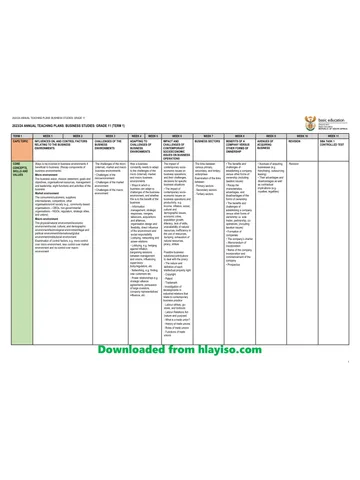
Gr 11 Bus Stu ATP 2023 24
Question paper and memo
Business Studies Grade 11 P1 2025 QP & Memo
Question paper and memo
Business Studies Grade 11 P2 2025 QP & Memo
Question paper
Business Studies Grade 11 P1 Eastern Cape November 2025 QP
Question paper