
CAPE WINELANDS EDUCATION
DISTRICT
CONSUMER STUDIES
REVISION PACK
Skip to contentStudy guide 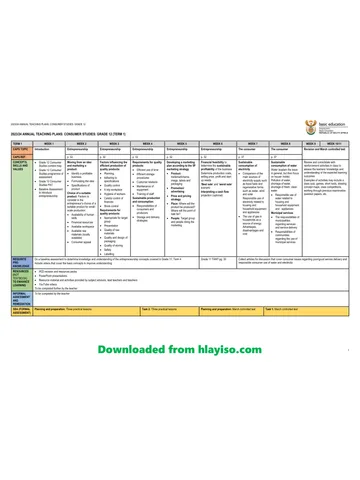
--8a5e377e-56ba-4e74-bf85-3168556146ef/v1-c25ccd3585e5fad59a83/card.webp)
View all
Consumer Studies Survival Kit
Grade 12 Consumer Studies study guide, 38 pages. Read online or get the free PDF download.
Publisher: WCED Study Guides
Consumer Studies · Grade 12. Study guide, 38 pages. Read online or download the PDF.
- Subject
- Consumer Studies
- Grade
- Grade 12
- Document type
- Study guide
- Publisher
- WCED Study Guides
- Curriculum
- CAPS
- Pages
- 38
- File size
- 1.7 MB
Loading document…
Loading document…
1 of 38
Document textSearch extracted text and jump to a page.
SPECIFICATION HOW TO IDENTIFY
OF PRODUCT “ 4 AN IDEA
+ detailed description + Identify need
* ensure standard is ENTREPRENEURSHIP + Do research
retained
«produ stays the IDEA TO PRODUCT \
same
/ SEE
FORMULATING AN IDEA .
+ Start with good idea Requirements
SEE Components + Idea must suit your skill of profitable
of business plan * Compile business plan business
Profit threshold (break even point)
START-U P is when minimum sales covers total cost PASS | fe) N
(income = production cost with no profit)
CAPITAL TARGET
REQUIREMENTS MARKET
TESTING OF PROFITABLE
THE IDEA 7X PRODUCT/
SERVICE
COMPETITIVE
LOCATION i
ADVANTAGE
SWOT INFORMATION
ai —— ON BUSINESS
; teen COMPONENTS PRODUCTION
- pleace OF A BUSINESS PLAN
* Price PLAN
- MARKETING
a / PLAN (5P's)
MANAGEMENT ane
FINANCIAL * Promotion
PLAN PLAN | place.
+ price
CONSUMER ATTRACTION
Visual
Smell
+ Feeling
Taste
FACTORS TO
CONSIDER CHOOSING
A PRODUCT
AVAILABLE RAW
MATERIALS
FINANCIAL RESOURCE
aS
Start-up cost
WORK SPACE
Options where money could be obtained:
Own savings/Bank loan Partner/Investor
Operating cost
AVAILABILITY OF
HUMAN RESOURCES
knowledge, experience
creativity, skills, motivation
Cost of
employment
Type of
workers
UIF= Unemployment insurance fund
PAYE= Pay as you earn
Partner=active member working in business
Investor = only give money
REQUIREMENTS OF EFFICIENT PRODUCTION
+ effective use of time
+ correct methods of storing
+ good customer relations
maintenace of equipment
+ training of staff
EFFICIENT PRODUCTION means that
ingredients and human resources
are used in such a way to:
7. Increase production
2. Reduce waste
STOCK CONTROL
Ensure correct quality & amount
Reduce wastage
Reduce theft
Production not interupted
Limited money invested in stock
FACTORS INFLUENCING
EFFICIENT PRODUCTION
PLANNING
+ Production goal - how many to
produce
+ Production plan - workschedule of
weorkers and sequence of products
+ Production cost- determine selling
price
‘KEEP TO SPECIFICATIONS
Ensure the same quality and quantity
CONTROL OF FINANCES
A BUDGET - Plan income & expenditure and H YG I E N E fe} F
compare to actual figures
B VOORRAADAANKOPE - highest expense WORKERS
TOO LITTLE TOO MUCH 1. Reduce illness of
workers
+ production stop
+ less proofit
+ Dissatisfied clients
C COSTING - all costs
(fixed, variable, mark-up)
* cash flow problems
* products can spoil & waste
* shortage of storing space
2. Prevent contamination
(cross contamination)
3. Satisfied clients
QUALITY CONTROL
+ Regular inspections in all processes
(buying, producing, final product,
packaging)
+ Ensure quality products
+ Reduces wastage
+ Saves money
TIDY WORKPLACE
+ Production faster - not seeking for anything
+ Prevent injuries
+ Prevent contamination (cross contamination)
MEASURES FOR
DELIVERIES
Cover food to protect
against contamination
_
SUSTAINABLE
PRODUCTION
+ If perishable transport \ 7
refrigerated
+ Deliver warm foods STORAGE -
immediately + Critical as it could affect quality
+ Keep to delivery dates + Product lost = money lost
and times
+ Pack carefully to avoid STORAGE STATEGIES -
damage + Store most used items near door of storeroom
+ Place items in shelves/containers for easy
identification
Computerprogrammes good for stock control
Store toxic/hazardous material seperate
+ Store items according to instructions
- DEFINITION
Using goods/services to improve quality of product
and environmentt by redusing the use of
natural resources
toxic chemicals
+ waste and pollution
_ RESPONSIBILITY
OF CONSUMERS
+ Reduce - fix, less packaging
+ Reuse - change in new item
+ Recycle make compost
WASTE
Anything that is thrown away
If waste is not bio-degradable it will
fill rubbish dumps (plastic, tin)
PERSONS -
+ TARGET MARKET - people
that will pay for product
+ people doing the
marketing
PLACE
+ Where produced
+ Where sold
- PRODUCT
+ NAME/BRAND -identify product and
MARKETINGPLAN
(5P's)
linked to quality
+ IMAGE - created by advertising
+ LABELS- contain information on
production, ingredients and date stamps
+ PACKAGING- must draw the attention of
PRICE
must ensure survival
+ must ensure profit
+ must increase market share
+ must increase sales
Price strategies
+ Cost based
+ Demand based
+ Competitive
FINANCIAL
FEASIBILITY
’
PURPOSE
+ Discover strengths
and weaknesses of
business
+ determine if business
will be profitable and
if it will succeed
’
BEST/WORST
CASE SCENARIO
BEST - al! products is
sold
WORST - not enough
products sold to cover
montly costs/expenses
consumer, must fit the product, must be
strong and protect item, must be airtight
to keep out moisture
PROMOTION/ADVERTISING
+ ASA(Advertising SA) controls advertising standards
+ Requirements for advertising - AIDA (Attention must
be drawn, Interest must be created, Desire must be
created, Action to buy must be inisiated
+ Type media - printers, bill boards, social media,
(email/sms/Facebook/internet)
TERMINOLOGY
+ START-UP COST - cost to start business
PRODUCTION COST - expenses to produce
goods/services
FIXED COST - cost remaining the same (rent)
* OVERHEADS - additional cost to operate
business (water, electricity, fuel, stationary,
telephone,etc.)
+ VARIABLE COST - cost changing every month,
increased prodution = more resources
needed
+ TOTAL COST = fixed cost + variable cost
+ SELLING PRICE = Total cost + mark-up
{mark-up= the %added to total cost price,
includes overheads and profit)
PROFIT - is the reward business owner
receives (calculated by subtracting expenses)
CASH FLOW PROJECTION |
WHY IMPORTANT
+ Budgeting will help prevent
business failing
+ Not cast in stone or accurate as
there may be unforseen expenses
+ Identify problems early for
corrective steps can be taken
+ Ensure business stay profitable
STEPS TO SET UP
. Identify sales targets
. List expenses
. Calculate total expenses
. Subtract total expenses from
targeted income (asin nr. 1)
5. Determine bank balance at end
of month
BRWDN
_ Salt
nm ~
Lu DANGERIOUS !
no = __—— INTAKE MUST BE VERY SMALL
uw = 5
-— J Fat
Q wi ~
= Q _-— Sugar
—| —
w i | <a NOT GOOD BE VERY CAUTIOUS
J rE INTAKE NEED TO BE CONTROLLED
ao o Alcohol
a>
— o —~ Be active
= k c Eat Variety of foods
oO Lu —_ Starchy foods the basis GOOD FOR BODY
oO oO of most meals REGULAR/
py chicken, fish, meat, milk/eggs DAILY
<— ~~... Fruit & vegetables IN TAKE NEEDED
n "~~~ Dry beans, peas, lentils, soya
\, Lots of water
HEARTDISEASE DESCRIBE CHOLESTROL
caused by cholestrol build-up White waxy eee.
blocking arteries substance in 7"
CAUSES blood that is
CORONARY HEART produced in
ISEASE, HI 0 the liver
NOT CONTROLABLE CONTROLABLE ® See teen op i
+ Genetic * overweight and no excersice ARTHERIOSCLEROSIS
+ Age + Smoking Q coum,
+ Men - higher risk + Stress
+ Too much alcohol
TIPES CHOLESTROL
“™
LDL
7 LOW DENISTY LIPOPROTEIEN
Bad
it causes plaque build up
Blocks arteries
causes artheriosclerosis
\
DANGERS OF CHOLESTROL
Narrow/block chotesterot
arteries and prevent
blood flow
HDL
HIGH DENISTY LIPOPROTEIEN
Good
removes plaque build up
Heart - heart attack
causes of —
BLOCKED 9 => Brain- stroke
Remove excessive cholestrol and transports BLOODFLOW
. a we ‘Limbs- Gangareen
it to liver where it is broken down
©. O8 my i
Excersise regulary
cholestrol
aturated fats
EA:
: Meanie ~
fibre
Coronary heart disease,
High blood —,.- Ateriosclerosis
LIFE STYLE
GUIDELINES
¥) Saturated TS @ marie
fats
| Water soluable
fats FFG) -ezunes fibre
PREVENTION DEFINITION
\ 3
HIGH BLOOD PRESSURE/
HIPERTENSIE
LIFESTYLE dL DANGERS
CHANGES
PREVENTION DEFINITION
\ ZA
ANEMIA
/ \ DANGERS
CAUSES
LIFESTYLE
CHANGES
FEARS ~ As DONE
GMO/
GENETICALLY CROPS
DISADVANTAGES | wT pul ATED MANIPULATED
ADVANTAGES SL
ADVANTAGES
CONSUMERS ADVANTAGES FARMERS/
DISTRIBUTORS PRODUCERS
DISADVANTAGES
Fal DESCRIPTION
A
ORGANIC
FOOD
| ™
ADVANTAGES LABOUR INTENSIVE
METHODS
DISADVANTAGES DESCRIPTION
IRRADIATED
FOOD
ADVANTAGES TYPE OF FOODS
IRRADIATED
FOOD
ADDITIVES
|_ > DESCRIPTION
> —s==p.- REASONS FOR
FLAVOURANTS
ANTI-
OXIDANTS
a
CHEMICALS
TYPES
ADDING
NUTRIENTS
STABILISERS
//
BLEACHES/
EMULSIFIERS
PROBLEMS
ASSOCIATED
WITH LOCAL
~\
COLOURANTS
DESCRIPTION
~~
AVAILABILITY FOOD
SECURITY
Le
REASONS WHY SOME
HOUSEHOLDS DO NOT
HAVE FOOD SECURITY
/ \
DEPENDING
FACTORS
TREATMENT \
DESCRIPTION
\
HEPATITUS
/
INCUBATION
TIME
/
METHOD
TRANSFERRED
TREATMENT 7 DESCRIPTION
» E COLT
INCUBATION METHOD
TIME TRANSFERRED
TREATMENT \ 7 DESCRIPTION
GASTRO-
ENTERITIS
INCUBATION METHOD
TIME TRANSFERRED
GRADE 12
CONSUMER STUDIES TERMINOLOGY
ENTREPRENEURSHIP
1. Entrepreneur:
• A person who sells or produces products in order to make profit
• A person who starts and manages his/her own business
• A person who notices a gap/ recognises business opportunities within the market and transforms it
into a successful and profitable business venture
2. Business plan:
• A formal statement of what a business wants to accomplish and how it intends to accomplish it
3. Target market:
• Is a specific group of people who would be interested on your products/services and purchase
them
• People who share the same characteristics e.g. gender, age, occupation, buying habits, income
group and culture
4. Market research:
• Is a planned and organised effort to get new knowledge/facts that will help the entrepreneur to
make informed decisions about his/her product and marketing thereof
• Is conducted to find out about the potential market and to identify what the market needs and
wants are
5. Start –up capital:
• Are costs/money needed to set up/start a business and to run it until it reaches the profit threshold
6. Start-up resources:
• Material and human resources needed to start up a business
7. Profit threshold: (break-even point)
• The point where total costs (expenses) and total sales (revenue) are equal. There is no net profit or
loss
• When the income equals the expenditure and the business shows no profit or loss
• Is the minimum number of sales necessary to cover all expenses
8. Operating costs:
• are costs paid out to run the business and to produce the product
• costs of all extra expenditure to run the business
9. Product specification:
• Are the standards that must be maintained in making a product
• Detailed statement describing the product
• Ensures that consumers will always get a good quality product regarding appearance, texture, taste,
size
10. Quality control:
• Is the process of inspecting products to ensure that the required standards are met
• Is the procedure for making sure that the quality of a product is maintained through inspection to
meet the required standards
11. Sustainable production:
• Using goods and services to improve the quality of life and meet basic needs of consumers without
harming the environment
12. Profitable business:
• A business that fulfils an unmet need in the market place and generates profit
13. Trade mark/name:
• A specific identification that makes it easy to recognise and distinguish competitor’s products
14. Stock control:
• Is the process of ensuring that the business does not run out of raw material
• Is the process of ensuring that production will not be interrupted as a result of a shortage of raw
material
15. Production costs:
• Are the expenses that a business must pay in order to supply goods and services to its customers
• Costs involved in the manufacturing and packaging of the product
16. Fixed costs:
• Are the costs that remain the same regardless of how many products are made
17. Variable costs:
• Are costs that are likely to change
18. Overheads:
• These are the additional costs that must be paid in order for the business to operate
19. Efficient production:
• Utilising material and human resources so that productivity is increased with little wastage
20. Selling price:
• Production costs plus the profit
21. Mark up:
• Is the percentage or amount that is added to the cost price to cover all the overheads expenses and
still leave money over for a profit
22. Profit:
• Is the reward the business owner receives for investing money in the business
23. Cash flow projection (forecast):
• Is a document that shows the movement of money over a future/forecast period
24. Financial feasibility study:
• A study of whether a business will be a success after taking into consideration its total costs and
probable revenues
25. Sustainable profitability:
• A business that is in production for a long period of time, covers all expenses and shows a profit
26. SWOT analysis:
• A way to identify and analyse a company’s goals by assessing its strength, weakness, opportunities
and threats
27. Gross salary:
• Income/salary before deductions are made
28. Net salary:
• Income/salary after deductions are made
29. Competitive edge:
• A business that offers a better product than the local businesses
30. Work plan/implementation plan:
• Is a document that states what tasks are to be done to achieve your goals, with reference to
available time and human resources
31. Marketing mix:
• Variables of product, place, people, promotion and price are five elements of marketing mix strategy
that determines the success of the product in the market place
32. Marketing strategy:
• A process that can allow an organisation to concentrate its resources on the optimal opportunities
with the goals of increasing sales and achieving a sustainable competitive advantage
GRADE 12
CONSUMER STUDIES TERMINOLOGY
CLOTHING
1. Fashion:
• Is a style of clothing that a specific group of people accept and wear at a given time and place
2. Style/Fashion style:
• Is the specific characteristic that make one product or item different from another product of the
same type
• Differences or additions whereby similar products are distinguished from one another
3. Silhouette:
• This is the outline of your body or a garment, which you can see from a distance, even before
you notice the detail of the style
4. Classic styles:
• Are styles that are continually accepted because they are timeless and tasteful
5. Fads:
• Is a fashion with very short lifecycle
• Is any style that catches on among a large group of people, it comes and goes very quickly
• Items that suddenly become popular but disappear again just as quickly
6. Fashion/standard trends:
• the directions in which the fashion moves
• trends start, grow, evolve and decline gradually
7. Retrospective fashion:
• Refers to clothes that imitate the style of the previous era
• Fashion often looks to the past for inspiration
8. Contemporary fashion:
• Is the style that many people accept and wear, manufactured in larger quantity and sold at low
price
9. Haute couture/high fashion:
• These are new, unique and exclusive styles that are created by fashion designer and expensive
FASHION CYCLE
10. Introduction/launch/beginning stage 1:
• Fashion is introduced
• At this stage the fashion leaders accept or reject the style
11. Rise stage 2:
• The fashion gains popularity as more people accept it
12. Peak stage 3:
• The fashion reaches the height of its popularity and widely accepted by many people, many
people wear it
13. Decline stage 4:
• Boredom sets in and fashion declines as fewer and fewer people wear it, until no one wears it
and it is marked down by shops
14. Obsolete/obsolescence stage 5:
• Garments go out of fashion. At this stage a new fashion trend has been established
• The fashion cycle is completed
15. Brand piracy:
• When the product is given a name that is similar to that of a well-known brand deliberately so that
consumers may mistake it for the actual brand name
• Unauthorised use of protected trademarks, brand names or logo and the imitation of labels,
packaging of products
16. Counterfeit:
• Are replicas of the original product
• An illegal copy of a product
17. Eco-fashion:
• Clothing produced by methods that are not harmful to the environment
• using organic raw material or recycled material
• using material that has been grown without the use of pesticides
18. Sustainable textiles:
• Are cultivated and manufactured in eco-friendly or environmentally friendly ways
• Little or no chemicals are used in the cultivation of the plants and production of the textiles
• Renewable resources such as plants that require little water, but produce good yields, are used
to manufacture these textiles
19. Organic textiles:
• No harmful pesticides or weed-killer are used when cultivating organic textiles
• No bleaching agents or chemical colourants are used during the manufacturing process
• Natural plant dyes are used to colour textiles so that workers are not exposed to harmful toxic
substances
GRADE 12
CONSUMER STUDIES TERMINOLOGY
FOOD AND NUTRITION
NUTRITIONAL AND FOOD-RELATED HEALTH CONDITIONS
1. Glycaemic index (GI):
• GI ranks food on a scale from 0-100 according to their actual effect on blood glucose levels
• Is the rate at which glucose is released into the blood stream
2. Blood glucose level:
• The amount of glucose in the blood
3. Low blood glucose (hypoglycaemia): hypo means under
• Is a condition in which the glucose level in the blood falls abnormally low
4. High blood glucose (hyperglycaemia): hype means over
• is a condition in which the glucose level in the blood becomes abnormally high
(GLYCAEMIA MEANS BLOOD GLUCOSE)
5. Diabetes:
• Is a chronic disease in which the blood –glucose level is abnormally high because the body
cannot control it properly
• It is a disease in which the pancreas produces no insulin/little insulin or the body does not use
insulin effectively
• As a result there is excess glucose and the body cannot control it
6. Soluble fibre:
• Fibre that dissolves to form a gel in water. It slows the entry of sugar (glucose) into the blood
stream
7. Insoluble fibre:
• Fibre that cannot be digested as it does not dissolve in water, but rather binds and holds water
as it passes through the body
8. Cholesterol:
• Cholesterol is a soft, white waxy substance produced in the liver and body cells. The liver
produces all the cholesterol that the body needs
9. High blood cholesterol:
• High levels of cholesterol in the blood can cause a build-up of fatty plaque on the inner walls of
arteries, obstructing blood flow through the arteries
10. Atherosclerosis:
• Is the clogging, narrowing and closing of arteries due to the build-up of cholesterol and other
fatty substances in the walls of the arteries
11. Osteoporosis: (means porous bones)
• Results from a low-calcium diet intake over a long period
• Calcium is withdrawn from the bones at a faster rate than it is replaced
• The bone gradually becomes smaller, thinner and so fragile that it breaks easily
• This leads to an increase risk of fractures of hips, legs and wrists
12. Saturated fats:
• Fats found mainly in animals and solid at room temperature
13. Unsaturated fats:
• Fats found mainly in plants and liquid at room temperature
14. Hydrogenated/trans fats:
• Hydrogenation is the process of converting vegetable oils into solids(fats)
15. Anaemia:
• Is a condition in which the blood contains fewer red blood cells than normal in the blood or
• lack of haemoglobin in the red blood cells due to shortage of iron, vitamin B12 and folic acid
• It is due to lack of iron
16. High blood pressure (hypertension):
• Is the condition that occurs when the blood in the arteries pump at a higher pressure than usual
• Is the pressure of the blood against the artery walls is so high as it circulates through the body
FOOD ALLERGIES AND INTOLERANCES
17. Food allergy:
• Occurs when the immune system responds to a protein which it regards as harmful and acts
against it.
• It is a response to the immune system
18. Milk allergy:
• Is caused when the immune system reacts to the milk proteins and regards it as harmful. This
can be life threatening
19. Food intolerance:
• Does not involve the immune system
• Is a non-allergic hypersensitivity to a certain food, drink, food additives that causes particular
symptoms in the body
20. Dairy/lactose intolerance:
• The body lacks the enzyme lactase in the small intestine that breaks down milk sugars into
glucose and galactose so that it can be absorbed into the blood stream
• Is the inability to digest the lactose (sugar in milk) found in dairy products due to the lack of
enzyme lactase
21. Gluten intolerance (Celiac disease):
• Is an intestinal disorder that occurs when the body cannot tolerate gluten causing inflammation
and long-term damage to the walls of the small intestine that causes the nutrients to pass
through quickly without being absorbed (gluten is the protein found in oats, wheat, rye, barley)
EATING DISORDERS
22. Anorexia nervosa:
• Is the restricted food intake to the point of excessive and dangerous weight loss
• The victim literally starve themselves to death
• Eating disorder that causes an obsession about body weight and diet with the fear of gaining
weight
23. Bulimia nervosa:
• It is when a person eats large amounts of food (binge eating) in a very short space of time and
the gets rid of by vomiting or using laxative or drugs.
24. Obesity:
• It is when the weight exceeds a standard based on height
• Is a condition of excessive fatness to the extent that it has a harmful effect on health
FOOD-BORNE DISEASES
25. Hepatitis A (infective jaundice)
• Is a contagious liver disease that is caused by the hepatitis A virus
26. Tuberculosis (TB)
• Is a serious, chronic bacterial infection affecting mostly lungs
27. E-coli infection:
• Is a type of bacterium that is found in the digestive track (intestines) of healthy humans and
animals and is usually harmless. Some E-coli cause infection of the intestine
28. Dysentery:
• Is the diarrhoea in which the loose and watery stools containing visible blood.
• It is an intestinal infection
29. Gastro-enteritis:
• It is an inflammation that irritates the inner lining of the stomach in reaction to an infection
caused by a virus, bacterium, toxic substances or medication
FOOD ADDITIVES
30. Food additives:
• Are substances (natural or artificial) added to foods during production to preserve or improve
their flavour, texture or appearance
31. Nutrients:
• Are substances found in food that performs a specific function in the body. Provide energy, build
tissues and maintain basic health
32. Emulsifiers:
• Allow oil and liquid to mix together to form permanent emulsion
33. Stabilisers:
• Are added to foodstuff to achieve an even texture and to improve the appearance
34. Bleaches:
• A bleaching agent is added to make flour to make it appear whiter as freshly milled flour has a
yellowish tint
35. Colourants :
• Natural or synthetic colourants are used to improve the appearance of food to make it more
attractive
36. Chemical preservatives:
• Preservatives prevent or slow down spoilage caused by micro-organisms.
• They inhibit or retard the growth of micro-organisms
37. Antioxidants:
• Delay enzymatic browning in cut or peeled fruit and vegetables that are exposed to air
• Prevent the oxidation that can lead to rancidity and discolouration
38. Additives:
• Used to improve the flavour of food products that are commercially prepared
GENETICALLY MODIFIED AND ORGANIC GROWN FOODS
39. Genetically modified food:
• Genetic material from one organism is implanted into another organism in order to introduce
characteristics from one species into another
40. Organic foods:
• Are grown without artificial fertilisers, pesticides, herbicides, growth regulators and live-stock
additives
• It is produced through agricultural methods that sustain the health and productivity of eco-
system
41. Food irradiation:
• Is a technology that reduces or eliminate micro-organisms and insects in food
• Improve the safety of food and extends their shelf life
FOOD SECURITY
42. Food security:
• It is when all people have access at all times to sufficient safe, nutritious food to maintain a
healthy and active life
43. Self-sufficiency:
• Farmers consume some of their own produce, therefore they are self –sufficient
• People keep vegetable gardens or some poultry in order to produce some of their own foods
• The country is able to provide food, through production or imports, to meet the basic needs of
its population
44. Import:
• To bring something in from another country
45. Export:
• To send goods for sale or exchange to other countries
GRADE 12
CONSUMER STUDIES TERMINOLOGY
HOUSING
1. Lessee/tenant:
• It is the person that is renting a house of flat
2. Lessor/landlord:
• Is the owner who lets out the property
3. Lease/lease agreement:
• Is an agreement or contract between the landlord and tenant
4. Full title ownership/freehold:
• The buyer becomes the legal owner of the entire property, the plot as well as the structure on it
5. Sectional title:
• The buyer is the legal owner of a section of a housing complex but communal areas are jointly
owned
6. Body corporate:
• A group that controls, administers and manages a sectional title complex. Every owner in the
sectional title complex is a member
FINANCIAL AND CONTRACTUAL ASPECTS
7. Hidden costs:
• Expense not normally included in the purchase price and buyers do not always take them into
account
8. Rent:
• Amount paid each month by the tenant to the landlord in order to stay in the accommodation
9. Levy:
• Is a fee paid monthly to the body corporate for the maintenance of the building and common
areas and security
10. Deposit:
• This is the amount of money a buyer has to pay to contribute towards the purchase of the house
11. Bond:
• Is a loan made to the owner of the property where the property is the security for the loan
• Is the money the buyer borrows from a bank to buy property. This is paid back in monthly
instalments, with interest, over a fixed period of time
12. Interest:
• The money the bank charges for borrowing money
13. Offer to purchase agreement :
• a document in which the buyer makes an offer to the seller and which contains the terms and
conditions for the purchase and sale of property
14. Insurance:
• This is life assurance to settle the home loan if something unexpected happens to the buyer
• This type of insurance covers repayments if the bondholder is unable to pay the bond
repayments as a result of death, retrenchment or disability
• This means that the homeowner’s family will retain the ownership of the home in the case of
death
15. Home owner’s insurance:
• Short term insurance that protects the house against structural damage from fire, floods, other
natural disasters and political unrest
16. Monthly repayments of bond:
• The owner of the house must pay the bank on monthly basis
• Monthly repayments should not exceed between 25% and 30% of the homeowners’ monthly
income
• Monthly instalments are made over a long period of about 20-30 years
17. Fixed interest rates:
• An interest rate that is fixed (does not change) over the agreed-upon period of time
18. Variable interest rates
• A fluctuating interest rates based on the home loan lending rate as set by the SARS
19. Deed of sale agreement:
• A formal written legal agreement between the buyer and seller, detailing the terms and
conditions of the sale of a property
20. Collateral security:
• Something pledged as security for the repayment of a loan (surrendering/ceasing the value of
life insurance policy)
• The value of the property /house serves as security for the money borrowed /loan
TRANSFER AND HIDDEN COSTS
21. Transfer:
• It is when the property rights are transferred legally to the buyer after the deed of sale
(purchase contract) has been signed by both parties and the financing of the property has been
approved by the bank
22. Transfer costs:
• These are legal fees payable when a property is purchased, because the property rights are
transferred from the seller to the buyer
23. Transfer duties:
• These are taxes payable when ownership of the property is transferred to the buyer
• The conveyance (property lawyer) pays this amount to SARS
24. Transfer/attorney/conveyance fees :
• Transfer fees are also called conveyancing fees, are paid to the attorney who oversees the
transfer process of the property
25. Conveyance/conveyancing attorney:
• Is a lawyer who has specialised in property law
26. Title deed:
• Is the legal document that proves that you are the owner of the property
• It includes the location, size of property and well as the owner’s particulars
27. Deed office fees:
• Fees paid to the deeds office for registration of the bond and title deed
28. Interim rates:
• Refer to interest that has to be paid before the registration of the bond
29. Initiation fee:
• The bank charges a once-off for preparing the documents and processing the loan application
30. Property valuation fee:
• This fee is payable to the bank for the valuation of the peroperty
31. Property tax/rates:
• The buyer is responsible for paying property tax from the date that the property is registered in
his/her name
32. Occupational rent:
• Should the buyer occupy the property before the bond is registered, occupational rent has to be
paid to the seller
33. Administration fees:
• The bank charges a monthly fee on loans for residential property
34. Moving/current expenses:
• This is the amount budgeted for removal company, and other related expense like new curtains,
paint, carpeting etc.
35. Service connection fees/utility connection deposit:
• A deposit paid to municipality for connecting services e.g. water, electricity and telephone
36. Variable costs of the attorney:
• These costs include postage, electronic instruction fee and FICA fees
HOUSING SUPPORT
37. Housing subsidy:
• Is a grant that the government provides to qualifying beneficiaries (low income consumers) to
help them to acquire housing
38. Employer support:
• The government, all municipalities and many other employers offer a monthly housing subsidy
or allowance to their employees
• The employer helps the employee to pay the monthly instalment on a property that he/she has
bought
BUYING HOUSEHOLD APPLIANCES
1. Universal design:
• Is the design of products and environments to be usable by all people, to the greatest extent
possible, without the need for adaptation or specialized design
• Products and environments that inherently accessible to older people, people without
disabilities, and people with disabilities.
2. Instalment sale transaction (Hire purchase):
• Consumers can buy expensive household appliances and furniture and pay for them in
instalments over a period of time
• The item can be taken home once the deposit has been paid and a contact has been signed by
both parties
• Extra costs include a deposit, administration fees, insurance charges and interest
3. Laybys:
• Is an agreement between the buyer and the retailer
• The consumer pays for an item in instalments and the retailer keeps the items until the whole
amount is paid out
4. Credit account transaction:
• When the price of the appliance is high and the consumer is unable it from one month’s income,
goods can be purchase, goods can be purchased on account even clothes
• The store sends the customer a statement of account with a balance owing
• Consumers can buy repeatedly on their account
• They must pay a minimum monthly amount
• The payment should be paid promptly
• There is a monthly spending limit
5. Bank credit card transaction:
• Credit cards are issued out by bake to qualifying consumer
• These cards can be used to buy anything in the shop
• Interest rates on these cards are high and card holders must also pay bank administration costs
6. Cash transaction:
• Consumers pay cash for when buying furniture or appliances
• They are entitled to a discount and can choose which retailer to use
GRADE 12
CONSUMER STUDIES TERMINOLOGY
THE CONSUMER
FINANCIAL AND CONTRACTUAL ASPECTS CONSUMERS SHOULD TAKE NOTE OF:
1. Contract:
• An agreement between two or more people in which one person offers to do something in return for a
valuable benefit
2. Breach of contact:
• When one party fails to perform the obligations specified in the contract, that party breaches the
contract
3. Warranty:
• Is a written guarantee promising to repair or replace an article if it breaks or does not work properly
within a specified period
4. Guarantee:
• Is an assurance that the product will remain in working order for a particular length of time
• Is a promise from the manufacturer that they will sort out any problems with the or services within a
specific fixed period of time
5. Grey goods/parallel imports
• Are items that a manufacturer does not want sold in a particular country but end up there through
unofficial distribution channels. It is not illegal
• Are goods that have been imported into a country through unofficial or unauthorised distribution
channels. These are not illegal goods they are imported into a country legally and necessary duties
are paid
• They are sold by individual or businesses that are not authorised by the manufacturer to do so
6. Direct marketing:
• Is to approach someone in person or by mail or electronic communication, for the direct or indirect
purpose of promoting or supplying goods in the ordinary course of business or requesting a donation
7. Cooling-off period:
• Is the amount of time the law gives a consumer who has signed a contract to cancel it without a
reason or financial implications
8. Exemption clauses:
• Provision in a contract under which one party (usually the one which drafted the agreement) is
protected from being sued by the other party for damages, loss, negligence, non-performance, etc.
9. Scams:
• Are dishonest schemes
• Involves an unsuspecting consumer who is cheated into paying an excessive for goods and services
offered while there are no real goods or services
• The consumer loses her money and get nothing in return
10. Stokvel:
• Is a communal-based saving club
• It consists of two or more people who agree to support each other in order to achieve a specific
objective
11. Pyramid schemes:
• Are “get-rich-quickly” money- making schemes that take the form of a pyramid. They promise
participants payments just for enrolling other people into the scheme
• Are an unsustainable business model in which members are paid to recruit new members, rather
than to sell goods or services
TAXES, INTEREST RATES AND INFLATION:
12. Income tax:
• Is a tax levied on all income and profit that a tax payer receives including individuals, companies and
trusts
13. VAT (Value Added Taxes):
• Is added to the price of some goods and services sold by business. It is currently levied at 14%. All
consumers pay VAT, regardless of their income
14. Excise duty (sin tax):
• Is a tax placed on manufacture and sale of products such as alcohol and tobacco
15. Fuel levy:
• Is a levy paid on every litre of petrol and diesel sold in South Africa. It includes a levy payable to the
Road Accident Fund
16. Licences:
• Licences, for which you have to pay fees, are also a form of tax e.g. drivers’ licences, TV licences etc.
17. Property taxes:
• Tax paid by homeowners to the municipality and not to SARS. It is based on the value of the
property
18. PAYE (Pay-as-you-earn)
• Employers deduct tax from an employee’s monthly income and pay to SARS
• The employer deducts one-twelfth of the estimated tax that the employee will pay at the end of the
year
19. Provisional tax:
• Tax payers whose income is not fixed/irregular, pay tax twice/two payments a year based on their
estimated taxable income
20. Interest rates:
• Is the rate at which borrowers pay interest for the money they borrowed from lenders
• Interest rates are not fixed, but increase and decrease (fluctuate) as the demand for money changes
21. Repo rate:
• Interest at which commercial banks can borrow money from the reserve bank
22. Simple interest:
• It is calculated on the principal (original) amount. Interest will be added to the total amount that
must be repaid every year
23. Compound interest:
• It is when interest is charged or paid on the principal (original) amount plus the interest to date
24. Inflation:
• Is the continuous increase in the price of goods and services that brings about a decrease in the
purchasing power of money (inflation reduces the buying capacity of money)
25. Inflation rate:
• Is the percentage at which the prices of goods and services increase in a year
26. Consumer price index (CPI):
• Is the instrument used to calculate price increase and the inflation rate
• It is used to measure changes in the economy as well as changes in the standard of living
GRADE 12
CONSUMER STUDIES TERMINOLOGY
ENTREPRENEURSHIP
1. Entrepreneur:
• A person who sells or produces products in order to make profit
• A person who starts and manages his/her own business
• A person who notices a gap/ recognises business opportunities within the market
and transforms it into a successful and profitable business venture
2. Business plan:
• A formal statement of what a business wants to accomplish and how it intends to
accomplish it
3. Target market:
• Is a specific group of people who would be interested on your products/services
and purchase them
• People who share the same characteristics e.g. gender, age, occupation, buying
habits, income group and culture
4. Market research:
• Is a planned and organised effort to get new knowledge/facts that will help the
entrepreneur to make informed decisions about his/her product and marketing
thereof
• Is conducted to find out about the potential market and to identify what the
market needs and wants are
5. Start –up capital:
• Are costs/money needed to set up/start a business and to run it until it reaches the
profit threshold
6. Start-up resources:
• Material and human resources needed to start up a business
7. Profit threshold: (break-even point)
• The point where total costs (expenses) and total sales (revenue) are equal. There is
no net profit or loss
• When the income equals the expenditure and the business shows no profit or loss
• Is the minimum number of sales necessary to cover all expenses
8. Operating costs:
• are costs paid out to run the business and to produce the product
• costs of all extra expenditure to run the business
9. Product specification:
• Are the standards that must be maintained in making a product
• Detailed statement describing the product
• Ensures that consumers will always get a good quality product regarding
appearance, texture, taste, size
10. Quality control:
• Is the process of inspecting products to ensure that the required standards are met
1
• Is the procedure for making sure that the quality of a product is maintained through
inspection to meet the required standards
11. Sustainable production:
• Using goods and services to improve the quality of life and meet basic needs of
consumers without harming the environment
12. Profitable business:
• A business that fulfils an unmet need in the market place and generates profit
13. Trade mark/name:
• A specific identification that makes it easy to recognise and distinguish competitor’s
products
14. Stock control:
• Is the process of ensuring that the business does not run out of raw material
• Is the process of ensuring that production will not be interrupted as a result of a
shortage of raw material
15. Production costs:
• Are the expenses that a business must pay in order to supply goods and services to
its customers
• Costs involved in the manufacturing and packaging of the product
16. Fixed costs:
• Are the costs that remain the same regardless of how many products are made
17. Variable costs:
• Are costs that are likely to change
18. Overheads:
• These are the additional costs that must be paid in order for the business to operate
19. Efficient production:
• Utilising material and human resources so that productivity is increased with little
wastage
20. Selling price:
• Production costs plus the profit
21. Mark up:
• Is the percentage or amount that is added to the cost price to cover all the
overheads expenses and still leave money over for a profit
22. Profit:
• Is the reward the business owner receives for investing money in the business
23. Cash flow projection (forecast):
• Is a document that shows the movement of money over a future/forecast period
24. Financial feasibility study:
• A study of whether a business will be a success after taking into consideration its
total costs and probable revenues
25. Sustainable profitability:
• A business that is in production for a long period of time, covers all expenses and
shows a profit
2
26. SWOT analysis:
• A way to identify and analyse a company’s goals by assessing its strength, weakness,
opportunities and threats
27. Gross salary:
• Income/salary before deductions are made
28. Net salary:
• Income/salary after deductions are made
29. Competitive edge:
• A business that offers a better product than the local businesses
30. Work plan/implementation plan:
• Is a document that states what tasks are to be done to achieve your goals, with
reference to available time and human resources
31. Marketing mix:
• Variables of product, place, people, promotion and price are five elements of
marketing mix strategy that determines the success of the product in the market
place
32. Marketing strategy:
• A process that can allow an organisation to concentrate its resources on the optimal
opportunities with the goals of increasing sales and achieving a sustainable
competitive advantage
3
GRADE 12
CONSUMER STUDIES TERMINOLOGY
CLOTHING
1. Fashion:
• Is a style of clothing that a specific group of people accept and wear at a given time
and place
2. Style/Fashion style:
• Is the specific characteristic that make one product or item different from another
product of the same type
• Differences or additions whereby similar products are distinguished from one
another
3. Silhouette:
• This is the outline of your body or a garment, which you can see from a distance,
even before you notice the detail of the style
4. Classic styles:
• Are styles that are continually accepted because they are timeless and tasteful
5. Fads:
• Is a fashion with very short lifecycle
• Is any style that catches on among a large group of people, it comes and goes very
quickly
• Items that suddenly become popular but disappear again just as quickly
6. Fashion/standard trends:
• the directions in which the fashion moves
• trends start, grow, evolve and decline gradually
7. Retrospective fashion:
• Refers to clothes that imitate the style of the previous era
• Fashion often looks to the past for inspiration
8. Contemporary fashion:
• Is the style that many people accept and wear, manufactured in larger quantity
and sold at low price
9. Haute couture/high fashion:
• These are new, unique and exclusive styles that are created by fashion designer
and expensive
FASHION CYCLE
10. Introduction/launch/beginning stage 1:
• Fashion is introduced
• At this stage the fashion leaders accept or reject the style
11. Rise stage 2:
• The fashion gains popularity as more people accept it
12. Peak stage 3:
• The fashion reaches the height of its popularity and widely accepted by many
people, many people wear it
4
13. Decline stage 4:
• Boredom sets in and fashion declines as fewer and fewer people wear it, until no
one wears it and it is marked down by shops
14. Obsolete/obsolescence stage 5:
• Garments go out of fashion. At this stage a new fashion trend has been
established
• The fashion cycle is completed
15. Brand piracy:
• When the product is given a name that is similar to that of a well-known brand
deliberately so that consumers may mistake it for the actual brand name
• Unauthorised use of protected trademarks, brand names or logo and the imitation
of labels, packaging of products
16. Counterfeit:
• Are replicas of the original product
• An illegal copy of a product
17. Eco-fashion:
• Clothing produced by methods that are not harmful to the environment
• using organic raw material or recycled material
• using material that has been grown without the use of pesticides
18. Sustainable textiles:
• Are cultivated and manufactured in eco-friendly or environmentally friendly
ways
• Little or no chemicals are used in the cultivation of the plants and production of
the textiles
• Renewable resources such as plants that require little water, but produce good
yields, are used to manufacture these textiles
19. Organic textiles:
• No harmful pesticides or weed-killer are used when cultivating organic textiles
• No bleaching agents or chemical colourants are used during the manufacturing
process
• Natural plant dyes are used to colour textiles so that workers are not exposed to
harmful toxic substances
5
GRADE 12
CONSUMER STUDIES TERMINOLOGY
FOOD AND NUTRITION
NUTRITIONAL AND FOOD-RELATED HEALTH CONDITIONS
1. Glycaemic index (GI):
• GI ranks food on a scale from 0-100 according to their actual effect on blood
glucose levels
• Is the rate at which glucose is released into the blood stream
2. Blood glucose level:
• The amount of glucose in the blood
3. Low blood glucose (hypoglycaemia): hypo means under
• Is a condition in which the glucose level in the blood falls abnormally low
4. High blood glucose (hyperglycaemia): hype means over
• is a condition in which the glucose level in the blood becomes abnormally high
(GLYCAEMIA MEANS BLOOD GLUCOSE)
5. Diabetes:
• Is a chronic disease in which the blood –glucose level is abnormally high because
the body cannot control it properly
• It is a disease in which the pancreas produces no insulin/little insulin or the body
does not use insulin effectively
• As a result there is excess glucose and the body cannot control it
6. Soluble fibre:
• Fibre that dissolves to form a gel in water. It slows the entry of sugar (glucose)
into the blood stream
7. Insoluble fibre:
• Fibre that cannot be digested as it does not dissolve in water, but rather binds
and holds water as it passes through the body
8. Cholesterol:
• Cholesterol is a soft, white waxy substance produced in the liver and body cells.
The liver produces all the cholesterol that the body needs
9. High blood cholesterol:
• High levels of cholesterol in the blood can cause a build-up of fatty plaque on
the inner walls of arteries, obstructing blood flow through the arteries
10. Atherosclerosis:
• Is the clogging, narrowing and closing of arteries due to the build-up of
cholesterol and other fatty substances in the walls of the arteries
11. Osteoporosis: (means porous bones)
• Results from a low-calcium diet intake over a long period
• Calcium is withdrawn from the bones at a faster rate than it is replaced
• The bone gradually becomes smaller, thinner and so fragile that it breaks easily
• This leads to an increase risk of fractures of hips, legs and wrists
6
12. Saturated fats:
• Fats found mainly in animals and solid at room temperature
13. Unsaturated fats:
• Fats found mainly in plants and liquid at room temperature
14. Hydrogenated/trans fats:
• Hydrogenation is the process of converting vegetable oils into solids(fats)
15. Anaemia:
• Is a condition in which the blood contains fewer red blood cells than normal in
the blood or
• lack of haemoglobin in the red blood cells due to shortage of iron, vitamin B12
and folic acid
• It is due to lack of iron
16. High blood pressure (hypertension):
• Is the condition that occurs when the blood in the arteries pump at a higher
pressure than usual
• Is the pressure of the blood against the artery walls is so high as it circulates
through the body
FOOD ALLERGIES AND INTOLERANCES
17. Food allergy:
• Occurs when the immune system responds to a protein which it regards as
harmful and acts against it.
• It is a response to the immune system
18. Milk allergy:
• Is caused when the immune system reacts to the milk proteins and regards it as
harmful. This can be life threatening
19. Food intolerance:
• Does not involve the immune system
• Is a non-allergic hypersensitivity to a certain food, drink, food additives that
causes particular symptoms in the body
20. Dairy/lactose intolerance:
• The body lacks the enzyme lactase in the small intestine that breaks down milk
sugars into glucose and galactose so that it can be absorbed into the blood
stream
• Is the inability to digest the lactose (sugar in milk) found in dairy products due
to the lack of enzyme lactase
21. Gluten intolerance (Celiac disease):
• Is an intestinal disorder that occurs when the body cannot tolerate gluten
causing inflammation and long-term damage to the walls of the small intestine
that causes the nutrients to pass through quickly without being absorbed
(gluten is the protein found in oats, wheat, rye, barley)
7
EATING DISORDERS
22. Anorexia nervosa:
• Is the restricted food intake to the point of excessive and dangerous weight loss
• The victim literally starve themselves to death
• Eating disorder that causes an obsession about body weight and diet with the
fear of gaining weight
23. Bulimia nervosa:
• It is when a person eats large amounts of food (binge eating) in a very short
space of time and the gets rid of by vomiting or using laxative or drugs.
24. Obesity:
• It is when the weight exceeds a standard based on height
• Is a condition of excessive fatness to the extent that it has a harmful effect on
health
FOOD-BORNE DISEASES
25. Hepatitis A (infective jaundice)
• Is a contagious liver disease that is caused by the hepatitis A virus
26. Tuberculosis (TB)
• Is a serious, chronic bacterial infection affecting mostly lungs
27. E-coli infection:
• Is a type of bacterium that is found in the digestive track (intestines) of healthy
humans and animals and is usually harmless. Some E-coli cause infection of the
intestine
28. Dysentery:
• Is the diarrhoea in which the loose and watery stools containing visible blood.
• It is an intestinal infection
29. Gastro-enteritis:
• It is an inflammation that irritates the inner lining of the stomach in reaction to
an infection caused by a virus, bacterium, toxic substances or medication
FOOD ADDITIVES
30. Food additives:
• Are substances (natural or artificial) added to foods during production to
preserve or improve their flavour, texture or appearance
31. Nutrients:
• Are substances found in food that performs a specific function in the body.
Provide energy, build tissues and maintain basic health
32. Emulsifiers:
• Allow oil and liquid to mix together to form permanent emulsion
33. Stabilisers:
• Are added to foodstuff to achieve an even texture and to improve the
appearance
8
34. Bleaches:
• A bleaching agent is added to make flour to make it appear whiter as freshly
milled flour has a yellowish tint
35. Colourants :
• Natural or synthetic colourants are used to improve the appearance of food to
make it more attractive
36. Chemical preservatives:
• Preservatives prevent or slow down spoilage caused by micro-organisms.
• They inhibit or retard the growth of micro-organisms
37. Antioxidants:
• Delay enzymatic browning in cut or peeled fruit and vegetables that are exposed
to air
• Prevent the oxidation that can lead to rancidity and discolouration
38. Additives:
• Used to improve the flavour of food products that are commercially prepared
GENETICALLY MODIFIED AND ORGANIC GROWN FOODS
39. Genetically modified food:
• Genetic material from one organism is implanted into another organism in order
to introduce characteristics from one species into another
40. Organic foods:
• Are grown without artificial fertilisers, pesticides, herbicides, growth regulators
and live-stock additives
• It is produced through agricultural methods that sustain the health and
productivity of eco-system
41. Food irradiation:
• Is a technology that reduces or eliminate micro-organisms and insects in food
• Improve the safety of food and extends their shelf life
FOOD SECURITY
42. Food security:
• It is when all people have access at all times to sufficient safe, nutritious food to
maintain a healthy and active life
43. Self-sufficiency:
• Farmers consume some of their own produce, therefore they are self –sufficient
• People keep vegetable gardens or some poultry in order to produce some of
their own foods
• The country is able to provide food, through production or imports, to meet the
basic needs of its population
44. Import:
• To bring something in from another country
45. Export:
• To send goods for sale or exchange to other countries
9
GRADE 12
CONSUMER STUDIES TERMINOLOGY
HOUSING
1. Lessee/tenant:
• It is the person that is renting a house of flat
2. Lessor/landlord:
• Is the owner who lets out the property
3. Lease/lease agreement:
• Is an agreement or contract between the landlord and tenant
4. Full title ownership/freehold:
• The buyer becomes the legal owner of the entire property, the plot as well as
the structure on it
5. Sectional title:
• The buyer is the legal owner of a section of a housing complex but communal
areas are jointly owned
6. Body corporate:
• A group that controls, administers and manages a sectional title complex. Every
owner in the sectional title complex is a member
FINANCIAL AND CONTRACTUAL ASPECTS
7. Hidden costs:
• Expense not normally included in the purchase price and buyers do not always
take them into account
8. Rent:
• Amount paid each month by the tenant to the landlord in order to stay in the
accommodation
9. Levy:
• Is a fee paid monthly to the body corporate for the maintenance of the building
and common areas and security
10. Deposit:
• This is the amount of money a buyer has to pay to contribute towards the
purchase of the house
11. Bond:
• Is a loan made to the owner of the property where the property is the security
for the loan
• Is the money the buyer borrows from a bank to buy property. This is paid back in
monthly instalments, with interest, over a fixed period of time
12. Interest:
• The money the bank charges for borrowing money
13. Offer to purchase agreement :
• a document in which the buyer makes an offer to the seller and which contains
the terms and conditions for the purchase and sale of property
10
14. Insurance:
• This is life assurance to settle the home loan if something unexpected happens
to the buyer
• This type of insurance covers repayments if the bondholder is unable to pay the
bond repayments as a result of death, retrenchment or disability
• This means that the homeowner’s family will retain the ownership of the home
in the case of death
15. Home owner’s insurance:
• Short term insurance that protects the house against structural damage from
fire, floods, other natural disasters and political unrest
16. Monthly repayments of bond:
• The owner of the house must pay the bank on monthly basis
• Monthly repayments should not exceed between 25% and 30% of the
homeowners’ monthly income
• Monthly instalments are made over a long period of about 20-30 years
17. Fixed interest rates:
• An interest rate that is fixed (does not change) over the agreed-upon period of
time
18. Variable interest rates
• A fluctuating interest rates based on the home loan lending rate as set by the
SARS
19. Deed of sale agreement:
• A formal written legal agreement between the buyer and seller, detailing the
terms and conditions of the sale of a property
20. Collateral security:
• Something pledged as security for the repayment of a loan
(surrendering/ceasing the value of life insurance policy)
• The value of the property /house serves as security for the money borrowed
/loan
TRANSFER AND HIDDEN COSTS
21. Transfer:
• It is when the property rights are transferred legally to the buyer after the deed
of sale (purchase contract) has been signed by both parties and the financing of
the property has been approved by the bank
22. Transfer costs:
• These are legal fees payable when a property is purchased, because the
property rights are transferred from the seller to the buyer
23. Transfer duties:
• These are taxes payable when ownership of the property is transferred to the
buyer
• The conveyance (property lawyer) pays this amount to SARS
24. Transfer/attorney/conveyance fees :
11
• Transfer fees are also called conveyancing fees, are paid to the attorney who
oversees the transfer process of the property
25. Conveyance/conveyancing attorney:
• Is a lawyer who has specialised in property law
26. Title deed:
• Is the legal document that proves that you are the owner of the property
• It includes the location, size of property and well as the owner’s particulars
27. Deed office fees:
• Fees paid to the deeds office for registration of the bond and title deed
28. Interim rates:
• Refer to interest that has to be paid before the registration of the bond
29. Initiation fee:
• The bank charges a once-off for preparing the documents and processing the
loan application
30. Property valuation fee:
• This fee is payable to the bank for the valuation of the peroperty
31. Property tax/rates:
• The buyer is responsible for paying property tax from the date that the property
is registered in his/her name
32. Occupational rent:
• Should the buyer occupy the property before the bond is registered,
occupational rent has to be paid to the seller
33. Administration fees:
• The bank charges a monthly fee on loans for residential property
34. Moving/current expenses:
• This is the amount budgeted for removal company, and other related expense
like new curtains, paint, carpeting etc.
35. Service connection fees/utility connection deposit:
• A deposit paid to municipality for connecting services e.g. water, electricity and
telephone
36. Variable costs of the attorney:
• These costs include postage, electronic instruction fee and FICA fees
HOUSING SUPPORT
37. Housing subsidy:
• Is a grant that the government provides to qualifying beneficiaries (low income
consumers) to help them to acquire housing
38. Employer support:
• The government, all municipalities and many other employers offer a monthly
housing subsidy or allowance to their employees
• The employer helps the employee to pay the monthly instalment on a property
that he/she has bought
12
BUYING HOUSEHOLD APPLIANCES
1. Universal design:
• Is the design of products and environments to be usable by all people, to
the greatest extent possible, without the need for adaptation or
specialized design
• Products and environments that inherently accessible to older people,
people without disabilities, and people with disabilities.
2. Instalment sale transaction (Hire purchase):
• Consumers can buy expensive household appliances and furniture and pay for
them in instalments over a period of time
• The item can be taken home once the deposit has been paid and a contact has
been signed by both parties
• Extra costs include a deposit, administration fees, insurance charges and interest
3. Laybys:
• Is an agreement between the buyer and the retailer
• The consumer pays for an item in instalments and the retailer keeps the items
until the whole amount is paid out
4. Credit account transaction:
• When the price of the appliance is high and the consumer is unable it from one
month’s income, goods can be purchase, goods can be purchased on account
even clothes
• The store sends the customer a statement of account with a balance owing
• Consumers can buy repeatedly on their account
• They must pay a minimum monthly amount
• The payment should be paid promptly
• There is a monthly spending limit
5. Bank credit card transaction:
• Credit cards are issued out by bake to qualifying consumer
• These cards can be used to buy anything in the shop
• Interest rates on these cards are high and card holders must also pay bank
administration costs
6. Cash transaction:
• Consumers pay cash for when buying furniture or appliances
• They are entitled to a discount and can choose which retailer to use
13
GRADE 12
CONSUMER STUDIES TERMINOLOGY
THE CONSUMER
FINANCIAL AND CONTRACTUAL ASPECTS CONSUMERS SHOULD TAKE NOTE OF:
1. Contract:
• An agreement between two or more people in which one person offers to do something
in return for a valuable benefit
2. Breach of contact:
• When one party fails to perform the obligations specified in the contract, that party
breaches the contract
3. Warranty:
• Is a written guarantee promising to repair or replace an article if it breaks or does not
work properly within a specified period
4. Guarantee:
• Is an assurance that the product will remain in working order for a particular length of
time
• Is a promise from the manufacturer that they will sort out any problems with the or
services within a specific fixed period of time
5. Grey goods/parallel imports
• Are items that a manufacturer does not want sold in a particular country but end up
there through unofficial distribution channels. It is not illegal
• Are goods that have been imported into a country through unofficial or
unauthorised distribution channels. These are not illegal goods they are imported
into a country legally and necessary duties are paid
• They are sold by individual or businesses that are not authorised by the
manufacturer to do so
6. Direct marketing:
• Is to approach someone in person or by mail or electronic communication, for the
direct or indirect purpose of promoting or supplying goods in the ordinary course of
business or requesting a donation
7. Cooling-off period:
• Is the amount of time the law gives a consumer who has signed a contract to cancel
it without a reason or financial implications
8. Exemption clauses:
• Provision in a contract under which one party (usually the one which drafted the
agreement) is protected from being sued by the other party for damages, loss,
negligence, non-performance, etc.
9. Scams:
14
• Are dishonest schemes
• Involves an unsuspecting consumer who is cheated into paying an excessive for
goods and services offered while there are no real goods or services
• The consumer loses her money and get nothing in return
10. Stokvel:
• Is a communal-based saving club
• It consists of two or more people who agree to support each other in order to
achieve a specific objective
11. Pyramid schemes:
• Are “get-rich-quickly” money- making schemes that take the form of a pyramid.
They promise participants payments just for enrolling other people into the scheme
• Are an unsustainable business model in which members are paid to recruit new
members, rather than to sell goods or services
TAXES, INTEREST RATES AND INFLATION:
12. Income tax:
• Is a tax levied on all income and profit that a tax payer receives including individuals,
companies and trusts
13. VAT (Value Added Taxes):
• Is added to the price of some goods and services sold by business. It is currently
levied at 14%. All consumers pay VAT, regardless of their income
14. Excise duty (sin tax):
• Is a tax placed on manufacture and sale of products such as alcohol and tobacco
15. Fuel levy:
• Is a levy paid on every litre of petrol and diesel sold in South Africa. It includes a levy
payable to the Road Accident Fund
16. Licences:
• Licences, for which you have to pay fees, are also a form of tax e.g. drivers’ licences,
TV licences etc.
17. Property taxes:
• Tax paid by homeowners to the municipality and not to SARS. It is based on the
value of the property
18. PAYE (Pay-as-you-earn)
• Employers deduct tax from an employee’s monthly income and pay to SARS
• The employer deducts one-twelfth of the estimated tax that the employee will pay
at the end of the year
19. Provisional tax:
• Tax payers whose income is not fixed/irregular, pay tax twice/two payments a year
based on their estimated taxable income
20. Interest rates:
• Is the rate at which borrowers pay interest for the money they borrowed from
lenders
• Interest rates are not fixed, but increase and decrease (fluctuate) as the demand for
money changes
15
21. Repo rate:
• Interest at which commercial banks can borrow money from the reserve bank
22. Simple interest:
• It is calculated on the principal (original) amount. Interest will be added to the total
amount that must be repaid every year
23. Compound interest:
• It is when interest is charged or paid on the principal (original) amount plus the
interest to date
24. Inflation:
• Is the continuous increase in the price of goods and services that brings about a
decrease in the purchasing power of money (inflation reduces the buying capacity of
money)
25. Inflation rate:
• Is the percentage at which the prices of goods and services increase in a year
26. Consumer price index (CPI):
• Is the instrument used to calculate price increase and the inflation rate
• It is used to measure changes in the economy as well as changes in the standard of
living
16
Study this subject
Notes, quizzes and topic questions for Grade 12 Consumer Studies.
- Grade 12 Consumer Studies notes
CAPS revision notes with worked examples.
- Consumer Studies questions by topic
Past exam questions sorted by CAPS topic, with memos where available.
- All Grade 12 Consumer Studies past papers
Past papers by year, with memos where available.
- Grade 12 SBA exemplars
More Consumer Studies and other subjects in this collection.
Recommended for this subject
More papers and memos for this grade and subject.
Annual teaching plan
Gr 12 Con Stu ATP 2023 24
Memorandum
Consumer Studies Grade 12 Eastern Cape Mock 2025 Memo
Question paper
Consumer Studies Grade 12 Eastern Cape Mock 2025 Question Paper
Memorandum
Consumer Studies Grade 12 NSC June 2025 Memo (English)
Question paper
Consumer Studies Grade 12 NSC June 2025 Question Paper (Afr)
Memorandum
Consumer Studies Grade 12 NSC November 2025 Memo (Afrikaans)
Related documents
Question paper
Consumer Studies Grade 12 NSC November 2025 Question Paper
Errata
Consumer Studies Grade 12 Eastern Cape Prelim 2024 Errata
Memorandum
Consumer Studies Grade 12 Eastern Cape Prelim 2024 Memo (Afr)
Memorandum
Consumer Studies Grade 12 Eastern Cape Prelim 2024 Memo (English)
Question paper
Consumer Studies Grade 12 Eastern Cape Prelim 2024 QP (Afr)
Question paper
Consumer Studies Grade 12 Eastern Cape Prelim 2024 QP (Eng)
More from Grade 12 Consumer Studies
Question paper
Consumer Studies Grade 12 November 2024 NSC Question Paper
Question paper
Consumer Studies Grade 12 November 2024 NSC Question Paper
Question paper
Consumer Studies Grade 12 November 2024 NSC MG Question Paper
Question paper
Consumer Studies Grade 12 NSC June 2024 Question Paper (Afr)
Memorandum
Consumer Studies Grade 12 Eastern Cape Mock 2023 Memo (Afrikaans)
Memorandum