
Downloaded from hlayiso.com
GRAAD 12
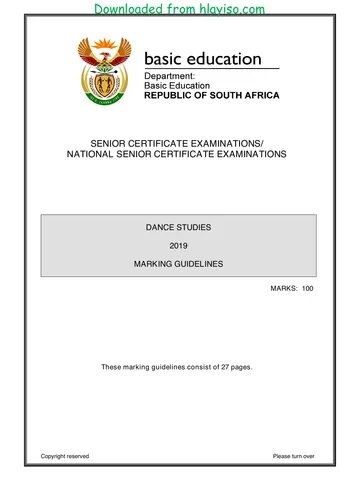
NATIONAL
SENIOR CERTIFICATE
GRADE 12
DANCE STUDIES
NOVEMBER 2019
MARKING GUIDELINES
MARKS: 100
These marking guidelines consist of 23 pages.
Copyright reserved Please turn over
Skip to contentAll 2019 papers 
View all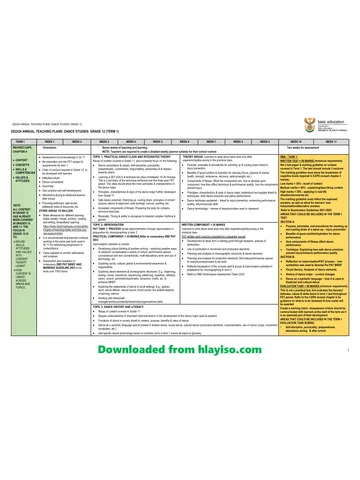
Dance Studies Grade 12 NSC November 2019 Memo (English)
Grade 12 Dance Studies memorandum from the NSC November Exam 2019 (English), 23 pages. Read online or download the free PDF.
Dance Studies · Grade 12 · NSC November Exam · 2019. Memorandum, 23 pages. Read online or download the PDF.
- Subject
- Dance Studies
- Grade
- Grade 12
- Document type
- Memorandum
- Year
- 2019
- Exam period
- NSC November Exam
- Curriculum
- CAPS
- Pages
- 23
- File size
- 429.2 KB
Free to read online, no sign-up needed
Loading document…
Loading document…
1 of 23
This exam
NSC November Exam 2019
Document textSearch extracted text and jump to a page.
Downloaded from hlayiso.com
Dance Studies 2 DBE/November 2019
NSC – Marking Guidelines
NOTE TO MARKERS:
• Adhere strictly to these marking guidelines when marking.
• The standardisation process during marking guidelines discussions ensures that
the marking guidelines cover most possible responses candidates could provide.
• Every marker must then apply this consistently. The marking guidelines may not be
altered in any way.
• In some qualitative questions, exercise your professional and informed judgement.
• This question paper must be marked by experienced dance
teachers/advisors/officials as it requires specialist knowledge.
• In some questions, candidates have a choice. If candidates have answered both
questions, mark only the answers to the FIRST question they have answered.
• Candidates may give a wide variety of answers depending on what they have
covered in class.
• Candidates could include correct information that is not included in the text book.
Professional judgement must be used. If unsure, this must be verified by
researching the area concerned.
• Low, medium or high cognitive levels expected in each answer are included above
the possible answers.
• Markers should NOT award full marks for an answer that is superficial and minimal
or where all requirements have not been met.
• Look for what the candidate knows, not what he/she doesn't know.
• Allocate ONE tick for ONE mark, for the content provided, up to the maximum
marks.
• No ½ marks may be awarded for insufficient content in answers.
Copyright reserved Please turn over
Downloaded from hlayiso.com
Dance Studies 3 DBE/November 2019
NSC – Marking Guidelines
SECTION A: SAFE DANCE PRACTICE AND HEALTH CARE
QUESTION 1: DANCE INJURIES – COMPULSORY
LOW LEVEL 1.1 Indicate 1 mark
1.2 Describing 3 marks
1.3 Explaining 4 marks
MEDIUM LEVEL 1.4 Describing 3 marks
HIGH LEVEL 1.5 Discuss 4 marks
POSSIBLE ANSWERS:
1.1 NOTE: ONE of the following could be named.
• Tendonitis
• Sprains
• Strains
• Broken or fractured bone (1)
1.2 NOTE: If the candidate names the cause but does not describe the
cause they will receive ZERO marks.
If more than 3 answers have been provided mark only the first THREE.
Causes of an ankle joint injury:
• Not warming up correctly.
• Pushing yourself too hard.
• Overuse/stress – when demanding too much from a tendon/ligament/
muscle/bone without allowing it to repair itself it is prone to injuries.
• Incorrect/poor technique – poor posture and alignment/incorrect weight
placement can create muscular imbalances that put stress on the
tendon/ligament/muscle/bone which can increase the risk of injury.
Explaining any other incorrect technique.
• Impact – such as a sudden powerful motion/fall can put strain on the
tendon/ligament/muscle/bone and could cause possible injury if done
continually.
• Inadequate warm up – neglecting to warm up before class will leave the
tendon/ligament/muscle unprepared for action as they are less pliable and
lack adequate blood supply.
• Trauma – tendon/ligament/muscle can become inflamed after a traumatic
injury such as twisting or falling in turns and big jumps through lack of
technique/strength, etc.
• Fatigue – when the dancer is tired, the tendon/ligament/muscle is less
likely to provide good support for the ankle joint. When tired, it is difficult to
control the body's movements accurately which can cause injuries.
• Poor conditioning – a lack of regular exercise can make your ankle joint
less flexible and more likely to be injured.
• Environmental – dancing on slippery, uneven or un-sprung floors could (3)
cause injury to the ankle joint.
• Any other possible answer related to ankle joint injuries.
Copyright reserved Please turn over
Downloaded from hlayiso.com
Dance Studies 4 DBE/November 2019
NSC – Marking Guidelines
1.3 NOTE: Immediate and/or long-term treatment must be accepted. If the
candidate names but does not explain the treatment they will receive
ZERO marks. If candidate includes RICE and additional treatments
evaluate the whole answer before awarding marks. Accept basic
definition for RICE. If more than FOUR treatments have been provided
mark only the first FOUR.
The answers must relate to the injury they have indicated.
Areas that could be included depending on the injury the candidate has
provided:
Rest:
• Stop the activity that caused the injury and rest the injured joint.
• Avoid activity for the first 48 to 72 hours after the injury.
• Rest injured area
Ice:
• The injured area or the first 48 to 72 hours after the injury.
• Apply ice wrapped in a damp towel to the injured area for 15 to 20 minutes
every two to three hours during the day.
• Ice injured area/reduce swelling
Compression:
• Compressing or bandaging the injured area to limit any swelling and
movement that could damage it furthers, e.g. a crepe bandage, a simple
elastic bandage, or an elasticated tubular bandage.
• Compress injured area.
Elevation:
• Keeping the injured area raised and supported on a pillow to help reduce
swelling.
• To drain fluids from the injured area and reduce swelling.
• Reduce bleeding.
• Elevate injured area.
Physiotherapy:
• Ultra sound to reduce swelling.
• Physiotherapist may provide additional exercises.
Anti- inflammatory pills:
• To bring down the swelling and reduce the pain.
Surgery:
• To surgically repair a broken bone or fracture.
• Any other suitable answer related to the treatment of an ankle joint injury. (4)
1.4 NOTE: Answers must relate to maintaining fitness during a recovery
period. These exercises should be suitable to do while recovering. Only
mark the FIRST THREE if more are provided in the candidate's answers.
Candidate must describe 3 actual exercises in detail. Describe means to
give a detailed account or describe an exercise- it indicates the HOW!
Non-weight bearing exercises:
• In the case of an ankle injury, plantar and dorsi flexing the foot in an
elevated position will be beneficial for reducing swelling.
Floor work:
• Could maintain core stability and strength through exercises such as sit
ups and push-ups on the knees.
Copyright reserved Please turn over
Downloaded from hlayiso.com
Dance Studies 5 DBE/November 2019
NSC – Marking Guidelines
• Flexibility exercises for all the parts of the body e.g. hamstrings,
quadriceps, torso etc. and sideways stretch could maintain mobility.
Weight-bearing exercises:
• Start with partial weight-bearing exercises and progress to full weight-
bearing exercises using a balancing board/cushion/barre.
Physiotherapy:
• Physiotherapist could prescribe additional exercises that can strengthen
other areas to support the injured area.
• Any other possible answer describing exercises that will maintain overall
fitness, during the recovery period. (3)
1.5 NOTE: The candidates answer must relate to the challenges in class
following the recovery period. Bullets have been used to guide marking.
The answers must relate to the injury they have diagnosed.
1 bullet = 1 Mark
Decreased cardiovascular fitness:
• The dancer will be unfit as endurance levels will have dropped.
• Movements will not be performed with energy, and the dancer will easily
become fatigued and out of breath.
• The work will not look effortless.
Loss of muscle strength:
• The muscles will not be at optimal strength due to lack of exercise, so
movements will not be controlled and sustained.
• This could cause the work to lack grace and precision/the dancer may not
be able to do jumps fully.
Loss of balance/posture/alignment :
• This could place strain on the joints and muscles that could lead to further
injuries.
• The spine and upper body will no longer have the strong support it did
before the injury.
Swelling:
• Of the injured ankle may occur once the dancer starts activity again and
this will cause constant pain and decreased activity levels.
Stiffness:
• In the injured area may prevent a wide range of movement.
• Limited range of movement in joints due to lack of stretching in
class/dynamic stretching.
The dancer could put on weight:
• Which would put more strain on the muscles and joints and the dancer
would have the added worry of how to lose the weight.
New knowledge is missed:
• This could hinder dance technique development.
Corrections on technique are missed:
• This could lead to injury.
Mental impact:
• Feeling that one's peers are improving much faster causing
depression/emotional upheaval.
• Any other possible answer discussing the challenges faced after an injury. (4)
[15]
Copyright reserved Please turn over
Downloaded from hlayiso.com
Dance Studies 6 DBE/November 2019
NSC – Marking Guidelines
QUESTION 2: DANCE TECHNIQUE – CHOICE
LOW LEVEL 2.1 Explaining 6 marks
HIGH LEVEL 2.2 Reflecting 4 marks
NOTE: Bullets are used to aid marking. One-word answers will not be accepted.
One bullet with clearly worded facts = 1 mark.
POSSIBLE ANSWERS:
2.1 NOTE: READ THE WHOLE QUESTION BEFORE AWARDING MARKS.
Answers must explain how correct posture and alignment of the body
and legs assists in landing of jumps, and could include the following:
• Bending the knees.
• The correct use of feet when landing should be toes, balls of feet and
heels to help absorb the shock of a jump.
• When bending the knees at the end of a jump the correct alignment of the
knees in a bend must have the knees balancing over the ankle and the
ankle balancing over the middle of the foot.
• Maintaining a correct posture and alignment could ensure balance and
control preventing uncontrollable falling after a jump.
• How the head balances on top of the spine with crown over the insteps
which helps with the alignment and control the downward movement of a
jump.
• The equal placement of the weight on the whole foot with knees aligned
over the middle of the foot could prevent injuries to the feet and ankles
when landing.
• Strong core stability will help with the control of the downward movement
of landing from a jump – resisting gravity and ensuring the correct
alignment of the spine and pelvis.
• Any other suitable answer that relates to how core stability assists in safe
(6)
landings from a jump.
2.2 Candidates must reflect on HOW they improved their own dance
technique. Use professional judgement when marking this question.
Each statement must be explained.
Possible areas that could be included:
• Punctuality – being on time to ensure that the warm up is not missed and
muscles are prepared for the class ahead.
• Attendance – attending all classes so no instructions/new steps/new
techniques are missed out on ensuring growth in dance vocabulary.
• Components of fitness – to ensure continued fitness and the
development of all the components needed to develop more complex
techniques.
• Commitment to movement – focussing on the exercise and executing
correct techniques to prevent injuries/enhance performance ability.
• Application – listening to and applying corrections provided by the
teacher will ensure that you don't develop incorrect dance technique.
Copyright reserved Please turn over
Downloaded from hlayiso.com
Dance Studies 7 DBE/November 2019
NSC – Marking Guidelines
• Practice - additional time made outside of the dance class to practice
movements until they are technically correct – this will allow movements to
be done with ease and grace.
• Daily stretching – will improve flexibility and range of movement which
will in turn improve the complexity and performance levels of a dancer.
• Healthy diet – provides the needed nutrition to sustain energy levels
during class/rehearsals, concentration to avoid injury and a strong immune
system to make sure you don't miss class due to illness.
• Any other suitable answer that relates to how they improved their own
dance technique. (4)
[10]
OR
QUESTION 3: MUSCLES AND ANATOMICAL ACTIONS – CHOICE
LOW LEVEL 3.1 Selecting 3 marks
3.2 Identifying 1 mark
3.3 Identifying 1 mark
3.4 Identifying 1 mark
HIGH LEVEL 3.5 Elaborating 4 marks
ANSWERS:
3.1 NOTE: Candidates must answer any THREE of the following
multiple-choice questions. Award one mark for each correct
answer. Only mark the first THREE answers if more have been
given. Check the selection candidates have made.
3.1.1 B
3.1.2 B
3.1.3 A
3.1.4 C
3.1.5 A (3)
3.2 Gracilis (1)
3.3 Dorsi Flexion (of the ankle joint.) (1)
3.4 Pectineus/Gluteus medius/Gluteus minimus/Adductor (1)
longus/Addicutor brevis/Adductor magnus
Copyright reserved Please turn over
Downloaded from hlayiso.com
Dance Studies 8 DBE/November 2019
NSC – Marking Guidelines
3.5 NOTE: Candidates must include any TWO muscles from the
list provided. If candidates answer on more muscles only
mark the first two provided.
Award 1 mark for each clear elaboration on how the muscles
are used in dance. The candidates do not have to provide
detailed sections of the muscles but could talk about the
muscles as a whole.
If candidates only name an anatomical action but do not
describe how they are used in dance – no marks are awarded.
2 facts per muscle = 2 marks
POSSIBLE ANSWERS:
Deltoids: (accept anterior deltoid, middle deltoid and posterior
deltoid).
• These muscles assist in the free movement of the arm in the
shoulder joint i.e. port de bras. (Candidates cannot just say arm
but must include the joint)
• Any other suitable answer on how the Deltoids are used in
dance movements (flexion, inward and outward rotation,
horizontal adduction, horizontal abduction, extension)
Latissimus Dorsi:
• Assists in the medial rotation of the arm to ensure correct
alignment of the shoulder girdle.
• Assists in carriage of the arms by providing support from the
back of the arm.
• Assists in maintaining strong posture and correct alignment of
the lower spine.
• Adduction of the arm to assist in lowering a partner out of a lift.
• Any other suitable answer on how the Latissimus Dorsi is used
in dance movements.
Pectoralis Major:
• Assist in stabilizing the shoulder girdle when doing floor work
and partner work for ease of movement.
• Assists in lowering a partner safely out of a lift by adducting the
arm.
• Flexion/internal rotation of the shoulder joint to assist with
strong movement of the arms crossing the midline of the body.
• Any other suitable answer on how the Pectoralis Major is used
in dance movements.
Trapezius:
• These muscles assist in extending the head (looking up).
• To manipulate the shoulder girdle i.e. depressing the shoulders
to create length in the neck line.
• Retracting the shoulders to open the chest for correct alignment
of the shoulder girdle.
Copyright reserved Please turn over
Downloaded from hlayiso.com
Dance Studies 9 DBE/November 2019
NSC – Marking Guidelines
Upper fibres:
• Elevate the scapula to assist with shoulder movements i.e.
shoulder rolls.
• Extend the head to assist in lifting the eye line for better
projection.
Middle fibres:
• Elevate the scapula to assist with shoulder movements i.e.
upward shoulder isolations.
• Adduct/retract the scapula when doing a back bend.
Lower fibres:
• Assists in lowering the shoulders (depressing) to avoid tension
in that area.
• Adduct the scapula to assist in correct alignment of the
shoulder girdle.
• Assists in stabilizing the shoulder girdle when doing port de
bras/floor work/partner work for ease and control of movement.
• Any other suitable answer on how the Trapezius is used in
dance movements.
Serratus Anterior:
• Assist in stabilizing the scapula during arm movements/floor
work/partner work to ensure a strong movement.
• Any other suitable answer on how the Serratus Anterior is used
in dance movements.
Romboid:
• Assist in stabilizing the scapula during arm movements/floor
work/partner work to ensure a strong movement.
• Attachment to the spine assists in alignment and correct
posture.
• Any other suitable answer on how the Romboid is used in
dance movements. (2 x 2) (4)
[10]
Copyright reserved Please turn over
Downloaded from hlayiso.com
Dance Studies 10 DBE/November 2019
NSC – Marking Guidelines
QUESTION 4: COMPONENTS OF FITNESS – CHOICE
LOW LEVEL 4.1 Matching 5 marks
MEDIUM LEVEL 4.2 Explaining 5 marks
HIGH LEVEL 4.3 Analysing 5 marks
ANSWERS:
4.1 4.1.1 B (1)
4.1.2 A (1)
4.1.3 D (1)
4.1.4 E (1)
4.1.5 C (1)
POSSIBLE ANSWERS:
4.2 NOTE: No marks will be awarded for a definition of cardiovascular
endurance.
The answers must explain how well-developed cardiovascular
endurance could increase a dancer's performance ability.
• Dancers can rehearse or perform for longer.
• Dancers can perform at a higher level of complexity.
• Cardiovascular endurance supplies the muscles with oxygen-rich blood
which increases fitness.
• Complex dance movements look effortless/the arms, legs and body won't
feel heavy and fatigued.
• Concentration is improved so that the dancer can focus on the
class/routine and learn complex combinations faster.
• The supply of nutrients to all parts of the body due to a strong heart rate
boosts the immune system which reduces illness so that training is not
missed.
• Good endurance allows the dancer to stay focused when executing
complex movements instead of feeling tired, thus reducing risk of injury.
• Dancers won't get out of breath so quickly due to stronger lungs and they
will have enough energy to try more complex movements.
• Any other suitable answers relating to cardiovascular endurance. (5)
Copyright reserved Please turn over
Downloaded from hlayiso.com
Dance Studies 11 DBE/November 2019
NSC – Marking Guidelines
4.3 NOTE: The candidate's answer must relate to the image. Candidates can
refer to any of the components of fitness shown in the answers below.
They could provide a detailed answer on one component only. No marks
will be awarded for naming without explaining.
Core stability:
• A strong centre/core assists in maintaining balance on one hand
• The core supports the spine, which assists in stabilising the movement.
• Strong stomach, buttocks and thigh muscles enables the dancer to lift the
legs off the ground and the core helps to maintain the position.
• It makes this level of complexity easier to achieve as it allows the dancer
to shows greater control of the movement and is able to balance with
suspension and control.
Strength:
• The strength in the torso and upper back makes the dancer more stable
and allows for the rotation in the upper body.
• The strength in the arms also helps to balance and control the movement.
• Developed muscle strength, allows the movement to be performed
accurately because the dancer's body is able to manage a more complex
movement.
Flexibility:
• Flexibility in the spine allows for the rotational movement demonstrated.
• Dynamic stretching to enable movement to occur.
Neuromuscular skills:
• The dancer has a developed sense of balance which gives her the ability
to maintain equilibrium over her arm as a support base.
• The dancer's sense of kinaesthetic awareness gives her an inner
awareness to place the body correctly in this position.
• She is able to co-ordinate her arms, legs and body in this position though
her developed spatial awareness.
• Any other suitable answers referring to how the dancer maintains this
position. (5)
[15]
OR
Copyright reserved Please turn over
Downloaded from hlayiso.com
Dance Studies 12 DBE/November 2019
NSC – Marking Guidelines
QUESTION 5: POSITIVE BODY IMAGE – CHOICE
LOW LEVEL 5.1 Describing 5 marks
MEDIUM LEVEL 5.2 Informing 5 marks
HIGH LEVEL 5.2 Designing 5 marks
NOTE: Bullets are used to aid marking. One-word answers will not be accepted.
One bullet with clearly worded facts = 1 mark. Candidates may refer directly to
the article but must not repeat verbatim the information from the article.
POSSIBLE ANSWERS:
5.1 • A lack of confidence in appearance could affect confidence in
performance.
• Could lead to eating disorders which will directly impact on your ability to
dance, i.e. energy levels/strength/lack of nutrition/illness.
• Uncomfortable in tight fitting clothes i.e. leotard or tights will make the
dancer self-conscious and reluctant to attend classes.
• Could lead to depression
• Thoughts of self-harming.
• Could lead to isolation and loneliness
• Any other suitable answer relating to the effect on a dancer. (5)
5.2 NOTE: Many possible answers/designs could be given. Use professional
judgement when marking. Bullets are used to aid marking.
A Creative and innovative layout and design on an A4 page could
include:
• Use of font/s, i.e. capital letters/cursive/calligraphy/graffiti style, etc.
• Layout of information, i.e. organised/clear/meaningful, etc.
• The use of images, shapes, emoji, illustrations, border, frame. (5)
Motivational quotes, tips, warning signs, symbolic images, etc. relating
to a positive body image could include
• Being happy in and about your body.
• Accepting who you are
• Not comparing yourself with others
• Any other suitable answers relating to a positive body image. (5)
[15]
TOTAL SECTION A: 40
Copyright reserved Please turn over
Downloaded from hlayiso.com
Dance Studies 13 DBE/November 2019
NSC – Marking Guidelines
SECTION B: DANCE HISTORY AND LITERACY
QUESTION 6: MUSIC – COMPULSORY
LOW LEVEL 6.1–6.5 True or False 5 marks
NOTE: For 6.1 and 6.4 do NOT award a mark if candidate has NOT supplied correct
answer.
ANSWERS:
6.1 False
Syncopation refers to the accenting of the weaker beat.
OR
Harmony refers to the simultaneous sounding of notes. (1)
6.2 True (1)
6.3 True (1)
6.4 False
Harmony refers to the simultaneous sounding of notes.
OR
Polyrhythms is when two or more rhythms take place simultaneously (1)
6.5 True (1)
[5]
QUESTION 7: CHOREOGRAPHIC STRUCTURES – COMPULSORY
LOW LEVEL 7.1 – 7.5 Defining 5 marks
POSSIBLE ANSWERS:
7.1 Canon:
One or more dancers execute a whole sequence and the other(s) repeat it
starting at different intervals (e. g. two counts after the first group has started
the sequence – almost like a Mexican wave). (1)
7.2 Theme:
This is an idea or subject matter that a dance work is based on. It could be a
story or an abstract idea or emotion. Identifies the play/production. (1)
7.3 Motif:
A recurring movement or idea that can be elaborated on or developed in a
variety of ways. If the word (repeat/reccurring) movement does not appear
ZERO marks should be awarded. (1)
7.4 Climax:
A climax is a highlight or memorable moment in a dance work. There can be
more than one such moment in a dance work. (1)
7.5 Unison:
Dancers moving at the same time and doing the same movements. (1)
[5]
Copyright reserved Please turn over
Downloaded from hlayiso.com
Dance Studies 14 DBE/November 2019
NSC – Marking Guidelines
QUESTION 8: CAREERS AND FUNCTIONS OF DANCE - CHOICE
LOW LEVEL 8.1 Identifying 2 marks
8.2 Describing 2 marks
MEDIUM LEVEL 8.3 Comparing 6 marks
POSSIBLE ANSWERS:
8.1 NOTE: Allocate ONE mark for naming a career. Below are two examples
of production careers. Careers must relate to running/managing a stage
production. Accept careers relating to a professional production.
• Front of house manager
• Stage manager
• Accept dance captain, dancer and choreographer (2)
8.2 NOTE: Allocate ONE mark for describing a main function of each career.
Below are some examples of the main functions of the above-mentioned
careers:
Front of house manager:
• He/she may oversee the running of the box office where ticket sales will
take place, any merchandising/catering stands as well as managing and
directing the ushers and any part of the building the public may enter
during their visit to the theatre.
• Coordinates the start of the show with the stage manager, and records the
start and end times of the performance, as well as the size of the house
(number of people attending the show). In the event of a fire or
emergency, he or she takes charge.
• Any other suitable answers describing this career. (1)
Stage manager:
• Manages everything that happens on stage and backstage such as set up/
props/communicating with sound and lighting technicians.
• Usually wears a headset during the performance and directs
members of the cast and crew to ensure that all aspects of the production
- sound and lighting cues, the placement of sets and props on-stage and
off, and the exits and entrances of the performers - are executed at the
right time and in accordance with the choreographer's directions.
• The stage manager is also responsible for the safety of the performers
and crew while in the theatre.
• Any other suitable answers describing this career. (1)
8.3
NOTE: Many possible answers could be given. Candidates must
compare both theatrical and cultural functions for full marks to be
awarded. A table has been used to aid marking. Will accept answers that
refer to concert and social dance. Use professional judgement when
marking this section. Do not take off marks for incorrect format.
Copyright reserved Please turn over
Downloaded from hlayiso.com
Dance Studies 15 DBE/November 2019
NSC – Marking Guidelines
FUNCTION OF THEATRICAL/CONCERT CULTURAL/SOCIAL
DANCE
8.3.1 Education • Educate an audience on • History and tradition is
socio-political aspects, passed down from one
e.g. abuse/ generation to the next.
homosexuality/equality,
etc. (2)
8.3.2 Competition • Eisteddfods/scholarships • Gumboot dancing is
are used as competition used as a means of
platforms to gain status establishing dominance
or win bursaries. between tribes/groups.
• Battle between groups
(Hip hop) (2)
8.3.3 Communication • Communication of a • Communicating with
story /theme/idea ancestors through rituals
through a stage to ask for blessings or
performance. permissions. (2)
[10]
OR
QUESTION 9: PRINCIPLES AND HISTORY OF DANCE MAJOR - CHOICE
LOW LEVEL 9.2 Explaining 3 marks
9.3 Describing 1 marks
MEDIUM LEVEL 9.4 Outlining 6 marks
POSSIBLE ANSWERS:
9.2 NOTE: One mark to be awarded for a clear description of the
principle. No marks are awarded for naming the dance major.
9.2.1 Gravity:
• Contemporary compliments gravity and defies gravity (must be
both).
• Classical ballet defies gravity.
• African dance compliments gravity.
• Jazz compliments gravity and defies gravity.
• Any other suitable answer relating to the principle of the dance
major. (1)
9.2.2 Arms: (Individual examples could be included)
• Contemporary arm movements are controlled from the centre
allowing the arms to move freely.
• Classical ballet makes use of the arms in a structured and
controlled manner with very specific arm positions that frame
the body.
• African has specific arm movements relating to the various
styles performed.
• Jazz makes use of structured and extended arms.
• Any other suitable answer relating to the principle of the dance
major.
Copyright reserved Please turn over
Downloaded from hlayiso.com
Dance Studies 16 DBE/November 2019
NSC – Marking Guidelines
9.2.3 Stance:
• Contemporary uses parallel and turned out feet and the body is
held strongly.
• In Classical ballet the feet are turned out and placed in different
positions of the feet.
• In African dance the feet are both parallel and turned out.
• In Jazz the feet are both parallel and turned out.
• Any other suitable answer relating to the principle of the dance
major. (1)
9.3 Examples of Characteristics:
• Contemporary can be recognised by the use of floor work and
the use of contraction and release movements.
• In Classical ballet the dancers usually wear elaborate costumes
such as tutus/velvet jackets and skirts etc.
• African makes use of vocals like ululating and whistling.
• Jazz makes use of a lot of hip, shoulder and rib isolations.
• Any other suitable answer that is a characteristic of the dance (1)
major.
9.4 NOTE: Candidates must outline SIX important factors of their
dance major. Bullets are used to aid marking. If more than six
facts are included, mark only the first six.
Below are examples of possible answers:
Ballet:
• Had its beginnings in the early renaissance period.
Renaissance means rebirth and showed the renewed interest in (1)
the arts.
• It was mostly done by nobility in the French courts and was
brought there by Catherine de Medici who married the French
king, Henry ǁ.
• Ballet Comique de la Reine was considered to be the first real
ballet – by Balthasar de Beujoyeulx. It lasted for five years.
• Schools were launched to train dancers as the steps became
more difficult. Only males trained at these schools initially.
• Point work and pas de deux were introduced in the 19th century.
• Although ballet is strictly codified, different styles have emerged
through the years, i.e. Balanchine's neoclassical style.
• Any other suitable answer relating to the history of ballet.
Contemporary:
• Contemporary was developed in the early 20th century and
means “of the times” and reflected and expressed the
frustration dancers experienced due to the restrictive nature of
ballet.
• Contemporary dance is a study of individuals and their ideas
and influences and how these made an impression on the
generations that followed. (6)
Copyright reserved Please turn over
Downloaded from hlayiso.com
Dance Studies 17 DBE/November 2019
NSC – Marking Guidelines
• Most of the pioneers wanted to express real emotions and
address real life issues with movement. Each individual
established a style or technique. His or her students would
break away and create something new, and so it would
continue.
• Isadora Duncan was one of the pioneers and she danced in
flowing Greek dresses and bare feet – inspired by nature and
poetry.
• Martha Graham was considered “the mother of contemporary
dance” and she created the “contraction and release”
technique.
• Today contemporary is used to communicate many ideas,
feelings and social issues i.e. Gregory Maqoma's Four
Seasons.
• Any other suitable answer relating to the history of
Contemporary (6)
African:
• African dance used to be considered primitive compared to the
European dance styles because the dances are often ritualistic
or ceremonial.
• The dancing often tells stories about the culture's history and
aesthetics. In Africa, dance is considered to be a part of
everyday life and it deals with every aspect from birth to death.
• Some dances are used for storytelling while others are used by
Shamans and healers to cure illness.
• In most African villages there was/is a “dance master” who
taught the young generations the various dances.
• The dancing and music is seen as one entity with complex
rhythms for both dancers and musicians. Music often comes
from vocals/clapping/stamping of feet and drumming.
• African dance has become much more popular and is now
performed on international stages.
• Any other suitable answer relating to the history of African
dance. (6)
[10]
Copyright reserved Please turn over
Downloaded from hlayiso.com
Dance Studies 18 DBE/November 2019
NSC – Marking Guidelines
QUESTION 10: INTERNATIONAL CHOREOGRAPHER AND DANCE WORK – COMPULSARY
LOW LEVEL 10.1.1 Providing 5 marks
MEDIUM LEVEL 10.1.2 Analysing 5 marks
HIGH LEVEL 10.2 Critical 8 marks
discussion
NOTE: Candidates may write on a different choreographer and dance work within
this question.
POSSIBLE ANSWERS:
10.1 NOTE: Candidates must name the international choreographer they
are answering on. No marks awarded. Candidates could answer on
personal and/or professional life. Candidates do not have to state
how factors influenced the choreographer- they can just state
facts.
10.1.1 Personal life:
• Childhood and upbringing i.e. poverty/segregation/slavery.
• Family members
• Medical conditions
• Artistic influences, i.e. shows they saw/artists they met.
• Mentors
• Training classes they were/were not exposed to.
• Any other suitable answers relating to major influences on the
choreographer's personal life.
Professional life:
• Training with/without proper facilities.
• Teachers/choreographers that had an impact.
• Companies they worked for/with.
• Artistic influences, i.e. fellow choreographers/art forms/dances styles
or genres.
• Could include for 1-mark information about how the Chilean war
influenced Ghost Dances.
• Political injustices.
• Any other suitable answers relating to major influences on the
choreographer's professional life. (5)
10.1.2 Possible areas of impact:
• Creating dance companies – creating new jobs for dancers.
• Creating new genres through fusion of existing genres i.e. fusing
ballet and contemporary.
• Adapting classical dance works into more modern versions to keep
them current.
• Using technology or mixed-media to enhance dance works.
• Creating awareness through choreography of socio-political issues
i.e. abuse/homosexuality/poverty/stereotyping, etc.
• Creating opportunities for emerging/young choreographers.
Copyright reserved Please turn over
Downloaded from hlayiso.com
Dance Studies 19 DBE/November 2019
NSC – Marking Guidelines
• Creating opportunities for emerging/young dancers.
• Dance outreach programmes to underprivileged communities
• Media coverage to attract/promote interest in dance.
• Any other suitable answers relating to the impact the choreographer
made. (5)
10.2 RUBRIC FOR MARKING QUESTION 10.2 ONLY.
Candidates can refer to the statement and critically
HIGH discuss how symbolism is used in the chosen dance
6-8 work. Detailed examples are used to justify opinions.
Candidates may or may not show an understanding
MEDIUM of referencing the statement. Candidates has
3-5 adequate knowledge of how symbolism was used.
Provide examples to justify opinions.
Candidates cannot reference the statement.
LOW Minimal/no understanding of symbolism. Minimal/no
1-2 examples are provided.
NOTE: Professional judgment must be used to evaluate the
candidate's response. Candidates must name the international
dance work they are answering on. The answer must relate to how
the choreographer portrayed through dance, what words alone
cannot express. The candidates should respond with their own
reflection and examples must be included for full marks to be
awarded.
If the candidate cannot relate their answer directly to the
statement, but includes correct facts about the selected dance
work, a maximum of THREE marks can be awarded.
POSSIBLE AREAS THAT COULD BE INCLUDED:
Could refer to quote with introduction and conclusion but should not
repeat the quote.
Production elements: how the choreographer used the following to
create meaning/symbolism/effect/atmosphere, etc.
• Lighting
• Costumes
• Makeup
• Set
• Props
• Special effects
• Technology
• Any other suitable answers on how production elements portrayed
through dance, what words alone cannot express.
Music/accompaniment: How the choreographer used
music/accompaniment to enhance the meaning/intent:
• Genre and how it added to the theme/intent/story/meaning
• Instrumentation and tone colour/timbre and how it created the
Copyright reserved Please turn over
Downloaded from hlayiso.com
Dance Studies 20 DBE/November 2019
NSC – Marking Guidelines
atmosphere.
• Songs/vocals and how the lyrics enhanced the theme/intent/
story/meaning.
• Accompaniment/sound effects and how this added to the
atmosphere/theme/intent
• Any other suitable answers on how the music/ accompaniment
portrayed what words alone cannot express.
Movement vocabulary:
• Symbolism of specific movements
• Gestures and their meaning
• Motifs to strengthen the message
• Groupings and the impact on the audience
• Choreographic structures and their visual impact
• Dance elements and their visual impact
• Any other suitable answers reflecting on how the choreographer
portrayed through dance, what words alone cannot express.
(8)
[18]
QUESTION 11: SOUTH AFRICAN CHOREOGRAPHER AND DANCE WORK – COMPULSARY
LOW LEVEL 11.1.1 Describing 5 marks
MEDIUM LEVEL 11.1.2 Analysing 5 marks
HIGH LEVEL 11.2 Opinion 8 marks
NOTE: Candidate may write on a different choreographer and dance work within
this question.
POSSIBLE ANSWERS:
11.1 NOTE: Candidates must name the choreographer they are
answering on.
11.1.1 Choreographic characteristics could include:
• Dance genres/fusion of genres
• Style/s of movement vocabulary
• Narrative/abstract choreographic works
• Use of/no use of improvisation
• Choices of music/accompaniment
• Inspiration/themes for the dance works, e.g. socio/economic
influences
• Use of production elements
• Programme notes
• Public appearances/profile
• Use of dancers/dance companies
• Any other suitable stylistic features (5)
Copyright reserved Please turn over
Downloaded from hlayiso.com
Dance Studies 21 DBE/November 2019
NSC – Marking Guidelines
11.1.2 NOTE: Do not award marks for listing accomplishments/
awards unless substantiated as to the impact made on dance.
The impact the choreographer has made on dance in South
Africa could include:
• Creating a company/s
• Creating new dance styles
• Including African dance in theatrical productions – pre-
apartheid
• Using mixed race casts – pre- apartheid
• Making statements about political/social situations through
dance
• Creating meaningful dance works to educate the public
• Outreach programmes/uplifting of communities
• Promoting South African dance internationally – putting African
dance on the global map.
• Any other suitable answers on the impact this choreographer
has made.
(5)
11.2
RUBRIC FOR MARKING QUESTION 11.2 ONLY
Candidates has an excellent understanding of
HIGH how production elements and movement
6-8 vocabulary compliments the dance work.
Candidate can provide detailed examples to
justify their opinions.
Candidates shows an adequate understanding
MEDIUM of how the production elements and movement
3-5 vocabulary are used in the dance work. Provide
some examples to justify their opinions.
Minimal or no understanding of the production
LOW elements and vocabulary are provided. Gives
1-2 little or no examples.
NOTE: Candidates must name the dance work they are
answering on.
The answer must evaluate how production elements and the
movement vocabulary complimented the dance work.
Candidates must answer on both production elements and
movement vocabulary to be awarded full marks. More may be
included in one section than the other.
If candidates cannot explain how the production elements and
movement vocabulary complimented the selected dance work,
but have described correct facts about the selected dance
work, a maximum of THREE marks can be awarded.
Production elements: how the choreographer used the
following to compliment the story/theme/intent of the dance
work:
Copyright reserved Please turn over
Downloaded from hlayiso.com
Dance Studies 22 DBE/November 2019
NSC – Marking Guidelines
• Lighting
• Costumes
• Makeup
• Set
• Props
• Special effects
• Technology
• Music/accompaniment
• Use of symbolism in any of the above
• Any other suitable answers on production elements
Movement vocabulary: How the choreographer used
movement vocabulary to compliment the dance work could
include:
• Symbolism of specific movements
• Gestures and their meaning
• Motifs to strengthen the message
• Groupings and the impact on the audience
• Choreographic structures and their visual impact
• Dance elements and their visual impact
• Any other suitable answers that relate to how the production
elements and movement vocabulary complimented the dance
work. (8)
[18]
Copyright reserved Please turn over
Downloaded from hlayiso.com
Dance Studies 23 DBE/November 2019
NSC – Marking Guidelines
QUESTION 12: REFLECTION – COMPULSARY
HIGH LEVEL Reflecting 4 marks
NOTE: READ THE WHOLE ANSWER BEFORE AWARDING MARKS.
CANDIDATES COULD ANSWER IN THE NEGATIVE.
CANDIDATES COULD INCLUDE THE FOLLOWING POSSIBLE AREAS OF
INFLUENCE:
• Personal life
• Class
• PATS
• Creativity
• Knowledge
• Movement vocabulary
• Any other suitable answers related to the influence dance works had on the
dancer. [4]
TOTAL SECTION B: 60
GRAND TOTAL: 100
Copyright reserved
Study this subject
Recommended for this subject
Memorandum
Dance Studies Grade 12 NSC November 2019 Memo (Afrikaans)
Question paper
Dance Studies Grade 12 NSC November 2019 QP (Eng)
Question paper
Dance Studies Grade 12 NSC November 2019 QP (Afr)
Memorandum
Dance Studies Grade 12 NSC June 2019 Memo (English)
Memorandum
Dance Studies Grade 12 NSC June 2019 Memo (Afrikaans)
Memorandum
Dance Studies Grade 12 NSC November 2023 Memo (English)
More from Grade 12 Dance Studies
Annual teaching plan
Gr 12 Dan Stu ATP 2023 24
Question paper
Dance Studies Grade 12 NSC June 2025 Question Paper (Eng)
Question paper
Dance Studies Grade 12 NSC November 2025 QP (Eng)
Question paper
Dance Studies Grade 12 NSC November 2025 QP (Afr)
Question paper
Dance Studies Grade 12 November 2024 NSC QP (Eng)
Question paper