
Downloaded from hlayiso.com
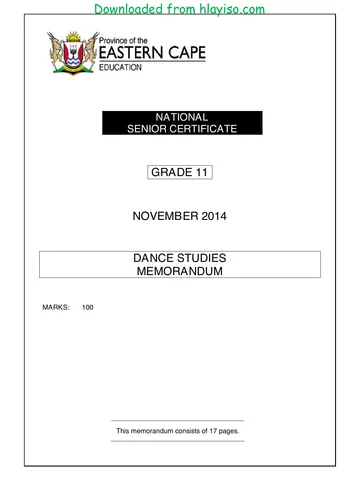
NATIONAL
SENIOR CERTIFICATE
GRADE 11
NOVEMBER 2014
DANCE STUDIES
MARKS: 100
TIME: 3 hours
*IDANCDM*
This question paper consists of 7 pages.
You're offline
Skip to contentQuestion paper 
_hlayiso.com_--1df684bf-cf23-4ae8-8676-1a802e77e828/v1-1b5cc7224ba2deb8dc70/card.webp)
View all
Dance Studies QP_hlayiso.com_.pdf
Dance Studies · Grade 11 · Eastern Cape November · 2014. Question paper, 14 pages. Read online or download the PDF.
- Subject
- Dance Studies
- Grade
- Grade 11
- Document type
- Question paper
- Year
- 2014
- Exam period
- Eastern Cape November
- Pages
- 14
- File size
- 869.6 KB
Loading document…
Loading document…
1 of 14
Document textSearch extracted text and jump to a page.
Downloaded from hlayiso.com
2 DANCE STUDIES (NOVEMBER 2014)
INSTRUCTIONS AND INFORMATION
1. This question paper consists of TWO sections:
SECTION A: Safe Dance Practice and Healthcare
SECTION B: Dance History and Literacy
2. Read through the whole paper carefully before answering it.
3. There is a choice between QUESTION 2 and QUESTION 3.
4. There are TEN questions in this question paper.
5. Number the answers according to the numbering system used in this
question paper.
6. Leave THREE lines after each question.
7. Start EACH SECTION on a NEW page.
8. Draw a line through any questions that you do not want marked.
9. Marks are NOT allocated according to the principle of ‘one mark per one
fact’, but according to the quality of the answer.
10. Write neatly and legibly.
Copyright reserved Please turn over
Downloaded from hlayiso.com
(NOVEMBER 2014) DANCE STUDIES 3
SECTION A: SAFE DANCE PRACTICE AND HEALTHCARE
QUESTION 1
1.1 Name THREE social values in dance. (3)
1.2 Explain THREE guidelines that will lead to safe dance practice in the dance
class. (3)
1.3 Peer pressure can be very dangerous. Explain how you can avoid being
influenced by your friends you in a negative way. (2)
1.4 Give reasons why it is important to have a positive body image. (2)
[10]
YOU MAY CHOOSE BETWEEN QUESTION 2 AND QUESTION 3.
QUESTION 2 (CHOICE QUESTION)
2.1 Give the name of the type of joint found at the knee. (1)
2.2 Give the name of the type of joint found at the hip. (1)
2.3 Give TWO anatomical actions found at the elbow joint. (2)
2.4 Give TWO anatomical actions found at the shoulder joint. (2)
2.5 Name TWO types of bone and give an example of each one. (4)
[10]
OR
QUESTION 3 (CHOICE QUESTION)
3.1 Name the powerful group of four muscles that all cross the knee joint. (1)
3.2 Name the large muscle of the chest which adducts and medially rotates the
humerus. (1)
3.3 Name the muscle that gives the calf its round appearance and that helps
with plantar flexion of the foot. (1)
3.4 Name the large muscle whose attachments originate from the base of the
skull, neck and thoracic vertebrae and insert into the clavicle. (1)
3.5 What are the names of TWO of the muscles responsible for core stability? (2)
3.6 Give TWO anatomical actions of the muscles that move the head. (2)
3.7 Give TWO anatomical actions of the group of muscles situated at the back of
the leg. (2)
[10]
Copyright reserved Please turn over
Downloaded from hlayiso.com
4 DANCE STUDIES (NOVEMBER 2014)
QUESTION 4
4.1 What is flexibility in dance? (1)
4.2 Why do you need to be flexible when you dance? (3)
4.3 What are the factors that can limit your flexibility? (2)
4.4 How would you improve or develop your flexibility? (4)
[10]
QUESTION 5
5.1 Describe a safe way to land from a jump to prevent injuries. (1)
5.2 What are the causes of shin splints during dance classes? (3)
5.3 How would you treat a cramp in the dance class? (2)
5.4 Name and explain what the acronym R I C E stands for. (4)
[10]
TOTAL SECTION A: 40
Copyright reserved Please turn over
Downloaded from hlayiso.com
(NOVEMBER 2014) DANCE STUDIES 5
SECTION B: DANCE HISTORY AND LITERACY
QUESTION 6
6.1 What are THEATRICAL dance forms? (1)
6.2 What are CULTURAL dance forms? (1)
6.3 There are THREE types of cultural dance forms. Explain ONE type of
cultural dance form and give an example of such a dance. (2)
6.4 Discuss some examples of the costumes/attire worn for African indigenous (3)
dances.
6.5 Give reasons why we study dances from other cultures. (3)
[10]
QUESTION 7
This year you have studied a prescribed international choreographer.
Answer the following questions.
7.1 Give the name of the choreographer.
7.2 Describe the choreographer’s dance training style. (4)
7.3 Discuss in detail his/her choreographic career. (4)
7.4 What are the characteristics of the dance style used in his/her dance works? (4)
7.5 How has this choreographer contributed to world of dance? (3)
[15]
BELOW IS THE PRESCRIBED LIST OF THE INTERNATIONAL
CHOREOGRAPHERS AND THEIR DANCE WORKS.
INTERNATIONAL DANCE WORKS
CHOREOGRAPHERS
George Balanchine Apollo/Jewels
Alvin Ailey Revelations
Martha Graham Lamentation/Errand into the Maze
Christopher Bruce Ghost Dancers
Mathew Bourne Swan Lake/Cinderella
Pina Bausch Rites of spring
William Forsythe In the middle, somewhat elevated
Mats Ek Giselle/Swan Lake/Carmen
Rudi van Dantzig Four Last Songs
Jiri Killian Wings of wax
Copyright reserved Please turn over
Downloaded from hlayiso.com
6 DANCE STUDIES (NOVEMBER 2014)
QUESTION 8
Choose one SOUTH AFRICAN CHOREOGRAPHER AND DANCE WORK from
the prescribed list below and answer the following questions:
8.1 Give the name of the choreographer and dance work.
8.2 Provide the story/synopsis of the dance work. (5)
8.3 Describe the costumes of the dance work. (3)
8.4 Describe the music accompaniment used in this dance work. Include
composer/artists/genre/instrumentation, etc. (4)
8.5 What has made this dance work innovative? Substantiate your answer. (3)
[15]
BELOW IS A PRESCRIBED LIST OF THE SOUTH AFRICAN
CHOREOGRAPHERS AND THEIR DANCE WORKS.
SOUTH AFRICAN CHOREOGRAPHERS DANCE WORKS
Veronica Paeper Orpheus in the
Underworld/Carmen
Vincent Mantsoe Gula Matari
Alfred Hinkel Last Dance (Bolero)/Rain in a
dead man’s footprints/Cargo
Sylvia Glasser Tranceformations
Gary Gordon Bessie’s Head
Mavis Becker Flamenco de Africa
Hazel Acosta Blood Wedding
Caroline Holden Imagenes
Gregory Maqoma Beauty Trilogy/Skeleton Dry
QUESTION 9
9.1 The speed at which music is played is called … (1)
9.2 A regular constant throb – a measure of passing time – is called … (1)
9.3 The amount of time taken to perform is called … (1)
9.4 Two or more rhythms played simultaneously are called … (1)
9.5 The rate at which the music proceeds is called … (1)
9.6 Name ONE brass instrument. (1)
9.7 Name ONE woodwind instrument. (1)
9.8 Name ONE percussion instrument. (1)
[8]
Copyright reserved Please turn over
Downloaded from hlayiso.com
(NOVEMBER 2014) DANCE STUDIES 7
QUESTION 10
10.1 The job titles below and their definitions have been mixed up.
Choose a statement in COLUMN B that matches a function in COLUMN A.
Write only the letter next to the appropriate question number
(10.1.1–10.1.5) in the answer book.
COLUMN A COLUMN B
10.1.1 Dancer A controls the stage lights in the theatre
10.1.2 Choreographer B does the stage make-up and may
also do character make-up needed
for a role e.g. that of a lion or a witch
10.1.3 Make-up artist C performs the movement sequences
created by the choreographers
10.1.4 Lighting designer D managers everything that happens
on the stage and backstage e.g. sets
coming on and coming off, lights,
props and curtains
10.1.5 Stage manager E creates the movement sequences
performed by the dancers,
sometimes working with the dancers
to achieve this
(5 x 1) (5)
10.2 What do we call the following performance spaces?
10.2.1 The middle part of a stage. (1)
10.2.2 A performance area that may be viewed from all sides
simultaneously. (1)
10.2.3 The part of the stage furthest from the audience. (1)
10.2.4 Off stage areas to the right and left of the stage where performers
prepare to enter the stage. (1)
10.3 Discuss the different spaces used during your improvisation and
composition lessons. (3)
[12]
TOTAL SECTION B: 60
GRAND TOTAL: 100
Copyright reserved Please turn over
(NOVEMBER 2014) DANSSTUDIES 7
VRAAG 10
10.1 Die werktitels en hul definisies is deurmekaar. Kies ʼn stelling in KOLOM B
wat pas by ʼn funksie in KOLOM A. Skryf slegs die letter langs die
toepaslike vraagnommer (10.1.1–10.1.5) in die ANTWOORDEBOEK neer.
KOLOM A KOLOM B
10.1.1 Danser A beheer die verhoogligte in die teater
10.1.2 Choreograaf B doen die grimering en mag ook
karaktergrimering doen soos benodig
word vir die rol van ʼn leeu of ʼn heks
10.1.3 Grimerings- C voer die bewegingsreekse uit wat
kunstenaar deur die choreograaf geskep word
10.1.4 Beligtingontwerper D beheer alles wat op en agter die
verhoog gebeur, bv. stelle wat op of
af gaan, ligte, rekwisiete en gordyne
10.1.5 Verhoogbestuurder E skep die bewegingsreekse wat
uitgevoer word deur die dansers, en
werk soms saam met die dansers om
dit te bereik
(5 x 1) (5)
10.2 Wat noem ons die volgende opvoeringsruimtes?
10.2.1 Die middelste gedeelte van die verhoog. (1)
10.2.2 Die opvoeringsarea wat gelyktydig van alle kante gesien kan
word. (1)
10.2.3 Die gedeelte van die verhoog wat die verste van die gehoor is. (1)
10.2.4 Die gedeeltes aan die linkerkant en regterkant van die verhoog
waar kunstenaars voorberei om die verhoog te betree. (1)
10.3 Bespreek die verskillende ruimtes wat gedurende improvisering en
komposisie-lesse gebruik word. (3)
[12]
TOTAAL AFDELING B: 60
GROOTTOTAAL: 100
Kopiereg voorbehou Blaai om asseblief
Downloaded from hlayiso.com
6 DANSSTUDIES (NOVEMBER 2014)
VRAAG 8
Kies een SUID-AFRIKAANSE CHOREOGRAAF EN DANSWERK uit die
voorgeskrewe lys hieronder en beantwoord die volgende vrae:
8.1 Gee die naam van die choreograaf en die naam van die danswerk.
8.2 Verskaf die storie/sinopsis van die danswerk. (5)
8.3 Beskryf die kostuums van hierdie danswerk. (3)
8.4 Gee ʼn beskrywing van die musikale begeleiding wat in hierdie dans gebruik
word. Sluit in die komponis/kunstenaars/genre/instrumente, ens. (4)
8.5 Wat het hierdie danswerk innoverend gemaak? Motiveer jou antwoord. (3)
[15]
HIERONDER IS DIE VOORGESKREWE LYS VAN SUID-AFRIKAANSE
CHOREOGRAWE EN HUL DANSWERKE.
SUID-AFRIKAANSE CHOREOGRAWE DANSWERKE
Veronica Paeper Orpheus in the
Underworld/Carmen
Vincent Mantsoe Gula Matari
Alfred Hinkel Last Dance (Bolero)/Rain in a
dead man’s footprints/Cargo
Sylvia Glasser Tranceformations
Gary Gordon Bessie’s Head
Mavis Becker Flamenco de Africa
Hazel Acosta Blood Wedding
Caroline Holden Imagenes
Gregory Maqoma Beauty Trilogy/Skeleton Dry
VRAAG 9
9.1 Die spoed waarteen die musiek gespeel word, word … genoem. (1)
9.2 ʼn Gereelde konstante klop – ʼn mate van verbygaande tyd – word ... (1)
genoem.
9.3 Die hoeveelheid tyd wat geneem word om op te tree word … genoem. (1)
9.4 Twee of meer ritmes wat terselfdertyd gespeel word, word ... genoem. (1)
9.5 Die mate waarteen die musiek voortgaan word … genoem. (1)
9.6 Noem EEN koperblaasinstrument. (1)
9.7 Noem EEN houtblaasinstrument. (1)
9.8 Noem EEN slaginstrument. (1)
[8]
Kopiereg voorbehou Blaai om asseblief
Downloaded from hlayiso.com
(NOVEMBER 2014) DANSSTUDIES 5
AFDELING B: DANSGESKIEDENIS EN GELETTERDHEID
VRAAG 6
6.1 Wat is TEATER dansvorme? (1)
6.2 Wat is KULTURELE dansvorme? (1)
6.3 Daar is DRIE tipes kulturele dansvorme. Verduidelik EEN tipe kulturele
dansvorm en gee ʼn voorbeeld van so ʼn dans. (2)
6.4 Bespreek sommige voorbeelde van die kostuum/kleredrag wat vir inheemse (3)
Afrika-danse gedra word.
6.5 Gee redes waarom ons danse van ander kulture bestudeer. (3)
[10]
VRAAG 7
Hierdie jaar het jy ʼn voorgeskrewe internasionale choreograaf bestudeer.
Beantwoord die volgende vrae:
7.1 Gee die naam van die choreograaf.
7.2 Beskryf die choreograaf se dansopleidingstyl. (4)
7.3 Bespreek in detail sy/haar choreografiese loopbaan. (4)
7.4 Wat is die eienskappe van die dansstyl wat in sy/haar danswerke gebruik
word? (4)
7.5 Hoe het hierdie choreograaf tot die danswêreld bygedra? (3)
[15]
HIERONDER IS DIE VOORGESKREWE LYS VAN INTERNASIONALE
CHOREOGRAWE EN HUL DANSWERKE.
INTERNASIONALE DANSWERKE
CHOREOGRAAF
George Balanchine Apollo/Jewels
Alvin Ailey Revelations
Martha Graham Lamentation/Errand into the Maze
Christopher Bruce Ghost Dancers
Mathew Bourne Swan Lake/Cinderella
Pina Bausch Rites of spring
William Forsythe In the middle, somewhat elevated
Mats Ek Giselle/Swan Lake/Carmen
Rudi van Dantzig Four Last Songs
Jiri Killian Wings of wax
Kopiereg voorbehou Blaai om asseblief
Downloaded from hlayiso.com
4 DANSSTUDIES (NOVEMBER 2014)
VRAAG 4
4.1 Wat is soepelheid in dans? (1)
4.2 Waarom moet jy soepel wees wanneer jy dans? (3)
4.3 Wat is die faktore wat jou soepelheid kan beperk? (2)
4.4 Hoe kan jy jou soepelheid verbeter of ontwikkel? (4)
[10]
VRAAG 5
5.1 Beskryf ʼn veilige manier om te land na ʼn sprong om sodoende beserings te
verhoed. (1)
5.2 Wat is die oorsaak van skeenbeensplinters gedurende dansklasse? (3)
5.3 Hoe sal jy ʼn kramp tydens die dansklas behandel? (2)
5.4 Benoem en verduidelik waarvoor die Engelse afkorting R I C E staan. (4)
[10]
TOTAAL AFDELING A: 40
Kopiereg voorbehou Blaai om asseblief
Downloaded from hlayiso.com
(NOVEMBER 2014) DANSSTUDIES 3
AFDELING A: VEILIGE DANSPRAKTYKE EN GESONDHEIDSORG
VRAAG 1
1.1 Noem DRIE sosiale waardes in dans. (3)
1.2 Verduidelik DRIE riglyne wat tot veilige danspraktyk in die dansklas sal lei. (3)
1.3 Groepsdruk kan baie gevaarlik wees. Verduidelik hoe jy kan verhoed dat jou
vriende jou op ʼn negatiewe manier beïnvloed. (2)
1.4 Gee redes waarom dit belangrik is om ʼn positiewe selfbeeld te hê. (2)
[10]
JY MAG TUSSEN VRAAG 2 EN VRAAG 3 KIES.
VRAAG 2 (KEUSEVRAAG)
2.1 Gee die naam van die soort gewrig wat in die knie gevind word. (1)
2.2 Gee die naam van die soort gewrig wat in die heup gevind word. (1)
2.3 Gee TWEE anatomiese aksies wat in die elmbooggewrig gevind word. (2)
2.4 Gee TWEE anatomiese aksies wat in die skouergewrig gevind word. (2)
2.5 Noem TWEE soorte been en gee ʼn voorbeeld van elkeen. (4)
[10]
OF
VRAAG 3 (KEUSEVRAAG)
3.1 Noem die kragtige groep van vier spiere wat almal die knie oorkruis. (1)
3.2 Noem die groot spier wat die borskas saamtrek en wat die humerus na binne
draai. (1)
3.3 Noem die spier wat aan die kuit sy ronde vorm gee en voetsoolrefleksie
beheer. (1)
3.4 Noem die groot spier wat se aanheggingspunt by die onderpunt van die
skedelbeen, nek en torakale werwels van die rugstring is, en by die klavikule
aangeheg word. (1)
3.5 Wat is die name van TWEE van die spiere wat verantwoordelik vir (2)
kernstabiliteit is?
3.6 Gee TWEE anatomiese aksies vir die spiere wat die kop beweeg. (2)
3.7 Gee TWEE anatomiese aksies vir die groep spiere wat aan die agterkant
van die been gevind word. (2)
[10]
Kopiereg voorbehou Blaai om asseblief
Downloaded from hlayiso.com
2 DANSSTUDIES (NOVEMBER 2014)
INSTRUKSIES EN INLIGTING
1. Hierdie vraestel bestaan uit TWEE afdelings:
AFDELING A: Veilige Danspraktyke en Gesondheidsorg
AFDELING B: Dansgeskiedenis en Geletterdheid
2. Lees die hele vraestel noukeurig deur voordat jy dit beantwoord.
3. Daar is ʼn keuse tussen VRAAG 2 en VRAAG 3.
4. Daar is TIEN vrae in hierdie vraestel.
5. Nommer die antwoorde volgens die nommeringstelsel wat in hierdie
vraestel gebruik word.
6. Laat DRIE reëls oop na elke vraag.
7. Begin ELKE AFDELING op ʼn NUWE bladsy.
8. Trek ʼn lyn deur enige vrae wat jy nie gemerk wil hê nie.
9. Die punte word NIE volgens die beginsel van ‘een punt per een feit’
toegeken NIE, maar volgens die gehalte van die antwoord.
10. Skryf netjies en leesbaar.
Kopiereg voorbehou Blaai om asseblief
Downloaded from hlayiso.com
NASIONALE
SENIOR SERTIFIKAAT
GRAAD 11
NOVEMBER 2014
DANSSTUDIES
PUNTE: 100
TYD: 3 uur
*IDANCDM*
Hierdie vraestel bestaan uit 7 bladsye.
Downloaded from hlayiso.com
Recommended for this subject
Published documents with matching subject and grade metadata.
Question paper
DANCE STUDIES GR11 QP ENG NOV2018 D_hlayiso.com_.pdf
Question paper
DANCE STUDIES GR11 QP AFR NOV2018 D_hlayiso.com_.pdf
Question paper
DANCE STUDIES GR11 QP NOV2017_Afrikaans_hlayiso.com_.pdf
Question paper
DANCE STUDIES GR11 QP NOV2017_ English_hlayiso.com_.pdf
Question paper
Gr11-DNCE-N16-QP-Afr_hlayiso.com_.pdf
Question paper
Gr11-DNCE-N16-QP-Eng_hlayiso.com_.pdf
Related documents
Matched using subject, grade, language, document type and exam metadata.
Memorandum
Dance Studies Memo_hlayiso.com_.pdf
Question paper
DANCE STUDIES QP GR11 NOV 2015 AFR_hlayiso.com_.pdf
Question paper
DANCE STUDIES QP GR11 NOV 2015 ENG_hlayiso.com_.pdf
Question paper
DANCE ST GR11 NOV2013 QP (Afr)_hlayiso.com_.pdf
Question paper
DANCE STUDIES GR11 NOV2013 QP (Eng)_hlayiso.com_.pdf
Memorandum
DANCE STUDIES GR11 MEMO ENG NOV2018_hlayiso.com_.pdf
More from Grade 11 Dance Studies
Explore more published documents in this catalogue.
Annual teaching plan
Gr 11 Dan Stu ATP 2023-24.pdf
Memorandum
DANCE STUDIES GR11 MEMO AFR NOV2018 D_hlayiso.com_.pdf
Memorandum
DANCE STUDIES MEMO GR11 NOV2017_Afrikaans_hlayiso.com_.pdf
Memorandum
DANCE STUDIES GR11 MEMO NOV2017_English_hlayiso.com_.pdf
Memorandum
Gr11-DNCE-N16-MEMO-Afr_hlayiso.com_.pdf
Memorandum