
Downloaded from hlayiso.com
PROVINCIAL EXAMINATION
JUNE 2023
GRADE 10
ECONOMICS
PAPER 2
TIME: 1½ hours
MARKS: 100
10 pages
P.T.O.
Skip to contentAll 2023 papers 
View all
Economics Grade 10 P2 Gauteng June 2023 Question Paper (Eng)
Grade 10 Economics Paper 2 question paper from the Gauteng June Exam 2023 (English), 10 pages. Read online or download the free PDF.
Economics · Grade 10 · Gauteng June Exam · 2023 · English. Question paper, 10 pages. Read online or download the PDF.
- Subject
- Economics
- Grade
- Grade 10
- Language
- English
- Document type
- Question paper
- Year
- 2023
- Exam period
- Gauteng June Exam
- Paper
- 2
- Curriculum
- CAPS
- Pages
- 10
- File size
- 419.6 KB
Free to read online, no sign-up needed
Loading document…
Loading document…
1 of 10
This exam
Gauteng June Exam 2023
Questions in this paper
Document textSearch extracted text and jump to a page.
Downloaded from hlayiso.com
ECONOMICS 2
(PAPER 2) GRADE 10
INSTRUCTIONS AND INFORMATION
1. Answer THREE questions as follows in the ANSWER BOOK:
SECTION A: COMPULSORY
SECTION B: Answer ONE of the two questions.
SECTION C: Answer ONE of the two questions.
2. Answer only the required number of questions. Answers in excess of the
required number will NOT be marked.
3. Number the answers correctly according to the numbering system used in this
question paper.
4. Read the questions carefully.
5. Start EACH question on a NEW page.
6. Leave 2 – 3 lines between subsections of questions.
7. Answer the questions in full sentences and ensure that the format, content and
context of your responses comply with the cognitive requirements of the
questions.
8. Use only black or blue ink.
9. You may use a non-programmable calculator.
10. Write neatly and legibly.
P.T.O.
Downloaded from hlayiso.com
ECONOMICS 3
(PAPER 2) GRADE 10
SECTION A (COMPULSORY)
QUESTION 1 30 MARKS – 20 MINUTES
1.1 Various options are provided as possible answers to the following questions.
Choose the correct answer and write only the letter (A – D) next to the question
number (1.1.1 to 1.1.5) in the ANSWER BOOK.
1.1.1 The law of diminishing marginal utility states that …
A marginal utility increases as more units of a good are consumed.
B marginal utility remains the same as more units of a good are
consumed.
C marginal utility decreases as more units of a good are consumed.
D marginal utility decreases as less units of a good are consumed.
1.1.2 A perfect market is characterised by …
A differentiation of products.
B imperfect information of products.
C homogeneous products.
D unique products.
1.1.3 Market failures occurs when …
A there is no demand for a product.
B governments intervene in markets.
C there is an excess supply of a product.
D inefficiencies occur in the allocation of resources and income.
1.1.4 The concept of scarcity is illustrated on the production possibility curve
with points …
A inside the production possibility curve.
B outside the production possibility curve.
C on the production possibility curve.
D inside and outside the production possibility curve.
1.1.5 Black markets are a consequence of …
A taxation.
B minimum prices.
C minimum wages.
D maximum prices. (5 x 2) (10)
P.T.O.
Downloaded from hlayiso.com
ECONOMICS 4
(PAPER 2) GRADE 10
1.2 Choose a description from COLUMN B that matches the item in COLUMN A.
Write only the letter (A – G) next to the question number (1.2.1 to 1.2.6) in the
ANSWER BOOK.
COLUMN A COLUMN B
1.2.1 Demand A The quantity sold at a certain price within a
certain period of time.
1.2.2 Value
B Minimum price set above the equilibrium price.
1.2.3 Pareto efficiency
C Refers to how much something is worth in terms
1.2.4 Sacrifice of money or other goods for which it can be
exchanged.
1.2.5 Sin tax
D When resources are so allocated that it is not
1.2.6 Price floor possible to make anyone better off without
making someone else worse off.
E Levied on consumption of products which are
harmful to human health.
F The quantity bought at a certain price within a
certain period of time.
G This refers to a trade-off between two products.
(6 x 1) (6)
1.3 Give ONE term for EACH of the following descriptions. Write only the term next to
the question number (1.3.1 to 1.3.4) in the ANSWER BOOK. Abbreviations,
acronyms, and examples will NOT be accepted.
1.3.1 The point where the quantity demanded is the same as the quantity
supplied.
1.3.2 A market with many suppliers who sell differentiated goods.
1.3.3 When the producer does not produce at the lowest possible cost.
1.3.4 Taxes levied on goods and services before they reach the consumer but
ultimately paid by the consumer as part of the market price. (4 x 1) (4)
TOTAL SECTION A: 20
P.T.O.
Downloaded from hlayiso.com
ECONOMICS 5
(PAPER 2) GRADE 10
SECTION B
Answer any ONE of the two questions from this section in the ANSWER BOOK.
QUESTION 2: MICROECONOMICS 40 MARKS – 30 MINUTES
2.1 Answer the following questions.
2.1.1 List any TWO types of workers who qualify to receive minimum wage in
South Africa. (2 x 1) (2)
2.1.2 What is an opportunity cost? (1 x 2) (2)
2.2 Study the following cartoon and answer the questions that follow.
RECORD HIGH FUEL PRICES
[Forecast increases will lead to record high fuel prices in March/Lowvelder]
2.2.1 Give ONE factor that can influence the demand for a product. (1)
2.2.2 What determines the market price of goods in a free market economy? (1)
2.2.3 Describe the term supply. (2)
2.2.4 Describe the slope of the demand curve. (2)
2.2.5 Why will an increase in fuel prices negatively impact the consumer? (4)
P.T.O.
Downloaded from hlayiso.com
ECONOMICS 6
(PAPER 2) GRADE 10
2.3 Study the following graph and answer the questions that follow.
PRODUCTION POSSIBILITY CURVES OF TWO PRODUCTS
(PRODUCT X AND PRODUCT Y)
2.3.1 Identify the curve that will yield better production combinations. (1)
2.3.2 What is the shape of this curve? (1)
2.3.3 Describe the term production possibility curve. (2)
2.3.4 What does the shift in the curve from AB to CD show? (2)
2.3.5 Discuss TWO possible reasons for the outward shift of a production
possibility curve. (4)
2.4 Explain FOUR factors that will determine the existence of a market. (8)
2.5 Evaluate the reasons why the government grants subsidies. (8)
[40]
P.T.O.
Downloaded from hlayiso.com
ECONOMICS 7
(PAPER 2) GRADE 10
QUESTION 3: MICROECONOMICS 40 MARKS – 30 MINUTES
3.1 Answer the following questions.
3.1.1 Name any TWO social welfare grants which are received by South
Africans. (2 x 1) (2)
3.1.2 What is the law of supply? (1 x 2) (2)
3.2 Study the following table and answer the questions that follow.
MARGINAL UTILITY OF BOTTLES ICE TEA CONSUMED
QUANTITY OF MARGINAL UTILITY
TOTAL UTILITY (TU)
BOTTLES ICE TEA (MU)
1 90 90
2 75 165
3 50 215
4 35 250
5 10 260
6 5 265
7 0 265
3.2.1 Which bottle of ice tea gives the greatest satisfaction? (1)
3.2.2 Identify which bottle of ice tea gives no extra satisfaction when consumed. (1)
3.2.3 Briefly explain the slope of the marginal utility curve. (2)
3.2.4 What is the relationship between utility and the demand for a product? (2)
3.2.5 Use the information from the table above to draw a clearly labelled
marginal utility graph. (4)
P.T.O.
Downloaded from hlayiso.com
ECONOMICS 8
(PAPER 2) GRADE 10
3.3 Study the following graph and answer the questions that follow.
AGRICULTURAL SUBSIDIES
3.3.1 Give ONE example of subsidies that the South African government
provides to farmers. (1)
3.3.2 Identify the quantity produced before the subsidy was granted. (1)
3.3.3 Describe the term subsidy. (2)
3.3.4 What is the effect of subsidies on the price of maize to consumers? (2)
3.3.5 How would a subsidy on petrol benefit the economy? (4)
3.4 Differentiate between productive inefficiency and allocative inefficiency. (8)
3.5 Evaluate the positive impact of world markets on the economy. (8)
[40]
TOTAL SECTION B: 40
P.T.O.
Downloaded from hlayiso.com
ECONOMICS 9
(PAPER 2) GRADE 10
SECTION C
Answer ONE of the two question from this section in the ANSWER BOOK.
Your answer will be assessed as follows:
STRUCTURE OF ESSAY MARK
ALLOCATION
Introduction
The introduction is a lower-order response.
A good starting point would be to determine the main concept related to
the question topic.
Max. 2
Do not include any part of the question in your introduction.
Do not repeat any part of the introduction in the body.
Avoid saying in the introduction what you are going to discuss in the
body.
Body: Max. 26
Main part: Discuss in detail/In depth discussion/Examine/Critically
discuss/Analyse/Compare/Evaluate/Distinguish/Explain/Assess/Debate.
Additional part: Give own opinion/Critically discuss/Evaluate/Critically
evaluate/Draw a graph and explain/Use the graph given and explain/
Complete the given graph/Calculate/Deduce/Compare/Explain/
Distinguish/Interpret/Briefly debate/How?/Suggest/Use the information Max. 10
and argue/Debate/Evaluate.
Conclusion
Any relevant higher-order conclusion that should include:
A brief summary of what has been discussed/analysed without repeating
facts already mentioned in the body.
Max. 2
An opinion or value judgement on the facts discussed.
Additional support information to strengthen the discussion/analysis.
A contradictory viewpoint with motivation, if required.
Recommendations.
TOTAL 40
P.T.O.
Downloaded from hlayiso.com
QUESTION 4: MICROECONOMICS 40 MARKS – 40 MINUTES
Discuss, in detail, the characteristics of imperfect markets. (26 marks)
How can the government protect consumers against exploitation by imperfect
markets? (10 marks) [40]
QUESTION 5: MICROECONOMICS 40 MARKS – 40 MINUTES
Discuss, in detail, state intervention as a consequence of market failures, under the
following headings:
o Maximum prices (10)
o Minimum prices (8)
o Taxation (8) (26 marks)
How does the South African government attempt to solve the problem of income
inequality? (10 marks) [40]
TOTAL SECTION C: 40
TOTAL: 100
END
Study this subject
Recommended for this subject
Question paper
Economics Grade 10 P2 Gauteng November 2023 QP (Eng)
Question paper
Economics Grade 10 P1 Gauteng June 2019 Question Paper (Eng)
Question paper
Economics Grade 10 P2 Gauteng November 2020 QP (Eng)
Question paper
Economics Grade 10 P2 Gauteng November 2019 QP (Eng)
Question paper
Economics Grade 10 P2 Gauteng June 2018 Question Paper (Eng)
Question paper
Economics Grade 10 P2 Gauteng November 2018 QP (Eng)
More from Grade 10 Economics
Memorandum
Economics Grade 10 Paper 1 November Mock 2026 Memo (English)
Annual teaching plan
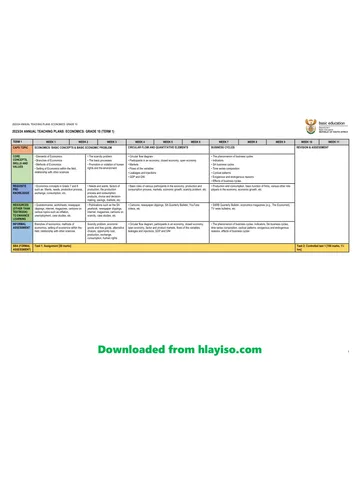
Gr 10 Eco ATP 2023 24
Question paper and memo
Economics Grade 10 Limpopo March Test 2025 Paper & Memo
Memorandum
Economics Grade 10 Paper 1 Gauteng June 2024 Memo (English)
Memorandum
Economics Grade 10 P1 Gauteng November 2023 Memo (English)
Question paper and memo