
Downloaded from hlayiso.com
GAUTENG DEPARTMENT OF EDUCATION
PROVINCIAL EXAMINATION
NOVEMBER 2016
GRADE 10
ECONOMICS
PAPER 1
MEMORANDUM
17 pages
Skip to contentAll 2016 papers 
View all
Economics Grade 10 P1 Gauteng November 2016 Memo (English)
Grade 10 Economics Paper 1 memorandum from the Gauteng November 2016 (English), 19 pages. Read online or download the free PDF.
Economics · Grade 10 · Gauteng November · 2016 · English. Memorandum, 19 pages. Read online or download the PDF.
- Subject
- Economics
- Grade
- Grade 10
- Language
- English
- Document type
- Memorandum
- Year
- 2016
- Exam period
- Gauteng November
- Paper
- 1
- Curriculum
- CAPS
- Pages
- 19
- File size
- 362.1 KB
Free to read online, no sign-up needed
Loading document…
Loading document…
1 of 19
This exam
Gauteng November 2016
Questions in this paper
- Question 1.1Growth, Development & Globalisation16 marks
- Question 1.2Basic Concepts & Basic Economic Problem8 marks
- Question 1.3Circular Flow & Quantitative Elements6 marks
- Question 2Circular Flow & Quantitative Elements40 marks
- Question 3Growth, Development & Globalisation14 marks
- Question 4Economic Redress14 marks
Document textSearch extracted text and jump to a page.
Downloaded from hlayiso.com
MEMORANDUM ECONOMICS PAPER 1 GRADE 10
GAUTENG DEPARTMENT OF EDUCATION
PROVINCIAL EXAMINATION
ECONOMICS
(Paper 1)
MEMORANDUM
SECTION A: COMPULSORY
QUESTION 1
1.1 MULTIPLE-CHOICE QUESTIONS
1.1.1 B (trade-off)
1.1.2 A (limited means)
1.1.3 C (feudalism)
1.1.4 A (commodity)
1.1.5 C (sanctions)
1.1.6 B (gold standard)
1.1.7 C (division of labour)
1.1.8 C (interest rate) (8x2)(16)
1.2 MATCHING ITEMS
1.2.1 E (A company fully or partly owned or controlled by the government).
1.2.2 F (A group of people that live together and make economic decisions,
sharing the same income).
1.2.3 A (All people have a basic human right to be free from poverty,
ignorance and ownership by another).
1.2.4 H (This is the voluntary exchange of goods and services).
1.2.5 B (It is the use of tools and methods to produce goods and services
in the economy).
1.2.6 G (The coexistence of the modern economy and subsistence activities).
1.2.7 C (Goods produced by the domestic economy and purchased by the
foreign sector.).
1.2.8 I (This is the economically active population that consists of people
between the ages 15 and 64 who are working or actively seeking
a job.) (8x1)(8)
1.3 GIVE ONE TERM
1.3.1 Global warming / Greenhouse effect
1.3.2 Savings
1.3.3 Barter
1.3.4 Communal
1.3.5 Colonialism
1.3.6 Unemployed / Unemployment (6x1)(6)
TOTAL SECTION A: [30]
2
Downloaded from hlayiso.com
MEMORANDUM ECONOMICS PAPER 1 GRADE 10
SECTION B
Answer any TWO of the three questions.
QUESTION 2: MACRO-ECONOMICS
2.1 2.1.1 Name any TWO branches of economics.
• Microeconomics✓
• Macroeconomics✓
• Development economics✓
• Econometrics✓
• Economic doctrines and systems✓
• Economic history✓
• Environmental economics✓
• International economics✓
• Labour economics✓
• Monetary economics✓
• Public sector economics✓
• Regional economics✓
• Resource/ Natural resource economics✓ Any (2x1)(2)
2.1.2 Why do economists make use of economic models?
• Economists use models to study and examine economic issues.✓✓
• These models consist of diagrams / graphs/illustrations / diagrams and
equations, etc. ✓✓
• They leave out a lot of detail so that the focus is on what is important ✓✓
• Simplification of reality for improved understanding.✓✓ Any (1x2)(2)
2.2 Data response
2.2.1 Which method is used to calculate GDP in the table above?
Production method✓ (1x1)(1)
2.2.2 Name any other method that can be used to calculate the GDP.
Income method✓
Expenditure method✓ (1x1)(1)
3
Downloaded from hlayiso.com
MEMORANDUM ECONOMICS PAPER 1 GRADE 10
2.2.3 Calculate GDP at market prices at point A. (Show all calculations)
Gross value added at basic prices 1 639 485 ✓
+ (plus)Taxes on products 312 863 ✓
- (minus) Subsidies on products 19 106 ✓
1 933 242 ✓
Item must be listed to obtain the mark, with the correct sign in front of taxes and
subsidies (4x1)(4)
2.2.4 Compare gross domestic product and gross national product.
Gross domestic product Gross national product
Total market value of goods and Total market value of goods and
services produced within the services produced by permanent
borders✓ of a country for a specific resident ✓of a country for a specific
period one year✓ period✓
(2x2)(4)
2.3 Data response
2.3.1 Identify the two types of consumer goods depicted above?
• PICTURE 1 / Car – Durable ✓
• PICTURE 2 / Food – Non Durable ✓ (2x1)(2)
2.3.2 Which participant in the economy will use an intermediate good?
Intermediate goods would be used by the makers / producers of goods in the
production of other goods✓✓ / firms ✓✓ / businesses ✓✓ (2x1)(2)
2.3.3 Briefly explain what are capital goods?
• Bought by producers to consumer in making more goods and services ✓✓
• These are goods that are used to produce consumer goods and
services. ✓✓ (2x1)(2)
2.3.4 Why do you think there has been an upward trend in the use of
picture 2? (2x2)(4)
• People now use more disposable things such as razors, baby nappies,
plastic bottles, food packaging etc.✓✓
• There has been an increase of peoples’ disposable income, making it
possible for them to afford more.✓✓
• Population increased so there are more people needing to eat food✓✓
(2x2)(4)
(Accept any other relevant answer)
4
Downloaded from hlayiso.com
MEMORANDUM ECONOMICS PAPER 1 GRADE 10
2.4 Briefly explain the differences between free goods and economic goods
Free goods Economic goods
Are so plentiful and have no price✓✓ Goods that are produced from scarce
resources and at a cost✓✓
Free goods have no exchange value✓✓ Economic goods have exchange value✓✓
Everyone has access to them and they Economic goods also have utility value✓✓
have utility value✓✓
For example water from rain, sand from For example house, car etc.✓
dessert etc.✓
Any (2x2)(4) Any (2x2)(4)
2.5 Distinguish between macroeconomics and microeconomics?
Macroeconomics Microeconomics
• Macroeconomics –Is the study of the • Microeconomics- Is the study of
economy as a whole✓✓ individual consumer, household, firms
and other organization.✓✓
• It focuses on the economic behavior of • Focuses on the supply and demand
a society✓✓ decisions of individuals. ✓✓
• Example macroeconomics would be • Micro economics consider the
the study of inflation, unemployment, individuals demand for a certain
etc. or a country’s economic product at a certain price, or how
performance.✓✓ individuals decide what to buy and
when to buy it.✓✓
Any (2x2)(4) Any (2x2)(4)
NB. The points must link for the learner to be credited. [40]
QUESTION 3: ECONOMIC PURSUITS
3.1 Answer the following questions
3.1.1 Name any TWO labour unions found in South Africa.
• NEHAWU (National Education, Health and Allied Workers Union)
• NUMSA (National Union of Metal Workers of South Africa)
• NUM (National Union of Mine Workers)
• COSATU (Congress of South African Trade Unions)
• FEDUSA (Federation of Trade Unions of South Africa)
• NACTU (National Council of Trade Unions)
• AMCU (Association of Construction and Mineworker Union)
(Accept any other relevant answers)
Any (2x1)(2)
5
Downloaded from hlayiso.com
MEMORANDUM ECONOMICS PAPER 1 GRADE 10
3.1.2 How can an increased income lead to development of industries?
• An increase in income leads to an expansion of economic activities
because better pay for workers in the factories increases both the
demand and supply of goods and services which leads to an
increase in GDP resulting in economic growth. (1x2)(2)
3.2 Data response
3.2.1 What is urban migration?
• It is a movement/migration from rural areas to urban areas. (1)
3.2.2 Provide a reason for this migration?
• People are in search of better economic opportunities/ better livelihoods
such as employment, education etc. (1)
3.2.3 Briefly explain the plan of government to curb the urban migration.
• The government is introducing agric-parks in which rural communities
are turned into industries through agricultural produce; people can
earn a living in their areas.making the rural areas as attractive as
the urban areas Any (1x2)(2)
3.2.4 Why is urban migration a problem for the government?
• Migration leads to densely populated informal settlements or slums
necessitating a massive demand for housing and infrastructure such as
land, roads, health clinics greater demand on resources in urban areas,
water and sanitation✓✓ etc.
(Accept any other relevant answer) (1x2)(2)
3.2.5 Sisulu said “the government realized that there was nothing it could do to
stop migration” Evaluate this statement.
• Because people are now free to move to the cities unlike before 1994
when there were apartheid influx laws curbing urban migration.
• No law would ever be designed or punishment implemented to stop the influx
of people People realise that they will get better opportunities in the urban
areas, and are looking for improved circumstances
(Accept any other relevant answers) Any (2x2)(4)
6
Downloaded from hlayiso.com
MEMORANDUM ECONOMICS PAPER 1 GRADE 10
3.3 DATA RESPONSE
3.3.1 Which stage of economic development is depicted in the cartoon?
The self-sufficient stage (1)
3.3.2 Quote one activity that took place during this stage
“Hunting” ; “gathering” ; “hunter gatherers” Any (1x1)(1)
3.3.3 The agricultural nature of the economy is one of the characteristics of this
stage. Briefly discuss two other characteristics of this stage.
• The absence of markets ✓
Markets did not exist, crops produced on landlords land were used to
pay the landlord, pay wages of the workers and trade / barter with.
• Little or no labour specialisation ✓
Nothing was produced on a large scale, as there were no markets to
produce for. There was no place where goods could be sold or
exchanged.
• Limited freedom of choice ✓
There was no choice in their profession, as it was dependent on family
tradition. People who worked for a particular landlord, were regarded
as the “property” of the landlord and could not move away.
• Wealth and Power ✓
Landlords expanded their already wide base of wealth, mostly by surplus
crops paid to them by people employed by the manor. Consequently it
was impossible for workers to accumulate wealth and improve their quality of
life.
• Limited tools ✓
Initially stone aged tools were used, for hunting and protection. ✓✓ More
advanced tools were developed to cultivate their land and use as protection
as time went by.
• In Africa ✓
In Northern parts of Africa, some tribes started domesticating cattle, and
developing some agricultural products. ANY (2x2)(4)
(Accept any other relevant answers)
7
Downloaded from hlayiso.com
MEMORANDUM ECONOMICS PAPER 1 GRADE 10
3.3.4 How does globalisation affect the South African economy?
In a mature state an economy is able to trade on a global (worldwide) scale
The process whereby the world becomes more integrated and connected in
different activities (economic and social) (2x2)(4)
(Accept any other relevant answer)
3.4 Discuss urbanisation during the maturity stage of self-sufficiency
• Industrialisation led to the creation of many jobs in factories.
• People started moving from the rural areas to the cities, for the factories and jobs
• The movement of people from rural areas to cities is known as urbanisation
• As more people moved to the factories, towns and cities started to develop.
• Johannesburg grew from a small trading town, because of the increase in
mining in the area.
• People moved from the rest of South Africa, and from the rest of the world to
Johannesburg
• Many people ended up taking any work, as there were not enough job
opportunities
• Many people worked in poor circumstances for very little money.
(Accept any other relevant answers) (4x2)(8)
3.5 The two most important consequences of industrialization is the development of
sophisticated transport and communication network. Justify this statement.
Transport
• Railway lines were built.
• Roads were improved.
• Bulk volumes of goods could be transported and delivered in shorter times.
• Harbours were built.
• Imports and exports possible
• Development of shipping
• Development is only possible if the above is in place to move goods / produce from
one place to another Any (2x2)(4)
8
Downloaded from hlayiso.com
MEMORANDUM ECONOMICS PAPER 1 GRADE 10
Communication
• Improved communication networks led to improved distribution of information.
• Business and consumers easily contacted for sales.
• Exports and imports businesses flourished as a result of international easy
contacts.
• Money transfers became easy through internet banking.
• Insurances and investments improved.
• The above assisted in facilitating communication and building trade between
businesses, and businesses across different countries.
(Accept any other relevant answers) Any (2x2)(4)
[40]
QUESTION 4: MACROECONOMICS AND ECONOMIC PURSUITS
4.1 4.1.1 Name any TWO factors of production.
• Labour
• Capital
• Entrepreneurship
• Land
• Technology Any (2x1)(2)
4.1.2 What does positive economics as a method of economics refer to?
Positive economics studies the objectives or scientific explanations of how the
economy works. (1x2)(2)
4.2 Data response
4.2.1 Name the institution that publishes this information.
S.A.R.B – South African Reserve Bank.✓ (1)
4.2.2 Give ONE example of an industry or undertaking that could be classified
under the heading “other”.
Tertiary sector or service sector✓ (1)
4.2.3 Explain the terms primary and secondary industry.
Primary is the Extraction of raw materials✓✓. Examples fishing, mining,
agriculture✓
Secondary sector is the manufacturing or processing of goods.✓✓ (2x2)(4)
Examples manufacturing, construction, gas etc. ✓
9
Downloaded from hlayiso.com
MEMORANDUM ECONOMICS PAPER 1 GRADE 10
4.2.4 Why is there a marked decrease in the relative contribution of agriculture to
the GDP over the years?
• The advances in the secondary and tertiary sectors
• Greater demand for goods other than agricultural goods as people become
more advanced
• More land used for living space for people
• Because of the dominance of the manufacturing sector✓✓
(Accept any other relevant answer) Any (2x2)(4)
4.3 DATA RESPONSE
4.3.1 Give ONE example of an indigenous farming method mentioned above.
Mixed cropping system✓✓ (1)
4.3.2 Define the concept indigenous knowledge systems
IKS is the local knowledge – knowledge that is unique to a given culture or
society, ✓✓ Knowledge from the environment gathered by indigenous people
through experience and trial-and-error ✓✓ (2)
4.3.3 In your opinion do indigenous knowledge systems hold an economic
benefit for indigenous groups of a country? Give a reason for your answer.
Yes, they do. ✓ The IKS can be made available to other communities at a
price, ✓✓ thereby raising revenue for the local group. ✓
Benefits of the product can be publicized, e.g. rooibos tea ✓ (3)
4.3.4 According to the article, why is it important to integrate Western research
techniques with indigenous knowledge systems and what benefits does this
hold for the community at large?
According to the article, it is important to fuse life-transforming indigenous
knowledge in different fields of human endeavour, ✓✓ in order to increase
innovation and creativity across the continent. For better creativity and
innovation. ✓✓ (2x2)(4)
4.4 Discuss the factors that promoted economic development, and those that
hampered economic development during the animal husbandry and
agricultural phase of development in South Africa.
Factors that promoted the economic development
Infrastructure ✓
Harbours, roads and railways were built. ✓✓ Postal services and telegraphic
communication was initiated. ✓✓ Export of products the export market. ✓✓
10
Downloaded from hlayiso.com
MEMORANDUM ECONOMICS PAPER 1 GRADE 10
Trade ✓
More freedom of trade came under the British rule. ✓✓ This encouraged trade both
locally and internationally. ✓✓
Imported knowledge and Skills ✓
Settlers from outside the country came with better farming methods that improved
agriculture. ✓✓ They introduced commercial farming and ✓✓used money to replace the
barter system. ✓✓
Imported Labour
European settlers imported slaves to meet labour requirements ✓✓.Specialist workers
such as experienced sugar workers were brought in from India for sugar production ✓✓
(Any other relevant reason that promoted economic development)
Factors that hampered the economic development
Mercantilist Policies ✓
The taxes collected were used by the officials, to enrich themselves and not for the
development of the local people. ✓✓
Hostile Environment ✓
The unfavourable environmental conditions –distances, lack of water, lack of transport
and mountainous barriers, etc. ✓✓
Quality of Grasslands ✓
Indigenous farmers used primitive techniques ✓✓. No crop rotation took place, leading to
erosion of land. ✓✓
Poor stimulus of trade ✓
No regular markets or trade fairs ✓✓, external trade restricted as indigenous people had
no access to foreign markets ✓✓
No technological development ✓
Indigenous societies showed no awareness of literacy or advances in science and
learning. ✓✓
Any (2x4)(8)
(8)
11
Downloaded from hlayiso.com
MEMORANDUM ECONOMICS PAPER 1 GRADE 10
4.5 How can injections benefit the South African economy?
• Injections refer to money added to the economy or circular flow. ✓✓
• This consists of exports, government expenditure and investment✓✓
• Investments include the buying of capital goods, equipment and machinery. ✓✓
• Exports is the selling of locally produced goods to the international market✓✓
• Both exports and investments will lead to more money flowing into SA, or more
production in SA thereby benefiting the SA economy✓ ✓
(Accept any other relevant answer) (4x2)(8)
TOTAL SECTION B: 80
12
Downloaded from hlayiso.com
MEMORANDUM ECONOMICS PAPER 1 GRADE 10
SECTION C
Answer any ONE of the two questions in this section in the ANSWER BOOK.
STRUCTURE OF THE ESSAY MARK
ALLOCATION
Introduction Max. 2
Body
Main part
Discuss in details / In-depth discussion / Examine / Critically discuss / Max.26
Analyse / Compare / Evaluate / Distinguish / Differentiate / Explain /
Assess / Debate
Additional part: Give own opinion / Critically discuss / Evaluate /
Critically evaluate / Draw a graph and explain / Use the graph given and Max.10
explain / Complete the given graph / Calculate / Deduce / Compare /
Explain / Distinguish / Interpret / Briefly debate / How? / Suggest
Conclusion
Any higher-order conclusion should include:
• A brief summary of what has been discussed without repeating facts
already mentioned in the body.
Max.2
• Any opinion or value judgement on the facts discussed
• Additional support information to strengthen the discussion / analysis
• A contradictory viewpoint with motivation, if required
• Recommendations
TOTAL 40 Marks
13
Downloaded from hlayiso.com
MEMORANDUM ECONOMICS PAPER 1 GRADE 10
QUESTION 5: MACRO-ECONOMICS
Every country experiences cyclical patterns in its economy
• Discuss in detail the phases of business cycles with the use of a diagram (26)
• Explain the exogenous reasons for business cycles. (10)
INTRODUCTION
Business cycles are defined as consecutive periods of increasing and decreasing economic
activity.
Continuous change in the level of economic activities that has a repetitive pattern of expansion
and contraction in production, income and consumption over a number of years. ✓✓
(Accept any other relevant introduction / definition.) (Max. 2)
BODY: MAIN PART
Prosperity phase✓
• There is an increase in real GDP ✓✓
• Firms make high profits and this attracts other business to enter the market ✓✓
• As more businesses open, more factors of production are employed. ✓✓
• The increase in income causes an increase in aggregate demand which in turn forces
producers to increase output. ✓✓
• Increased output causes an increase in investment spending as producers expand their
businesses and buy more inventories. ✓✓
(Accept any other relevant answers)
Recession phase✓
• This phase follows immediately after the peak. ✓✓
• It is a phase where economic activity starts to slow down. ✓✓
• It is called economic downturn. ✓✓
• It occurs when there is a continuous decrease in economic activity for a period of six
consecutive months or two quarters. ✓✓
• Jobs are lost / employment levels drop. ✓✓
• Aggregate demand falls. ✓✓
• The value of money depreciates. ✓✓
• Inflation increases ✓✓
• Interest rates will increase, discouraging the demand for credit. ✓✓
(Accept any other relevant answers)
14
Downloaded from hlayiso.com
MEMORANDUM ECONOMICS PAPER 1 GRADE 10
Depression phase✓
• During this phase many businesses close down resulting in low output. ✓ ✓
• Aggregate demand decreases due to many people having little or no income. ✓✓
• When economic activity is at its lowest, a trough is reached ✓✓
• Business sentiment is depressed. ✓ ✓
• Low demand for credit. ✓ ✓
• Share prices start to increase. ✓✓
(Accept any other relevant answers)
Recovery phase✓
• This phase follows immediately after the trough. ✓✓
• It shows that the economy is growing after the contraction. ✓✓
• The recovery is slow but it accelerates until it enters the prosperity phase. ✓✓
• Production increases and more jobs are created. ✓✓
• Business sentiment rises and there is increased spending by firms. ✓✓
• Exports increase and the value of money appreciates. ✓✓
• Inflation decreases. ✓✓
(Accept any other relevant answers)
15
Downloaded from hlayiso.com
MEMORANDUM ECONOMICS PAPER 1 GRADE 10
Business Cycle
✓
✓
• Heading = 1 Mark
• Trend line (G) = 1 Mark
• Peak = 1 Mark
• Trough = 1 Mark
• Labelling of the axis = 1 Mark
Max = 4 marks
8+18 = 26
(Accept explanation of contraction, expansion, peak, through)
A maximum of 18 marks is allocated for different phases of a business cycle and maximum of
8 marks for headings and the graph. (Max. 26)
BODY: ADDITIONAL PART
Exogenous reasons for business cycles:
• Exogenous reasons ✓✓are reasons for business cycles that originate outside the market
system.
• Changes in weather conditions affect the output of the agricultural sector and tourism
industry of an economy and the total level of economic activity. ✓✓
• When the economy has structural change, it affects production, employment, investments,
government expenses, taxes, imports and exports. ✓✓
• Variations in the money supply also cause business cycles. ✓✓
• Random shocks can cause business cycles e.g. war, sudden increase in the price of oil,
natural disasters etc. ✓✓
• Political actions such as when the government wants to win election votes, will adopt an
expansionary policy and after the election the inflationary effects of this expansionary policy
begins. ✓✓
(Accept any other relevant responses) (Max. 10)
16
Downloaded from hlayiso.com
MEMORANDUM ECONOMICS PAPER 1 GRADE 10
CONCLUSION
Economic indicators such as leading indicators, coincident indicators and lagging indicators can
be used to predict business cycles. ✓✓
(Accept other relevant higher order conclusion) (Max. 2)
[40]
QUESTION 6: ECONOMIC PURSUITS
Early banking was set up to make more currency available and lend money and grant
loans. Banks had to have a bookkeeper, who lived in the building to make sure that the
money & valuables were safe
Discuss the history of banking in the development of the South African Economy.
(26 marks)
The South African Reserve Bank (SARB) is the monetary authority, controlling all money-
related issues of this country. Evaluate this statement, highlighting the functions of the
SARB today. (10 marks)
INTRODUCTION:
• Modern banking is characterized by its constant improvements in its functions.
• Banks brought about the present economic development throughout the world.
• Highly economically developed countries are where they are because of a well-developed
banking infrastructure.
• Banks are a link to all economic activities.
(Max. 2)
BODY: MAIN PART
Early Development ✓
• Banking started hundreds of years ago, when people deposited money and their valuables
with goldsmiths. ✓✓
• Goldsmiths started to lend money and arrange payments on behalf of their clients. ✓✓
• This is where the practice of depositing and drawing money came from.✓✓
• Banks were the first financial institutions, they are store keepers of money. ✓✓
Private Banks ✓
• Private banks were started all over South Africa, by private inhabitants. ✓✓
• The main functions of these banks is to receive savings ✓✓, issue bank notes and provide
credit facilities. ✓✓
17
Downloaded from hlayiso.com
MEMORANDUM ECONOMICS PAPER 1 GRADE 10
Imperial Banks ✓
• These banks expanded in South Africa by opening branches, to service the expanding
capitalist economy. ✓✓
• They originated from abroad, and were profit driven✓✓
• They aimed to take over the private banks in SA. ✓✓
South African money ✓
The role of Banks
Intermediaries✓
• Banks are intermediaries, bringing together lenders (depositors) and borrowers of
money.
Generally acceptable✓
• Money must be accepted by all who trade as a token of payment. ✓✓
Store of Value✓
• Provide facilities where people can store money in the safe place. / Banks are the safe
keepers of money.
• Any example of money as a store of value✓✓
• Banks accept and store deposits on which interest is paid.
• Keep foreign currency.
• Fees can be transferred from one account to the other.
Standard of debt✓
• Lend money in the form of loans and overdrafts at the risk of the banks.
• Banks charge interest for loanable funds.
• Banks make profit from two sources namely: earning interest on loans and overdrafts.
• They charge service fees for service rendered.
• Improves the standard of living of the people, by providing loans to the individuals who want
to buy assets such as houses.
• Banks contribute to the growth of the economy through efficient allocation of resources.
• Lends money to businesses who want to expand. / Helps with new business ventures by
loaning money.
18
Downloaded from hlayiso.com
MEMORANDUM ECONOMICS PAPER 1 GRADE 10
Unit of Account✓
Redistribution of Income✓
• Address the socio-economic issues of the public by providing financial education.
• Banks also grant study loans and enable people to acquire further education and
training.
• Increases the possibility for better opportunities through bursaries and loans.
• Banks are involved in community development projects e.g. sport etc.
(Accept any other relevant answers) (Max. 8 + 18) (Max. 26)
ADDITIONAL PART
The South African Reserve Bank (SARB) is the monetary authority, controlling all money
related issues of this country. Evaluate this statement, highlighting the functions of the
SARB today.
• The South African Reserve Bank is a central bank that controls other banks.
• It was established in 1920.
• It has the sole right to issue bank notes and coins /Issuing banknotes and coins
• South African Reserve Bank is the bank to other banks, they borrow money from it.
• It is also a government bank / Acting as banker to the government
• It is responsible for formulating the monetary policies / inflation targeting
• The South African Reserve Bank is the custodian of gold and foreign reserve.
• It oversees the commercial banks.
• The Financial Service Board oversees the other financial institutions such as insurance and
investments companies.
• Supervising the banking system.
• Ensuring the effective functioning of the national payment system (NPS).
(Accept any other relevant answers) (Max. 10)
CONCLUSION
• Without banking, there would have been no economic development as it is today.
• Through activities such as internet banking we have globalization.
• Countries trade internationally because of the banks bringing together the buyer and the
seller.
(Accept any acceptable HIGHER ORDER conclusion.) (Max. 2)
[40]
TOTAL SECTION C: [40]
TOTAL: 150
19
Study this subject
Recommended for this subject
Memorandum
Economics Grade 10 P2 Gauteng November 2016 Memo (English)
Memorandum
Economics Grade 10 P1 Gauteng November 2022 Memo (English)
Memorandum
Economics Grade 10 P1 Gauteng November 2020 Memo (English)
Memorandum
Economics Grade 10 P1 Gauteng November 2017 Memo (English)
Question paper
Economics Grade 10 P1 Gauteng June 2016 Question Paper (Eng)
Question paper
Economics Grade 10 P1 Gauteng November 2022 QP (Eng)
More from Grade 10 Economics
Question paper
Economics Grade 10 P2 November Mock 2026 QP (Eng)
Annual teaching plan
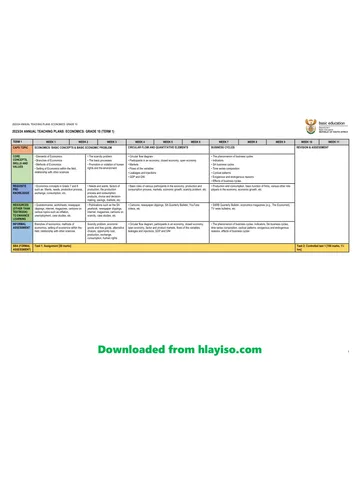
Gr 10 Eco ATP 2023 24
Question paper and memo
Economics Grade 10 Limpopo March Test 2025 Paper & Memo
Question paper
Economics Grade 10 P2 Gauteng June 2024 Question Paper (Eng)
Question paper
Economics Grade 10 P1 North West June 2024 Question Paper
Question paper