
hlayiso mock exams
Practice Series:
Grade 11 Exam Preparation
WWW.HLAYISO.COM
NATIONAL
SENIOR CERTIFICATE
GRADE 11
HISTORY P1
NOVEMBER EXAMINATION 2026 (MOCK)
MARKING GUIDELINES
MARKS: 150
These marking guidelines consist of 26 pages.
Copyright reserved Please turn over
Skip to contentAll 2026 papers 


View all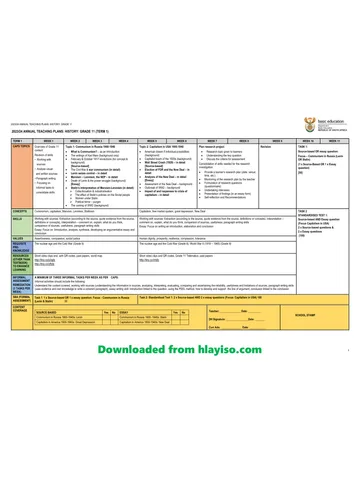



History Grade 11 Paper 1 November Mock 2026 Memo (English)
Grade 11 History Paper 1 memorandum from the November Mock Exam 2026 (English), 26 pages. Read online or download the free PDF.
History · Grade 11 · November Mock Exam · 2026 · English. Memorandum, 26 pages. Read online or download the PDF.
- Subject
- History
- Grade
- Grade 11
- Language
- English
- Document type
- Memorandum
- Year
- 2026
- Exam period
- November Mock Exam
- Paper
- 1
- Publisher
- Hlayiso
- Curriculum
- CAPS
- Pages
- 26
- File size
- 194.2 KB
Free to read online, no sign-up needed
Loading document…
Loading document…
1 of 26
This exam
November Mock Exam 2026
- Paper 1Question paperAddendumMemo
- Paper 2Question paperAddendumMemo
Document textSearch extracted text and jump to a page.
History/P1 2 Hlayiso/Gr 11 Mock 2026
NSC – Marking Guidelines
1. SOURCE-BASED QUESTIONS
1.1 The following cognitive levels were used to develop source-based questions:
Cognitive Historical skills Weighting of
levels questions
LEVEL 1 • Extract evidence from sources 30%
• Selection and organisation of relevant information from (15)
sources
• Define historical concepts/terms
LEVEL 2 • Interpretation of evidence from sources 50%
• Explain information gathered from sources (25)
• Analyse evidence from sources
• Explain historical concepts in context
LEVEL 3 • Interpret and evaluate evidence from sources 20%
• Engage with sources to determine usefulness, reliability, (10)
bias and limitations
• Compare and contrast interpretations and perspectives
presented in sources and draw independent conclusions
1.2 The information below indicates how source-based questions are assessed:
• In the marking of source-based questions, credit must be given to any other valid and
relevant viewpoints, arguments, evidence or examples.
• In the allocation of marks, emphasis should be placed on how the requirements of the
question have been addressed.
• In the marking guidelines the requirements of the question (skills to be addressed) as well
as the level of the question are indicated in italics.
• When assessing open-ended source-based questions, learners should be credited for any
other relevant answers.
• Learners are expected to take a stance when answering ‘to what extent’ questions in order
for any marks to be awarded.
1.3 Assessment procedures for source-based questions
• Use a tick (✓) for each correct answer.
• Pay attention to the mark scheme, e.g. (2 x 2) means two reasons, each awarded two
marks (✓✓✓✓); (1 x 2) means one reason awarded two marks (✓✓).
• If a question carries 4 marks, indicate this by placing 4 ticks (✓✓✓✓).
Paragraph question
Paragraphs are assessed globally (holistically). Both the content and the structure of the
paragraph must be taken into account when awarding a mark. Use the following steps:
• Read the paragraph and place a bullet (•) at each point within the text where the candidate
has used relevant evidence to address the question.
• Re-read the paragraph to evaluate the extent to which the candidate has been able to use
relevant evidence to write a paragraph.
• At the end of the paragraph indicate the ticks (✓) awarded, the level (1, 2 or 3) as indicated
in the holistic rubric and a brief comment, e.g.
Copyright reserved Please turn over
History/P1 3 Hlayiso/Gr 11 Mock 2026
NSC – Marking Guidelines
•
• • Level 2 ✓✓✓✓
COMMENT: Used mostly relevant evidence to write a basic paragraph.
• Count all the ticks for the source-based question and write the mark (e.g. 32/50) on the
right-hand bottom margin.
• Ensure that the total mark is transferred accurately to the front/back cover of the answer
script.
2. ESSAY QUESTIONS
2.1 The essay questions require candidates to structure their argument in a logical and
coherent manner. They need to select, organise and connect the relevant information so that
they present a reasonable sequence of facts or an effective argument to answer the question
posed. It is essential that an essay has an introduction, a coherent and balanced body of
evidence and a conclusion.
2.2 Marking of essay questions: Candidates may have any other relevant introduction
and/or conclusion than those included in the essay marking guidelines for a specific essay.
2.3 Global assessment of the essay
The essay is assessed holistically (globally): the teacher assesses the essay as a whole
rather than marking the main points separately. This approach rewards an original argument
supported by relevant evidence; learners are not required simply to regurgitate content
to achieve a Level 7, and it discourages the reproduction of prepared essays that ignore
the specific requirements of the question. Holistic assessment does not penalise language
inadequacies; the emphasis is on:
• The learner’s interpretation of the question
• The appropriate selection of factual evidence (relevant content selection)
• The construction of an argument (planned, structured and with an independent line of
argument)
2.4 Assessment procedures of the essay
• Keep the synopsis in mind when assessing the essay.
• During the reading of the essay, ticks are awarded for a relevant introduction, the main
aspects/body of the essay that sustain the line of argument and a relevant conclusion
(each indicated by a bullet in the marking guidelines). For example, in an essay with five
main points there could be about seven ticks.
• Keep the PEEL structure in mind:
P Point: The candidate introduces the essay by taking a line of
argument/making a major point. Each paragraph should include a point that
sustains the major point.
E Explanation: The candidate explains in more detail what the main point is
about and how it relates to the question posed.
E Example: The candidate selects relevant content and examples to sustain
the line of argument.
L Link: The line of argument is sustained throughout the essay and written
coherently.
• The following symbols MUST be used when assessing an essay:
Copyright reserved Please turn over
History/P1 4 Hlayiso/Gr 11 Mock 2026
NSC – Marking Guidelines
Introduction, main aspects and conclusion not properly ∧
contextualised
Wrong statement
Irrelevant statement |
Repetition R
Analysis A✓
Interpretation I✓
Line of argument LOA
2.5 The matrix
In the marking of essays the criteria provided in the matrix should be used. Note both
the content and the presentation; at the point of intersection of the content level and the
presentation level a mark is awarded.
(a) The first reading determines to what extent the main aspects have been covered and
allocates the content level, e.g. C LEVEL 4 .
(b) The second reading relates to the level of presentation, e.g. C LEVEL 4 P LEVEL 3 .
(c) Allocate an overall mark using the matrix, e.g. C LEVEL 4 and P LEVEL 3 → 26–27.
COMMENT: Some omissions in content coverage. Attempts to sustain a line of argument.
Copyright reserved Please turn over
History/P1 5 Hlayiso/Gr 11 Mock 2026
NSC – Marking Guidelines
MARKING MATRIX FOR ESSAY: TOTAL: 50
PRESENTATION → LEVEL 7 LEVEL 6 LEVEL 5 LEVEL 4 LEVEL 3 LEVEL 2 LEVEL 1*
Very well planned Very well planned Well planned and Planned and Shows some Attempts to Little or no attempt
and structured and structured structured essay. constructed an evidence of a structure an to structure the
essay. Good essay. Developed a Attempts to develop argument. planned and answer. Largely essay.
CONTENT ↓ synthesis of relevant line of a clear argument. Evidence used to constructed descriptive or some
information. argument. Conclusion drawn some extent to argument. Attempts attempt at
Developed an Evidence used to from the evidence support the line of to sustain a line of developing a line of
original, defend the to support the line argument. argument. argument. No
well-balanced and argument. Attempts of argument. Conclusions Conclusions not attempt to draw a
independent line of to draw an reached based on clearly supported conclusion.
argument with the independent evidence. by evidence.
use of evidence conclusion from the
and sustained and evidence to support
defended the the line of
argument argument.
throughout.
Independent
conclusion is drawn
from evidence to
support the line of
argument.
LEVEL 7 47–50 43–46
Question has been fully
answered. Content selection
fully relevant to line of
argument.
LEVEL 6 43–46 40–42 38–39
Question has been
answered. Content selection
relevant to a line of
argument.
LEVEL 5 38–39 36–37 34–35 30–33 28–29
Question answered to a
great extent. Content
adequately covered and
relevant.
LEVEL 4 30–33 28–29 26–27
Question recognisable in
answer. Some omissions or
irrelevant content selection.
LEVEL 3 26–27 24–25 20–23
Content selection does
relate to the question, but
does not answer it, or does
not always relate to the
question. Omissions in
coverage.
LEVEL 2 20–23 18–19 14–17
Question inadequately
addressed. Sparse content.
LEVEL 1* 14–17 0–13
Question inadequately
addressed or not at all.
Inadequate or irrelevant
content.
* Guidelines for allocating a mark for Level 1:
• Question not addressed at all/totally irrelevant content; no attempt to structure the =0
essay
• Content selection includes basic and generally irrelevant information; no attempt = 1–6
to structure the essay
• Question inadequately addressed and vague; little attempt to structure the essay = 7–13
Copyright reserved Please turn over
History/P1 6 Hlayiso/Gr 11 Mock 2026
NSC – Marking Guidelines
SECTION A: SOURCE-BASED QUESTIONS
QUESTION 1: HOW DID STALIN’S POLICY OF COLLECTIVISATION AFFECT THE
PEASANTS OF THE SOVIET UNION BETWEEN 1929 AND 1933?
1.1
1.1.1 [Extraction of evidence from Source 1A – L1]
• 1928
(1 x 1) (1)
1.1.2 [Definition of a historical concept from Source 1A – L1]
• The combining of individual peasant farms into large state-controlled
collective farms on which land, livestock, tools and machinery were shared
and the produce was delivered to the state
• Any other relevant response
(any 1 x 2) (2)
1.1.3 [Extraction of evidence from Source 1A – L1]
• The new factories and workers in the cities needed a regular supply of
cheap food
• Grain exports would pay for foreign machinery and foreign engineers
• Farming was carried out on about 25 million small, inefficient peasant farms
• Peasants held back grain in 1927–1928 and the cities faced food shortages
• It would allow the Communist Party to control the peasants
• To destroy the last remains of capitalism in the countryside / to eliminate
the kulaks
(any 3 x 1) (3)
1.1.4 [Interpretation of evidence from Source 1A and own knowledge – L2]
• Grain fed the millions of workers who moved to the cities to work in the new
factories
• Grain was the Soviet Union’s most important export and earned foreign
currency
• Money from grain exports paid for foreign machinery, technology and
engineers needed for the Five-Year Plans
• A reliable supply of grain would prevent food shortages in the cities that
could slow down industrialisation
• Any other relevant response
(any 2 x 2) (4)
Copyright reserved Please turn over
History/P1 7 Hlayiso/Gr 11 Mock 2026
NSC – Marking Guidelines
1.1.5 [Interpretation of evidence from Source 1A – L2]
• The kulaks owned more land and animals and hired other peasants, so
they were seen as rural capitalists
• Communist ideology regarded them as exploiters of the poorer peasants
• They were blamed for holding back grain to obtain higher prices
• They were expected to oppose collectivisation because they had the most
to lose
• Labelling them as enemies justified taking their property and removing
them
• Any other relevant response
(any 2 x 2) (4)
Copyright reserved Please turn over
History/P1 8 Hlayiso/Gr 11 Mock 2026
NSC – Marking Guidelines
1.2
1.2.1 [Extraction of evidence from Source 1B – L1]
• They slaughtered their cattle, pigs, sheep and horses and ate or sold the
meat
• They burnt their crops and farm buildings
• They attacked and even murdered Party officials
• Peasant women led riots against the closing of village churches and the
seizure of their cows
(any 2 x 1) (2)
1.2.2 [Extraction of evidence from Source 1B – L1]
• ‘Kulak families had their land, houses, animals and tools taken from them’
• ‘Some were shot or sent to labour camps’
• ‘nearly two million others were loaded onto cattle trucks and deported to
remote areas of Siberia, Kazakhstan and the Urals’
• ‘where many died of cold, hunger and disease’
(any 1 x 2) (2)
1.2.3 [Interpretation of evidence from Source 1B – L2]
• To blame local officials for the violence and chaos and avoid blame himself
• To calm the anger and resistance of the peasants
• To make sure that the spring crops would be sown and avoid a food crisis
• It was a temporary tactical retreat before collectivisation was resumed
• Any other relevant response
(any 1 x 2) (2)
1.2.4 [Interpretation of evidence from Source 1B – L2]
• The collective farms started with far fewer animals than expected
• Fewer horses meant fewer animals to pull ploughs and carts, and there
were not enough tractors to replace them
• Less meat, milk and wool were produced, which led to food shortages
• Less manure was available to fertilise the fields, so harvests decreased
• It took many years to rebuild the herds
• Any other relevant response
(any 2 x 2) (4)
Copyright reserved Please turn over
History/P1 9 Hlayiso/Gr 11 Mock 2026
NSC – Marking Guidelines
1.3
1.3.1 [Extraction of evidence from Source 1C – L1]
• Sheep and goats (from 146,7 million to 50,2 million)
(1 x 1) (1)
1.3.2 [Interpretation of evidence from Source 1C – L2]
• The number of horses fell by about half, from 33,5 million in 1928 to 16,6
million in 1933, because peasants slaughtered them rather than hand them
over to the collective farms; this left the farms with fewer draught animals
for ploughing
• Any other relevant response
(any 1 x 2) (2)
1.3.3 [Ascertaining the usefulness of Source 1C – L3]
The source is USEFUL because:
• It provides statistical evidence of the decline in livestock during
collectivisation
• It compares the situation before (1928) and after (1933) collectivisation
• It shows the scale of the losses in every category of livestock
• It supports written accounts of the slaughter of animals by peasants
• Any other relevant response
(any 1 x 2) (2)
1.4 [Comparison of evidence from Sources 1B and 1C – L3]
• Source 1B states that peasants slaughtered their cattle, and Source 1C
shows that the number of cattle fell from 70,5 million to 38,4 million
• Source 1B states that peasants slaughtered their pigs, and Source 1C
shows that pigs fell from 26,0 million to 12,1 million
• Source 1B states that peasants slaughtered their sheep, and Source 1C
shows that sheep and goats fell from 146,7 million to 50,2 million
• Source 1B states that peasants slaughtered their horses, and Source 1C
shows that horses fell from 33,5 million to 16,6 million
• Any other relevant response
(any 2 x 2) (4)
Copyright reserved Please turn over
History/P1 10 Hlayiso/Gr 11 Mock 2026
NSC – Marking Guidelines
1.5
1.5.1 [Extraction of evidence from Source 1D – L1]
• A law of 7 August 1932 declared collective farm property state property /
anyone caught stealing grain could be shot or sent to a labour camp for
ten years
• Villages that failed to meet their quotas were placed on ‘blacklists’
• Blacklisted villages were denied supplies of goods such as salt, matches
and paraffin
• Peasants were not given internal passports, so they could not leave their
villages
• Officials demanded ever higher quotas and took the grain that peasants
needed for food and seed
(any 3 x 1) (3)
1.5.2 [Definition of a historical concept from Source 1D – L1]
• An extreme and widespread shortage of food in a region that causes mass
starvation, disease and death
• Any other relevant response
(any 1 x 2) (2)
1.5.3 [Interpretation of evidence from Source 1D – L2]
• Grain exports earned foreign currency to pay for machinery for the
Five-Year Plans
• Stalin regarded industrialisation as more important than the lives of the
peasants
• To hide the failure of collectivisation from the outside world
• Stalin saw the peasants, especially in Ukraine, as enemies who were
resisting the state and deserved punishment
• To maintain the image of the Soviet Union as a successful socialist state
• Any other relevant response
(any 2 x 2) (4)
1.5.4 [Interpretation of evidence from Source 1D – L2]
• Admitting the famine would show that collectivisation had failed
• It would damage the propaganda image of the Soviet Union as a successful
socialist state
• To avoid foreign criticism and the need to accept foreign aid
• The government did not want to take responsibility for the deaths of millions
• Any other relevant response
(any 1 x 2) (2)
Copyright reserved Please turn over
History/P1 11 Hlayiso/Gr 11 Mock 2026
NSC – Marking Guidelines
1.6 [Interpretation, evaluation and synthesis of evidence from relevant sources –
L3]
Candidates could include the following aspects in their response:
• Individual peasant farms were forced into collective farms and state farms
(Source 1A)
• Peasants had to deliver fixed quotas of produce to the state at low prices
(Source 1A)
• The kulaks were ‘liquidated as a class’; they lost their property, were shot,
sent to labour camps or deported (Source 1B)
• Peasants resisted by slaughtering their livestock and burning crops
(Source 1B)
• Livestock numbers fell sharply between 1928 and 1933 (Source 1C)
• Peasants were controlled by harsh laws, blacklists and the denial of internal
passports (Source 1D)
• Grain was taken from the peasants, which led to the famine of 1932–1933
in which between five and eight million people died (Source 1D)
• Peasants lost their independence and became workers on state-controlled
farms (own knowledge)
• Machine Tractor Stations were used to supply machinery and to control the
collective farms (own knowledge)
• Any other relevant response
(6)
Use the following rubric to allocate marks:
LEVEL 1 • Uses evidence in an elementary manner, e.g. shows no or little MARKS:
understanding of how Stalin’s policy of collectivisation affected the 0–2
peasants of the Soviet Union between 1929 and 1933.
• Uses evidence partially or cannot write a paragraph.
LEVEL 2 • Evidence is mostly relevant and relates largely to the topic, e.g. shows MARKS:
some understanding of how Stalin’s policy of collectivisation affected 3–4
the peasants of the Soviet Union between 1929 and 1933.
• Uses evidence in a basic manner to write a paragraph.
LEVEL 3 • Uses relevant evidence, e.g. demonstrates a thorough understanding MARKS:
of how Stalin’s policy of collectivisation affected the peasants of the 5–6
Soviet Union between 1929 and 1933.
• Uses evidence very effectively in an organised paragraph that shows
an understanding of the topic.
[50]
Copyright reserved Please turn over
History/P1 12 Hlayiso/Gr 11 Mock 2026
NSC – Marking Guidelines
QUESTION 2: HOW DID WEAKNESSES IN THE AMERICAN ECONOMY OF THE 1920s
LEAD TO THE WALL STREET CRASH OF 1929 AND THE GREAT
DEPRESSION?
2.1
2.1.1 [Extraction of evidence from Source 2A – L1]
• Motor cars
• Radios
• Refrigerators
• Vacuum cleaners
• Washing machines
(any 3 x 1) (3)
2.1.2 [Definition of a historical concept from Source 2A – L1]
• Buying shares by paying only a small part of the price (about 10%) and
borrowing the rest from a stockbroker, with the loan to be repaid from the
profits when the share price rose
• Any other relevant response
(any 1 x 2) (2)
2.1.3 [Extraction of evidence from Source 2A – L1]
• ‘the richest 5 per cent of Americans received about one-third of all personal
income’
• ‘about 60 per cent of families earned less than $2 000 a year, the amount
regarded as necessary for a decent standard of living’
(any 1 x 2) (2)
2.1.4 [Interpretation of evidence from Source 2A – L2]
• Mass production produced more goods than Americans could afford to buy
• Wealth was unevenly distributed, so most families had little money to spend
on consumer goods
• Farmers had produced large surpluses during the First World War, but
demand from Europe fell after the war
• Surpluses caused prices to fall, so farmers and factories could not sell at
a profit
• High tariffs led other countries to place tariffs on American goods, so
surplus goods could not be exported
• Unsold goods forced businesses to cut production and dismiss workers
• Any other relevant response
(any 2 x 2) (4)
Copyright reserved Please turn over
History/P1 13 Hlayiso/Gr 11 Mock 2026
NSC – Marking Guidelines
2.1.5 [Interpretation of evidence from Source 2A – L2]
• Other countries retaliated by placing tariffs on American goods, so
American goods became too expensive to sell abroad
• European countries could not sell goods to the USA and therefore could
not earn dollars to buy American goods
• It reduced the export markets for American farmers and factories and
increased the surpluses
• Any other relevant response
(any 1 x 2) (2)
2.2
2.2.1 [Extraction of evidence from Source 2B – L1]
• 381 points (3 September 1929)
(1 x 1) (1)
2.2.2 [Interpretation of evidence from Source 2B – L2]
• Share prices fell sharply from 381 points in September 1929 to 41 points
in July 1932, a loss of almost 90% of their value; there was only a short
recovery in early 1930 (294 points in April 1930) before prices continued
to fall
• Any other relevant response
(any 1 x 2) (2)
2.2.3 [Interpretation of evidence from Source 2B and own knowledge – L2]
• They had to repay the money they had borrowed, but their shares were
now worth much less than the loans
• Stockbrokers demanded repayment (margin calls), which forced investors
to sell their shares at a loss
• Investors could not make the profits they had expected to use to repay the
loans
• Many lost their savings, homes and businesses and became bankrupt
• Any other relevant response
(any 2 x 2) (4)
2.2.4 [Ascertaining the limitations of Source 2B – L3]
The source is LIMITED because:
• It shows only the fall in share prices and not the causes of the crash,
e.g. speculation, buying on the margin, overproduction or the uneven
distribution of wealth
• The values are approximate and only a few points are shown
• It does not show the human or social impact of the crash
• It covers only the period 1928 to 1932
• It was drawn by the examiner and is not a primary source
• Any other relevant response
(any 2 x 2) (4)
Copyright reserved Please turn over
History/P1 14 Hlayiso/Gr 11 Mock 2026
NSC – Marking Guidelines
2.3
2.3.1 [Extraction of evidence from Source 2C – L1]
• 29 October 1929
(1 x 1) (1)
2.3.2 [Extraction of evidence from Source 2C – L1]
• They met and pooled their money to buy large numbers of shares at high
prices in an attempt to restore confidence
(1 x 2) (2)
2.3.3 [Interpretation of evidence from Source 2C – L2]
• Banks had used depositors’ money to buy shares that became worthless
• Banks had lent money to speculators who could not repay their loans
• Worried people rushed to withdraw their savings (bank runs), and the banks
did not have enough cash
• There was no government insurance to protect deposits, so panic spread
from bank to bank
• Farmers and businesses could not repay their loans
• Any other relevant response
(any 2 x 2) (4)
2.3.4 [Interpretation of evidence from Source 2C – L2]
• Hoover was over-optimistic and underestimated the seriousness of the
Depression
• He believed in laissez-faire and that the economy would recover by itself
• He appeared out of touch with the suffering of ordinary Americans, which
made him unpopular (e.g. ‘Hoovervilles’)
• Any other relevant response
(any 1 x 2) (2)
Copyright reserved Please turn over
History/P1 15 Hlayiso/Gr 11 Mock 2026
NSC – Marking Guidelines
2.4
2.4.1 [Extraction of evidence from Source 2D – L1]
• 12,8 million (25% of the labour force)
(1 x 1) (1)
2.4.2 [Interpretation of evidence from Source 2D – L2]
• Unemployment increased rapidly every year, from 1,6 million (3%) in 1929
to 12,8 million (25%) in 1933, an eight-fold increase; by 1933 one in every
four workers was unemployed
• Any other relevant response
(any 1 x 2) (2)
2.4.3 [Interpretation of evidence from Source 2D and own knowledge – L2]
• Families lost their income and could not pay rent or mortgages, so many
were evicted and became homeless
• Many families went hungry and depended on breadlines and soup kitchens
• Families were broken up as men left home to look for work elsewhere
• Children left school to look for work
• Malnutrition, illness, shame and depression increased
• Any other relevant response
(any 2 x 2) (4)
2.5 [Comparison of evidence from Sources 2C and 2D – L3]
• Source 2C states that businesses cut production and dismissed workers,
and Source 2D shows that unemployment rose from 1,6 million in 1929 to
12,8 million in 1933
• Source 2C states that millions of ordinary Americans lost their savings and
that homeless people lived in Hoovervilles, and Source 2D shows that 25%
of the labour force was unemployed by 1933
• Source 2C states that Hoover refused direct federal relief to the
unemployed, and Source 2D shows that unemployment continued to rise
until 1933
• Any other relevant response
(any 2 x 2) (4)
Copyright reserved Please turn over
History/P1 16 Hlayiso/Gr 11 Mock 2026
NSC – Marking Guidelines
2.6 [Interpretation, evaluation and synthesis of evidence from relevant sources –
L3]
Candidates could include the following aspects in their response:
• The government followed laissez-faire policies with little control over
business (Source 2A)
• Wealth was unevenly distributed and most families could not afford the
goods produced (Source 2A)
• Overproduction in industry and agriculture led to falling prices (Source 2A)
• High tariffs led to retaliation and reduced American exports (Source 2A)
• Speculation and buying on the margin pushed share prices above the real
value of companies (Source 2A)
• Share prices collapsed from 381 points in 1929 to 41 points in 1932 (Source
2B)
• Panic selling on Black Thursday and Black Tuesday ruined investors
(Source 2C)
• Thousands of banks failed and people lost their savings (Source 2C)
• Businesses closed and unemployment rose to 12,8 million by 1933
(Sources 2C and 2D)
• The crash spread to other countries because the USA recalled its loans to
Europe (own knowledge)
• Any other relevant response
(6)
Use the following rubric to allocate marks:
LEVEL 1 • Uses evidence in an elementary manner, e.g. shows no or little MARKS:
understanding of how weaknesses in the American economy of the 0–2
1920s led to the Wall Street Crash of 1929 and the Great Depression.
• Uses evidence partially or cannot write a paragraph.
LEVEL 2 • Evidence is mostly relevant and relates largely to the topic, e.g. shows MARKS:
some understanding of how weaknesses in the American economy 3–4
of the 1920s led to the Wall Street Crash of 1929 and the Great
Depression.
• Uses evidence in a basic manner to write a paragraph.
LEVEL 3 • Uses relevant evidence, e.g. demonstrates a thorough understanding MARKS:
of how weaknesses in the American economy of the 1920s led to the 5–6
Wall Street Crash of 1929 and the Great Depression.
• Uses evidence very effectively in an organised paragraph that shows
an understanding of the topic.
[50]
Copyright reserved Please turn over
History/P1 17 Hlayiso/Gr 11 Mock 2026
NSC – Marking Guidelines
QUESTION 3: HOW DID THE REMOVAL OF ABORIGINAL CHILDREN FROM THEIR
FAMILIES REFLECT IDEAS OF RACE IN AUSTRALIA IN THE 20TH
CENTURY?
3.1
3.1.1 [Definition of a historical concept from Source 3A – L1]
• The application of Darwin’s theory of natural selection (‘survival of the
fittest’) to human societies, claiming that some races are superior to others
and are destined to dominate or replace them
• Any other relevant response
(any 1 x 2) (2)
3.1.2 [Extraction of evidence from Source 3A – L1]
• They believed that the Aboriginal people were a ‘dying race’ who would
eventually die out
(1 x 1) (1)
3.1.3 [Extraction of evidence from Source 3A – L1]
• The Chief Protector
(1 x 1) (1)
3.1.4 [Interpretation of evidence from Source 3A – L2]
• Officials believed that children of mixed descent could be separated from
their Aboriginal culture and ‘absorbed’ into white society
• They wanted to ‘breed out’ Aboriginal ancestry over a few generations
through marriage with white people
• Racist ideas held that children with European ancestry were more ‘capable’
than other Aboriginal children
• Officials were concerned about the growing number of children of mixed
descent
• The children could be trained as a source of cheap labour
• Any other relevant response
(any 2 x 2) (4)
3.1.5 [Interpretation of evidence from Source 3A – L2]
• The authorities claimed to be protecting Aboriginal people from abuse and
from dying out, but in reality the laws were used to control every aspect of
their lives
• The term disguised the removal of their rights, e.g. where they could live,
work and marry
• It reflected a paternalistic and racist belief that Aboriginal people could not
look after themselves
• Any other relevant response
(any 1 x 2) (2)
Copyright reserved Please turn over
History/P1 18 Hlayiso/Gr 11 Mock 2026
NSC – Marking Guidelines
3.2
3.2.1 [Extraction of evidence from Source 3B – L1]
• 1915
(1 x 1) (1)
3.2.2 [Interpretation of evidence from Source 3B – L2]
• Aboriginal people of mixed descent were to be merged into the white
population through removal from their families and intermarriage, so that
their Aboriginal identity would eventually disappear
• Any other relevant response
(any 1 x 2) (2)
3.2.3 [Interpretation of evidence from Source 3B – L2]
• Aboriginal people were counted in the national census, which recognised
them as part of the Australian nation
• The Commonwealth government could make laws for Aboriginal people,
which opened the way to national policies to improve their lives
• The overwhelming ‘yes’ vote (more than 90%) showed that the attitudes of
white Australians were changing
• It strengthened the movement for Aboriginal rights, e.g. land rights
• Any other relevant response
(any 2 x 2) (4)
3.2.4 [Ascertaining the usefulness of Source 3B – L3]
The source is USEFUL because:
• It provides a chronological overview of the laws and policies from 1869 to
2008
• It shows how policies changed from ‘protection’ to absorption, assimilation
and eventually an apology
• It shows that removal policies existed in different states (Victoria, Western
Australia and New South Wales)
• It includes the official estimate of the number of children removed between
1910 and 1970
• Any other relevant response
(any 1 x 2) (2)
Copyright reserved Please turn over
History/P1 19 Hlayiso/Gr 11 Mock 2026
NSC – Marking Guidelines
3.3
3.3.1 [Extraction of evidence from Source 3C – L1]
• They were given new names
• They were forbidden to speak their own languages
• They were forbidden to practise their culture
• Brothers and sisters were often separated from each other
• They were told that their parents were dead or did not want them
• They were taught that Aboriginal people and their way of life were inferior
(any 3 x 1) (3)
3.3.2 [Definition of a historical concept from Source 3C – L1]
• A policy that expected Aboriginal people to give up their own culture,
languages and identity and to adopt the way of life of white Australians
• Any other relevant response
(any 1 x 2) (2)
3.3.3 [Interpretation of evidence from Source 3C – L2]
• To provide cheap labour for white households and farmers
• Racist ideas held that Aboriginal people were suited only to unskilled,
menial work
• To keep them in a subordinate (inferior) position in white society
• Their wages were often paid to the authorities, so they could be exploited
• Any other relevant response
(any 2 x 2) (4)
3.3.4 [Interpretation of evidence from Source 3C – L2]
• They lost their identity, family, language and culture
• Many suffered lasting trauma as a result of abuse and separation
• Many never found their parents again
• The effects were passed on to later generations, e.g. difficulties in raising
their own children
• Any other relevant response
(any 1 x 2) (2)
Copyright reserved Please turn over
History/P1 20 Hlayiso/Gr 11 Mock 2026
NSC – Marking Guidelines
3.4 [Comparison of evidence from Sources 3A and 3C – L3]
• Source 3A states that officials wanted children to be separated from their
families and culture, and Source 3C shows that children were taken from
their families and placed in institutions, missions or white families
• Source 3A states that the aim was to train children to live like white people,
and Source 3C shows that they were given new names and forbidden to
speak their languages or practise their culture
• Source 3A states that children were to be ‘absorbed’ into white society, and
Source 3C shows that lighter-skinned children were separated so that they
could be absorbed into white society
• Source 3A states that parents lost the legal right to decide what happened
to their children, and Source 3C shows that children were taken without
warning and parents were not told where they had been sent
• Any other relevant response
(any 2 x 2) (4)
Copyright reserved Please turn over
History/P1 21 Hlayiso/Gr 11 Mock 2026
NSC – Marking Guidelines
3.5
3.5.1 [Extraction of evidence from Source 3D – L1]
• Prime Minister Kevin Rudd
• 13 February 2008
(2 x 1) (2)
3.5.2 [Extraction of evidence from Source 3D – L1]
• ‘For the pain, suffering and hurt of these Stolen Generations, their
descendants and for their families left behind, we say sorry.’
(1 x 2) (2)
3.5.3 [Interpretation of evidence from Source 3D and own knowledge – L2]
• To acknowledge officially that the removal policies were wrong and had
caused grief, suffering and loss
• The Bringing Them Home report (1997) had found that the removals
violated human rights and recommended an apology
• To promote reconciliation between Aboriginal and other Australians
• To restore the dignity of the members of the Stolen Generations and help
the healing process
• The new government had promised to make an apology
• Any other relevant response
(any 2 x 2) (4)
3.5.4 [Interpretation of evidence from Source 3D – L2]
• The government refused to set up a compensation fund for the victims
• Words alone would not close the gaps in health, education and life
expectancy between Aboriginal and other Australians
• Practical action was needed to improve the lives of Aboriginal people
• Any other relevant response
(any 1 x 2) (2)
Copyright reserved Please turn over
History/P1 22 Hlayiso/Gr 11 Mock 2026
NSC – Marking Guidelines
3.6 [Interpretation, evaluation and synthesis of evidence from relevant sources –
L3]
Candidates could include the following aspects in their response:
• Social Darwinism led white Australians to believe that Aboriginal people
were an inferior, ‘dying race’ (Source 3A)
• ‘Protection’ laws controlled where Aboriginal people lived, worked and
married (Sources 3A and 3B)
• The Chief Protector became the legal guardian of Aboriginal children
(Sources 3A and 3B)
• Children of mixed descent were removed so that they could be ‘absorbed’
and Aboriginal ancestry ‘bred out’ (Sources 3A and 3B)
• Assimilation required Aboriginal people to give up their culture (Sources
3B and 3C)
• Removed children were given new names, forbidden to speak their
languages and taught that Aboriginal culture was inferior (Source 3C)
• Children were trained only as domestic servants and farm labourers
(Source 3C)
• Between one in three and one in ten Aboriginal children were removed
between 1910 and 1970 (Source 3B)
• The National Apology of 2008 recognised the injustice of these racially
based policies (Source 3D)
• Aboriginal people were not counted in the census and had few rights until
1967 (own knowledge)
• Any other relevant response
(6)
Use the following rubric to allocate marks:
LEVEL 1 • Uses evidence in an elementary manner, e.g. shows no or little MARKS:
understanding of how the removal of Aboriginal children from their 0–2
families reflected ideas of race in Australia in the 20th century.
• Uses evidence partially or cannot write a paragraph.
LEVEL 2 • Evidence is mostly relevant and relates largely to the topic, e.g. shows MARKS:
some understanding of how the removal of Aboriginal children from their 3–4
families reflected ideas of race in Australia in the 20th century.
• Uses evidence in a basic manner to write a paragraph.
LEVEL 3 • Uses relevant evidence, e.g. demonstrates a thorough understanding MARKS:
of how the removal of Aboriginal children from their families reflected 5–6
ideas of race in Australia in the 20th century.
• Uses evidence very effectively in an organised paragraph that shows
an understanding of the topic.
[50]
Copyright reserved Please turn over
History/P1 23 Hlayiso/Gr 11 Mock 2026
NSC – Marking Guidelines
SECTION B: ESSAY QUESTIONS
QUESTION 4: COMMUNISM IN RUSSIA: 1900–1940 – THE RUSSIAN REVOLUTIONS
OF 1917
[Plan and construct an original argument based on relevant evidence using analytical and
interpretative skills]
SYNOPSIS
Candidates should explain to what extent the weaknesses of the Tsarist government and the
impact of the First World War made it possible for the Bolsheviks to seize power in October
1917. They should take a stance and support their line of argument with relevant historical
evidence.
MAIN ASPECTS
Candidates could include the following aspects in their essays:
• Introduction: Candidates should take a stance and indicate how they intend to support
their line of argument, e.g. the weaknesses of Tsarism and the strains of the First World
War created a crisis that the Bolsheviks were able to exploit in October 1917.
ELABORATION
• Autocracy: Tsar Nicholas II ruled as an autocrat and refused to share power; he was a
weak and indecisive leader; opposition was suppressed by the secret police (Okhrana);
censorship.
• Social and economic problems: The peasants (the large majority of the population) were
poor and hungry for land; industrial workers in cities such as St Petersburg and Moscow
worked long hours for low wages and lived in overcrowded conditions; strikes increased,
e.g. the Lena goldfields massacre (1912).
• The 1905 Revolution: Defeat in the Russo-Japanese War (1904–1905) and Bloody
Sunday (January 1905) led to strikes and mutinies; the October Manifesto promised a
Duma (parliament), but the Fundamental Laws (1906) kept real power with the Tsar;
the Dumas were dissolved when they criticised the government; Stolypin’s reforms and
repression did not solve the land problem.
• Opposition parties: The Social Democrats split into Bolsheviks (led by Lenin) and
Mensheviks (1903); the Socialist Revolutionaries had the support of peasants; liberals
(Kadets) wanted a constitutional monarchy.
• The impact of the First World War: Heavy defeats, e.g. Tannenberg (1914); millions of
soldiers killed, wounded or captured; shortages of weapons, ammunition and supplies;
Nicholas took personal command of the army in 1915 and was blamed for defeats.
• The home front: The Tsarina Alexandra and Rasputin influenced government decisions
while the Tsar was at the front; ministers were frequently changed; Rasputin was murdered
in December 1916; inflation and shortages of food and fuel in the cities; the transport
system collapsed.
• The February Revolution (1917): Strikes and bread riots in Petrograd; soldiers mutinied
and joined the protesters; Nicholas II abdicated in March 1917; the Provisional Government
and the Petrograd Soviet shared power (‘dual power’); Order No. 1 weakened the authority
of officers.
• Weaknesses of the Provisional Government: It continued the war (the failed June
Copyright reserved Please turn over
History/P1 24 Hlayiso/Gr 11 Mock 2026
NSC – Marking Guidelines
offensive); it postponed land reform and elections for a Constituent Assembly; food
shortages continued.
• The role of Lenin and the Bolsheviks: Lenin returned in April 1917 with German help;
the April Theses and slogans ‘Peace, Land and Bread’ and ‘All power to the Soviets’ won
support; the July Days failed and Lenin fled to Finland; the Kornilov affair (August 1917) led
Kerensky to arm the Red Guards and increased support for the Bolsheviks; the Bolsheviks
won a majority in the Petrograd and Moscow Soviets.
• The October Revolution: Trotsky led the Military Revolutionary Committee; on 24–25
October 1917 the Red Guards seized key points in Petrograd and the Winter Palace; there
was little resistance; power was handed to the Second All-Russian Congress of Soviets.
• Conclusion: Candidates should tie up their argument with a relevant conclusion, e.g.
the weaknesses of Tsarism and the war destroyed the old order, but it was Bolshevik
organisation, leadership and the failures of the Provisional Government that allowed the
Bolsheviks to seize power.
[50]
QUESTION 5: CAPITALISM IN THE USA: 1900–1940 – ROOSEVELT’S NEW DEAL
[Plan and construct an original argument based on relevant evidence using analytical and
interpretative skills]
SYNOPSIS
Candidates should critically discuss whether Roosevelt’s New Deal changed the role of the
federal government in the lives of ordinary Americans during the 1930s. They should refer to
the relief, recovery and reform measures of the New Deal and may agree or disagree with the
statement, or show the extent to which it is valid.
MAIN ASPECTS
Candidates could include the following aspects in their essays:
• Introduction: Candidates should take a stance and indicate how they intend to support
their line of argument, e.g. the New Deal ended laissez-faire and made the federal
government responsible for the economic welfare of ordinary Americans, although it did
not end the Depression.
ELABORATION
• Background: The Great Depression; Hoover’s laissez-faire approach and refusal to give
direct relief; Roosevelt’s promise of a ‘New Deal for the American people’ and his victory
in the 1932 election; his inaugural address (March 1933): ‘the only thing we have to fear
is fear itself’.
• The Hundred Days and restoring confidence: The Emergency Banking Act and a bank
holiday; only sound banks were allowed to reopen; ‘fireside chats’ on the radio explained
government policy to ordinary people.
• Relief: The Federal Emergency Relief Administration (FERA) gave money to states
for the unemployed; the Civilian Conservation Corps (CCC) employed young men on
conservation projects; the Civil Works Administration (CWA) and later the Works Progress
Administration (WPA) created millions of jobs in public works.
• Recovery: The Agricultural Adjustment Act (AAA) paid farmers to reduce production
so that prices would rise; the National Industrial Recovery Act (NIRA) set fair codes for
Copyright reserved Please turn over
History/P1 25 Hlayiso/Gr 11 Mock 2026
NSC – Marking Guidelines
prices, wages and working hours; the Public Works Administration (PWA) built roads,
dams, schools and hospitals; the Tennessee Valley Authority (TVA) built dams, provided
electricity and created jobs in a poor region.
• Reform: The Glass–Steagall Act (1933) created federal insurance for bank deposits;
the Securities and Exchange Commission (1934) regulated the stock market; the Social
Security Act (1935) introduced old-age pensions and unemployment insurance; the
Wagner Act (1935) protected the rights of trade unions; the Fair Labor Standards Act
(1938) set a minimum wage and maximum working hours.
• The changing role of government: The federal government became directly involved in
the economy and in the welfare of citizens; the beginning of a welfare state; government
spending and budget deficits increased.
• Opposition and limitations: The Supreme Court declared the NIRA (1935) and the AAA
(1936) unconstitutional; Roosevelt’s plan to enlarge the Supreme Court (1937) failed;
critics from the right (e.g. the American Liberty League) accused him of socialism, while
critics such as Huey Long, Father Coughlin and Dr Francis Townsend said he did not go
far enough; African Americans, women and tenant farmers benefited less; the recession
of 1937–1938; unemployment remained high until the Second World War.
• Conclusion: Candidates should tie up their argument with a relevant conclusion, e.g.
although the New Deal did not fully end the Depression, it permanently changed the role
of the federal government in the lives of ordinary Americans.
[50]
QUESTION 6: IDEAS OF RACE IN THE LATE 19TH AND 20TH CENTURIES – NAZI
GERMANY AND THE HOLOCAUST
[Plan and construct an original argument based on relevant evidence using analytical and
interpretative skills]
SYNOPSIS
Candidates should explain how Nazi racial ideology led to the escalation of the persecution
of Jews in Germany and occupied Europe from discrimination in 1933 to genocide by 1945.
They should show how persecution increased in stages and support their line of argument
with relevant historical evidence.
MAIN ASPECTS
Candidates could include the following aspects in their essays:
• Introduction: Candidates should take a stance and indicate how they intend to support
their line of argument, e.g. Nazi racial ideology, based on Social Darwinism and eugenics,
led step by step from legal discrimination to the mass murder of six million Jews.
ELABORATION
• Nazi racial ideology: Pseudo-scientific racism, Social Darwinism and eugenics; the idea
of an Aryan ‘master race’ and ‘inferior’ races (Untermenschen); antisemitism in Mein
Kampf; Jews were blamed for Germany’s defeat in the First World War (the ‘stab in the
back’ myth) and for economic problems; propaganda (e.g. Goebbels and Der Stürmer).
• Discrimination from 1933: The boycott of Jewish shops and businesses (April 1933);
Jews were dismissed from the civil service and later from professions such as law and
medicine; the burning of books by Jewish authors; the sterilisation law of 1933 targeted
Copyright reserved Please turn over
History/P1 26 Hlayiso/Gr 11 Mock 2026
NSC – Marking Guidelines
people with disabilities (eugenics).
• The Nuremberg Laws (1935): The Reich Citizenship Law took away the German
citizenship of Jews; the Law for the Protection of German Blood and German Honour
banned marriages and sexual relations between Jews and Germans; Jews were defined
by race, not religion.
• Increased persecution (1936–1938): Jews were excluded from schools, universities,
public places and the economy (‘Aryanisation’ of businesses); Jews had to carry identity
cards stamped with ‘J’ and add the names ‘Israel’ or ‘Sara’; many Jews emigrated, but
many countries were unwilling to accept refugees (the Evian Conference, 1938).
• Kristallnacht (9–10 November 1938): Synagogues, Jewish homes and shops were
attacked and burnt; Jews were killed; about 30 000 Jewish men were sent to concentration
camps; the Jewish community was fined for the damage.
• The Second World War and the ghettos: After the invasion of Poland (1939) millions
of Jews came under Nazi control; Jews were forced into ghettos (e.g. Warsaw and Łódź)
where many died of hunger and disease; the euthanasia programme (T4) killed people
with disabilities.
• Mass shootings: After the invasion of the Soviet Union (June 1941) mobile killing
units (Einsatzgruppen) shot hundreds of thousands of Jews, e.g. at Babi Yar near Kiev
(September 1941).
• The ‘Final Solution’: The Wannsee Conference (January 1942) coordinated the plan
to murder all the Jews of Europe; deportations by train to extermination camps such as
Auschwitz-Birkenau, Treblinka, Sobibor and Belzec; gas chambers; slave labour; about
six million Jews were murdered; Roma (Gypsies), people with disabilities, homosexuals
and others were also persecuted and killed.
• Conclusion: Candidates should tie up their argument with a relevant conclusion, e.g. Nazi
racial ideology provided the justification for each stage of persecution, which escalated
from discrimination to genocide.
[50]
TOTAL: 150
Copyright reserved
Study this subject
Recommended for this subject
Memorandum
History Grade 11 P1 Eastern Cape November 2019 Memo (Eng)
Memorandum
History Grade 11 P1 Eastern Cape November 2018 Memo (Eng)
Question paper
History Grade 11 P1 Eastern Cape November 2025 QP (Eng)
Question paper
History Grade 11 P1 North West June 2024 QP (Eng)
Question paper
History Grade 11 P1 North West November 2024 QP (Eng)
Question paper
History Grade 11 P1 Eastern Cape November 2023 QP (Eng)
More from Grade 11 History
Annual teaching plan
Gr 11 His ATP 2023 24
Question paper
History Grade 11 P1 Eastern Cape June 2025 Question Paper
Question paper and memo
History Grade 11 Paper 2 Eastern Cape June 2025 Paper & Memo
Question paper
History Grade 11 P2 Eastern Cape November 2025 QP (Afr)
Question paper
History Grade 11 P2 North West June 2024 QP (Eng)
Question paper