
PROVINCIAL ASSESSMENT
GRADE 11
HISTORY P 2
NOVEMBER 2024
MARKS: 150
TIME: 3 hours
This question paper consists of 9 pages and an addendum of 14 pages.
Copyright reserved Please turn over
Skip to contentAll 2024 papers 
View all
History Grade 11 P2 North West November 2024 QP (Eng)
Grade 11 History Paper 2 question paper from the North West November Exam 2024 (English), 9 pages. Read online or download the free PDF.
History · Grade 11 · North West November Exam · 2024 · English. Question paper, 9 pages. Read online or download the PDF.
- Subject
- History
- Grade
- Grade 11
- Language
- English
- Document type
- Question paper
- Year
- 2024
- Exam period
- North West November Exam
- Paper
- 2
- Curriculum
- CAPS
- Pages
- 9
- File size
- 897.5 KB
Free to read online, no sign-up needed
Loading document…
Loading document…
1 of 9
This exam
North West November Exam 2024
- Paper 1Question paper
- Paper 2Question paper
Questions in this paper
Document textSearch extracted text and jump to a page.
History/P2 2 NW/November 2024
Grade 11
INSTRUCTIONS AND INFORMATION
1. This question paper consists of SECTION A and SECTION B based on the
prescribed content framework in the CAPS document.
SECTION A: SOURCE-BASED QUESTIONS
QUESTION 1: NATIONALISMS – AFRICAN NATIONALISM
QUESTION 2: NATIONALISMS – AFRIKANER NATIONALISM
QUESTION 3: APARTHEID SOUTH AFRICA – LEGALISING APARTHEID
SECTION B: ESSAY QUESTIONS
QUESTION 4: NATIONALISMS – AFRICAN NATIONALISM
QUESTION 5: NATIONALISMS – AFRIKANER NATIONALISM
QUESTION 6: APARTHEID SOUTH AFRICA – OVERCOMING
APARTHEID
2. SECTION A consists of THREE (3) source-based questions. Source
material that is required to answer these questions can be found in the
ADDENDUM.
3. SECTION B consists of THREE (3) essay questions.
4. Answer THREE questions as follows:
4.1 At least ONE must be a source-based question and at least
ONE must be an essay question.
4.2 The THIRD question can be either a source-based or an essay
question.
5. You are advised to spend at least ONE hour per question.
6. When answering questions, you should apply your knowledge, skills and
insight.
7. You will be disadvantaged by merely rewriting the sources as answers.
8. Number the answers correctly according to the numbering system used in
this question paper.
9. Write neatly and legibly.
Copyright reserved Please turn over
History/P2 3 NW/November 2024
Grade 11
SECTION A: SOURCE-BASED QUESTION
Answer at least ONE question, but not more than TWO questions in this section.
Source material to be used to answer these questions is contained in the
ADDENDUM.
QUESTION 1: HOW DID DIFFERENT ORGANISATIONS IN SOUTH AFRICA
CONTRIBUTE TO THE GROWTH OF AFRICAN NATIONALISM
BETWEEN 1900s AND 1930s?
Study Sources 1A, 1B, 1C and 1D and answer the questions that follow.
1.1 Refer to Source 1A.
1.1.1 Define the term African Nationalism in your own words. (1 x 2) (2)
1.1.2 What, according to the source, were the aims of the African
People’s Organisation (APO)? (2 x 1) (2)
1.1.3 Which, strategies according to the source, did the APO employ
to fight injustices in South Africa? (2 x 1) (2)
1.1.4 Comment on why the APO joined the South African Native
National Congress (SANNC) delegation to Britain in 1909.
(2 x 2) (4)
1.2 Use Source 1B.
1.2.1 According to the source, what contributed to the loss of a crucial
resource (land) on black communities? (2 x 1) (2)
1.2.2 Identify any TWO factors in the source that led to the formation
of the South African Native National Congress (SANNC) on the
8th January 1912. (2 x 1) (2)
1.2.3 Comment on what Pixley Seme implied with the statement, “…
we have discovered that in the land of their birth, Africans are
treated as hewers (people who use axes to chop wood) and
drawers of water.” (2 x 2) (4)
1.2.4 Explain the concept racial discrimination in the context of South
Africa. (1 x 2) (2)
1.2.5 Explain the usefulness of this source to a historian studying the
factors that led to the founding of the SANNC. (2 x 2) (4)
1.3 Refer to Sources 1A and 1B. Explain how the information in Source 1A
supports the evidence in Source 1B regarding the rise of African
Nationalism in South Africa. (2 x 2) (4)
Copyright reserved Please turn over
History/P2 4 NW/November 2024
Grade 11
1.4 Study Source 1C.
1.4.1 Who, according to the source, became the leader of the
Industrial and Commercial Union (ICU)? (1 x 1) (1)
1.4.2 Why, according to the source, did the ICU adopt a more active
approach? (1 x 1) (1)
1.4.3 According to the source, which two factions emerged within the
ICU that led to its disintegration? (2 x 1) (2)
1.4.4 Explain the historical significance that the ICU had on the black
labour in South Africa. (2 x 2) (4)
1.5 Read Source 1D.
1.5.1 What message is being conveyed by the eye on the letterhead
of the ICU? (1 x 2) (2)
1.5.2 Comment on the implication of the motto ‘unity is strength’ on
the letterhead of the ICU. (2 x 2) (4)
1.6 Using the information in the relevant sources and your own knowledge,
write a paragraph of about EIGHT lines (about 80 words) explaining how
different organisations in South Africa contributed to the growth of
African Nationalism between 1900s and 1930s. (8)
[50]
Copyright reserved Please turn over
History/P2 5 NW/November 2024
Grade 11
QUESTION 2: HOW DID THE NATIONAL PARTY VICTORY IN THE 1948
ELECTIONS CONTRIBUTE TO THE RISE OF AFRIKANER
NATIONALISM?
Study Sources 2A, 2B, 2C and 2D and answer the questions that follow.
2.1 Study to Source 2A.
2.1.1 Define the term Afrikaner Nationalism in your own words. (1 x 2) (2)
2.1.2 What, according to the information in the source, attributed to
the newly found nation pride after the 1948 election? (1 x 1) (1)
2.1.3 Using the information in the source and your own knowledge,
explain why the National Party’s racial policy was widely
supported by many Afrikaners. (2 x 2) (4)
2.1.4 Name any TWO organisations that promoted Afrikaner
Nationalism. (2 x 1) (2)
2.1.5 Why do you think the working-class Afrikaners viewed blacks as
a threat in the labour market? (2 x 2) (4)
2.2 Use Source 2B.
2.2.1 According to the source, which political party formed an alliance
with the National Party after the 1948 elections? (1 x 1) (1)
2.2.2 What do you think D.F. Malan implied by the statement “Today
South Africa belongs to us once more……” after the 1948
election? (2 x 2) (4)
2.2.3 Identify any THREE British symbols in the source removed by
the government to ensure victory for Afrikaner Nationalism.
(3 x 1) (3)
2.3 Refer to Sources 2A and 2B. Explain how the information in Source 2A
supports the evidence in Source 2B regarding how the National party
promoted the interests of Afrikaners in South Africa. (2 x 2) (4)
2.4 Study Source 2C.
2.4.1 Explain the message being conveyed in this poster. (1 x 2) (2)
2.4.2 Comment on why a historian would find this source reliable
when studying the policy of apartheid in South Africa. (2 x 2) (4)
Copyright reserved Please turn over
History/P2 6 NW/November 2024
Grade 11
2.5 Read Source 2D.
2.5.1 How, according to the source, did apartheid laws affect different
racial groups in South Africa? (2 x 1) (2)
2.5.2 What, according to the source, where the main differences
between apartheid and existing laws before the Afrikaner
Nationalist Party came to power in 1948? (3 x 1) (3)
2.5.3 Explain the concept racial superiority in the context of South
Africa. (1 x 2) (2)
2.5.4 Why do you think the policy of apartheid was implemented in
1948? (2 x 2) (4)
2.6 Using the information in the relevant sources and your own knowledge,
write a paragraph of about EIGHT lines (about 80 words) explaining how
the National Party victory in the 1948 elections contributed to the rise of
Afrikaner Nationalism. (8)
[50]
Copyright reserved Please turn over
History/P2 7 NW/November 2024
Grade 11
QUESTION 3: HOW DID THE PROHIBITION OF MIXED MARRIAGES ACT
(NO. 55 OF 1949) AFFECT THE LIVES OF SOUTH AFRICANS?
Study Sources 3A, 3B, 3C and 3D and answer the questions that follow.
3.1 Read Source 3A.
3.1.1 Define the concept apartheid in your own words. (1 x 2) (2)
3.1.2 According to the source, what characterised the years of
apartheid (1948-1994) in South Africa? (3 x 1) (3)
3,1,3 Explain why the years of apartheid are referred to as the
‘darkest moments in South Africa’s history’. (2 x 2) (4)
3.1.4 Quote evidence from the source that confirms that the apartheid
policies segregated people in their everyday lives. (1 x 1) (1)
3.1.5 Using the source and your own knowledge, why do you think the
National Party implemented the policy of apartheid? (2 x 2) (4)
3.2 Use Source 3B.
3.2.1 What, according to the source, did the Prohibition of Mixed
Marriages Act mean for white people? (1 x 1) (1)
3.2.2 Using the information in the source, comment on why the
apartheid government implemented the Prohibition of Mixed
Marriages Act. (2 x 2) (4)
3.2.3 According to the source, what was the punishment for people
that violated the Immorality Act? (3 x 1) (3)
3.3 Study Source 3C.
3.3.1 What was the population group of Sherrin (Mr. Whiteley’s wife)?
(1 x 1) (1)
3.3.2 Explain whether you think Sherrin’s parents were justified in
referring to Mr. Whiteley ‘as their son in law’? (2 x 2) (4)
3.3.3 Explain the term immorality in the context of apartheid South
Africa. (1 x 2) (2)
3.3.4 What, according to the source, did Mr. Whiteley miss about
South Africa when they lived in Europe? (3 x 1) (3)
Copyright reserved Please turn over
History/P2 8 NW/November 2024
Grade 11
3.4 Refer to Sources 3B and 3C. Explain how Source 3B complements
(supports) Source 3C regarding resistance to the Prohibition of Mixed
Marriages Act. (2 x 2) (4)
3.5 Consult Source 3D.
3.5.1 What messages are conveyed in this poster regarding marriages
between whites and non-whites? (2 x 2) (4)
3.5.2 Explain the implication of the statement ‘White South Africans
believe that their race should be pure and non-diverse’. (1 x 2) (2)
3.6 Using the information in the relevant sources and your own knowledge,
write a paragraph of about EIGHT lines (about 80 words) explaining how
the Prohibition of Mixed Marriages Act (No. 55 OF 1949) affected the
lives of South Africans. (8)
[50]
Copyright reserved Please turn over
History/P2 9 NW/June 2024
Grade 11
SECTION B: ESSAY QUESTIONS
Answer at least ONE question, but not more than TWO questions in this section.
Your essay should be about THREE pages long.
QUESTION 4: NATIONALISM - AFRICAN NATIONALISM
The influence of the Second World War and different types of African Nationalism
gave rise to African nationalism in South Africa, with the ideals of ending white
minority rule that subjected black South Africans to racial discrimination and
segregation in the 1940s.
Do you agree with this statement? Use relevant evidence to support your line of
argument. [50]
QUESTION 5: NATIONALISMS – AFRIKANER NATIONALISM
The Afrikaner people in South Africa desired to be distinctive (typical) with their
own language, social and cultural traditions, religion and other marks of identity.
Critically discuss the above statement by referring to the factors that led to the
rise of Afrikaner Nationalism in South Africa from 1924 to 1948.
Use relevant evidence to support your line of argument. [50]
QUESTION 6: APARTHEID SOUTH AFRICA – OVERCOMING APARTHEID
Explain to what extent Black South Africans resisted discrimination and
oppression by the apartheid government in the 1940s and 1960s.”
Support your line of argument by referring to the different forms of resistance in
the 1940s and 1960s. [50]
TOTAL: 150
Copyright reserved
Study this subject
Recommended for this subject
Question paper
History Grade 11 P2 Eastern Cape November 2022 QP (Eng)
Question paper
History Grade 11 P2 Eastern Cape November 2018 QP (Eng)
Question paper
History Grade 11 P2 Eastern Cape November 2016 QP (Eng)
Addendum
History Grade 11 P2 Eastern Cape November 2023 Addendum
Addendum
History Grade 11 P2 Eastern Cape November 2022 Addendum
Addendum
History Grade 11 P2 Eastern Cape November 2020 Addendum
More from Grade 11 History
Memorandum
History Grade 11 Paper 1 November Mock 2026 Memo (English)
Annual teaching plan
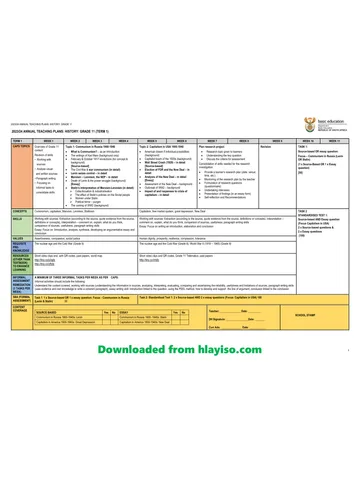
Gr 11 His ATP 2023 24
Question paper and memo
History Grade 11 Paper 2 Eastern Cape June 2025 Paper & Memo
Memorandum
History Grade 11 Paper 1 Eastern Cape November 2025 Memo
Memorandum
History Grade 11 P2 Eastern Cape November 2025 Memo (Eng)
Memorandum