
Downloaded from hlayiso.com
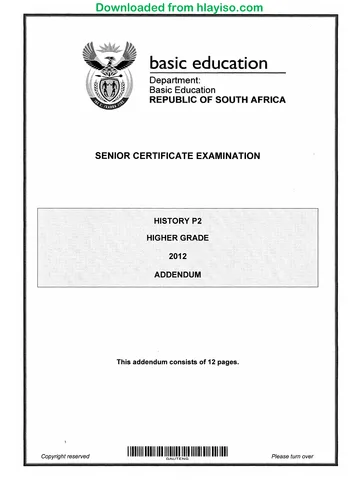
SENIOR CERTIFICATE EXAMINATION
HISTORY P1
STANDARD GRADE
2014
ADDENDUM
This addendum consists of 12 pages.
3
Copyright reserved Please turn over
Skip to contentAll 2014 papers 
View all



History Grade 12 Paper 1 NSC June 2014 Addendum (English)
Grade 12 History Paper 1 addendum from the NSC June 2014 (English), 12 pages. Read online or get the free PDF download.
History · Grade 12 · NSC June · 2014 · English. Addendum, 12 pages. Read online or download the PDF.
- Subject
- History
- Grade
- Grade 12
- Language
- English
- Document type
- Addendum
- Year
- 2014
- Exam period
- NSC June
- Paper
- 1
- Curriculum
- CAPS
- Pages
- 12
- File size
- 717.6 KB
Free to read online, no sign-up needed
Loading document…
Loading document…
1 of 12
This exam
Questions in this paper
Document textSearch extracted text and jump to a page.
Downloaded from hlayiso.com
History/SG/P1 2 DBE/2014
SCE – Addendum
QUESTION 4: THE PERIOD 1924 TO 1948
4.1 WHAT CONSTITUTIONAL CHANGES DID THE PACT GOVERNMENT
BRING ABOUT IN THE UNION OF SOUTH AFRICA BETWEEN 1924 AND
1934?
SOURCE 4A
The following source describes the steps taken by the Pact Government to
win constitutional sovereignty from Britain.
... This was aimed at securing SA's constitutional independence from Britain.
The Colonial Laws Validity Act (1865) was still in force which meant that in
theory Britain could intervene if there was a conflict of laws. There were also
limitations on South Africa's foreign policy. 1926 brought an opportunity for
South Africa to secure its sovereignty. At the Imperial Conference in Britain
attended by Hertzog clarity of the status of dominions was sought. The
Balfour Declaration stated: 'Autonomous communities within the British
Empire are equal in status, in no way subordinate to one another in any
aspect of their domestic or external affairs, though united by common
allegiance to the crown and freely associated as members of the
Commonwealth of Nations'. South Africa immediately established its own
Department of Foreign Affairs. The Statute of Westminster was adopted by
the British government in 1931; according to this statute dominions were no
longer members of the British Empire. No British law would have any force in
a dominion. South Africa passed two laws to protect its independence as the
Statute of Westminster was British law. The Status of the Union Act (1934)
confirmed the Statute of Westminster. The Royal Executive Functions and
Seals Act (1934) further entrenched South Africa's independence. General
Hertzog felt he had succeeded in his aims.
[Source: South Africa: A Modern History]
Copyright reserved Please turn over
Downloaded from hlayiso.com
History/SG/P1 3 DBE/2014
SCE – Addendum
SOURCE 4B
This cartoon is about the relationship between General JC Smuts and
General JBM Hertzog. In the main part of the cartoon, Hertzog is lying with his
head on Smuts' lap.
[Source: Die Burger, 8 December 1934]
Copyright reserved Please turn over
Downloaded from hlayiso.com
History/SG/P1 4 DBE/2014
SCE – Addendum
SOURCE 4C
The following cartoon shows General JBM Hertzog (NP) on the left and
General JC Smuts (SAP) on the right, standing with their backs to each other
and DF Malan and F Stallard (with the Union Jack) walking away.
[Source: Die Burger, 10 December 1934]
Copyright reserved Please turn over
Downloaded from hlayiso.com
History/SG/P1 5 DBE/2014
SCE – Addendum
QUESTION 5: THE PERIOD 1948 TO 1976
5.1 WHAT ROLE DID EXTRA-PARLIAMENTARY ORGANISATIONS PLAY IN
INTENSIFYING THE RESISTANCE AGAINST THE APARTHEID REGIME
AFTER 1949?
SOURCE 5A
The following extract contains the response by the apartheid government to
the defiance campaigns of the 1950s.
Numerous laws were passed in the creation of the apartheid state in the
1950s. This decade can be described as the era of petty apartheid, when the
nationalists passed many new racists laws to enforce a racially separate and
unequal social order. The 1953 Reservation of Separate Amenities Act, for
instance, imposed segregation on all public facilities, including post offices,
beaches, stadiums, parks, toilets, cemeteries, buses and trains. In early 1953,
the government imposed stiff penalties for protesting against discriminatory
laws, including heavy fines and prison sentences of up to five years. It then
enacted the Public Safety Act, allowing for the declaration of a State of
Emergency to override existing laws and oversight by the courts.
[Source: Readers' Digest Illustrated History of South Africa]
Copyright reserved Please turn over
Downloaded from hlayiso.com
History/SG/P1 6 DBE/2014
SCE – Addendum
SOURCE 5B
The following source traces the history of the struggle from pre-colonial times
to apartheid.
The adoption of the Programme of Action at the 1949 conference of the ANC
marked the beginning of a new era. It was a great shift from the defensive
position ... The government opened its programme of trampling [disregard]
human rights by passing the Suppression of Communism Act. In 1950 the
ANC decided to share the platform with the Communist Party on May Day to
protest against the Suppression of Communism Bill, which parliament had
duly passed into law. During the course of protests in various parts of the
Reef, the police killed eighteen black South Africans and wounded many
others. After the killings the National Executive Committee of the ANC held a
series of meetings and eventually decided on the form the protest should take
against the brutal murder of defenceless workers. A stay-at-home was called
for
26 June 1950. After the 26 June observance of Freedom Day, it was
recommended that a campaign be launched jointly by black South Africans in
the ANC, together with coloureds in the South African Coloured People's
Organisation and Indians in the Indian Congress. The defiance campaign was
a significant watershed (turning point), which saw 8 326 people volunteering
to defy unjust laws and thus court imprisonment.
[Source: History of the Struggle in South Africa by Govan Mbeki]
Copyright reserved Please turn over
Downloaded from hlayiso.com
History/SG/P1 7 DBE/2014
SCE – Addendum
SOURCE 5C
The following photograph taken by Jurgen Schadeberg shows a large crowd
which assembled at Fordsburg in July 1951.
Copyright reserved Please turn over
Downloaded from hlayiso.com
History/SG/P1 8 DBE/2014
SCE – Addendum
SOURCE 5D
The following extract focuses on the lessons learnt from the defiance
campaigns.
The boycott campaigns of the 1950s had some important lessons. Firstly,
employers in industry and commerce got to know that even though black
workers were denied the right to organise trade unions, the ANC would not
allow them to be exploited. Secondly, the traders in the black townships and
in the white towns and cities who depended on black consumer support were
taught the lesson that they could not disregard the decisions of the ANC on
matters that affected the community. Thirdly, the masses of the black people,
especially in the urban areas, saw in the ANC an unflinching [steady]
organisation that fought uncompromisingly for their rights. This gained
increasing support for the ANC in both urban and rural areas.
[Source: A Place in the City by L Callinicos]
Copyright reserved Please turn over
Downloaded from hlayiso.com
History/SG/P1 9 DBE/2014
SCE – Addendum
QUESTION 6: THE PERIOD 1976 TO 1994
6.1 WHY DID PW BOTHA DECIDE TO RELEASE NELSON MANDELA FROM
PRISON IN THE 1980s?
SOURCE 6A
This cartoon by Abe Berry focuses on the pressure put on PW Botha to have
talks with Nelson Mandela, who was serving 25 years in prison at the time
(1988).
[Source: Act by Act – 40 Years of Nationalist Rule in South Africa by A Berry]
EMINENT PERSONS GROUP: A group commissioned by the Commonwealth
of Nations to visit South Africa and persuade PW Botha to hold talks with
Nelson Mandela.
Copyright reserved Please turn over
Downloaded from hlayiso.com
History/SG/P1 10 DBE/2014
SCE – Addendum
SOURCE 6B
The following is an extract from PW Botha's speech delivered at the National
Party Congress in Natal.
... Most of the media in South Africa have already informed you on what I was
going to say tonight, or what I ought to say, according to their superior
judgment ... Seldom in our past has there been a party congress of the
National Party for which so many expectations were raised as this Congress
in Natal. Some of the reasons for this are evident, for example the partial
emergency situation in less than 14% of the magisterial districts of the RSA.
Other reasons are more sinister, such as the motives of those who have put
words in my mouth in advance.
During recent weeks there was an unparalleled scurry [rush] from different
sources, within and outside South Africa, to predict and prescribe what is to
be announced at the Congress. It was also envisaged that worldwide, people
are going to be dissatisfied if certain things are not announced as were
predicted. It is of course a well-known tactic in negotiations to limit the other
person's freedom of movement about possible decisions, thus forcing him in a
direction where his options are increasingly restricted ...
I am not prepared to lead white South Africans and other minority groups on a
road to abdication and suicide. Destroy white South Africa and our influence,
and this country will drift into faction strife [trouble], chaos and poverty.
Together with my policy statements earlier this year in Parliament, I see this
speech of mine as my Manifesto for a new South Africa. From certain
international as well as local quarters, appeals are being made to me to
release Mr. Nelson Mandela from jail. I stated in Parliament, when put this
question, that if Mr. Mandela gives commitment that he will not make himself
guilty of planning, instigating or committing acts of violence for the furtherance
of political objectives, I will, in principle, be prepared to consider his release ...
[Source: Keesing's Records of World Events]
Copyright reserved Please turn over
Downloaded from hlayiso.com
History/SG/P1 11 DBE/2014
SCE – Addendum
SOURCE 6C
This is an extract of the response by Nelson Mandela to PW Botha's offer of
conditional release in 1985.
I am a member of the African National Congress. I have always been a
member of the African National Congress and I will remain a member of the
African National Congress until the day I die ... I am surprised at the
conditions that the government wants to impose on me. I am not a violent
man. My colleagues and I wrote in 1952 to Malan asking for a round table
conference to find a solution to the problems of our country, but that was
ignored. When Strijdom was in power, we made the same offer. Again it was
ignored. When Verwoerd was in power we asked for a national convention for
all the people in South Africa to decide on their future. It was only then, when
all other forms of resistance were no longer open to us, that we turned to
armed struggle. Let Botha show that he is different to Malan, Strijdom and
Verwoerd. Let him renounce violence. Let him say that he will dismantle
apartheid. Let him unban the people's organisation, the African National
Congress. Let him free all who have been imprisoned, banished or exiled for
their opposition to apartheid. I cherish my freedom clearly, but I care even
more for your freedom. Too many have died since I went to prison. Too many
have suffered for the love of freedom. I owe it to their widows, to their
orphans, to their mothers and to their fathers who have grieved and wept for
them. Not only I have suffered during these long, lonely wasted years. I am in
prison as the representative of the people and of your organisation, the
African National Congress, which was banned. What freedom am I being
offered while the organisation of the people remains banned? What freedom
am I being offered when I may be arrested on a pass offence? What freedom
am I being offered when I cannot live my life with my family? What freedom
am I being offered when my dear wife is in banishment in Brandford? What
freedom am I being offered when I need a stamp in my pass to seek work?
What freedom am I being offered when my very South African citizenship is
not respected? Only free men can negotiate. Prisoners cannot enter into
contracts.
Copyright reserved Please turn over
Downloaded from hlayiso.com
History/SG/P1 12 DBE/2014
SCE – Addendum
ACKNOWLEDGEMENTS
Extracts and visual sources used in this addendum were taken from the following
publications:
ANC. (n.d.). What Can I Do? A Guide to Action against Apartheid, Amsterdam: World Assembly
of Youth.
Berry, A. 1989. Act by Act 40 Years of Nationalist Rule in South Africa, Johannesburg: Lowry.
Boyce, AN 1967 Europe and South Africa, Oxford University press.
Callinicos, L. 1993. A Place in the City The Rand on the Eve of Apartheid, Cape Town: Ravan &
Maskew Miller Longman.
Cronin, J et al. 1986. 30 Years of the Freedom Charter, Johannesburg: Ravan.
Die Burger, 8 December 1934
Die Burger, 10 December 1934
Dugmore, H et al (ed.). 1999. Nelson Mandela A Life in Cartoons, Cape Town: David Philip.
Du Toit, D. 1981. Capital and Labour in South Africa, London: Kegan Paul.
Fenwick, J and Rosenhain, C. 1991. South Africa; From Settlement to Self-Determination,
Melbourne: Oxford University Press.
Frederikse, J. 1987. South Africa A Different Kind of War, London: James Currey.
Institute for Justice and Reconciliation. 2004. Turning Points in History Series Books 4–6,
Johannesburg: STE Publishers.
Joyce, P. 1990. The Rise and Fall of Apartheid, Cape Town: Struik.
Mbeki, G. History of the struggle in South Africa. Johannesburg: Ravan Press.
Mermelstein, D. 1987. The Anti-Apartheid Reader, New York: Grove.
Ministry of Education. 2004. Every Step of the Way: The Journey to Freedom in South Africa,
Cape Town: HSRC Press.
Nasson, B (ed.). 2004 Turning Points in History, Johannesburg: STE Publishers.
New Nation Publication. 16 April 22 April 1993.
Nuttal, T et al. From Apartheid to Democracy, Pietermaritzburg: Shuter & Shooter.
Pampallis, J. 1997. Foundations of the New South Africa, Cape Town: Maskew Miller Longman.
Reader's Digest Illustrated History of South Africa 1992, Cape Town: Reader's Digest.
Roberts, M. 1993. A History of South Africa, Essex: Longman.
Suttner, Raymond. (n.d.). The Freedom Charter The People's Charter in the Nineteen-Eighties,
Paper delivered at the University of Cape Town.
The Poster Book Collective: South African History Archive 1991 Images of Defiance,
Johannesburg: Ravan Press.
Copyright reserved
Study this subject
Recommended for this subject
Memorandum
History Grade 12 Paper 1 NSC June 2014 Memo (English)
Memorandum
History Grade 12 Paper 2 NSC June 2014 Memo (English)
Question paper
History Grade 12 P2 NSC June 2014 Question Paper (English)
Addendum
History Grade 12 Paper 2 NSC June 2012 Addendum (English)
Addendum
History Grade 12 Paper 1 EC June 2019 Addendum (English)
Addendum
History Grade 12 Paper 1 EC June 2018 Addendum (English)
More from Grade 12 History
Study guide
Workguide Case Study Strategies
Memorandum
History Grade 12 Paper 2 North West Mock 2025 Memo
Memorandum
History Grade 12 Paper 1 NSC June 2025 Memo (English)
Question paper
History Grade 12 P1 Gauteng Prelim 2024 Question Paper (Eng)
Question paper
History Grade 12 P2 Eastern Cape June 2023 QP (Eng)
Memorandum