
Downloaded from hlayiso.com
Physical Sciences / P2 1 Preparatory Examination September 2016
NSC-Memorandum
Education
ducation
KwaZulu-Natal
Department of Education REPUBLIC OF
SOUTHAFRICA
PHYSICAL SCIENCES P2
(CHEMISTRY)
PREPARATORY
NATIONAL
GRAD
MARKS : 150
TIME : 3hours
This memorandum consists of 10 pages.
The marking guidelines as per 2014 Examination Guidelines, pages 34-37 must be applied when
marking this Paper.
Copyright Reserved Please Turn Over
Skip to contentAll 2016 papers 
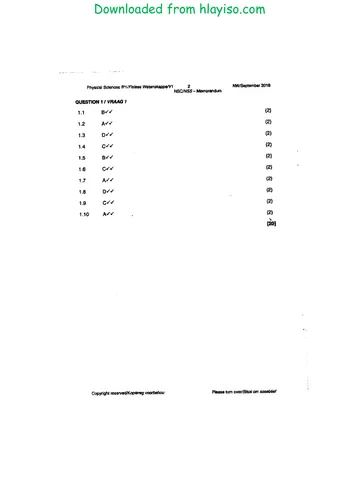
View all





Physical Sciences Grade 12 KwaZulu Natal Mock 2016 Memo
Grade 12 Physical Sciences memorandum from the KwaZulu Natal Mock Exam 2016, 11 pages. Read online or download the free PDF.
Physical Sciences · Grade 12 · KwaZulu Natal Mock Exam · 2016. Memorandum, 11 pages. Read online or download the PDF.
- Subject
- Physical Sciences
- Grade
- Grade 12
- Document type
- Memorandum
- Year
- 2016
- Exam period
- KwaZulu Natal Mock Exam
- Curriculum
- CAPS
- Pages
- 11
- File size
- 258.7 KB
Free to read online, no sign-up needed
Loading document…
Loading document…
1 of 11
This exam
KwaZulu Natal Mock Exam 2016
- Other filesQuestion paperQuestion paper (2)Memo
Document textSearch extracted text and jump to a page.
Downloaded from hlayiso.com
Physical Sciences / P2 2 Preparatory Examination September 2016
NSC-Memorandum
QUESTION 1
1.1 C (2)
1.2 B (2)
1.3 D (2)
1.4 B (2)
1.5 A (2)
1.6 C (2)
1.7 B (2)
1.8 A (2)
1.9 C (2)
1.10 D (2)
[20]
QUESTION 2
2.1. H (2)
2.2 A (1)
2.3 B (2)
2.2.1 chloroethene accept 1-chloroethene (2)
2.2.2 2-methylpentan-2-ol accept 2–methyl– 2-pentanol (2)
2.3
H H H H O H
│ │ │ │ ║ │
H― C ― C ― C ― C ― C ― O
│ │ │
H H H
H―C―H
│
H
Functional group correct rest of structure correct (2)
[10]
Copyright Reserved Please Turn Over
Downloaded from hlayiso.com
Physical Sciences / P2 3 Preparatory Examination September 2016
NSC-Memorandum
QUESTION 3
3.1.1 Boiling does not involve breaking the chemical (intra molecular) bonds between
atoms.
OR Boiling involves breaking the intermolecular forces between molecules. (1)
3.1.2 Pentane has a longer chain of carbons than methane, therefore a greater
surface area. Hence more sites for London force attraction and stronger
intermolecular forces. More energy is needed to break the stronger
intermolecular forces. (3)
3.1.3
OPTION 1: OPTION 2:
2-methylbutane (or methylbutane) 2,2-dimethylpropane (or
dimethylpropane)
H H H H
│ │ │ │ H
H─C─C─C─C─H │
│ │ │ H─C─H
H H H
H H
H ─C─H │ │
│ H─C─C─C─H
H │ │
H H
H─C─H
│
H (3)
3.2 The pressure exerted by a vapour at equilibrium with its liquid in a closed
system. (2)
3.3.1 D (2)
3.3.2 A (2)
3.4 The carboxylic acid has the strongest intermolecular forces,
because there are two sites for hydrogen bonding in each carboxylic acid
molecule. The stronger the intermolecular forces the lower the vapour
pressure (at a given temperature). The graph indicates that D has the lowest
vapour pressure. (3)
[16]
Copyright Reserved Please Turn Over
Downloaded from hlayiso.com
Physical Sciences / P2 4 Preparatory Examination September 2016
NSC-Memorandum
QUESTION 4
4.1.1 methyl ethanoate (2)
4.1.2
M (C3H6O2) = 74
n = m
M
= 68,88
74
= 0,93 mol
M (CH4O) = 32
1 : 1 (alcohol : acid)
m = 0,93 x 32
= 29,78 g
% purity : 29,78 x 100 = 59,57 %
50 (5)
4.2.1 A - hydration (or addition)
C - substitution
D - dehydration (or elimination)
E - combustion (4)
4.2.2 (i) Dissolve C2H5Cl in ethanol.
(ii) Add concentrated NaOH solution.
(iii) Heat the mixture. (3)
4.2.3 H2SO4 OR sulphuric acid (1)
4.2.4 Polythene OR Polyethene (1)
4.2.5 The chemical process in which longer chain hydrocarbon molecules are broken
down to shorter molecules at high temperatures (and pressures). (2)
4.2.6 C4H10 (2)
[20]
Copyright Reserved Please Turn Over
Downloaded from hlayiso.com
Physical Sciences / P2 5 Preparatory Examination September 2016
NSC-Memorandum
QUESTION 5
5.1 The amount of product formed/reactant used up per unit time (per second). (2)
5.2 concentration of HCl (1)
5.3 Product CO2 is an insoluble gas and escapes from the beaker. (2)
5.4 Calcium carbonate is used up and the reaction stops, no more CO2 formed. (2)
5.5.1 graph B (1)
5.5.2 graph D (1)
5.5.3 graph C (1)
5.6 graph C.
Catalyst speeds up the rate of reaction, therefore gradient of graph will be
steepest for same initial mass. (4)
5.7 Remains the same. (1)
[15]
Copyright Reserved Please Turn Over
Downloaded from hlayiso.com
Physical Sciences / P2 6 Preparatory Examination September 2016
NSC-Memorandum
QUESTION 6
6.1.1 Increases (1)
6.1.2 When the equilibrium in a closed system is disturbed, the system will
re-instate a new equilibrium by favouring the reaction that will oppose the
disturbance. (2)
6.1.3 Increase in temperature increases Kc
Increase in Kc indicates that the forward reaction has been favoured ,
Increase in temperature favours the endothermic reaction ,
Therefore the forward reaction is endothermic . (4)
6.1.4 Add a catalyst
Increase pressure OR decrease volume of container (2)
6.2
A2 + 2B → 2AB
Initial (mol) x 2 0
Used / formed -0,2 -0,4 0,4 RATIO
Equilibrium (mol) x – 0,2 1,6 0,4
[equilibrium] x – 0,2 1,6 0,4 Addition for
all three
For conc. only
A2 + 2B → 2AB
Initial conc.(mol.dm-3) x 2 0
RATIO
Used / formed -0,2 -0,4 0,4
[equilibrium] x – 0,2 1,6 0,4 Addition for
all three
Kc = [AB]2
Marking criteria:
[A2][B]2
• Initial mol/conc correctly indicated.
• Mol/conc of AB produced = 0,4.
= (0,4)2 • Ratio applied correctly.
(x – 0,2) (1,6)2 • Equilibrium mol: initial – used
Initial + produced
= 0,5 OR
Equilibrium conc: initial – used
∴ 0,5 [((x – 0,2) (1,6)2] = (0,4)2 Initial + produced
• Equilibrium mol ÷ 1 = eq conc.
∴ 1,28x - 0,256 = 0,16 • Correct Kc expression.
• Substitution of eq conc to Kc expression.
∴ X = 0,325 mol • Final answer.
Wrong Kc expression – (Max.: 4/8)
Wrong values on the table but used
in the calculation (positive marking)
Copyright Reserved - (Max.: 3/8) no mark for answer. Please Turn Over
Downloaded from hlayiso.com
Physical Sciences / P2 7 Preparatory Examination September 2016
NSC-Memorandum
(8)
[17]
Copyright Reserved Please Turn Over
Downloaded from hlayiso.com
Physical Sciences / P2 8 Preparatory Examination September 2016
NSC-Memorandum
QUESTION 7
7.1.1
Option 1:
pH = - log [H3O+]
=1
∴ [H3O+] = 10-1 = 0,1
∴ [HCl] = 0,1 mol.dm-3
Option 2:
pH = - log [H3O+]
=1
∴ [HCl] = 0,1 mol.dm-3
(3)
7.1.2 increase (1)
7.1.3 Mg(OH)2(s) + 2HCl(aq) → MgCl2(aq) + 2H2O(l) (3)
Reactants Products Balancing
7.2 When an acid reacts with a base to produce a salt and water. OR
Chemically equivalent quantities of acid and base are reacted. (2)
7.3
Option 1:
2NaOH + H2SO4 → Na2SO4 + 2H2O
n(NaOH) = c x V = 0,1 x 0,012 = 0,0012 mol
n(H2SO4) = ½ x n(NaOH) = 0,0006 mol
V(H2SO4) = n/C = 0,0006 / 0,05 = 0,012 dm3
V(H2SO4) that reacts with Ba(OH)2 = 54 – 12 = 42 cm3 (OR 0,054 - 0,012 = 0,042 dm3)
Ba(OH)2 + H2SO4 → BaSO4 + 2H2O
n(H2SO4) that reacts with Ba(OH)2 = c x V = 0,05 x (42 x 10-3 mol) = 0,0021 mol
n(Ba(OH)2) = 1 x 0,0021 = 0,0021 mol
[Ba(OH)2] = n/v = 0,0021 x 0,048 = 0,04375 mol∙dm-3
Copyright Reserved Please Turn Over
Downloaded from hlayiso.com
Physical Sciences / P2 9 Preparatory Examination September 2016
NSC-Memorandum
7.3
Option 2: Option 3:
2NaOH + H2SO4 → Na2SO4 + 2H2O 2NaOH + H2SO4 → Na2SO4 + 2H2O
n(NaOH) = c x V = 0,1 x 0,012 na = Va x ca
nb Vb x cb
= 0,0012 mol
n(H2SO4) = ½ x n(NaOH) 1 = Va x 0,05
2 0,1 x 12
= 0,0006 mol
n(H2SO4) tot = c x V Va = 12 cm3
= 0,05 x (54 x10-3)
V(H2SO4) with Ba(OH)2 = 54 – 12
= 0,0027 mol = 42 cm3
Ba(OH)2 + H2SO4 → BaSO4 + 2H2O
n(H2SO4) with Ba(OH)2
na = Va x ca
= 0,0027 - 0,0006 = 0,0021 mol nb Vb x cb
Ba(OH)2 + H2SO4 → BaSO4 + 2H2O
1 = 0,05 x 42
n(Ba(OH)2) = 1 x 0,0021 1 48 x cb
= 0,0021 mol
[Ba(OH)2] = 0,04375 mol∙dm-3
[Ba(OH)2] = n / v = 0,0021 x 0,048 =
0,04375 mol∙dm-3
(8)
[17]
QUESTION 8
8.1.1 Pt or the electrode where oxygen reacts or where peroxide is formed (1)
8.1.2 Cu → Cu2+ + 2e- Cu ⇌ Cu2+ + 2e- (1) (2)
Cu ← Cu2+ + 2e- (0)
8.1.3 O2 + 2H+ + 2e- → H2O2 (2)
8.1.4 EΘcell = EΘcathode - EΘanode
= 0,68 - 0,34
= 0,34 V (4)
8.2 2Ce + 3Pd2+ → 2Ce3+ + 3Pd (balance ) (3)
[12]
Copyright Reserved Please Turn Over
Downloaded from hlayiso.com
Physical Sciences / P2 10 Preparatory Examination September 2016
NSC-Memorandum
QUESTION 9
9.1 Electrical energy to chemical energy.
(1)
9.2 Decrease in mass/ decrease in size/ gets used up/ errosion
(2)
9.3 Oxidation (1)
9.4 Note:
+ -
9.4.1 Ag + e → Ag Marking rule 3.3
(2)
9.4.2 Silver nitrate OR AgNO3
OR
Silver ethanoate/silver acetate
CH3COOAg/ AgC2H3O2/ AgCH3CO2 (1)
OR
Ag+ ions
9.5 Rate of oxidation is equal to the rate of reduction.
ACCEPT: Reduction and oxidation take place simultaneously
(2)
[9]
QUESTION 10
10.1.1 2SO2 + O2 ⇌ 2SO3 (ACCEPT: 2SO2 + O2 → 2SO3 ) (2)
10.1.2 Step 2 (1)
10.1.3 Vanadium pentoxide (1)
10.2.1 Fertilisers must replenish nutrients used by growing of crops. (1)
10.2.2 Any ONE:
Excessive fertiliser seeps/washes into groundwater and contaminates
Drinking Water OR
Excessive fertiliser run-off can lead to eutrophication which depletes aquatic
life which serves as a food source OR
Excessive fertilisation can damage a crop which leads to a smaller harvest. (1)
10.2.3 Eutrophication (1)
10.2.4 (NH4)2SO4 (2)
Copyright Reserved Please Turn Over
Downloaded from hlayiso.com
Physical Sciences / P2 11 Preparatory Examination September 2016
NSC-Memorandum
10.3.1 Total percentage of active fertiliser. OR Combined percentage of N, P and K.
(1)
10.3.2 OPTION 1
13 = 5 x 26
x
x = 10
thus N = 3
N:P:K = 3: 2 : 5 (4)
OPTION 2
(N + P + K) in the bag = 26/100 x 20 = 5,2 kg
K in the bag = 13/100 x 5,2 = 2,6 kg
2,6/5,2 x 100 = 50% = 5 parts
P = 2 parts = 20 %
Therefore, N = 30% = 3 parts
Unknown component = 3. (4)
[14]
Copyright Reserved Please Turn Over
Study this subject
Recommended for this subject
Memorandum
Physical Sciences Grade 12 P2 Eastern Cape Mock 2016 Memo
Memorandum
Physical Sciences Grade 12 Free StateNovember 2016 Memo
Memorandum
Physical Sciences Grade 12 Limpopo November 2016 Memo
Memorandum
Physical Sciences Grade 12 North West Mock 2016 Memo
Question paper
Physical Sciences Grade 12 P2 Eastern Cape Mock 2016 QP
Question paper
Physical Sciences Grade 12 P1 EC June 2016 QP (Eng)
More from Grade 12 Physical Sciences
Question paper
Physical Sciences Grade 12 P1 Eastern Cape June 2025 QP
Question paper
Physical Sciences Grade 12 P2 Eastern Cape Mock 2025 QP
Question paper
Physical Sciences Grade 12 P2 Gauteng Mock 2025 QP
Question paper
Physical Sciences Grade 12 P1 KZN Mock 2025 Question Paper
Question paper
Physical Sciences Grade 12 Limpopo March Test 2025 QP
Question paper