
Downloaded from hlayiso.com
NATIONAL
SENIOR CERTIFICATE
GRADE 12
PHYSICAL SCIENCES P2: CHEMISTRY
FISIESE WETENSKAPPE VR 2: CHEMIE
SEPTEMBER 2016
MEMORANDUM
MARKS: 150
Skip to contentAll 2016 papers 
View all





Physical Sciences Grade 12 Limpopo November 2016 Memo
Grade 12 Physical Sciences memorandum from the Limpopo November 2016, 11 pages. Read online or get the free PDF download, question paper linked when available.
Physical Sciences · Grade 12 · Limpopo November · 2016. Memorandum, 11 pages. Read online or download the PDF.
- Subject
- Physical Sciences
- Grade
- Grade 12
- Document type
- Memorandum
- Year
- 2016
- Exam period
- Limpopo November
- Curriculum
- CAPS
- Pages
- 11
- File size
- 329.7 KB
Free to read online, no sign-up needed
Loading document…
Loading document…
1 of 11
This exam
Limpopo November 2016
- Paper 1Question paperMemo
- Other filesQuestion paperMemo
Document textSearch extracted text and jump to a page.
Downloaded from hlayiso.com
2
Physical Science P2 Memo NCS Limpopo DoE September 2016
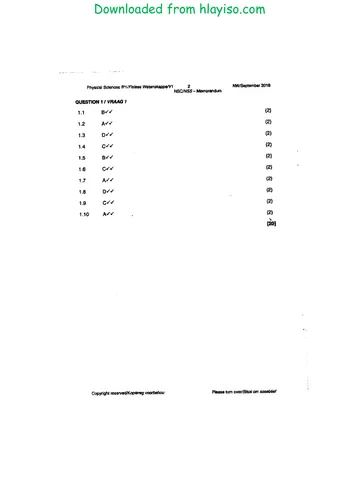
QUESTION?VRAAG 1
1.1 A (2)
1.2 D (2)
1.3 B (2)
1.4 C (2)
1.5 D (2)
1.6 C (2)
1.7 A (2)
1.8 A (2)
1.9 C (2)
1.10 B (2)
[20]
QUESTION/VRAAG 2
2.1
2.1.1 Esters (1)
2.1.2 Carboxyl group/karboksiel groep (1)
2.1.3 A (1)
2.1.4 5-bromo-2,4-dimethylheptane // (3)
5-broom–2,4–dimetielheptaan of / 5-bromo–2,4–
dimetielheptaan
2.1.5 C n H 2n (1)
2.1.6
H Notes
H C O H
∙ Functional group
H ∙ Whole structure correct (2)
2.1.7 propanoic acid / propanoësuur (1)
2.2
2.2.1 Polyethene/ Polythene/ polieteen/ politeen/ polietileen
Accept: Polyethylene (1)
2.2.2 Addition Polymerisation addisie polimerisasie (1)
2.2.3 (a) CH 2 (1)
(b) CH 2 (1)
[14]
Copyright reserved Please turn over
Downloaded from hlayiso.com
3
Physical Science P2 Memo NCS Limpopo DoE September 2016
QUESTION/VRAAG 3
3.1 A series of organic compounds that can be described by the same general
formula. / ‘n reeks organiese verbindings wat deur ‘n algemene formule
beskryf kan word
OR: A series of organic compounds in which one member differs from the next
with a CH 2 group./ ‘n reeks organiese verbindings waar een van die ander met
CH 2 groep/eenheid verskil
NOTES: 2 or 0
3.2 Ketones / ketone (1)
3.3 Butanoic acid/ butanoöesuur (1)
3.4.1 Boiling point/ kookpunt (1)
3.4.2 Molecular mass / molekulêre massa (1)
3.5 The boiling point of carboxylic acids > b.p of alcohols > b.p of aldehydes (1)
Kookpunt van karboksielsure > k.pt alkohole > k.pt van aldehiede
3.6 ∙ Both compounds A and B are hydrogen bonded / beide A en B het
waterstofbinding IM kragte
∙ Compound A has two (more) sites for hydrogen bonding /A forms
dimers/A is more polar/ B has less/one sites for hydrogen bonding // A het
twee plekke vir waterstofbinding (B het slegs 1 plek vir H-bd)
∙ Therefore A has stronger intermolecular forces than B/B has weaker
Intermolecular forces than A / A het sterke IM kragte (3)
3.7 The stronger/weaker the intermolecular forces, the lower/higher the
vapour pressure. // hoe sterker die IM kragte hoe swakker is die dampdruk / h (1)
swakker die IM kragte hoe hoer is die dampdruk
[11]
Copyright reserved Please turn over
Downloaded from hlayiso.com
4
Physical Science P2 Memo NCS Limpopo DoE September 2016
QUESTION/VRAAG 4
4.1.1 Addition/hydrobromination / Hydrohalogeantion / Addisie/
hidrohalogenasie aanvaar: hidrobromasie (1)
4.1.2 H H H H H H H H
H- C C C C H + HBr H C C C C H
H H H H Br H (4)
Notes: Reactants Product Marking Rule 6.3.10.
4.1.3 2-bromobutane / 2-broombutaan/2-bromobutaan Notes
∙ 2-bromo
∙ butane
(2)
4.2.1 Substituition /Hydrolysis / substitusie/ hidroliese (1)
4.2.2 Notes:
H H H H ∙ Functional group correct /
Funksionele groep korrek
H C C C C H
H H OH H ∙ Whole structure correct /
Hele struktuur korrek
(2)
4.2.3 Butan-1-ol / 1- butanol (2)
Marking Rules:
4.3 H H H H Functional group correct / korrekte
H C C C C H funksionele groep
Whole structure correct / hele
H H struktuur reg
(2)
4.4
4.4.1 Alkene / alkene (1)
4.4.2 Potassim bromide/KBr / kaliumbromied
Water /H 2 O (2)
[17]
Copyright reserved Please turn over
Downloaded from hlayiso.com
5
Physical Science P2 Memo NCS Limpopo DoE September 2016
QUESTION/VRAAG 5
5.1 Carbon dioxide/CO 2 / koolstofdioksied (2)
5.2.1 The decrease in concentration of hydrochloric acid per unit time. /
die afname in soutsuur konsentrasie per eenheidstyd (2)
(2 or 0)
5.2.2 Concentration(of the acid) / konsentrasie (1)
5.2.3 For a fair test/comparison / vir ‘n regverdige toets
(1)
5.2.4 Higher acid concentration in experiment 2 means:
• More particles/molecules per unit volume
• More particles have kinetic energy equal to or greater than
activation energy/More particles have enough kintetic energy
• More effective collisions per unit time/frequency of effective
collisions increases/Rate of effective collisions increases. (3)
Hoër konsentrasie suur vir eksperiment beteken:
• Meer deeltjies/ eenheidsvolume
• Meer deeltjies het genoeg E K gelyk of groter as aktiverings
energie/ genoeg E K
• Meer effektiewe botsings/ eenheidstyd
m
5.2.5 n(CaCO 3 ) = 𝑀𝑀
4
= 100 Marking Guidelines:
𝑚𝑚
= 0,04 mol ∙ Substitution into n =
𝑀𝑀
1
n(HCℓ):n(CaCO 3 ) = 2 : 1 ∙ Ratio n(HCℓ) = n(CaCO3)
2
∴ n(HCℓ) = 2(0,04) = 0,08 mol ∙ Substitution in c = n/V
∙ Final answer
𝑛𝑛
c(HCℓ) = 𝑉𝑉
0,08
0,4 = 𝑉𝑉
∴ V = 0,2 dm3 = 200 cm3
(4)
5.3 POTENTIAL ENERGY VERSUS REACTION COORDINATE GRAPH
Activated Complex / geaktiveerde kompleks
Ea
Potential energy/ Potensiële energie
Shape /
∆H vorm
(4)
Reaction Coordinate / reaksie ko-ordinate [17]
Copyright reserved Please turn over
Downloaded from hlayiso.com
6
Physical Science P2 Memo NCS Limpopo DoE September 2016
QUESTION/VRAAG 6
6.1 3 to 4 minutes (Any value from 3 min to 4 min can be accepted) / 3 - 4 (1)
minute
6.2.1 Greater than/ groter as (1)
6.2.2 Equal to / gelyk aan (1)
6.3 CALCULATION USING NUMBER OF MOLES / bereken met aantal
mol
Marking Criteria:
• Correct Kc expression/ korrekte Kc uitdrukking
• Substituting the Kc value in the expression/ vervanging van Kc waarde
• Substituting concentration value of PCℓ5(g) in Kc/ vervanging van [PCℓ5]] in Kc
• Equilibrium concentration PCℓ3 and Cℓ2 = 0,91 mol·dm-3/ [ewewig] PCℓ3 = Cℓ2 =
0,91
• Using n = cV to find the n of PCℓ5 (multiplying c by 2)/ x 2 om n van PCℓ5 te kry
• Ratio of n(PCℓ5): n(PCℓ3): n(Cℓ2) = 1:1:1/ verhouding [PCℓ5]: [PCℓ3]: [Cℓ2] =
1:1:1
• Calculating n (PCℓ5) initial = 2,12 mol/ berekening van aanvanklik PCℓ5 = 2,12
Assume that the equilibrium concentration of PCℓ 3 (g) is x
[PCl3][Cl2]
Kc =
[PCl5]
( x )( x )
5.55 =
0,15
∴x =0.91 mol·dm-3
PCℓ 5 PCℓ 3 Cℓ 2
Initial Quantity (mol) 2,12 0 0
Change in quantity (mol) -1,82 +1,82 +1,82 R
Equilibrium quantity (mol) 0,30 1,82 1,82 X2
Concentration at equilibrium 0,15 0,91 0,91
(mol·dm-3) V = 2 dm3
𝑚𝑚
n = 𝑀𝑀
m
2,12 =
102
m = 216,24 g
Copyright reserved Please turn over
Downloaded from hlayiso.com
7
Physical Science P2 Memo NCS Limpopo DoE September 2016
CALCULATION USING CONCENTRATION/ berekening met [ ]
• Correct Kc expression/ korrekte Kc uitdrukking
• Substituting the Kc value in the expression/ vervanging van Kc waarde
• Substituting concentration value of PCℓ5(g) in Kc / vervanging van [PCℓ5]] in Kc
• Equilibrium concentration for PCℓ3 and Cℓ2 = 0,91 mol·dm-3 / [ewewig] PCℓ3 = Cℓ2 = 0,91
• Ratio of [PCℓ5]: [PCℓ3]: [Cℓ2] = 1:1:1 / verhouding [PCℓ5]: [PCℓ3]: [Cℓ2] = 1:1:1
• Initial concentration of PCℓ5(g) / aanvanklike [PCℓ5]
• Substituting 2 in c = n/V / deel deur 2 vir [ ]
• Substituting 102 in n = m/M / vervanging van 102 in n = m/M
• Final answer / finale antwoord
Assume that the equilibrium concentration of PCℓ 3 (g) is x
[PCl3][Cl2]
Kc =
[PCl5]
( x )( x )
5.55 =
0,15
∴x =0.91 mol·dm-3
PCℓ 5 PCℓ 3 Cℓ 2
Initial concentration (mol·dm-3 ) 1,06 0 0
aanvanklik
Change in concentration (mol·dm-3 ) -0,91 +0,91 +0,91 Ratio/
Verandering verhouding
Equilibrium concentration (mol·dm-3 ) 0,15 +0,91 +0,91
Ewewig
𝑛𝑛 OR/ of
𝑐𝑐 =
𝑉𝑉 m = cMV
n
1.06 = 2 =(1,06)(102)(2)
n = 2,12 mol =216,24 g
m = n M = (2,12)(31+5 x 31,5)
= 443,02 g (9)
Copyright reserved Please turn over
Downloaded from hlayiso.com
8
Physical Science P2 Memo NCS Limpopo DoE September 2016
6.4 Endothermic. endotermies
Decrease in temperature increases [PCℓ 5 ] and decreases [Cℓ 2 ] and
[PCℓ 3 ], which implies that the reverse reaction is favoured/equilibrium
position shifts to the left. According to Le Chatelier ‘s Principle, the
decrease in temperature favours the exothermic reaction.
Therefore, the forward reaction is endothermic. /
Afname in temperatuur verhoog [PCℓ 5 ] en verlaag [Cℓ 2 ] en [PCℓ 3 ], dus word
terugwaartse reaksie bevoordeel/ ewewig skuif na links
Volgens Le Chatelier se beginsel sal ‘n afname in temperatuur die
eksotermiese reaksie bevoordeel (d.w.s terugwaartse reaksie is endotermies )
Dus is die voorwaartse reaksie endotermies (3)
[15]
QUESTION/VRAAG 7
7.1
7.1.1 Concentrated acid- contains a large amount (number of moles) of
acid in proportion to the volume of water.
Dilute acid – contains a small amount (number of moles) of acid in
proportion to the volume of water./ (2)
Gekonsentreede suur: bevat ‘n groot hoeveelheid /mol suur in
verhouding to die volume water
Verdunde suur bevat ‘n klein hoeveelheid / aantal mol suur in
verhouding tot die volume water
7.1.2 It ionises completely in water to form a high concentration of H 3 O+
ions. // dit ioniseer volledig in water en vorm ‘n hoë konsentrasie
H 3 O+ ione (2)
Note: 2 or 0
7.1.3 pH = -log[H 3 O+]
= - log(0,20)
= 0,7 (3)
7.2.1 Basic / basies
(1)
7.2.2 CO 3 (aq) + H 2 O (ℓ) HCO 3 (aq) + OH (aq)
2- - -
(reactants products )
Excess OH- (aq) ions are produced/it is a salt of strong base and
weak acid (and the resultant solution is basic.)
‘n Oormaat OH- ione word geproduseer/ dit is die sout van ‘n sterk
basis en ‘n swak suur (3)
Copyright reserved Please turn over
Downloaded from hlayiso.com
9
Physical Science P2 Memo NCS Limpopo DoE September 2016
Marking Criteria / nasienkriteria:
7.3.1 V
n(CO2) = • Substitution into/vervanging in
Vm 𝑉𝑉
4,48 n =
= 𝑉𝑉𝑚𝑚
22,4 • Using mole ratio/ gebruik molverhouding
= 0,2 mol • Multiplying by/ vermenigvuldig met 106
• Percentage purity / pesentasie
n(Na 2 CO 3 ): n(CO 2 ) = 1:1 suiwerheid
∴ n(Na 2 CO 3 ) = 0,2 mol
m(Na 2 CO 3 ) = n·M = (0,2)(106) = 21,2 g
mass of pure Na2 CO3
∴ % purity = × 100%
mass of impure Na2 CO3
21,2
= × 100
25
(5)
= 84,8%
7.3.2 Mass of impurity/ massa onsuiwerheid = 25 -21,2 = 3,8 g
OR % impurity/ onsuiwerheid = 100-84,8 = 15,2%
15,2
x 25 = 3,8 g
100
(2)
[18]
QUESTION/VRAAG 8
8.1.1 Reduction is a gain in electron(s) (by a chemical substance)// die (2)
bykry van elektrone
Note: 2 or 0
8.1.2 Aluminium is a stronger reducing agent than Sn/ Ag/ Hg and
therefore it is easily oxidised and a current flows, simulating the
pain sensors./ (3)
Al is ‘n sterker reduseermiddel as sn/Ag/Hg en word daarom maklike
geoksideer. ‘n Stroom vloei wat pyn veroorsaak
8.2.1 2Cr2+(aq) + Cu2+(aq) 2Cr3+(aq) + Cu(s)
(reactants, products, balancing) (3)
8.2.2 Eθcell = Eθcathode − Eθanode
=+0,34-(-0,41)
= 0,75 V
OR
Eθcell = Eθcathode − Eθanode
= +0,34+0,41 (4)
= 0,75 V
8.2.3 Increases / verhoog
Increase in temperature increases the rate of electron transfer as well
as the movement of ions in the electrolyte.
(This increases the rate of flow of charge in the cell.)/ (2)
Copyright reserved Please turn over
Downloaded from hlayiso.com
10
Physical Science P2 Memo NCS Limpopo DoE September 2016
‘n verhoging in temperatuur verhoog die tempo van electron oordrag en
die beweging van ione in die elektroliet
8.2.4 As the cell operates, [cation]/[Cr 3+ ]increases in the anode half cell and
[cation]/[Cu 2+]decreases in the cathode half cell.
Anions from the salt bridge move into the anode half-cell to balance out
excess cations.
Cations from the salt bridge move into the cathode half-cell to balance
out shortage of cations./ (3)
3+
Soos die sel werk, verhoog [katione] / [Cr ] in die anode/Cr halfsel en
[katione] / [Cu 2+] verlaag in die katode/Cu halfsel. Anione /
negatiewe ione va die soutbrug beweeg na die anode/ Cr halfsel om
die oormaat katione/ Cr 3+ uit te balanseer
Katione / negatiewe ione van die soutbrug beweeg na die katode/ Cu
halfsel om die tekort van katione/ Cu2+ te balanseer
[17]
QUESTION/VRAAG 9
9.1 Bauxite / Bauksiet (2)
9.2 Carbon / Koolstof (1)
9.3 The anode reacts with the oxygen produced to form CO 2. // Die (1)
anode reageer met die suurstof wat geproduseer word en vorm CO 2.
9.4 Cryolite / Krioliet (1)
9.5 Aℓ + 3e- Aℓ (2)
9.6 1890 C~ 0,176 g Aℓ
96500 C ~ x g Aℓ
(96500 )(0,176 )
∴x =
(1890 )
= 8,98 g
1 mol of metal ~ 27 g
Since 8,98 g of metal are discharged by 1 mol of electrons,
27g
27 g of metal are discharged by =3 moles of electrons.
8,98g
If 1 mole of metal needs 3 moles of electrons, the charge on the
cations is +3/
1 mol metaal ~ 27 g
Omdat 8,98 g metaal ontlaai word deur 1 mol elektrone, sal
27g
27 g metaal ontlaai word deur =3 mol elektrone
8,98g
Indien 1 mol metal 3 mol elektrone benodig, is die lading van die
katioon +3 (3)
[10]
Copyright reserved Please turn over
Downloaded from hlayiso.com
11
Physical Science P2 Memo NCS Limpopo DoE September 2016
QUESTION/VRAAG 10
10.1
10.1.1 Increase in population requires an increase in the production of food.
OR Removing plant material from the soil depletes the nutrients so
more fertilizer must be added to the soil. /
Toename in bevolking vereis ‘n toename in voedselproduksie OF (1)
verwydering van plantmateriaal vanuit die grond veroorsaak uitputting
van voedingstowwe so meer kunsmis moet tot die grond toegevoeg
word
10.1.2 Allows nutrients to be absorbed through roots with water./ laat toe (1)
dat voedingstowwe deur die wortels opgeneem word
10.1.3 Run off/ leaching results in the cost of lost nutrients/ eutrophication/ (1)
eutrifikasie/ afloop /loging veroorsaak verhoogte koste as gevolg van
verlore voedingstowwe
10.2
10.2.1 Contact process/ kontakproses (1)
10.2.2 Oleum/ pyrosulphuric acid/ fuming sulphuric acid/oleum/rokende (1)
swael
10.2.3 H 2 S 2 O 7 + H 2 O 2H 2 SO 4
(reactants, products, balancing) Note: Marking rule 6.3.10 (3)
10.2.4 Ammonium sulpahte /(NH 4 ) 2 SO 4 / ammoniumsulfaat (1)
10.2.5 (a) For stems and leaves development / vir ontwikkeling van (1)
blare en stamme
(1)
(b) Fractional distillation of liquid air / fraksionele distillasie van
vloeibare lug
[11]
GRAND TOTAL : 150
Copyright reserved Please turn over
Study this subject
Recommended for this subject
Memorandum
Physical Sciences Grade 12 P2 Eastern Cape Mock 2016 Memo
Memorandum
Physical Sciences Grade 12 Free StateNovember 2016 Memo
Memorandum
Physical Sciences Grade 12 North West Mock 2016 Memo
Question paper
Physical Sciences Grade 12 P2 Eastern Cape Mock 2016 QP
Question paper
Physical Sciences Grade 12 P1 EC June 2016 QP (Eng)
Question paper
Physical Sciences Grade 12 Western Cape November 2016 QP
More from Grade 12 Physical Sciences
Question paper
Physical Sciences Grade 12 P1 Eastern Cape June 2025 QP
Question paper
Physical Sciences Grade 12 P2 Eastern Cape Mock 2025 QP
Question paper
Physical Sciences Grade 12 P2 Gauteng Mock 2025 QP
Question paper
Physical Sciences Grade 12 P1 KZN Mock 2025 Question Paper
Question paper
Physical Sciences Grade 12 Limpopo March Test 2025 QP
Question paper