
Downloaded from hlayiso.com
NATIONAL
SENIOR CERTIFICATE
GRADE 12
PHYSICAL SCIENCES: PHYSICS (P1)
PREPARATORY EXAMINATIONS
SEPTEMBER 2016
MEMORANDUM
MARKS: 150
TIME: 3 hours
This memorandum consists of 10 pages.
Copyright reserved Please turn over
Skip to contentAll 2016 papers 



View all



Physical Sciences Grade 12 P1 Limpopo November 2016 Memo
Grade 12 Physical Sciences Paper 1 memorandum from the Limpopo November 2016, 11 pages. Read online or download the free PDF.
Physical Sciences · Grade 12 · Limpopo November · 2016. Memorandum, 11 pages. Read online or download the PDF.
- Subject
- Physical Sciences
- Grade
- Grade 12
- Document type
- Memorandum
- Year
- 2016
- Exam period
- Limpopo November
- Paper
- 1
- Curriculum
- CAPS
- Pages
- 11
- File size
- 234.0 KB
Free to read online, no sign-up needed
Loading document…
Loading document…
1 of 11
This exam
Limpopo November 2016
- Paper 1Question paperMemo
- Other filesQuestion paperMemo
Questions in this paper
Document textSearch extracted text and jump to a page.
Downloaded from hlayiso.com
Physical Sciences/P1 Limpopo DoE September 2016
NSC
QUESTION 1
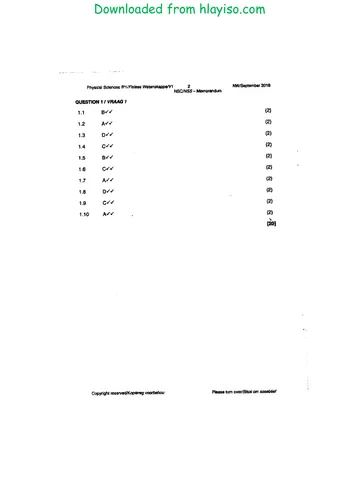
1.1 D (2)
1.2 A (2)
1.3 C (2)
1.4 B (2)
1.5 C (2)
1.6 A (2)
1.7 D (2)
1.8 D (2)
1.9 B (2)
1.10 A (2)
[20]
QUESTION 2
2.1
2.1.1 When a net force (Fnet) is applied to an object (of mass, m) it accelerates in the
direction of the (net) force. The acceleration (a) is directly proportional to the (net)
force and inversely proportional to the mass of the object. (2 or 0)
OR
The net force acting on an object is equal to the rate of change of momentum of
the object (in the direction of the force). (2 or 0) (2)
2.1.2
N / FN / Force of surface on trolley
F/Applied force
F / Ff / Friction
w / Fg / weight / gravitational force (4)
(Accept the components of Fg INSTEAD of Fg but not both Fg and the
components. No arrows = ¾; forces not touching dots = 3/4)
2.1.3 (a) Ff = μkFN = μk (mg Cos 30 ) = 0,2 (33,95) = 6,79 N
o
(3)
(b) Positive marking from 2.1.3 a
Fg// = mgSin 300 = (4)(9,8)sin 30 = 19,6 N
Fnet = maR = F + Ff + Fg//
(4) (0,43) = F + (–6,79) + (–19,6)
F = 28,11 N (5)
2
Downloaded from hlayiso.com
Physical Sciences/P1 Limpopo DoE September 2016
NSC
2.2 = = 18944,34 N (4)
[18]
QUESTION 3
Any sign convention is accepted, i.e. learners may also work with upwards as positive
3.1
3.1.1 9,8 (m.s–2) – object is falling through the air. (2)
3.1.2 tx = (0,5 + 0,5) = 1 s (1)
3.2 The area under the graph represents the displacement.
displacement = area = ½ base x height = ½ x (–0,5) x 3,9 = –0,98 m
height = 0,98 m (3)
3.3
3.3.1 From the graph, downward motion as POSITIVE.
v f = vi + a ∆t
= –4,9 + (+9,8) (1,7)
= 11,76 m.s–1 (3)
3.3.2
Upwards as - Upwards as +
∆y = v i ∆t + 21 a∆t 2 ∆y = v i ∆t + 21 a∆t 2
= (–4,9) (1,7) + ½ (+9,8) (1,7)2 = (4,9) (1,7) + ½ (-9,8) (1,7)2
= 5,83 m = - 5,83
Δ y = 5,83 m
3
Downloaded from hlayiso.com
Physical Sciences/P1 Limpopo DoE September 2016
NSC
OR
Upwards as - Upwards as +
∆y = v i ∆t + 21 a∆t 2 ∆y = v i ∆t + 21 a∆t 2
= (- 4,9) (0,7) + ½ (+9,8) (0,7)2 = (4,9) (0,7) + ½ (- 9,8) (0,7)2
= 5,83 m = - 5,83
Δ y = 5,83 m
(3)
3.4
a (m.s–2)
t (s)
(2)
[14]
4
Downloaded from hlayiso.com
Physical Sciences/P1 Limpopo DoE September 2016
NSC
QUESTION 4
4.1 N / FN / Normal Force
0,86 N / f / Ff / friction 0,3 N / Fapp / Applied Force
w / Fg / Weight / Gravitational force
(4)
4.2 Fnet = Fapplied + Ff = 0,30 + (–0,86) = –0,56 N = 0,56 N opposite direction of
motion/ to the left
(3)
4.3 Work Energy theorem states that, the net/total work done on an object is
equal to the change in the object's kinetic energy.
OR
the work done on an object by a resultant/net force is equal to the change
in the object's kinetic energy. (2)
4.4 W NET = ∆ EK
Fnet ∆x Cos ϴ = ½ mvf2 – ½ mvi2
0,56 ∆x Cos 180 = ½ (0,8) (0,2)2 – ½ (0,8) (1,2)2
(0,56) x (∆x) x (–1) = 0,016 – 0,576
∆x = 1 m
OR
W NC = ∆ EK + ∆ EP
f ∆x Cos 180 + FAPPL ∆x Cos 0 = ½ mvf2 – ½ mvi2 + 0
0,86. ∆x Cos 180 + 0,3. ∆x Cos 0 = ½ (0,8) (0,22) – ½ (0,8) 1,22
(-0,86 +0,3). ∆x = 0,016 – 0,576
∆x = 1 m (4)
4.5 Friction OR applied force (note: symbols not accepted) (1)
[14]
5
Downloaded from hlayiso.com
Physical Sciences/P1 Limpopo DoE September 2016
NSC
QUESTION 5
5.1 Impulse is the product of the resultant/net force acting on an object and
the time the resultant/net force acts on the object. (2 or 0)
5.2
5.2.1
OPTION 1 OPTION 2
Take direction towards left as Take direction towards right as
positive positive
Σpi = Σpf Σpi = Σpf
0 = Mvcannon + mvball Any one 0 = Mvcannon + mvball Any one
0 = (1250) v + 1,25 (–80) 0 = (1250) v + 1,25 (80)
v = 100 / 1250 = 0,08 m.s–1, left v = 100 / 1250 = – 0,08 m.s–1
v = 0,08 m.s–1, left
5.3.2 (5)
OPTION 1 OPTION 2
Take direction towards left as Take direction towards right as
positive positive
Fnet∆t = m∆v = mvf – mvi Fnet∆t = m∆v = mvf – mv i
F (1,0)= (1250) ((0)–(0,08)) Fnet (1,0)= (1250) ((0) – (–0,08))
F = –100 N Fnet = 100 N
Fnet = 100 N
OR
v f = vi + a ∆t
0 = 0,08 + a (1,0)
a = – 0,08
Fnet = m x a
= 1250 x (–0,08) = –100 N
= 100 N
(4)
[11]
6
Downloaded from hlayiso.com
Physical Sciences/P1 Limpopo DoE September 2016
NSC
QUESTION 6
6.1
6.1.1 The Doppler Effect is the change in the observed frequency (or pitch) of
the sound detected by a listener because the sound source and the listener
have different velocities relative to the medium of sound propagation. (2 or 0)
OR
The change in the (observed) frequency when there is relative motion between
the source and the observer. (2 or 0)
6.1.2 away (1)
v ± vL
6.1.3 fL = fs
v ± vs
340 − 0
88 = x 90
340 + v s
vs = 7,73 m.s–1 (5)
(note: it is not necessary to show the zero)
6.2
6.2.1 Red Shift occurs when absorption lines are shifted towards smaller
frequencies ( or larger wavelengths) (which is the red end of the spectrum)(2)
6.2.2 absorption (spectrum) (1)
6.2.3 F. fastest galaxy/highest velocity (2)
[14]
QUESTION 7
7.1
direction
Q1 Q2 pattern
field lines do not touch
(3)
7
Downloaded from hlayiso.com
Physical Sciences/P1 Limpopo DoE September 2016
NSC
7.2 The magnitude of the electrostatic force exerted by one point charge (Q 1) on
another point charge (Q 2) is directly proportional to the product of the
(magnitudes of the) charges and inversely proportional to the square of the
distance (r) between them. (2)
kQ 1Q 2
7.3 F=
r2
3 9 x 10 9 x Q x Q
4 x10 N =
-
(6 x 10 -3 ) 2
Q = (-) 4 x 10⁻⁹ C (4)
kQ
7.4 E=
r2
4,44 x 105 = 9 x 10⁹ (4 x 10⁻⁹)
(r)2
r = 9 x 10⁻³ m
d (or r) = 9 x 10⁻³ m – 6 x 10⁻³ m = 3 x 10⁻³ m = 3 mm (5)
[14]
QUESTION 8
8.1 Emf is the total potential difference across an electric circuit when the
switch is open.
OR
Emf is the energy supplied per coulomb of charge/unit charge moving
through the battery (2)
8.2
8.2.1 Internal Resistance // lost volts (used up by internal r) (1)
8.2.2 0 (V) / zero (1)
8
Downloaded from hlayiso.com
Physical Sciences/P1 Limpopo DoE September 2016
NSC
8.2.3
V
(or I = )
R
I= = 0,9A
Rp = 12 Ω
Rext = 12 + 43 = 55 Ω
Emf = I (R + r) = 0,9 (55 + 5) = 0,9 x 60 = 54 V (7)
8.2.4 Positive marking from Q 8.2.3
Therefore, VP = I x RP = 0,9 x 12 = 10,8 V
(OR VP = 49,5 – V43 = 49,5 – (0,9 x 43) = 10,8 V)
V 10,8
I 30Ω = 30Ω = = 0,36 A
R 30
(3)
8.3 Decrease. Total resistance in the circuit increases. Current decreases.
Hence, power decreases. (3)
[17]
QUESTION 9
9.1 Internal resistance in the opposition to the flow of charge in a cell/ an ammeter
(in an electric circuit.) (2 or 0)
9.2
9.2.1 3 V (1)
9.2.2 ‘lost’ volts = 3,0 – 2,0 = 1 V OR 1 V (2)
9
Downloaded from hlayiso.com
Physical Sciences/P1 Limpopo DoE September 2016
NSC
9.2.3 r can be found by finding the gradient of the graph
gradient = ∆ I
∆V
= 0,4 – 0,6
1–0
= –0,2
1
= – 0,2 Ω–1
Rint = 5 Ω
(other correct values from the graph can be used for the calculation) (3)
[8]
QUESTION 10
10.1 10.1.1 (split – ring) commutator (1)
10.1.2 coil (1)
Vmax
10.2 10.2.1 Vrms =
2
Vmax
200 = Vmax = 282,84 V (3)
2
10.2.2 P = V2rms Therefore, R = 2402 = 26,18 Ω
R 2200
During load shedding:
P = V2rms = 2002 = 1527,88 W (4)
R 26,18
OR
P = V2rms Therefore, R = 2402 = 26,18 Ω
R 2200
V=IR
200 = I (26,18)
I = 7,64 A
P = VI = 200 (7,64) = 1527,88 W (4)
[9]
10
Downloaded from hlayiso.com
Physical Sciences/P1 Limpopo DoE September 2016
NSC
QUESTION 11
11.1 E = hf = hc = 6,63 x 10–34 x 3 x 108 = 3,9 x 10⁻¹⁹ J (4)
λ 510 x 10–9
OR
c=fxλ
3 x 108 = f x 510 x 10–9
f = 5,88 x 10 14
E = hf = 6,63 x 10–34 x 5,88 x 10 14 = 3,9 x 10 -19 J (4)
11.2 Positive marking from 11.1
Caesium.Its work function is less than the energy of a
photon of green light. (2)
11.3 Positive marking from 11.1 and 11.2
E = hf = W 0 + Ek
Ek = E – W 0
= 3,9 x 10⁻¹⁹ – 3.36 x 10–19
= 5,4 x 10 –20 J (3)
11.4
11.4.1 remain the same (1)
11.4.2 remain the same (1)
11.4.3 remain the same (1)
[12]
Grand Total: 150
11
Study this subject
Recommended for this subject
Memorandum
Physical Sciences Grade 12 Limpopo November 2016 Memo
Question paper
Physical Sciences Grade 12 P1 EC June 2016 QP (Eng)
Memorandum
Physical Sciences Grade 12 P2 Eastern Cape Mock 2016 Memo
Memorandum
Physical Sciences Grade 12 Free StateNovember 2016 Memo
Memorandum
Physical Sciences Grade 12 North West Mock 2016 Memo
Memorandum
Physical Sciences Grade 12 P1 Gauteng June 2024 Memo (Afr)
More from Grade 12 Physical Sciences
Question paper
Physical Sciences Grade 12 P1 Eastern Cape June 2025 QP
Question paper
Physical Sciences Grade 12 P2 Eastern Cape Mock 2025 QP
Question paper
Physical Sciences Grade 12 P2 Gauteng Mock 2025 QP
Question paper
Physical Sciences Grade 12 P1 KZN Mock 2025 Question Paper
Question paper
Physical Sciences Grade 12 Limpopo March Test 2025 QP
Question paper