
Downloaded from hlayiso.com
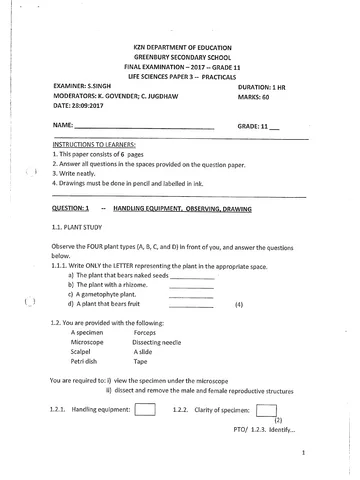
KZN DEPARTMENT OF EDUCATION
GREENBURY SECONDARY SCHOOL
FINAL EXAMINATION — 2017 -- GRADE 11
LIFE SCIENCES PAPER 3 -- PRACTICALS
EXAMINER: S.SINGH DURATION: 1 HR
MODERATORS: K. GOVENDER; C. JUGDHAW MARKS: 60
DATE: 28:09:2017
NAME: GRADE: 11
INSTRUCTIONS TO LEARNERS:
1. This paper consists of 6 pages
2. Answer all questions in the spaces provided on the question paper.
3. Write neatly.
4. Drawings must be done in pencil and labelled in ink.
QUESTION: 1 -- HANDLING EQUIPMENT, OBSERVING, DRAWING
1.1. PLANT STUDY
Observe the FOUR plant types (A, B, C, and D) in front of you, and answer the questions
below.
1.1.1. Write ONLY the LETTER representing the plant in the appropriate space.
a) The plant that bears naked seeds
b) The plant with a rhizome.
c) A gametophyte plant.
d) A plant that bears fruit
—_— (4)
1.2. You are provided with the following:
A specimen Forceps
Microscope Dissecting needle
Scalpel Aslide
Petri dish Tape
You are required to: i) view the specimen under the microscope
ii) dissect and remove the male and female reproductive structures
1.2.4. Handling equipment: 1.2.2. Clarity of specimen:
(2)
PTO/ 1.2.3. Identify...
Skip to contentAll 2017 papers 
View all
Life Sciences Grade 11 P3 September Test 2017 Paper & Memo
Grade 11 Life Sciences Paper 3 question paper and memo from the September Test 2017, 12 pages. Read online or get the free PDF download.
Life Sciences · Grade 11 · September Test · 2017. Question paper and memorandum, 12 pages. Read online or download the PDF.
- Subject
- Life Sciences
- Grade
- Grade 11
- Document type
- Question paper and memo
- Year
- 2017
- Exam period
- September Test
- Paper
- 3
- Curriculum
- CAPS
- Pages
- 12
- File size
- 538.4 KB
Free to read online, no sign-up needed
Loading document…
Loading document…
1 of 12
This exam
September Test 2017
- Paper 1Paper and memo
- Paper 2Paper and memo
- Paper 3Paper and memo
- Paper and memo
Document textSearch extracted text and jump to a page.
Downloaded from hlayiso.com
1.2.3. Identify the plant organ. (1)
1.2.4. Separate the male and female reproductive structures and paste them in the
appropriate space below:
Male Reproductive Structure Female Reproductive Structure
(2)
1.2.5. Draw and label a neat diagram of the Male Reproductive Structure in the space
below. (4)
1.2.6. Name the pollinating agent of this flower. (1)
1.2.7. Give ONE reason for your answer. (1)
[15]
PTO/ Question 2
(3
Downloaded from hlayiso.com
QUESTION 2: DESIGN / PLAN INVESTIGATIONS OR EXPERIMENTS
2.1. The apparatus for an investigation is set up in front of you. Study it and answer the
questions below.
2.1.1. Write down the AIM of the investigation. (1)
2.1,2. Write down the steps you would follow to carry out this investigation, using the
apparatus in front of you. (4)
2.1.3, State ONE precaution that must be observed when carrying out this investigation. (1)
2.1.4, Draw and label the leaf showing the results of the experiment. (4)
2.2. Smoking is one of the main causes of cancer in the lungs. As a voluntary worker at a
Hospice you have been given a project to carry out. You have been asked to investigate the
number of lung cancer patients that were once smokers.
Write down FIVE steps that you would follow when planning out your investigation. (5)
PTO/ Question 3
Downloaded from hlayiso.com
QUESTION 3: MAKE OBSERVATIONS/ ANALYSE/ RECOGNISE
3.1, Observe the specimen of the organ provided and answer the questions that follow.
3.1.1. Provide labels for the parts labelled:
(4)
3.1.2. Name the functional unit of this structure: (1)
"3.1.3. State TWO functions of this organ: (2)
(7)
3.2. Two Grade 11 learners want to investigate which enzyme is responsible for chemical
digestion of starch to glucose.
They are provided with two different enzymes (Enzymes A and B), starch, warm water at
about 37°C and basic apparatus and chemicals to test for glucose.
3.2.1. Formulate a HYPOTHESIS for your investigation. (2)
3.2.2. Name the following:
Independent variable: C ,
Dependent variable:
Controlled variable:
3.2.3. Explain why the water bath was kept at 37°C. (1)
(6)
[13]
PTO / QUESTION 4
Downloaded from hlayiso.com
QUESTION 4 RECORDING DATA, DRAWING A GRAPH/ INTERPRETING DATA,
MEASURING, CALCULATING
4.1. Study the set-up of the apparatus shown in the diagram below. The number of oxygen
bubbles (O2) released was counted at different times of the day as shown by the watch.
Since photosynthesis releases oxygen, the amount of oxygen released was used as an
indication of the rate of photosynthesis.
Morning Evening
O2
bubbles
Pond-
weed
Water
4.1.1. Draw a table to record the results of this investigation.
4.1.2. Use the information from the table you drew above, to draw a bar graph. (5)
PTO/ 4.1.3, What...
Downloaded from hlayiso.com
4.1.3. What general conclusion can be made from the results of the investigation on page 5.
(1)
4.2. POPULATION ECOLOGY
4.2.1. A group of Grade 11 learners have been selected to assist a Flour Mill Company to
determine the number of flour beetles in Bread Flour,
As practice a simulation has been set up for you. Each jar contains 250g flour. The spoon
measures 10g. Carry out the investigation three times and calculate number of flour beetles
present in the jar. Write down the formula and show ALL working. (6)
4.2.2, State ONE way how you can increase the reliability of your results. (1)
[17]
GREENBURY SECONDARY SCHOOL
DEPARTMENT OF MATHS & SCAENCES
(3
Downloaded from hlayiso.com
KZN DEPARTMENT OF EDUCATION
GREENBURY SECONDARY SCHOOL
FINAL EXAMINATION — 2017 -- GRADE 11
LIFE SCIENCES PAPER 3 -- PRACTICALS
EXAMINER: S.SINGH DURATION: 1 HR
MODERATORS: K.GOVENDER;C.JUGDHAW MARKS: 60
DATE: 28:09:2017 GREENBUIY SECONDARY SCHOOL
1 OF MATHS & SCIENCES
HOLD. MPO PALLAY
2 Te) GRADE: 41___
DEF
NAME: __ M@mo
INSTRUCTIONS TO LEARNERS: v
1. This paper consists of 6 pages
2. Answer all questions in the spaces provided on the question paper,
3. Write neatly,
4, Drawings must be done in pencil and labelled in ink.
QUESTION: 1 -- HANDLING EQUIPMENT, OBSERVING, DRAWING
1.1. PLANT STUDY
Observe the FOUR plant types (A, B, C, and D) in front of you, and answer the questions
below.
1.1.4. Write ONLY the LETTER representing the plant in the appropriate space.
a) The plant that bears naked seeds 8 Pine ~
b) The plant with a rhizome. C_ Fern v
c) A gametophyte plant. A Mossv
d) A plant that bears fruit D Ficus ~ (4)
1.2. You are provided with the following:
A specimen Forceps
Microscope Dissecting needle
Scalpel Aslide
Petri dish Tape
You are required to: i) view the specimen under the microscope
ii) dissect and remove the male and female reproductive structures
1.2.1. Handling equipment: 1.2.2. Clarity of specimen:
(2)
PTO/ 1.2.3. Identify...
Downloaded from hlayiso.com
1.2.3. Identify the plant organ. Flower
v
(1)
1.2.4. Separate the male and female reproductive structures and paste them in the
appropriate space below:
Male Reproductive Structure
Female Reproductive Structure
Stuck anther Stick ovary “ ©
(2)
1.2.5, Draw and label a neat diagram of the Male Reproductive Structure in the space
below. (4)
anther
drawing %
Silament “
Male Reproductive structure
of lower” / Stamen (
1.2.6. Name the pollinating agent of this flower.
Wind “
(1)
1.2.7. Give ONE reason for your answer,
Large anthers bresent
(1)
“1
Smell petals present
[15]
7
PTO/ Question 2
Downloaded from hlayiso.com
QUESTION 2: DESIGN / PLAN INVESTIGATIONS OR EXPERIMENTS
2.1. The apparatus for an investigation is set up in front of you. Study it and answer the
questions below.
2.1.1. Write down the AIM of the investigation. (1) 4
Vo test for starch wn aceen\eaves. /
To test \f chlorebhull is” essential Lor phetasunthesis
2.1.2. Write down the steps you would follow to carry out this investigatiorr, using the
apparatus in front of you. (4)
U.Beoil the leaf mM water.”
2.Boi\ the leaf in alechol.” Place eal wna test-tube of
alechel ard place thetest=-bube iw boilina water
BL. Rinse \eal m hot water ~ ~
4 Add \odine to decclourised leal”
2.1.3. State ONE precaution that must be observed when carrying out this investigation. (1)
Ensure that the burner is off“ when beiling the
\eaf ww alechol =
2.1.4, Draw and label the leaf showing the results of the experiment. {4)
brown”
near, Correct blue -black Vv
dioaram
Diagram showna reeult
Sterch Lest ~~
2.2. Smoking is one of the main causes of cancer in the lungs. As a voluntary worker at a
Hospice you have been given a project to carry out. You have been asked to investigate the
number of lung cancer patients that were once smokers.
Write down FIVE steps that you would follow when planning out your investigation. (5)
\.Pecide on sample size /Tdenify size of the aroub te be tested,
2. Prebare ao questionaire ~
B-Decide how cmd when questionarces will be Aiabributed and collected.
&, Tenti@u the aroubs of pechle te be investinated eo. clinics,
hosbotoals senior citizen aroubs houses,
S. How will data be recoraed
PTO/ Question 3
3
Downloaded from hlayiso.com —
QUESTION 3: MAKE OBSERVATIONS/ ANALYSE/ RECOGNISE
3.1. Observe the specimen of the organ provided and answer the questions that follow.
3.1.1, Provide labels for the parts labelled:
At Cortex c: Calux
B: Peis D: Medulle
(4)
3.1.2, Name the functional unit of this structure: (1) Nephron
3.1.3. State TWO functions of this organ: (2)
Osmereaulation Reauwlalton of bY | Salt requlation
Removal of metobolc wastes | excretion. ©
(7)
3.2. Two Grade 11 learners want to investigate which enzyme is responsible for chemical
digestion of starch to glucose.
They are provided with two different enzymes (Enzymes A and B), starch, warm water at
about 37°C and basic apparatus and chemicals to test for glucose.
3.2.1. Formulate a HYPOTHESIS for your investigation. (2) Wy
Eneaume A will dinest Starch te alucese /
J ~~) .
Eameume @ wr\\ digest, starch mio “alucese
wo
t
3.2.2, Name the following:
Independent variable: _Ene@unne v 7 \
Dependent variable: Conversion of starch inte alucese /EBESHOM ae pees xe
Controlled variable: Same T° /Same amt of slarth [same awk of BnBuind /
identical beaker or test tube (3)
3.2.3. Explain why the water bath was kept at 37°C. (1) oe
Obtimum ve Soc EnZuwne ackivity [ Body \
T J
(6)
[13]
PTO / QUESTION 4
on
Downloaded from hlayiso.com
QUESTION 4 RECORDING DATA, DRAWING A GRAPH/ INTERPRETING DATA,
MEASURING, CALCULATING
4.1. Study the set-up of the apparatus shown in the diagram below. The number of oxygen
bubbles (02) released was counted at different times of the day as shown by the watch.
Since photosynthesis releases oxygen, the amount of oxygen released was used as an
indication of the rate of photosynthesis.
Morning
Oo
Evening
0,
bubbles
Pond-
weed
Water
4.1.1. Draw a table to record the results of this investigation. (4)
Ti AN G
mes ©6100 [OM,c@ [12.00 |IG.o6 [18.06 |21.06 Maorrect
No. of
Bub) e 20 20 \o fa) WANG
i Wes 2 Correct
4.1,2. Use the information from the table you drew above, to draw a bar graph. (5)
Number of Bubbles released during 24 hours V
2S
20)
No of 's
Bublles io
Type “
Saale on ¥ EY v
Label for ¥ BY”
Ml tlt, @ space mal vw
0606 OAL0O
Time of Day Clres)
(20m \Gtoe Ug .00 PTOL 4.1.3. What...
5
Downloaded from hlayiso.com
4.1.3. What general conclusion can be made from the results of the investigation on page 5.
(1)
Photosunthesis (s hiahest from 12> 3pm” vA ;
The caté o& photosynthesis increases Prom 6.00 to 12.00 ,
Temorns stable at is.co aud decieases thereatter Until ib stoke
4.2. POPULATION ECOLOGY
4.2.1. A group of Grade 11 learners have been selected to assist a Flour Mill Company to
determine the number of flour beetles in Bread Flour.
As practice a simulation has been set up for you, Each jar contains 250g flour. The spoon
measures 10g. Carry out the investigation three times and calculate number of flour beetles ( )
present in the jar. Write down the formula and show ALL working. (6)
N= Tetol Mags of Flour + Beans ~ Ne. c& Beans to Somble
ot BS2e
= on Swork Vaan Ang Bene C |= Sample SVE lh Sampo SwZ +
= Onawer Ay Answer B + Qnawer CM Sombl gies B+ 3
a ¢ ea STATA BSH
= sv a \o 4
= ig BBB
= Bgl = 132,32 Clour brelles
4.2.2. State ONE way how you can increase the reliability of your results. (1)
Take. more Sawbles ond Land the average. v/
Choose, Samples randomly.
[17]
Study this subject
Recommended for this subject
Question paper and memo
Life Sciences Grade 11 September Test 2017 Paper & Memo
Question paper and memo
Life Sciences Grade 11 P1 September Test 2017 Paper & Memo
Question paper and memo
Life Sciences Grade 11 P2 September Test 2017 Paper & Memo
Question paper and memo
Life Sciences Grade 11 Paper 3 NSC Prelim 2017 Paper & Memo
Question paper and memo
Life Sciences Grade 11 NSC Prelim 2017 Paper & Memo
Question paper and memo
Life Sciences Grade 11 September Test 2019 Paper & Memo
More from Grade 11 Life Sciences
Annual teaching plan
Gr 11 Life Sci ATP 2023 24
Memorandum
Life Sciences Grade 11 Eastern Cape November 2025 Memo (Afr)
Memorandum
Life Sciences Grade 11 P1 Eastern Cape November 2025 Memo
Question paper
Life Sciences Grade 11 Eastern Cape November 2025 QP (Afr)
Question paper
Life Sciences Grade 11 P2 Eastern Cape November 2025 QP
Memorandum