
Final Examination November 2017
~e
C)
[co
EXAMINER: MRS J. RAMSEWAK (STANMORE SECONDARY SCHOOL)
MODERATOR: MR N. BRAMDAW (MT EDGECOMBE PRIVATE SCHOOL)
MARKS: 150
TIME: 2% HOURS
education
Department of Education
REPUBLIC OF SOUTH AFRICA
LIFE SCIENCES P2 —
FINAL EXAMINATION
NOVEMBER 2017
GRADE 11
N.B. This question paper consists of 12 pages.
PLEASE TURN OVER
Skip to contentAll 2017 papers 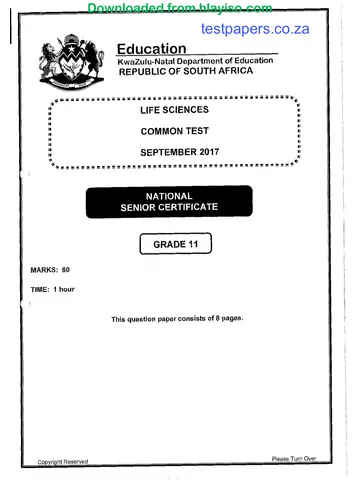
View all
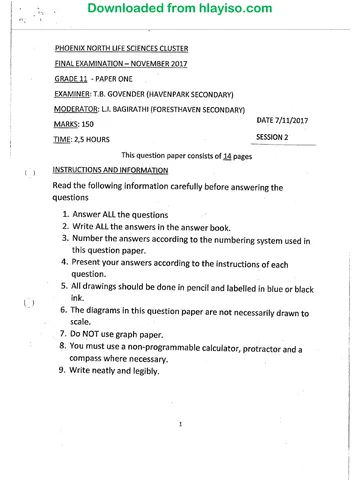
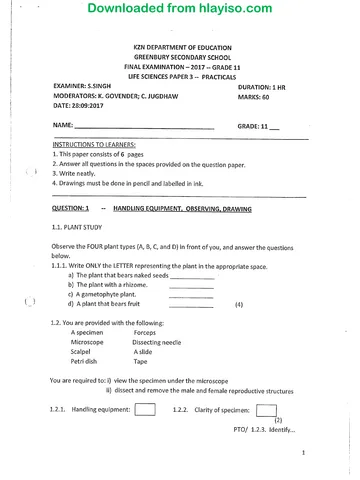
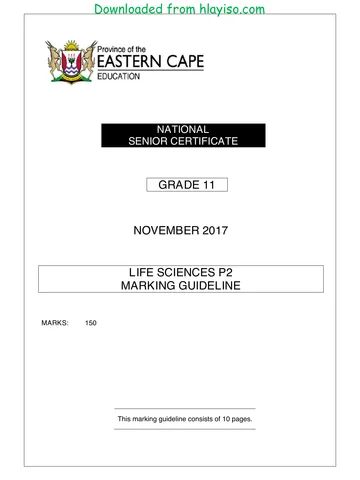
Life Sciences Grade 11 P2 September Test 2017 Paper & Memo
Grade 11 Life Sciences Paper 2 question paper and memo from the September Test 2017, 20 pages. Read online or get the free PDF download.
Life Sciences · Grade 11 · September Test · 2017. Question paper and memorandum, 20 pages. Read online or download the PDF.
- Subject
- Life Sciences
- Grade
- Grade 11
- Document type
- Question paper and memo
- Year
- 2017
- Exam period
- September Test
- Paper
- 2
- Curriculum
- CAPS
- Pages
- 20
- File size
- 1.1 MB
Free to read online, no sign-up needed
Loading document…
Loading document…
1 of 20
This exam
September Test 2017
- Paper 1Paper and memo
- Paper 2Paper and memo
- Paper 3Paper and memo
- Paper and memo
Document textSearch extracted text and jump to a page.
ute sdences/P2 DOWNIOAGED TOM NIAYIS @nABGMTaion November 2017
INSTRUCTIONS AND INFORMATION
Read the following instructions carefully before answering the questions.
1. Answer ALL the questions.
2. Write ALL the answers in your ANSWER BOOK.
3. Start the answers to EACH question at the top of a NEW page.
4. Number the answers correctly according to the numbering system used in this question paper.
5. If answers are NOT presented according to the instructions of each question, candidates will
lose marks.
6. All drawings should be done in pencil and labelled in blue or black ink.
7, Draw diagrams and flow charts ONLY when requested to do so.
8. The diagrams in this question paper may NOT necessarily be drawn to scale.
9. The use of graph paper is NOT permitted.
10. You may use a non-programmable calculator, protractor, and compass.
11. Write neatly and legibly.
PLEASE TURN OVER
Life Sciences/ P2 Final Examination November 2017
SECTION A
aN
Nae
C)
QUESTION ONE
1.1,
(i)
(ii)
(ii!)
(iv)
Various options are provided as possible answers to the following questions.
Choose the correct answer and write only the letter (A-D) next to the question
number (1.1.1. — 1.1.10.) in the ANSWER BOOK, for example, 1.1.11. D.
. Bacteria are ...
. _Unicellular and without a nucleus.
Unicellular and parasitic in plants and animals.
. Microscopic plants with a saprophytic mode of nutrition.
. Unicellular with a nucleus and parasitic in plants and animals.
. Viruses have a...
Nucleic acid core and protein coat.
DNA-containing nucleus and a lipid envelope.
. Nucleic acid core and a plasma membrane.
. DNA core and a protein coat.
. The following is a list that describes viruses:
Play a significant role as decomposers.
Are the major pathogens of humans.
Are parasites.
Reproduce within host celis.
Which of the following are of biological importance in viruses?
A.
B.
c.
D.
1.1.4,
DOUrFH DOWD
DOUSD
(i); (ii) and (iil)
(il); (ili) and (iv)
(); (iii) and (iv)
(ii) and (iv)
Bryophytes are terrestrial plants that have NO ...
Cellulose
. Rhizoids
. Vascular tissue
. Sporophyte phase
. The carpel (pistil) of a flower consists of the ...
Anther, style and ovary
. Stigma, filament and ovary
. Anther, filament and ovary
. Stigma, style and ovary
Fertilization in Angiosperms occurs when ...
The pollen tube grows down the style.
Pollen moves from the anther to the stigma.
. A sperm unites with an egg cell,
The ovary enlarges into a fruit.
PLEASE TURN OVER
Life sciences/ 2 DOWNTOAGET FFOM NIAYISQ,.GOM ion november 2017
1.1.7.
pomp>
Angiosperms are classified as spermatophyte because they ...
Produce flowers.
Produce seeds.
Are naked seeded plants.
Produce cones.
Fungi DO NOT play a role as ...
Saprophytes
Producers
Parasites
. Symbionts
Which one of the following statements about Platyhelminthes is incorrect?
They are diploblastic.
They do not have a coelem.
. They are bilaterally symmetrical.
. They are parasitic.
1.1.10. Using natural resources so that they are not depleted.
A.
B.
Cc,
D.
1.2,
1.2.4.
1,2.2.
4.2.3.
1.2.4.
1.2.5.
1.2.6,
Conservation
Sustainable use
Poaching
Deforestation. 10x2 [20]
Give the correct biological term for each of the following descriptions. Write only
the term next to the question number (1.2.1. to 1.2.6.) in your ANSWER BOOKLET.
The concentration of sense organs at the anterior end of an animal leading to the
formation of a head.
Places where seeds are stored to help preserve biodiversity.
A fluid filled cavity lined with mesoderm.
The type of alimentary canal which stretches from the mouth to the anus.
The increase in concentration of nutrients in an aquatic ecosystem, which leads to algal
boom.
Measurement of the total amount of carbon dioxide emission of an individual, a defined
population or a company per year. ; 1x6 [6]
PLEASE TURN OVER
4 .
#
1.3.
Life Sciences/ P2
Final Examination November 2017
Match a statement from COLUMN II with the terms from COLUMN |, Write only the
~~
‘ew?
()
correct LETTER next to the questions 1.3.1 ~ 1.3.5, in your ANSWER BOOKLET.
COLUMN |
COLUMN II
. Vector
. A plant body that has no differentiations into roots, stems
and leaves.
._ Thallus
. Has roots, stems and leaves.
. Diploblastic
. Anotochord is present in the adult form.
_ Vertebrates
. A body plan with two layers of cells.
. Thermal pollution
MolQm) >
by it.
An organism that carries a disease without being affected
m
Caused when water is released into a river after being
heated by industries.
G. Causes algal bloom.
1.4.
Indicate whether each of the statements in COLUMN | applies to A ONLY, B ONLY,
BOTH A AND B or NONE of the items in COLUMN II. Write A ONLY, B ONLY, BOTH A
AND B or NONE next to the question number (1.4.1. to 1.4.7.),
5x2 [10]
COLUMN |
COLUMN II
1.4.1.
Requires water to undergo sexual
reproduction.
. Angiosperms
Pteridophytes
1.4.2.
The part that is formed from a
fertized ovule.
Seed
Fruit
14.3.
The plant(s) where the gametophyte
is dominant.
Fern
Gymnosperm
1.4.4,
Unicellular organisms that can exist
in coccus, spirillum and bacillus for
form.
w Pl >i >| >
. Viruses
Bacteria
1.4.5.
Reduces the pest population by the
introduction of its natural enemy.
Biological control
Chemical control
1.4.6.
Examples of greenhouse gases.
Carbon dioxide
Methane
1.4.7.
Factors affecting water availability.
DPD riD>
Destruction of wetlands
Poor farming practices
7x2 [14]
PLEASE TURN OVER
ute Sciences/P2 DOWMOAACE TOM NIAYIS@.L@NAion November 2017 |
QUESTION TWO
| || 2.4. Flowers are reproductive structures used for sexual reproduction in angiosperm
plants. Study the diagram below and answer the questions that follow.
Magnification: X20.
2.1.1. Is this flower insect, wind, or bird pollinated? : (1)
2.1.2. List TWO characteristics of this flower that make it well adapted for your answer given
in QUESTION 2.1.1. * (2)
[3]
2.2. Angiosperms are a group of plants that produce seeds by means of sexual :
reproduction. . {
2.2.1, Whatis the main advantage of sexual reproduction to plants? (1)
2.2.2. Aseed bank in Norway has been storing seeds of a rare and endangered plant. To keep
the seeds fresh, 120 of the.seeds of this plant were selected to be grown. Out of these
120 seeds, only 90 germinated.
What percentage of the seeds was not fertile? Show all your working. (2)
2.2.3. Explain how each of the following features of seeds is important for the plant's survival:
a) Seeds can remain dormant for long periods of time. (1)
b) Some seeds contain endosperm tissue. (1)
[5]
PLEASE TURN OVER
Life Sciences/ P2 Final Examination November 2017
2.3. Study the phylogenetic tree below, taking note of how the four plant divisions have
a
()
evolved and answer the questions that follow.
.....Phylegenetic tree showing plant evolution
: i
Moss Fern Gymnosperms Angiosperms ; |
Naked seeds Frutt
Enclosed seed
Cones a .
. Flower
Pollen
Non . Motile sperm Non-motile sperin :
vascular . i ir
f Seedless : Seed
Root, stems; leaves ; '
Vascular
Motile gametes
Algae
2.3.1. What is the ancestral form of all the plant divisions shown? (1)
2.3.2. Which plant division is the best adapted to life on land? (1)
2.3.3. Which plants are the most closely related? (2)
[4]
PLEASE TURN OVER
Life Sciences/ e» Down loaded from h lAYIS@aG@rlwion November 2017
2.4. The table below shows the number of cases of tuberculosis (TB) and the number of
deaths from TB around the world in 2009. Study the table and answer that questions
that follow.
—_ Region Number of cases _| Number of deaths |!
Affiea . ‘3.900. 1 430 ;
‘America. © “380 20
Europe. 560_ __ 62
' | South-East Asia _- 4900 480 |}
Western Pacific _ 2900 240 |
| | Eastern Mediterranean. 1.600 99
Global Total_ 14 000 1300
‘{
2.4.1. Draw a BAR GRAPH using the data for each region in the table to show the
number of deaths from TB in 2009. (6)
2.4.2, Calculate the percentage of cases in the Eastern Mediterranean. (2)
2.4.3, Why do you think that Europe and America have such a small number of cases of TB
compared to the other countries in the table? Give ONE reason. (2)
[10)
2.5. Study the diagram representing three animals and answer the questions that follow:
‘é
_ _ Arthropeda Poritera Cnidaria
PLEASE TURN OVER 8 |
Life Sciences/ P2 Final Examination November 2017
a
2.5.1, State the type of symmetry of animal B. (1)
2.5.2. Which of the animal(s) (A, B or C) does not poses a through gut? (2)
2.5.3, State whether each of the organisms A and C are diploblastic or triploblastic? : (2)
2.5.4. Mention the type of symmetry, as it relates to each of the following animals, and explain
how the symmetry is appropriate to the mode of life of:
a) Organism A ;
b) Organism C 2X3 (6)
[11]
2.6. Read the passage and study the graph.
Accumulation of greenhouse gases in the atmosphere changes the climate melting glaciers,
rising sea levels and new and more frequent weather extremes will change the entire world.
Water supplies are decreasing, crop yields are dropping, forests are burning and our oceans are
becoming more acidic.
Climate change scientists warn that if we do not reduce our greenhouse gas emissions, average
global temperatures could increase by 4°C or more by the year 2100”...with frightening
implications.
[ Changes in CO; levels in the atmosphere from’ 2006 to 2017
405
$ - 400 Z|
EI _~
-— 395 LA.
A 390
¢ —
2 385 A
é 4
8 380 a
| 875
2006 2008 2010 2012 2014 2016
2.6.1. Write ONE phrase from the passage that indicates that climate change affects the
following: . .
a) Food security (1)
b) Water availability (1)
2.6.2. From the graph, state the COs level in the atmosphere in 2013. (2)
2.6.3, Describe how the destruction of forests by humans contributes to global warming. ~ (3)
(7]
GoMARKS]
PLEASE TURN OVER 3 |
ue saences/P2 DOWNIOAGEM FrOM NlayiS @uGOMAion november 2017 |
QUESTION THREE -
A certain community living close to an industrial area witnessed the unexplained death of
many fish and other aquatic organisms in the nearby river. Many members of the.
community accused the local chemical-factory of disposing untreated acid containing
| effluent into the river. This incident triggered an investigation by learners at nearby school.
| ‘The leatners were instructed to monitor and record pH levels of two different sites A and B
ag indicated in the site diagram below, on a daily basis, for three weeks. c
Factory
site
| THE RIVER fe |
Suspected 1 | ee
{| untreated i
| effluent 1. {
disposal
| A summary of the recorded data is below. Study the information below and answer the
questions that follow.
vl pu of water at Site A pH of water at Site B
Week 1 6.5 4
Week 2 6,8 3,5
Week 3 64 3,2
3.1.1. State the aim of the above investigation. , (2)
3.1.2. State a hypothesis for the investigation. . (2)
3.1.3. Mention any TWO steps to be considered when planning this investigation. (2)
3.1.4. Provide a reason for also testing the pH of water at Site A. (2)
3.1.5. State ONE WAY in which this investigation can be made more reliable. (2)
[10]
PLEASE TURN OVER
——--_ Dewnleaded-from-blayise com —____
Life Sciences/ P2 : Final Examination November 2017
3.2. Study the graph below, which shows the body’s response to a vaccination given by
()
The amount of antibodies in
an injection and a booster injection. Answer the questions that follow.
| Primary and Secondary responses to an injection containing dead or weakened germs
D
4
fhe serum / antibody units
Cc
4
B
rf J. \ J. 1 tL t. tL
A 40 80 420 = 180 200 = 240 280
A= First infection
| B = Second injection ‘Time after immunisation / days
3.2.1 Mention ONE common ways of receiving vaccines. (2)
3.2.2 What in the vaccination stimulated the body to make antibodies? (2)
3.2.3 Which cells in the immune system produce the antibodies? (2)
3.2.4 What happened to the antibody level after the first injection? (2)
3.2.5 What happened to the antibody level after the second injection? (2)
[10]
3.3. Read through the text below and answer the questions that follow.
—
Cape Towns landfill crisis
Approximately 6 000 tons of waste are currently generated daily within the City of Cape
Town. Fifty-five percent of waste ending up at the Council’s six landfill sites is directly }
received from the industrial and commercial sectors, whereas the domestic waste from
households account for approximately 30% of the waste stream.
A total of 1,7 million tons of waste was received in landfill sites in Cape Town during 2002
compared to the 1,6 million tons in 2001 and the 1,5 million tons in 2000. This is roughly
an annual increase of 7%.
Waste from lower income households are shown to contain about 80% organic waste
compared to that from affluent suburbs, which typically contains about 60-70% of
packaging waste. Of the total amount of waste produced, more than 90% is landfilled by
the City of Cape Town,
PLEASE TURN OVER
ute scences/ 2 DOWNIOAGE TOM NlAYiS@aGANelion November 2027
There is an urgent need for a new regional landfill site as the city faces the closure of
most of its current landfill sites. Clean-up costs of litter and dumping exceed R100 million
ayear. This is money that could be put to far greater use within the city, particularly given
the housing crisis.
[Adapted from: www.capetown.gov.za/en/SolidWaste]
|
3.3.1 Calculate how many tons of domestic waste are produced per day.
Show all calculations. (3)
3.3.2 Suggest ONE reason for the increase in solid waste in the city landfill site. (2)
. 3.3.3 Landfills are known to cause pollution to the environment. Briefly describe TWO possible
"ways in which this could happen. (4)
3.3.4 Give ONE way in which lower income households could reduce thie amount of waste that
they send to landfills. (1) \ )
3.3.5 Explain how poor management of landfill sites can affect the water quality in a city. (2)
[12]
3.4, Water shortage in Cape Town have reached crisis levels.
If you were the Minister of Water Affairs, explain FOUR strategies you could use to ensure
that the city of Cape Town copes with the water crisis. , [8] |
SECTION: C
QUESTION FOUR
Describe how habitat loss through various human activities may lead to a loss of biodiversity.
Content : 17
Synthesis: 3
[20]
NOTE: No marks will be awarded for answers in the form of flow charts, tables and diagrams.
GRAND TOTAL: 150]
PLEASE TURN OVER
'¢
‘———_ Dewnleaded from-hlayise-cam
Life Sciences/ P2 Final Examination November 2017
()
)
education
Department of Education
REPUBLIC OF SOUTH AFRICA
Se A Se A NS a a a et a
~ LIFE SCIENCES P2_
FINAL EXAMINATION
~ NOVEMBER 2017
GRADE 11
EXAMINER: MRS J. RAMSEWAK (STANMORE SECONDARY SCHOOL) |
MODERATOR: MR N. BRAMDAW (MT EDGECOMBE PRIVATE SCHOOL)
MARKS: 150
TIME: 2% HOURS
N.B. This question paper consists of 7 pages.
PLEASE TURN OVER
_||SECTION: A
1.1.1. Avy
1.1.2. Avy
1.1.3. By
114. Cv
1.1.5. Dv
1.1.6. CyV
e 14.7. Bay
» 4.1.8. BY
, 14.9. AW
/ 1.110. BW 2x10 “|
1.2.1. cephalization ¥
1.2.2. Seed Banks¥
1.2.3, coglomy © |
1.2.4, through guty
1.2.5. eutrificationy
1.2.6. carbon footprint ¥ 6x1 |
1.3.1. EW
1.3.2. Avy
1.3.3. DVvV
1.3.4. CW
1.3.5. Fvv 2x5 (10)
4.4.1. Bonly VW 1.4.5. Aonlyvy (
© 1.4.2. Aoniy 1.4.6. Both A and Bvy
1.4.3. None vV¥ 1.4.7, Both Aand BY
1.4.4, Bo onlyvy 2x7 (14)
[50 MARKS]
Jownloaged
| SECTION: 7
. || QUESTION TWO
2.1.1. Wind.V
2.1.2.
2.2.1,
2.2.3.
2.3.1. Algae.V (1)
2.3.2. Angiosperms¥ (1)
2.3.3. Gymnosperms and Angiosperms:v¥, (must have both together to get 2 v1)
2.4.1.
Small flowers without colourful petals¥
Produces large amounts of pollen to increase chance of pollinationy
Pollen grains are light, smooth and dry to allow them to float.V
Anthers are attached to filament in such a way that they are easily movable with windy
Stigma is large, feathery and sticky to trap as much pollen as possible.¥
Large anthers.¥
Any2 2X1(2)V
It generates genetic variety.V (1)
120 - 90 = 30
(2)
(1)
b) Provides food for the growing embryo V until the plant starts to make food by photosynthesis(1
30/120 x 100/1V¥ = 25%
a) They can survive unfavourable periods.V
v Number of deaths due to TB in different regions
“boo of the world ~
480
g 500
3 400 +
430
vq)
vv
i
‘5 300 +
#200 s
= 400 +
re & ae ey ao ra
240
Regions
Page | 2
Correct type of graph
Title of graph
Correct label and scale of x-
axes
Correct label and scale of y- 1
axes
Plotting of points : 1: 1 to 3 points plotted correctly
2: all 6 points plotted correctly
NOTE:
if the wrong type of graph is drawn, 3 marks will be lost for:
« ‘Correct type of graph
¢ ‘Plotting of points’
If labels of the axes are transposed then 2 marks will be lost for:
* ‘Correct label and scale for X-axis and Y-axis’ _. (6)
2.4.2. 1000/14000 x 100/1V
=71%7
They are well developed countries V
Low level of povertyv-V/ well off/ good health and social infrastructure.
More people are well nourishedyW/did not live in crowded/ dirty/unhygienic conditions.
Well educated about the diseasevV Any 1 1x2 (2)
B- Asymmetricaly (1)|
B Vand Cy (2)
A- Triploblastic ¥ C. diploblastic ¥ ; (2)
a) bilateral symmetry Leads to cephalizationy
As soon as the organism enters into a new environment it can sense ( ,
danger and detect food.¥ (3)
b) Radial symmetryY Can sense food and dangerv equally well from all directionsV
especially because of their sedentary nature. ; (3)
2.6.1.a) Crop yields
b) Water supplies are decreasingv
2.6.2. 395v parts per millionV
2.6.3. There will be less trees/no trees
So that less carbon dioxide will be used from the atmospherey
for photosynthesis
Carbon dioxide will accumulate in the atmosphere, leading to enhanced greenhouse effect
Which will cause global warming. Any 3 3x1(3)
UESTION THREE!
3.1.1. To compare the pH at two sites A and BY before and after effluent disposal
3.1.2. The ph of water at Site B (after effluent disposal)y will be lower than that at Site A.(Any other)(2)
) 3.1.3.
Formulate a hypothesis for testingV
Seek expert advice from relevant peopley
Decide on a suitable site for samplingY
Organise all the required chemicals and: equipment before the start of the sampling
process
Design a relevant recording sheet
Obtain permission to enter the area if it is requiredy
Organise protective clothing such as gloves and boots.¥
Decide on the volume of daily samples/ Depth at which samples are collected/
and the time of sample taken¥ Any2¥ 2X1 (2)
re)
To compare the variations of ph at Site BV (2)
. Sample A is used as a controly
. Repeat the investigationy or
Take more samples at each sitey
3.2.1. injectionvy
3.2.2. Dead or weakened germsvV
3.2.3. white blood cells/ T- lymphocytesvY
3.2.4. It increases slowly to about day 50’ where it is at its highest and then it decreasesY ¢
3.2.5. It increases rapidly in the first 30 days/ +- day 140to its maximum, then levels off and stayed (2)
constanty until up to over 280 days.
3.3.1. 30/1007 x 60007
= 1800V tons
3.3.2. Increase in population produces more solid wastev¥
People more well off, purchasing more goods/ food.vV
b—]-.e There-could-be tittering V when wind blows plastic bags/paper into surrounding areas¥
¢ The ground water could be polluted¥ when leaching takes placev
¢ Air pollution occursV when waste is burnt/ incinerated
* Air pollution occursV¥ when methane gas is given off at the dumpsy¥ Any2 = 2x2(4)
3.3.4. They could have compost heaps and not throw away organic wastes.
They can recycle goods. Any1 — 1x1(1)
3.3.5. If an impermeable layer (plastic) is not laid down before dumping,V leachate could
contaminate ground water, causing it to be polluted. (2)
3.4.
Fix leaking pipes/ toilets/ taps
To reduce wastage of waterv
e Provide incentives to families to save watery To encourage sustained use of watery
* Reduce pressure in pipes To reduce wastage of water\
¢ Provide education to peoplev On wise use of watery
¢ Encourage good farming practices To prevent contamination of water sources by
fertilizers and pesticidesV
e Use boreholes/ tanks ¥ To increase water availabilityy
e Prevent destruction of wetlandsy To improve the availability and quality of water
() ¢ Desalinate sea watery To make more water availabley
e Remove alien trees¥ Because it takes up a lot of watery
e Recycling of grey waterv To conserve watery
« Impose fines for overuse of water’ To reduce water wastage
(Mark first 4 only) 4X2 (8)
40 MARKS]
Downloaded from hlayiso.com
SECTION: C
QUESTION FOUR
* Asa result of urbanisation land is cleared for housingy industries and roads
¢ leading to loss of habitat for animals/ insects causing loss of biodiversity.
* Monoculturey many species of indigenous vegetation and animals are removedy
« for the purpose of planting crop of a single species¥
¢ Disrupts predator- prey relationships V/ Food chains are broken
* Uniform flora attracts only a few species of animalsy:
¢ The lack of variety of plants and animals may lead to rapid increases in pest populationsY
¢ Asa result of overgrazingy loss of topsoil/erosion increases
* Decreasing soil fertility decreasing the potential of plant lifey
e When pesticides are used to kill pestsy the chemicats enter the ground waterv and may
affect plant life in the area.V ¢ }
which eventually leads to a depletion of oxygen in the watery making it difficult to sustain
lifey
¢ As aresult of miningy The pH of water may be affectedy and toxic gases may be emitted
* When fertilizers are added to soil ¥ it may be washed into rivers causing algal bloomy
into the atmospherev the environment is altered such that organisms can no longer exist in
the areay-
¢ An increase in deforestationy as a result of the demand for wood products destroys the
ecosystems within the forest areaV
¢ Destructions of wetlands and grasslandsY To make way for agriculturey / human
inhabitation, reduces the biodiversity of organisms living on wetlands and grasslands
ASSESSNG THE PRESENTATION OF THE ESSAY
Content (Any 17 ¥
“Relevance
Logical sequence
All information provided Is
relevant to the topic
Ideas arranged in a logical/cause-
effect sequence
required bythe essay
| Com rehensive synthesis
‘Answered all aspects Total
(
3
20
Only information relating to Toss
of biodiversity through habitat
destruction is provided ~~
Effects on the habitat are
appropriately linked to the cause
Atleast five causes of
habitat destruction should”
be fully described (6 x 2=
a MARKS]
(There Is no Irrelevant 10 marks). °
Information) 2 :
4 mark 4_mark. 4 mark.
[[eRano TOTAL: 150 MARKS]
Page |7
Study this subject
Recommended for this subject
Question paper and memo
Life Sciences Grade 11 September Test 2017 Paper & Memo
Question paper and memo
Life Sciences Grade 11 P1 September Test 2017 Paper & Memo
Question paper and memo
Life Sciences Grade 11 P3 September Test 2017 Paper & Memo
Memorandum
Life Sciences Grade 11 P2 Eastern Cape November 2017 Memo
Question paper
Life Sciences Grade 11 P2 Eastern Cape November 2017 QP
Question paper
Life Sciences Grade 11 P2 Eastern Cape November 2017 QP
More from Grade 11 Life Sciences
Annual teaching plan
Gr 11 Life Sci ATP 2023 24
Memorandum
Life Sciences Grade 11 Eastern Cape November 2025 Memo (Afr)
Memorandum
Life Sciences Grade 11 P1 Eastern Cape November 2025 Memo
Question paper
Life Sciences Grade 11 Eastern Cape November 2025 QP (Afr)
Question paper
Life Sciences Grade 11 P2 Eastern Cape November 2025 QP
Memorandum