
Downloaded from hlayiso.com
NATIONAL SENIOR CERTIFICATE EXAMINATION
NOVEMBER 2017
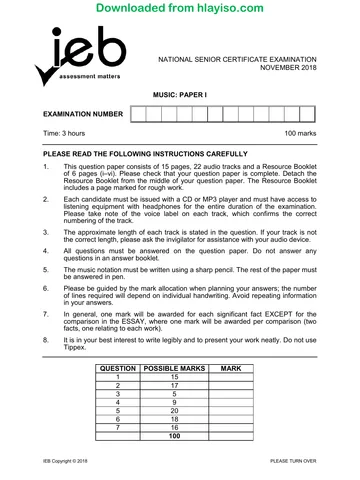
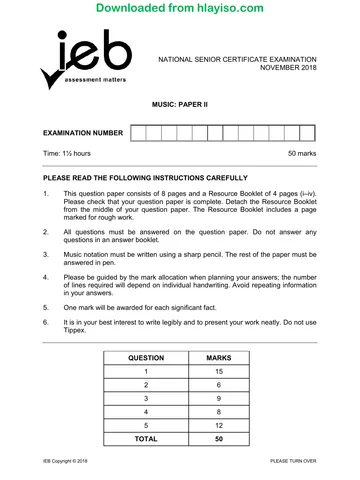
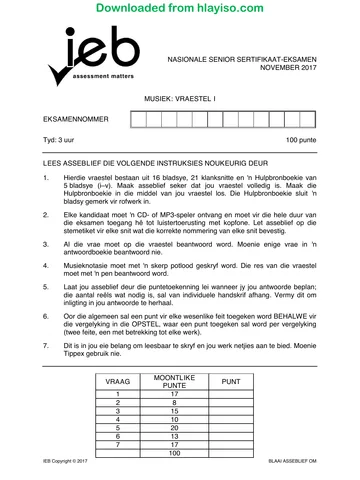
MUSIC: PAPER I
EXAMINATION NUMBER
Time: 3 hours 100 marks
PLEASE READ THE FOLLOWING INSTRUCTIONS CAREFULLY
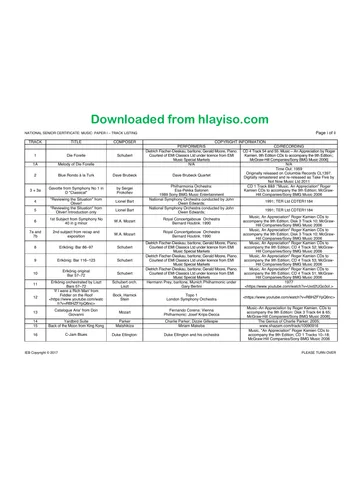
1. This question paper consists of 16 pages, 21 audio tracks and a Resource Booklet
of 5 pages (i–v). Please check that your paper is complete. Detach the Resource
Booklet from the middle of your question paper. The Resource Booklet includes a
page marked for rough work.
2. Each candidate must be issued with a CD or MP3 player and must have access to
listening equipment with headphones for the entire duration of the examination.
Please take note of the voice label on each track, which confirms the correct
numbering of each track.
3. All questions must be answered on the question paper. Do not answer any
questions in an answer booklet.
4. Music notation must be written using a sharp pencil. The rest of the paper must be
answered in pen.
5. Please be guided by the mark allocation when planning your answers; the number
of lines required will depend on individual handwriting. Avoid repeating information
in your answers.
6. In general, one mark will be awarded for each significant fact EXCEPT for the
comparison in the ESSAY, where one mark will be awarded per comparison (two
facts, one relating to each work).
7. It is in your best interest to write legibly and to present your work neatly. Do not use
Tippex.
QUESTION POSSIBLE MARKS MARK
1 17
2 8
3 15
4 10
5 20
6 13
7 17
100
IEB Copyright © 2017 PLEASE TURN OVER
Skip to contentQuestion paper 
View all
Music Grade 12 IEB Paper 1 2017 Question Paper
IEB Grade 12 Music Paper 1 question paper from the 2017, 16 pages. Read online or get the free PDF download, memo linked when available.
Publisher: IEB
Music · Grade 12 · 2017. Question paper, 16 pages. Read online or download the PDF.
- Subject
- Music
- Grade
- Grade 12
- Document type
- Question paper
- Year
- 2017
- Paper
- 1
- Publisher
- IEB
- Curriculum
- IEB
- Pages
- 16
- File size
- 814.3 KB
Loading document…
Loading document…
1 of 16
Document textSearch extracted text and jump to a page.
Downloaded from hlayiso.com
NATIONAL SENIOR CERTIFICATE: MUSIC: PAPER I Page 2 of 16
QUESTION 1
Listen to Track 1.
1.1 Place four (4) ticks to identify features present in the music.
Major tonality Lied
Consonant harmony Dissonance
Aria Through-composed
Modified strophic form Melodic inversion
Polyphonic texture Major and minor tonality (4)
1.2 Listen to Track 1a. It is the opening of the melody from Track 1 above.
Place a tick next to the phrase that matches what you hear.
(1)
Listen to Track 2.
1.3 Identify the style of jazz.
(1)
1.4 Motivate your answer in 1.3 with reference to two characteristics of the
style.
(2)
IEB Copyright © 2017
Downloaded from hlayiso.com
NATIONAL SENIOR CERTIFICATE: MUSIC: PAPER I Page 3 of 16
1.5 Listen again to Track 2 and tick the correct answer to show the rhythm of
one 4-bar phrase of the extract.
(1)
1.6 Name an artist, or group, associated with this style.
(1)
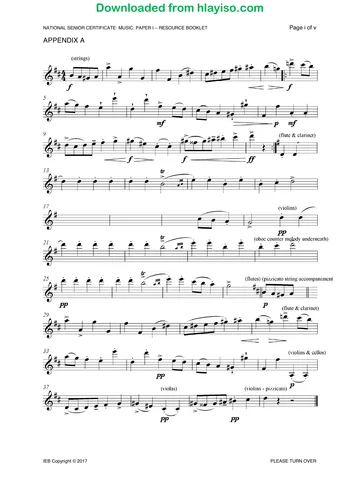
1.7 Listen to Track 3 while following the melody line in the Resource Booklet,
APPENDIX A. This is the Gavotte, the third movement from the "Classical"
Symphony by Prokofiev, which was composed in 1917.
1.7.1 Complete the following:
Section B begins at bar _______ beat _______ and section A2 begins
at bar _______ beat _______. (2)
1.7.2 Identify the key of section B.
(1)
1.7.3 What is the relationship of this key to the tonic key?
(1)
1.7.4 Listen to Track 3a, which begins at bar 122, and notate the melody in
bars 17, 18 and 19.
(2)
1.7.5 Give the bar numbers of a pattern and sequence in the music.
(1)
[17]
IEB Copyright © 2017 PLEASE TURN OVER
Downloaded from hlayiso.com
NATIONAL SENIOR CERTIFICATE: MUSIC: PAPER I Page 4 of 16
QUESTION 2
Listen to Track 4.
2.1 Identify the character that you hear.
(1)
2.2 State the context of this song in the musical.
(1)
2.3 Identify and comment on two characteristics in the music that inform the
audience of the character's cultural background.
(2)
2.4 How is this song typical of a musical theatre number?
(1)
Listen to Track 5.
2.5 How does the composer create tension in the introduction to this number?
What dispels the tension as the song progresses?
(3)
[8]
IEB Copyright © 2017
Downloaded from hlayiso.com
NATIONAL SENIOR CERTIFICATE: MUSIC: PAPER I Page 5 of 16
QUESTION 3
Listen to Track 6.
3.1 Which theme of the movement is heard in the extract?
(1)
3.2 Mozart developed this theme from a 3-note motive – printed below. Name
three compositional techniques that he used, and describe how he used
them to construct the 4-bar phrase.
(5)
3.3 Name the Mannheim technique that is present in the first two notes of the
motive.
(1)
Listen to Track 7a and 7b.
3.4 Which theme of the movement is heard in the tracks?
(1)
IEB Copyright © 2017 PLEASE TURN OVER
Downloaded from hlayiso.com
NATIONAL SENIOR CERTIFICATE: MUSIC: PAPER I Page 6 of 16
3.5 Explain the difference in tonality between the two versions of the theme.
(2)
3.6 Listen to Track 7b again. On the theme that is printed below, identify and
label, the cadences that are heard at the end of each phrase. Remember to
state the key.
CADENCE
KEY
CADENCE
(3)
3.7 Name two characteristics of this work, other than orchestration/
instrumentation, that indicate that it was written in the Classical period.
(2)
[15]
IEB Copyright © 2017
Downloaded from hlayiso.com
NATIONAL SENIOR CERTIFICATE: MUSIC: PAPER I Page 7 of 16
QUESTION 4
Listen to Track 8 and Track 9.
4.1 Identify the 'character' depicted in these two tracks.
(1)
4.2 Complete the table below to compare the two extracts.
ELEMENT TRACK 8 TRACK 9
Tonality [0.5 × 2 = 1]
Accompaniment
Pattern
[0.5 × 2 = 1] (2)
4.3 With reference to the story, and to the elements in the table above, explain
the change in tone between the two verses.
(4)
IEB Copyright © 2017 PLEASE TURN OVER
Downloaded from hlayiso.com
NATIONAL SENIOR CERTIFICATE: MUSIC: PAPER I Page 8 of 16
Listen to Track 10 and Track 11, which is a different arrangement of the same
section of the work.
4.4 With reference to the story, comment on the effectiveness of the
orchestrated version, compared with the original setting. State which
version you prefer, giving a reason for your choice.
(3)
[10]
IEB Copyright © 2017
Downloaded from hlayiso.com
NATIONAL SENIOR CERTIFICATE: MUSIC: PAPER I Page 9 of 16
QUESTION 5
Listen to Track 12 and Track 13.
The lyrics to Track 12, and some background to the work, can be found in the
Resource Booklet as APPENDIX B.
In an essay, compare similarities and differences of the two pieces heard in
Track 12 and Track 13.
In addition to the comparison, which will form the body of your essay, also:
Provide a brief background to the two genres.
Comment on the depiction of characters in the musical settings.
State the context of the extract from your set work, and name the character
who is singing.
In conclusion, offer your own opinion as to which track you prefer, and justify it
with reference to the use of two elements of music.
Ensure that you compare the two pieces, and not only the genres. (20)
Your essay will be marked using the following rubric:
RUBRIC FOR ESSAY
Clearly demonstrates an understanding of the question, cites factual evidence,
completes all requirements, and provides an insightful comparison of the two works,
16–20 with reference to both the general characteristics of the genres and the specific
features of the two tracks. Own opinion of the works is offered with insight and
specific reference to the use of the elements of music.
Demonstrates an understanding of the question, completes all requirements, cites
factual evidence and provides some comparison of the two works, with some
10.5–15.5 reference to both the general characteristics of the genres and the specific features
of the two tracks. Own opinion of the works is offered with limited insight and some
generalisation in terms of the use of the elements of music.
May address all of the requirements, but demonstrates only a partial understanding
of the question and limited factual evidence. Comparison of the two works is limited
with only partial reference to either the general characteristics of the genre or the
5.5–10
specific features of the two tracks. Own opinion is limited with little or no reference
to the use of the elements of music. There is an imbalance between the sections of
the essay.
Demonstrates minimal understanding of the question, does not complete all
0.5–5 requirements, and provides only a vague reference to, or no use of, the facts. No
comparison or opinion is offered. There is no balance within the essay.
IEB Copyright © 2017 PLEASE TURN OVER
Downloaded from hlayiso.com
NATIONAL SENIOR CERTIFICATE: MUSIC: PAPER I Page 10 of 16
IEB Copyright © 2017
Downloaded from hlayiso.com
NATIONAL SENIOR CERTIFICATE: MUSIC: PAPER I Page 11 of 16
[20]
IEB Copyright © 2017 PLEASE TURN OVER
Downloaded from hlayiso.com
NATIONAL SENIOR CERTIFICATE: MUSIC: PAPER I Page 12 of 16
QUESTION 6
Listen to Track 14 while following the lead sheet below.
IEB Copyright © 2017
Downloaded from hlayiso.com
NATIONAL SENIOR CERTIFICATE: MUSIC: PAPER I Page 13 of 16
6.1 Identify the style of jazz, and state the decade in which it developed.
(2)
6.2 Why did this style develop?
(1)
6.3 List two characteristics that you can hear in the recording which are typical
of the style.
(2)
6.4 Clearly mark the sections (form) of the piece on the lead sheet. Please note
that there is an 8-bar introduction which is not notated on the lead sheet. (2)
6.5 Use the table below to comment on the improvisations.
Describe the
Solo Instrument/s (4)
accompaniment (2)
Improvisation 1
Improvisation 2
Improvisation 3
Improvisation 4
(6)
[13]
IEB Copyright © 2017 PLEASE TURN OVER
Downloaded from hlayiso.com
NATIONAL SENIOR CERTIFICATE: MUSIC: PAPER I Page 14 of 16
QUESTION 7
Listen to Track 15. It is a song called Back of the Moon from the South African
jazz musical King Kong, composed in 1958 by Todd Matshikiza. The lyrics are
reproduced as APPENDIX C in the Resource Booklet.
7.1 Identify and comment on the social conditions, referred to in the song,
which influenced the development of South African urban music from the
late 19th century onwards.
(2)
7.2 Describe the musical features of ONE style of South African urban music
that developed prior to 1958, as a direct result of the social conditions that
you have named above.
(3)
IEB Copyright © 2017
Downloaded from hlayiso.com
NATIONAL SENIOR CERTIFICATE: MUSIC: PAPER I Page 15 of 16
Listen to Track 16 and Track 17.
7.3 Identify features relating to Track 16 in Column A and features relating to
Track 17 in Column B.
Place three ticks (3) in Column A and three ticks (3) in Column B.
COLUMN A COLUMN B
Features of Features of
Track 16 Track 17
Quadruple metre
Originally a keyboard style
Walking bass
I – IV – Ic (I6/4) – V
Swung quavers
12-bar blues
Triplets
Cyclic structure
3-bar riff (3)
7.4 Name two features from the above list that are common to both tracks.
and (1)
7.5 How did the styles represented by Track 16 and Track 17 contribute to the
development of mbaqanga/Sophiatown jazz in the 1950s?
(2)
IEB Copyright © 2017 PLEASE TURN OVER
Downloaded from hlayiso.com
NATIONAL SENIOR CERTIFICATE: MUSIC: PAPER I Page 16 of 16
Listen to Track 18 and refer to the translated lyrics and background to the song
that are provided in APPENDIX D in the Resource Booklet.
7.6 'Ndodemnyama' (Track 18), and your set work, Meadowlands both protest
against aspects of apartheid. Compare the lyrics of the two songs. State
which song, in your opinion, is a more effective means of protest, giving
three reasons for your view.
(6)
[17]
Total: 100 marks
IEB Copyright © 2017
Study this subject
Revise the topics in this paper, then practise them question by question.
Recommended for this subject
More papers and memos for this grade and subject.
Question paperIEB
Music Grade 12 IEB Paper 1 2019 Question Paper
Question paperIEB
Music Grade 12 IEB Paper 1 2019 Question Paper (Afrikaans)
Question paperIEB
Music Grade 12 IEB Paper 2 2019 Question Paper
Question paperIEB
Music Grade 12 IEB Paper 2 2019 Question Paper (Afrikaans)
Question paperIEB
Music Grade 12 IEB Paper 1 2018 Question Paper
Question paperIEB
Music Grade 12 IEB Paper 2 2018 Question Paper
Related documents
Question paperIEB
Music Grade 12 IEB Paper 1 2017 Question Paper (Afrikaans)
Question paperIEB
Music Grade 12 IEB Paper 1 2017 Question Paper
Question paperIEB
Music Grade 12 IEB Paper 1 2017 Question Paper
Question paperIEB
Music Grade 12 IEB Paper 1 2017 Question Paper (Afrikaans)
MemorandumIEB
Music Grade 12 IEB Paper 1 2017 Memo
MemorandumIEB
Music Grade 12 IEB Paper 1 2017 Memo (Afrikaans)
More from Grade 12 Music
MemorandumIEB
Music Grade 12 IEB Paper 1 2019 Memo
MemorandumIEB
Music Grade 12 IEB Paper 1 2019 Memo (Afrikaans)
AddendumIEB
Music Grade 12 IEB Paper 1 2019 Addendum
AddendumIEB
Music Grade 12 IEB Paper 1 2019 Addendum (Afrikaans)
MemorandumIEB
Music Grade 12 IEB Paper 2 2019 Memo
MemorandumIEB