
Downloaded from hlayiso.com
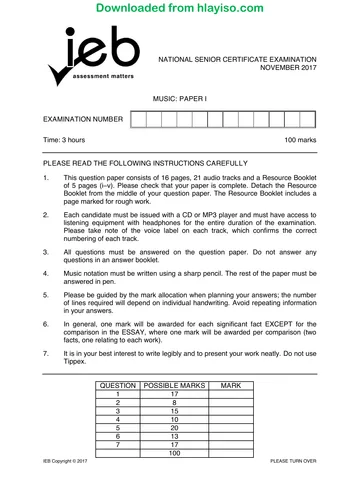
NATIONAL SENIOR CERTIFICATE EXAMINATION
NOVEMBER 2018
MUSIC: PAPER I
EXAMINATION NUMBER
Time: 3 hours 100 marks
PLEASE READ THE FOLLOWING INSTRUCTIONS CAREFULLY
1. This question paper consists of 15 pages, 22 audio tracks and a Resource Booklet
of 6 pages (i–vi). Please check that your question paper is complete. Detach the
Resource Booklet from the middle of your question paper. The Resource Booklet
includes a page marked for rough work.
2. Each candidate must be issued with a CD or MP3 player and must have access to
listening equipment with headphones for the entire duration of the examination.
Please take note of the voice label on each track, which confirms the correct
numbering of the track.
3. The approximate length of each track is stated in the question. If your track is not
the correct length, please ask the invigilator for assistance with your audio device.
4. All questions must be answered on the question paper. Do not answer any
questions in an answer booklet.
5. The music notation must be written using a sharp pencil. The rest of the paper must
be answered in pen.
6. Please be guided by the mark allocation when planning your answers; the number
of lines required will depend on individual handwriting. Avoid repeating information
in your answers.
7. In general, one mark will be awarded for each significant fact EXCEPT for the
comparison in the ESSAY, where one mark will be awarded per comparison (two
facts, one relating to each work).
8. It is in your best interest to write legibly and to present your work neatly. Do not use
Tippex.
QUESTION POSSIBLE MARKS MARK
1 15
2 17
3 5
4 9
5 20
6 18
7 16
100
IEB Copyright © 2018 PLEASE TURN OVER
Skip to contentQuestion paper 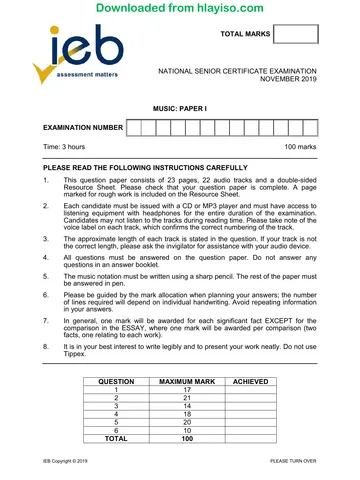
View all
Music Grade 12 IEB Paper 1 2018 Question Paper
IEB Grade 12 Music Paper 1 question paper from the 2018, 15 pages. Read online or get the free PDF download, memo linked when available.
Publisher: IEB
Music · Grade 12 · 2018. Question paper, 15 pages. Read online or download the PDF.
- Subject
- Music
- Grade
- Grade 12
- Document type
- Question paper
- Year
- 2018
- Paper
- 1
- Publisher
- IEB
- Curriculum
- IEB
- Pages
- 15
- File size
- 324.1 KB
Loading document…
Loading document…
1 of 15
Document textSearch extracted text and jump to a page.
Downloaded from hlayiso.com
NATIONAL SENIOR CERTIFICATE: MUSIC: PAPER I Page 2 of 15
QUESTION 1
Listen to Track 1 (00:43).
1.1 Identify the repetitive compositional technique heard in the extract.
(1)
1.2 Place a tick next to the rhythm of the compositional technique you have
named above.
(1)
1.3 Listen to Track 1a (00:12). It is the main melody from Track 1.
1.3.1 Place a tick next to the phrase that matches what you hear. (1)
1.3.2 Add ties where necessary to match the rhythm that you hear.
(1)
IEB Copyright © 2018
Downloaded from hlayiso.com
NATIONAL SENIOR CERTIFICATE: MUSIC: PAPER I Page 3 of 15
Listen to Track 2 (01:38).
1.4 Place four (4) ticks to identify features NOT present in the music.
Compound time Quadruple metre
Dissonant harmony Snare drum & cymbal
Minor tonality Monophonic texture
Major tonality Pizzicato
Polyphonic & homophonic
Ritardando – a tempo
texture (4)
Listen to Track 3 (00:11).
1.5 Printed below in random order are the eight bars from Track 3. On the stave
provided below, re-write them in the correct order to form the 8-bar melody
heard in Track 3. Include the time signature.
(2)
1.6 Listen again to Track 3, and identify the cadence in bar 8.
(1)
Listen to Track 4 (00:33). It is the whole piece from Track 3.
1.7 Tick the structural pattern that you hear.
a b a b b a a a b a (1)
IEB Copyright © 2018 PLEASE TURN OVER
Downloaded from hlayiso.com
NATIONAL SENIOR CERTIFICATE: MUSIC: PAPER I Page 4 of 15
Whilst listening to ClassicFM™, you hear this announcement, followed by the
piece of music on Track 5 (01:07):
Announcer:
"And next up, we hear The Sorrow of the Daughter by the Classical composer,
Mozart. The soloist is Susan Mitchell on cello."
1.8 With reference to Track 5, comment on the accuracy of the information
given by the announcer. Motivate your response with reference to three
different features of the music.
(3)
[15]
IEB Copyright © 2018
Downloaded from hlayiso.com
NATIONAL SENIOR CERTIFICATE: MUSIC: PAPER I Page 5 of 15
QUESTION 2
Listen to Track 6 (00:49), Track 7 (00:43) and Track 8 (00:21).
2.1 Complete the table below. Take note of the mark allocation for each
heading.
Track 6 Track 7 Track 8
Name the
character
[1 mark per track
× 3 = 3 marks]
State two facts
about the way in
which the
character is
depicted in the
music.
[2 marks per track
× 3 = 6 marks]
State one fact
about the work
that indicates the
stylistic period in
which it was
written.
[1 mark per track
× 3 = 3 marks] (12)
Listen to Track 9 (01:18).
2.2 Identify the texture of the extract, and describe how it is created by the
soloists.
(2)
IEB Copyright © 2018 PLEASE TURN OVER
Downloaded from hlayiso.com
NATIONAL SENIOR CERTIFICATE: MUSIC: PAPER I Page 6 of 15
2.3 What is happening at this point in the opera, and how does the composer
convey the action in the music?
(3)
[17]
QUESTION 3
Listen to Track 10 (00:51).
3.1 Identify the section of the work from which this extract is taken.
(1)
3.2 Comment on Mozart's use of keys in this section.
(2)
Listen to Track 11 (00:34).
3.3 Name the theme heard in Track 11, and state its purpose in the exposition.
(2)
[5]
IEB Copyright © 2018
Downloaded from hlayiso.com
NATIONAL SENIOR CERTIFICATE: MUSIC: PAPER I Page 7 of 15
QUESTION 4
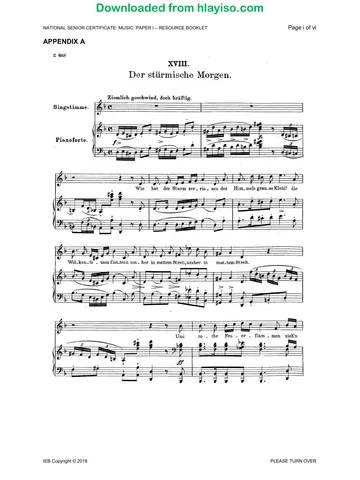
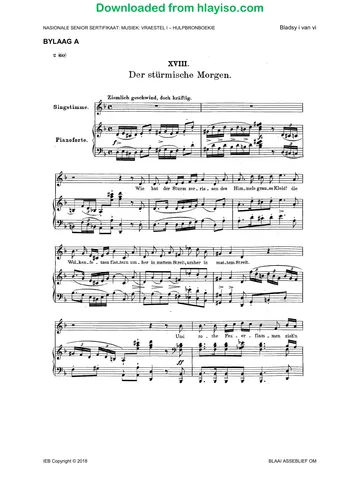
Listen to Track 12 (00:53). The score and the lyrics, with an English translation,
are printed as APPENDIX A in the Resource Booklet.
4.1 Identify the key of the piece.
(1)
4.2 What is the form (structure) of this Lied?
(1)
4.3 Evaluate the musical setting of this Lied in comparison with your set work,
Der Erlkönig. Describe the word painting and programmatic elements, texture
and harmony. Give your opinion as to which Lied is more effective, giving a
reason for your choice.
(7)
[9]
IEB Copyright © 2018 PLEASE TURN OVER
Downloaded from hlayiso.com
NATIONAL SENIOR CERTIFICATE: MUSIC: PAPER I Page 8 of 15
QUESTION 5
Listen to Track 13 (07:48), which is an arrangement of one of your set works.
Track 14 (01:57) is the original version of the same work.
Write an essay in which you compare Track 13 to the original work, heard in
Track 14.
In addition to the comparison, include the following information in your discussion:
• The name of the work and the composer
• A definition of, and brief background to, the genre
• Comment on the jazz influences / styles in the arrangement heard in Track 13
Offer your own opinion as to which track you prefer, and justify it with reference to
the use of at least two elements of music. Ensure that the comparison forms the
body of the essay, and that you discuss both similarities and differences.
Your essay will be marked using the following rubric:
RUBRIC FOR ESSAY
Clearly demonstrates an understanding of the question, cites factual evidence,
completes all requirements, and provides an insightful comparison of the works,
20–16 with reference to both the general characteristics of the genres and the specific
features of the two tracks. Own opinion of the works is offered with insight and
specific reference to the use of the elements of music.
Demonstrates an understanding of the question, completes all requirements,
cites factual evidence and provides some comparison of the works, with some
15,5–10,5 reference to both the general characteristics of the genres and the specific features
of the tracks. Own opinion of the works is offered with limited insight and some
generalisation in terms of the use of the elements of music.
Meets all of the requirements, but demonstrates only a partial understanding of the
question and limited factual evidence. Comparison of the works is limited with only
10–5,5 partial reference to either the general characteristics of the genre or the specific
features of the tracks. Own opinion is limited with little or no reference to the use of
the elements of music. There is an imbalance between the sections of the essay.
Demonstrates minimal understanding of the question, does not complete all
5–0,5 requirements, and provides only a vague reference to, or no use of, the facts. No
comparison or opinion is offered. There is no balance within the essay.
IEB Copyright © 2018
Downloaded from hlayiso.com
NATIONAL SENIOR CERTIFICATE: MUSIC: PAPER I Page 9 of 15
IEB Copyright © 2018 PLEASE TURN OVER
Downloaded from hlayiso.com
NATIONAL SENIOR CERTIFICATE: MUSIC: PAPER I Page 10 of 15
IEB Copyright © 2018
Downloaded from hlayiso.com
NATIONAL SENIOR CERTIFICATE: MUSIC: PAPER I Page 11 of 15
[20]
IEB Copyright © 2018 PLEASE TURN OVER
Downloaded from hlayiso.com
NATIONAL SENIOR CERTIFICATE: MUSIC: PAPER I Page 12 of 15
QUESTION 6
Listen to Track 15 (01:12) and Track 16 (01:21).
6.1 Place three ticks in Column A to identify unique features of Track 15 and
place three ticks in Column B to identify unique features of Track 16. Place
2 ticks in Column C to identify features common to both tracks.
Place ticks for common features only in Column C – do not tick in all
three columns.
COLUMN A COLUMN B COLUMN C
Unique Unique Common
features of features of features of
Track 15 Track 16 Track 15 &
3 ticks 3 ticks Track 16
2 ticks
Call and response
Acoustic guitar
A capella
Cyclical
4-bar introduction
Walking bass
iib-Ic-V
Multi-part male voices
I, IV & V
8-bar introduction (4)
6.2 Identify the style of music represented by each track and name one other
musical style that influenced each style.
Track 15:
Track 16:
(3)
IEB Copyright © 2018
Downloaded from hlayiso.com
NATIONAL SENIOR CERTIFICATE: MUSIC: PAPER I Page 13 of 15
6.3 Explain the role that the media played in the development, and spread, of
South African Urban music in the 1950s under the apartheid government.
(3)
Listen to Track 17 (02:00).
6.4 Name the composer of this work, and state the issue of protest in the song.
(2)
6.5 On the stave below, write out the basic chord progression on which this
song is constructed. Name the key, and figure the chords.
(2)
Listen to Track 18 (00:48).
6.6 With reference to the error in the statement made by the singer at the
beginning of the track, comment on the lyrics of this song and state how
they were interpreted by the authorities.
(4)
[18]
IEB Copyright © 2018 PLEASE TURN OVER
Downloaded from hlayiso.com
NATIONAL SENIOR CERTIFICATE: MUSIC: PAPER I Page 14 of 15
QUESTION 7
Listen to Track 19 (00:55). It is an extract from one of your set works.
7.1 Identify the work.
(1)
7.2 Why is the recording of this piece considered so important in the history of
jazz?
(2)
7.3 Highlight or underline three characteristics from the list below that are
unique to this style of jazz.
7.3.1 Collective improvisation 7.3.6 Swung quavers
7.3.2 Walking bass 7.3.7 Bass drum "bombs"
7.3.3 Unusual time signatures 7.3.8 Front line instruments:
saxophone, trumpet, trombone
7.3.4 Motivic melodies
7.3.9 Highly virtuosic, very fast
7.3.5 Syncopation improvisation (3)
Listen to Track 20 (05:13) and Track 21 (05:32).
7.4 Write out the blues scale on which the melody of this work is based.
(1)
IEB Copyright © 2018
Downloaded from hlayiso.com
NATIONAL SENIOR CERTIFICATE: MUSIC: PAPER I Page 15 of 15
7.5 Use the headings in the table below to describe and compare the
introduction and the improvisations on Track 20 and Track 21. Do not refer
to the difference in tempo between the two versions.
Track 20 Track 21 (Set work)
Introduction (2)
Improvisation 1 and
Accompaniment (2)
Improvisation 2 and
Accompaniment (2)
(6)
Refer to APPENDIX B, which is the lead sheet of Cry me a River, and answer the
questions that follow:
7.6 With reference to APPENDIX B, identify each section of the form using a
letter (e.g. A) followed by the bar numbers of the section.
A: bar 1 to bar _________
___: bar ____ to bar _____
___: bar ____ to bar _____
A: bar ______ to bar 32 (2)
7.7 Name the compositional technique in bars 23 and 24.
(1)
[16]
Total: 100 marks
IEB Copyright © 2018
Study this subject
Revise the topics in this paper, then practise them question by question.
Recommended for this subject
More papers and memos for this grade and subject.
Question paperIEB
Music Grade 12 IEB Paper 1 2019 Question Paper
Question paperIEB
Music Grade 12 IEB Paper 1 2019 Question Paper (Afrikaans)
Question paperIEB
Music Grade 12 IEB Paper 2 2019 Question Paper
Question paperIEB
Music Grade 12 IEB Paper 2 2019 Question Paper (Afrikaans)
Question paperIEB
Music Grade 12 IEB Paper 2 2018 Question Paper
Question paperIEB
Music Grade 12 IEB Paper 2 2018 Question Paper (Afrikaans)
Related documents
MemorandumIEB
Music Grade 12 IEB Paper 1 2018 Memo
MemorandumIEB
Music Grade 12 IEB Paper 1 2018 Memo (Afrikaans)
AddendumIEB
Music Grade 12 IEB Paper 1 2018 Addendum
AddendumIEB
Music Grade 12 IEB Paper 1 2018 Addendum (Afrikaans)
Question paperIEB
Music Grade 12 IEB Paper 1 2017 Question Paper
Question paperIEB
Music Grade 12 IEB Paper 1 2017 Question Paper (Afrikaans)
More from Grade 12 Music
MemorandumIEB
Music Grade 12 IEB Paper 1 2019 Memo
MemorandumIEB
Music Grade 12 IEB Paper 1 2019 Memo (Afrikaans)
AddendumIEB
Music Grade 12 IEB Paper 1 2019 Addendum
AddendumIEB
Music Grade 12 IEB Paper 1 2019 Addendum (Afrikaans)
MemorandumIEB
Music Grade 12 IEB Paper 2 2019 Memo
MemorandumIEB