
Downloaded from hlayiso.com
TOTAL MARKS
NATIONAL SENIOR CERTIFICATE EXAMINATION
NOVEMBER 2019
MUSIC: PAPER I
EXAMINATION NUMBER
Time: 3 hours 100 marks
PLEASE READ THE FOLLOWING INSTRUCTIONS CAREFULLY
1. This question paper consists of 23 pages, 22 audio tracks and a double-sided
Resource Sheet. Please check that your question paper is complete. A page
marked for rough work is included on the Resource Sheet.
2. Each candidate must be issued with a CD or MP3 player and must have access to
listening equipment with headphones for the entire duration of the examination.
Candidates may not listen to the tracks during reading time. Please take note of the
voice label on each track, which confirms the correct numbering of the track.
3. The approximate length of each track is stated in the question. If your track is not
the correct length, please ask the invigilator for assistance with your audio device.
4. All questions must be answered on the question paper. Do not answer any
questions in an answer booklet.
5. The music notation must be written using a sharp pencil. The rest of the paper must
be answered in pen.
6. Please be guided by the mark allocation when planning your answers; the number
of lines required will depend on individual handwriting. Avoid repeating information
in your answers.
7. In general, one mark will be awarded for each significant fact EXCEPT for the
comparison in the ESSAY, where one mark will be awarded per comparison (two
facts, one relating to each work).
8. It is in your best interest to write legibly and to present your work neatly. Do not use
Tippex.
QUESTION MAXIMUM MARK ACHIEVED
1 17
2 21
3 14
4 18
5 20
6 10
TOTAL 100
IEB Copyright © 2019 PLEASE TURN OVER
Skip to contentQuestion paper 
View all
Music Grade 12 IEB Paper 1 2019 Question Paper
IEB Grade 12 Music Paper 1 question paper from the 2019, 23 pages. Read online or get the free PDF download, memo linked when available.
Publisher: IEB
Music · Grade 12 · 2019. Question paper, 23 pages. Read online or download the PDF.
- Subject
- Music
- Grade
- Grade 12
- Document type
- Question paper
- Year
- 2019
- Paper
- 1
- Publisher
- IEB
- Curriculum
- IEB
- Pages
- 23
- File size
- 816.9 KB
Loading document…
Loading document…
1 of 23
Document textSearch extracted text and jump to a page.
Downloaded from hlayiso.com
NATIONAL SENIOR CERTIFICATE: MUSIC: PAPER I Page 2 of 23
QUESTION 1
1.1 Listen to Track 1 (02:17). The melody line, with some bars missing, is printed
below.
1.1.1 This is a Minuet and Trio by Mozart. The end of the first section of the
Minuet is indicated in bar 8a and 8b using 1st and 2nd time bars and repeat
signs. In the same way, on the score, mark the following:
(a) end of the Minuet/beginning of the Trio.
(b) the end of the first section of the Trio. (3)
1.1.2 Name the cadence at the end of the Minuet and state the chords that form it.
Cadence: ___________________ Chords: ____________________ (1)
1.1.3 Name the key of the Trio and state its relationship to the key of the Minuet.
Key: _______________________ Relationship: ________________ (1)
IEB Copyright © 2019
Downloaded from hlayiso.com
NATIONAL SENIOR CERTIFICATE: MUSIC: PAPER I Page 3 of 23
1.1.4 Bar 27, 29, 30 and 32 are printed below in random order. Listen to Track 1a
(00:49) which is the Trio and write the correct bar number next to each
phrase.
BAR NUMBER
(2)
1.1.5 State the bar number in which you find six consecutive notes of a chromatic
scale.
_______________________________________________________
(1)
IEB Copyright © 2019 PLEASE TURN OVER
Downloaded from hlayiso.com
NATIONAL SENIOR CERTIFICATE: MUSIC: PAPER I Page 4 of 23
1.2 Listen to Track 2 (01:05). An extract from the piano reduction of the score is
printed below.
A
1.2.1 This extract contains three changes of time signature. Add the correct time
signatures where necessary. (3)
1.2.2 Apart from the changing time signatures, name one other way in which the
composer creates rhythmic interest in the piece.
(1)
1.2.3 Name a scale which contains the five notes in the block labelled A.
(1)
Listen to Track 3 (01:13)
1.3 Place six ticks to identify features present in the music.
Compound time Triple metre
Dissonant harmony Imitation
Sequence Consonant harmony
Quintuple metre Monophonic texture
Major tonality Ostinato
Triplets Simple time (3)
IEB Copyright © 2019
Downloaded from hlayiso.com
NATIONAL SENIOR CERTIFICATE: MUSIC: PAPER I Page 5 of 23
Listen to Track 3a (00:16). It is the melody from Track 3.
1.4 Place a tick next to the melodic shape that you hear.
(1)
[17]
IEB Copyright © 2019 PLEASE TURN OVER
Downloaded from hlayiso.com
NATIONAL SENIOR CERTIFICATE: MUSIC: PAPER I Page 6 of 23
QUESTION 2
Listen to Track 4 (01:10), Track 5 (01:04) and Track 6 (01:08).
2.1 Identify and define the element of opera/musical theatre heard in each Track.
Track 4:
Element of Opera/Musical Theatre:
Definition:
Track 5:
Element of Opera/Musical Theatre:
Definition:
Track 6:
Element of Opera/Musical Theatre:
Definition:
(6)
IEB Copyright © 2019
Downloaded from hlayiso.com
NATIONAL SENIOR CERTIFICATE: MUSIC: PAPER I Page 7 of 23
Listen to Track 7 (01:27).
2.2 Indicate whether the following statements about this track, and the work from which
it is taken, are TRUE or FALSE. If the statement is false, provide the correct
answer: e.g. Oliver! is written in Dutch. Answer: False, it is written in English.
(a) The melody sung by Oliver in this track is in ABA form.
(b) The opening melody sung by Oliver in this track is based on the Jewish
Phrygian dominant scale.
(c) The musical Oliver! was written by Duke Ellington.
(d) This song is sung by Oliver after he has been taken in by Mr Brownlow.
(e) The opening of this number (before the section heard on this track) develops
into a homophonic texture because of the intertwining of the street sellers' cries.
(5)
Listen to Track 8 (01:05) and Track 9 (01:05).
2.3 State how the social status/cultural background of each character is portrayed
through the musical setting.
(2)
IEB Copyright © 2019 PLEASE TURN OVER
Downloaded from hlayiso.com
NATIONAL SENIOR CERTIFICATE: MUSIC: PAPER I Page 8 of 23
2.4 Compare the subject matter of the tracks. Do not refer to the language of the
tracks.
(4)
2.5 Comment on the effectiveness of the tempo and meter change between the two
sections of Track 8 with specific reference to the setting of the lyrics.
(4)
[21]
IEB Copyright © 2019
Downloaded from hlayiso.com
NATIONAL SENIOR CERTIFICATE: MUSIC: PAPER I Page 9 of 23
QUESTION 3
Refer to SCORE A, SCORE B and SCORE C on page 9–11.
SCORE A
IEB Copyright © 2019 PLEASE TURN OVER
Downloaded from hlayiso.com
NATIONAL SENIOR CERTIFICATE: MUSIC: PAPER I Page 10 of 23
SCORE B
iii
i
ii
IEB Copyright © 2019
Downloaded from hlayiso.com
NATIONAL SENIOR CERTIFICATE: MUSIC: PAPER I Page 11 of 23
SCORE C
IEB Copyright © 2019 PLEASE TURN OVER
Downloaded from hlayiso.com
NATIONAL SENIOR CERTIFICATE: MUSIC: PAPER I Page 12 of 23
3.1 Place the three scores in chronological order by completing the table below. Write
the letter of each score.
Classical Romantic 20th Century
(1.5)
3.1.1 Give reasons for your choice above by comparing at least two of the scores.
REASON 1: with reference to the string family.
(1.5)
REASON 2: with reference to the wind instruments.
(2)
IEB Copyright © 2019
Downloaded from hlayiso.com
NATIONAL SENIOR CERTIFICATE: MUSIC: PAPER I Page 13 of 23
3.2 The following extract, from another section of Score C, is written for two clarinets in
A, which sound a minor 3rd lower than written. Rewrite the music at concert pitch.
Include the new key signature and all musical details.
(4)
3.3 This melody is taken from another section of Score A. Rewrite it in the equivalent
compound time signature. Include the new time signature.
(2)
3.4 Identify the following intervals, labelled (i), (ii) and (iii) on Score B. Intervals (i) and
(ii) are printed below for ease of reference. Please refer to the score for interval (iii).
(i) Between the lowest note of the clarinet and the lowest note of the oboe:
_____________________________________________________________________
IEB Copyright © 2019 PLEASE TURN OVER
Downloaded from hlayiso.com
NATIONAL SENIOR CERTIFICATE: MUSIC: PAPER I Page 14 of 23
(ii) Between the double bass and the viola:
_____________________________________________________________________
(iii) Between the two flutes: (please refer to the score)
_____________________________________________________________________
(3)
[14]
IEB Copyright © 2019
Downloaded from hlayiso.com
NATIONAL SENIOR CERTIFICATE: MUSIC: PAPER I Page 15 of 23
QUESTION 4
Listen to Track 10 (01:29) and Track 11 (01:11).
4.1 Read each statement and then write the track number under the correct answer. In
each case, only two of the three answers will be used.
EXAMPLE:
STATEMENT
The style of the track is: Classical Romantic 20th Century
TRACK NUMBER 8 9
STATEMENT
The roots of this style of Indigenous musical Marabi Mbaqanga
music lie in: styles
TRACK NUMBER
This style of music is Sophiatown Shebeens & Zulu migrant
most associated with: gangsters workers and all-
male mining
hostels
TRACK NUMBER
This style of music was American Big Band Vocal jive jazz African-American
also influenced by: swing close harmony
TRACK NUMBER
A typical characteristic Call-and-response Heavy melodic Short, 2–3 note
of the style is: bass phrases
TRACK NUMBER
The texture of the track Mainly polyphonic Mainly A mixture of
is: homophonic homophonic &
polyphonic texture
TRACK NUMBER
The timbre of the track is Saxophones & A capella, multi- The kwela flute
dominated by: brass part male voices
TRACK NUMBER
(3)
IEB Copyright © 2019 PLEASE TURN OVER
Downloaded from hlayiso.com
NATIONAL SENIOR CERTIFICATE: MUSIC: PAPER I Page 16 of 23
Listen to Track 12 (01:27).
4.2 Tick the cyclical chord progression that you hear in Track 12.
I – iib (ii6) – IV – V I – IV – V – I
I – IV – Ic (I6/4) – V I – vi – IV – V
(1)
4.3 This song is in D major. Write the chord progression that you have chosen above
without key signature, but with any necessary accidentals. Indicate the key and
figure the chords.
(2)
Listen to Track 13 (01:15).
4.4 The lyrics of the first and second verses of the song are printed below. In the right
hand column, add the missing musical details as indicated:
LYRICS
Number of bars (1):
INTRODUCTION
Played by (2):
Sizohamba ubusuku nemini Describe the use of the voices (1):
SiyeGoli eMeadowlands
Sizohamba ubusuku nemini
SiyeGoli eMeadowlands
Meadowlands, Meadowlands, Describe the use of the voices (1):
Meadowlands sithandwa sam
Otla utlwa makgowa a re, Comment on the piano part and name the
A re yeng ko Meadowlands texture that is created (1):
Otla utlwa makgowa a re,
A re yeng ko Meadowlands
Meadowlands, Meadowlands,
Meadowlands sithandwa sam
(3)
IEB Copyright © 2019
Downloaded from hlayiso.com
NATIONAL SENIOR CERTIFICATE: MUSIC: PAPER I Page 17 of 23
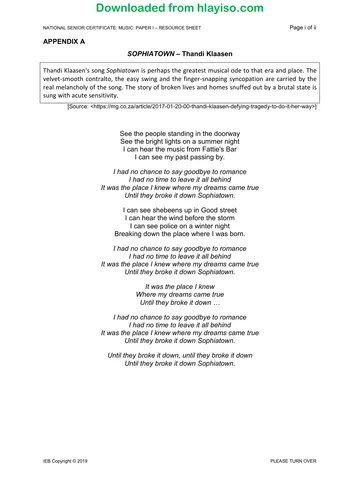
Listen to Track 14 (04:31). The lyrics can be found on the Resource Sheet as Appendix
A.
4.5 Name the Apartheid law, and explain its consequences, which led to the events
referred to in this song.
(1)
4.6 Evaluate the use of the following elements of music in the creation of the mood of
the song: tempo, tonality and melody. Include appropriate comparisons with
Meadowlands to substantiate your evaluation. Write your answer as a paragraph.
(6)
4.7 Compare the lyrics of Sophiatown with those of Meadowlands. Use quotations from
the lyrics to support your comparison. Do not refer to the language of the lyrics.
(2)
[18]
IEB Copyright © 2019 PLEASE TURN OVER
Downloaded from hlayiso.com
NATIONAL SENIOR CERTIFICATE: MUSIC: PAPER I Page 18 of 23
QUESTION 5
Listen to Track 15 (04:06) and Track 16 (03:45).
Write an essay in which you compare Track 15 and Track 16.
In addition to the general elements of music, also compare the setting of the lyrics, word
painting, programmatic elements and mood.
Include the following information in your discussion:
• The name of the poet
• A definition of the genre
• The form of the work, with an explanation
• Name two non-musical Romantic characteristics in the work
Offer your own opinion as to which track you prefer, and justify it with reference to the use
of at least two elements of music. Ensure that the comparison forms the body of the essay
and that both similarities and differences are discussed.
Your essay will be marked using the following rubric:
RUBRIC FOR ESSAY
Clearly demonstrates an understanding of the question, cites factual evidence, completes all
requirements, and provides an insightful comparison of the works, with reference to both the
20–16
general characteristics of the genres and the specific features of the two tracks. Own opinion of
the works is offered with insight and specific reference to the use of the elements of music.
Demonstrates an understanding of the question, completes all requirements, cites factual
15,5– evidence and provides some comparison of the works, with some reference to both the general
10,5 characteristics of the genres and the specific features of the tracks. Own opinion of the works is
offered with limited insight and some generalisation in terms of the use of the elements of music.
Meets all of the requirements, but demonstrates only a partial understanding of the question and
limited factual evidence. Comparison of the works is limited with only partial reference to either
10–5,5 the general characteristics of the genre or the specific features of the tracks. Own opinion is
limited with little or no reference to the use of the elements of music. There is an imbalance
between the sections of the essay.
Demonstrates minimal understanding of the question, does not complete all requirements, and
5–0,5 provides only a vague reference to, or no use of, the facts. No comparison or opinion is offered.
There is no balance within the essay.
IEB Copyright © 2019
Downloaded from hlayiso.com
NATIONAL SENIOR CERTIFICATE: MUSIC: PAPER I Page 19 of 23
IEB Copyright © 2019 PLEASE TURN OVER
Downloaded from hlayiso.com
NATIONAL SENIOR CERTIFICATE: MUSIC: PAPER I Page 20 of 23
IEB Copyright © 2019
Downloaded from hlayiso.com
NATIONAL SENIOR CERTIFICATE: MUSIC: PAPER I Page 21 of 23
[20]
IEB Copyright © 2019 PLEASE TURN OVER
Downloaded from hlayiso.com
NATIONAL SENIOR CERTIFICATE: MUSIC: PAPER I Page 22 of 23
QUESTION 6
Listen to Track 17 (01:40) and Track 18 (01:55).
6.1 Place three ticks in Column A to identify unique features of Track 17 and place
three ticks in Column B to identify unique features of Track 18. Place 2 ticks in
Column C to identify features common to both tracks.
Place ticks for common features only in Column C – do not tick in all three
columns.
COLUMN A COLUMN B COLUMN C
Unique features Unique features Common features
of Track 17 of Track 18 of Track 17 and
Track 18
3 ticks 3 ticks 2 ticks
Changing time
signatures
Call-and-response
between piano and
saxophone.
Saxophone
improvisation
Bass drum "bombs"
Trumpet improvisation
Piano improvisation
Walking bass
Quadruple time
(4)
6.2 Identify the style of music represented by each track and state the decade
in which each developed.
Track 17: Style: ____________________ Decade: ___________________
Track 18: Style: ____________________ Decade: ___________________
(2)
IEB Copyright © 2019
Downloaded from hlayiso.com
NATIONAL SENIOR CERTIFICATE: MUSIC: PAPER I Page 23 of 23
Listen to Track 19 (02:03) and Track 20 (01:35).
6.3 Choose six statements from the list below: two that are true for Track 19, two that
are true for Track 20 and two that are true for both tracks. Write the NUMBER
ONLY of each statement in the relevant column in the table below.
6.3.1 Rhythm section consisting 6.3.6 Slower than Track 19
of bass, piano, drum kit.
6.3.2 Head is played twice at the 6.3.7 Solo improvisations on
beginning violin and muted trombone
6.3.3 No collective improvisation 6.3.8 The last solo is played by
the muted cornet
6.3.4 4-bar solo break precedes 6.3.9 Solo improvisations on
each improvisation trumpet and saxophone
6.3.5 Solo improvisations on 6.3.10 Imitation between the solo
trumpet and clarinet instruments
Unique to Unique to Common to
Track 19 Track 20 both
Statement
Number
Statement
Number
(3)
6.4 Some of the solo instruments are in B flat, which sound a major 2nd lower than
written. Transpose the C blues scale so that it can be played by the solo
instruments. Use a key signature and add any necessary accidentals.
(1)
[10]
Total: 100 marks
IEB Copyright © 2019
Study this subject
Revise the topics in this paper, then practise them question by question.
Recommended for this subject
More papers and memos for this grade and subject.
Question paperIEB
Music Grade 12 IEB Paper 1 2019 Question Paper (Afrikaans)
Question paperIEB
Music Grade 12 IEB Paper 2 2019 Question Paper
Question paperIEB
Music Grade 12 IEB Paper 2 2019 Question Paper (Afrikaans)
Question paperIEB
Music Grade 12 IEB Paper 1 2018 Question Paper
Question paperIEB
Music Grade 12 IEB Paper 2 2018 Question Paper
Question paperIEB
Music Grade 12 IEB Paper 2 2018 Question Paper (Afrikaans)
Related documents
MemorandumIEB
Music Grade 12 IEB Paper 1 2019 Memo
MemorandumIEB
Music Grade 12 IEB Paper 1 2019 Memo (Afrikaans)
AddendumIEB
Music Grade 12 IEB Paper 1 2019 Addendum
AddendumIEB
Music Grade 12 IEB Paper 1 2019 Addendum (Afrikaans)
Question paperIEB
Music Grade 12 IEB Paper 1 2017 Question Paper
Question paperIEB
Music Grade 12 IEB Paper 1 2017 Question Paper (Afrikaans)
More from Grade 12 Music
MemorandumIEB
Music Grade 12 IEB Paper 2 2019 Memo
MemorandumIEB
Music Grade 12 IEB Paper 2 2019 Memo (Afrikaans)
MemorandumIEB
Music Grade 12 IEB Paper 1 2018 Memo
MemorandumIEB
Music Grade 12 IEB Paper 1 2018 Memo (Afrikaans)
AddendumIEB
Music Grade 12 IEB Paper 1 2018 Addendum
AddendumIEB