
Downloaded from hlayiso.com
NATIONAL SENIOR CERTIFICATE EXAMINATION
NOVEMBER 2018
MUSIC: PAPER I
MARKING GUIDELINES
Time: 3 hours 100 marks
These marking guidelines are prepared for use by examiners and sub-examiners,
all of whom are required to attend a standardisation meeting to ensure that the
guidelines are consistently interpreted and applied in the marking of candidates'
scripts.
The IEB will not enter into any discussions or correspondence about any marking
guidelines. It is acknowledged that there may be different views about some
matters of emphasis or detail in the guidelines. It is also recognised that,
without the benefit of attendance at a standardisation meeting, there may be
different interpretations of the application of the marking guidelines.
IEB Copyright © 2018 PLEASE TURN OVER
Skip to contentMemorandum 
View all
Music Grade 12 IEB Paper 1 2018 Memo
IEB Grade 12 Music Paper 1 memorandum from the 2018, 15 pages. Read online or get the free PDF download, question paper linked when available.
Publisher: IEB
Music · Grade 12 · 2018. Memorandum, 15 pages. Read online or download the PDF.
- Subject
- Music
- Grade
- Grade 12
- Document type
- Memorandum
- Year
- 2018
- Paper
- 1
- Publisher
- IEB
- Curriculum
- IEB
- Pages
- 15
- File size
- 498.6 KB
Loading document…
Loading document…
1 of 15
Document textSearch extracted text and jump to a page.
Downloaded from hlayiso.com
NATIONAL SENIOR CERTIFICATE: MUSIC: PAPER I – MARKING GUIDELINES Page 2 of 15
QUESTION 1
Listen to Track 1: [Extract from Bolero – Maurice Ravel: Ravel Bolero and
other orchestral works. Track 14; CSR Symphony Orchestra (Bratislava),
Kenneth Jean; Naxos 8.550173 1988]
1.1 Identify the repetitive compositional technique heard in the extract.
Ostinato (some may answer Riff).
1.2 Place a tick next to the rhythm of the compositional technique you have
named above.
x
1.3 Listen to Track 1a. It is the main melody from Track 1. [Set on Sibelius ©
by the examiner.]
1.3.1 Place a tick next to the phrase that matches what you hear.
1.3.2 Add ties where necessary to match the rhythm that you hear.
ANSWER: 0,5 per tie x
Continuous accuracy: if incorrect melody is chosen but ties are correctly placed, then the
mark for ties will be credited. However, they will lose the mark for 1.3.1.
IEB Copyright © 2018 PLEASE TURN OVER
Downloaded from hlayiso.com
NATIONAL SENIOR CERTIFICATE: MUSIC: PAPER I – MARKING GUIDELINES Page 3 of 15
Listen to Track 2. [Waltz 2 from Jazz Suite No. 2 – Dmitri Shostakovich:
Shostakovich The Jazz Album, Track 13. Royal Concertgebouw Orchestra,
Riccardo Chailly. The Decca Record Company Limited, London, 1993]
1.4 Place four (4) ticks to identify features NOT present in the music.
Compound time x Quadruple metre x
Dissonant harmony x Snare drum and cymbal
Minor tonality Monophonic texture x
Major tonality Pizzicato
Polyphonic and
Ritardando – a tempo
homophonic texture
Listen to Track 3. [Minuet from Piano Sonata H XVII/11 by Franz Joseph Haydn
performed by Andrew Remillard: <https://www.youtube.com/watch?v
=msjjvrRWncE>. Accessed: 11 February 2018]
1.5 Printed below in random order are the eight bars from Track 3. On the stave
provided below, re-write them in the correct order to form the 8-bar melody
heard in Track 3. Include the time signature.
MARKING: 2 PHRASES × 1 MARK = 2 MARKS. No time signature: -0,5
Marking changed to 0.25 per bar X 8. Bars need to match bar numbers.
IEB Copyright © 2018 PLEASE TURN OVER
Downloaded from hlayiso.com
NATIONAL SENIOR CERTIFICATE: MUSIC: PAPER I – MARKING GUIDELINES Page 4 of 15
1.6 Listen again to Track 3, and identify the cadence in bar 8.
Imperfect
Listen to Track 4. It is the whole piece from Track 3.
1.7 Tick the structural pattern that your hear.
a b a b b a a a b a x
Whilst listening to ClassicFM™, you hear this announcement, followed by the
piece of music on Track 5: [Joyeuse Marche: Emmanuel Chabrier Orchestra of
the Royal Opera House, Covent Garden CD 2 Track 1 from the CDs
accompanying Fortissimo for GCSE by Roy Bennett, Cambridge University
Press, 1995]
Announcer:
"And next up, we hear The Sorrow of the Daughter by the Classical composer,
Mozart. The soloist is Susan Mitchell on cello."
1.8 With reference to Track 5, comment on the accuracy of the information
given by the announcer. Motivate your response with reference to three
different features of the music.
This announcement is not accurate for the following reasons: (no
mark given for this statement)
The title given refers to "sorrow", which leads one to expect a slow
piece, possibly in a minor key. It also indicates that it is a Classical
work, and that there is a solo cellist. However, the piece that we hear
is fast, in a major key, and features an orchestra with a large brass
and percussion section, which is more likely to be Romantic because
the brass only became an important section of the orchestra in the
19th century. There is also a noticeably large percussion section,
which is also not typical of a Classical orchestra. A piece that refers to
"sorrow" is also likely to be soft, whereas the dynamics of this work
are loud. There is no solo cellist present in the recording – only a large
orchestra.
Mozart, being a Classical composer is unlikely to have given a piece a
title, as he wrote mainly absolute music – having a title indicates a
programmatic element, which is more common in Romantic music.
Other valid points will be credited.
Three different features must be referred to in order to achieve full
marks.
IEB Copyright © 2018 PLEASE TURN OVER
Downloaded from hlayiso.com
NATIONAL SENIOR CERTIFICATE: MUSIC: PAPER I – MARKING GUIDELINES Page 5 of 15
QUESTION 2
Listen to Track 6 [Leporello's Opening Aria from Don Giovanni – Mozart.
Music – An Appreciation by Roger Kamien. CDs to accompany the 9th
Edition: Disk 3 Track 60; McGraw-Hill Companies/Sony BMG Music 2006],
Track 7 ["Pick a Pocket or Two" from Oliver! by Lionel Bart; 1991; National
Symphony Orchestra conducted by John Owen Edwards; TER Ltd
CDTER1184] and Track 8 [Erlkönig – Schubert: Erlking's 2nd verse: Dietrich
Fischer-Dieskau, baritone; Gerald Moore, piano. Courtesy of EMI Classics
Ltd under licence from EMI Music Special Markets: Music – An Appreciation
by Roger Kamien. CDs to accompany the 9th Edition; CD 4 Track 52;
McGraw-Hill Companies/Sony BMG]
2.1 Complete the table below. Take note of the mark allocation for each heading.
Track 6 Track 7 Track 8
Name the Leporello Fagin Erlking/Erlkönig
character
[1 mark per track
× 3 = 3 marks]
State two facts Patter singing – Shows his Erlking sings in
about the way in comic element of Jewish roots the major key to
which the the character. through the use show his enticing
character is Melodic of the Jewish nature – as
flourishes when Phrygian opposed to the
depicted in the
he sings about Dominant scale/ other characters
music wanting to be a tambourine/ in the minor key.
gentleman. flexibility of The piano
[2 marks per tempo – accompaniment
track × 3 = 6 Sudden forte – reminiscent of is arpeggiated,
marks] his need to be Klezmer style. which is different
Only 0,5 if no heard because as from the
explanation is a servant, he Oom-pah. repetitive triplet
included. generally isn’t. Syllabic setting – pattern that
simple character. characterises the
Anxious, pacing rest of the song.
– V – I bass line Lyrical melody
middle register
State one fact Balanced It is a musical It is a lied, which
about the work phrases, which developed is a typical
that indicates the orchestra with in the 20th Romantic work.
stylistic period in paired winds, century – sung in Supernatural
homophonic English. elements.
which it was
texture. Any Orchestra has Chromatic,
written. other valid point. more brass and programmatic
Written by percussion. Any elements, e.g. the
Mozart. other valid point. horse galloping.
Written by Bart. Any other valid
point.
Written by
[1 mark per track Schubert.
× 3 = 3 marks]
IEB Copyright © 2018 PLEASE TURN OVER
Downloaded from hlayiso.com
NATIONAL SENIOR CERTIFICATE: MUSIC: PAPER I – MARKING GUIDELINES Page 6 of 15
Listen to Track 9. [End of the Introduction to Don Giovanni: the
Commendatore's death – Mozart. Music – An Appreciation by Roger Kamien.
CDs to accompany the 9th Edition: Disk 3 Track 62; McGraw-Hill
Companies/Sony BMG Music 2006].
2.2 Identify the texture of the extract, and describe how it is created by the
soloists.
Polyphonic: there are three characters (Leporello, Don Giovanni and
the Commendatore) each singing their own melodic line because they
are expressing their own feelings/ideas, at the same time.
2.3 What is happening at this point in the opera, and how does the composer
convey the action in the music?
The Commendatore has been stabbed by Don Giovanni and is dying.
Mozart uses a suspended/held/paused chord as the Commendatore is
stabbed. Then the music changes tempo – slows down. Uses a
descending chromatic scale to show that he has died.
Minor key, appoggiaturas. Diminished 7ths, short phrases, limited
range
Other possible answers.
QUESTION 3
Listen to Track 10. [Development section from Symphony No 40 in g minor by
W A Mozart. Music – An Appreciation by Roger Kamien. CDs to accompany
the 9th Edition; Disk 3 Track 14; McGraw-Hill Companies/Sony BMG Music
2006]
3.1 Identify the section of the work from which this extract is taken.
Development
3.2 Comment on Mozart's use of keys in this section.
The expectation in a Classical symphony is that the development will
modulate to closely-related keys. However, in this symphony, Mozart
modulates instead to the minor of the 7th degree (f# minor) and then
passes through a number of other distantly-related keys. The harmony
is more chromatic than one would expect in a Classical symphony.
Works through the Cycle of 5ths which destabilises the tonic key.
Restless atmosphere (0.5), tension (0.5)
Listen to Track 11. [Bridge from Symphony No 40 in g minor by W A Mozart.
Music – An Appreciation by Roger Kamien. CDs to accompany the 9th
Edition; Disk 3 Track 11; McGraw-Hill Companies/Sony BMG Music 2006]
3.3 Name the theme heard in Track 11, and state its purpose in the exposition.
Bridge passage/Transition – to modulate from the Tonic to the relative
major in preparation for the 2nd subject.
IEB Copyright © 2018 PLEASE TURN OVER
Downloaded from hlayiso.com
NATIONAL SENIOR CERTIFICATE: MUSIC: PAPER I – MARKING GUIDELINES Page 7 of 15
QUESTION 4
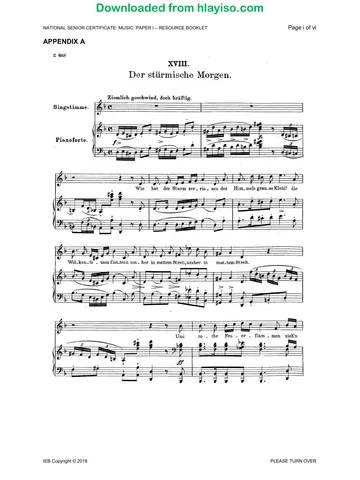
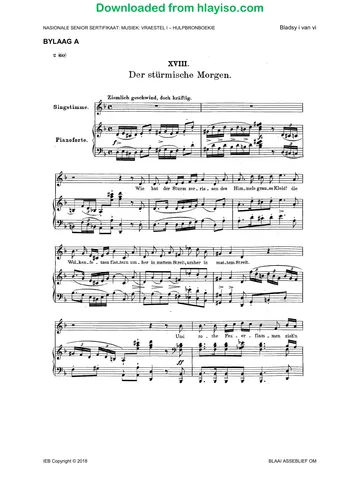
Listen to Track 12. ["Der stürmische Morgen" (The Stormy Morning) from
Winterreise by Franz Schubert. Performed by Dietrich Fischer-Dieskau and
Gerald Moore. <https://www.youtube.com/watch?v=8l8l0HPDMOE> Accessed:
10 February 2017]. The score [IMSLP60822-PMLP02203 Schubert_Werke_-
Breitkopf_Serie_XX_Band_9_F.S.878-904.pdf] and the lyrics, with an English
translation, are printed as APPENDIX A in the Resource Booklet. [The LiederNet
Archive: Text added to archive between May 1995 and September 2003. Last
modified 22/11/2017 <http://www.lieder.net/lieder/get_text.html?TextId=11861>.
Accessed: 10 February 2018]
4.1 Identify the key of the piece.
D minor
4.2 What is the form (structure) of this Lied?
Through-composed
4.3 Evaluate the musical setting of this Lied in comparison with your set work,
Der Erlkönig. Refer to word painting and programmatic elements, texture
and harmony. Give your opinion as to which Lied is more effective, giving a
reason for your choice.
The answer must be written as a paragraph – the table is just for easy
reference. Valid points not listed in the table will be credited.
6 marks for the comparison: 2 per element. All three listed elements
must be discussed.
1 mark for reason for opinion – no mark for opinion
IEB Copyright © 2018 PLEASE TURN OVER
Downloaded from hlayiso.com
NATIONAL SENIOR CERTIFICATE: MUSIC: PAPER I – MARKING GUIDELINES Page 8 of 15
"Der stürmische Morgen" Der Erlkönig
Word Painting Relatively little word A lot of word painting:
and painting. In fact, a number Rising fear of the child:
Programmatic of opportunities for word chromatic melody that rises
Elements painting are not used: each time he sings,
"Torn apart" – is sung in reflecting his growing panic.
unison with the piano,
which indicates unity rather Enticing nature of the
than being torn apart. Erlking: in a major key with
Begins loudly – like a storm. a change of accompaniment
"Shreds of cloud flit about" pattern.
– the melody is disjunct
reflecting clouds being Galloping of the horse
blown in the sky. depicted in the consistent
The triplets in the interlude triplet pattern in the
after verse one could be accompaniment.
reminiscent of "shreds of
clouds flit about" in verse 1. The calming voice of the
Fortissimo on "fiery red father in a lower register.
flames" combined with Not chromatic like the son.
dotted values creates the
drama of a fire. Recitative at the very end –
Dynamics are softer on the depicting death.
words "my heart sees its
own image …"
Use of accents
Torn apart – staccato
Texture Monophonic in the Homophonic throughout
introduction and verse 1. with melody in left hand
Homophonic in verse 2. against the repetitive triplets
Monophonic again at the in the right hand. Very short
beginning of verse 3 but recitative – monophonic – at
becomes homophonic as the end. The sudden change
the song reaches its climax. from the homophonic
The texture alternates texture that dominates the
between monophonic and lied is a shock to the
homophonic which creates listener which emphasises
interest for the listener and the tragedy of the boy's
emphasises the death.
wildness/changing patterns
of the storm.
Harmony Minor in Verse 1 and 3, Minor tonality. Also
Major in Verse 2: links to chromatic and use of
lyrics “This is to my liking”; diminished chords to create
use of chromaticism and tension and emphasise the
diminished triads fear.
emphasise the destruction Changes to Major for
of the storm. Erlking. More harmonically
complex
Opinion Needs to be backed up with reference to one of the
elements (doesn't have to be one mentioned in the body of
the answer). Cannot just be "I like it better".
IEB Copyright © 2018 PLEASE TURN OVER
Downloaded from hlayiso.com
NATIONAL SENIOR CERTIFICATE: MUSIC: PAPER I – MARKING GUIDELINES Page 9 of 15
QUESTION 5
Listen to Track 13, [Mozart 40th in G minor, arranged by Gordon Goodwin
Played by Jazz Music Orchestra (Belgium) Clarinet: Arnaud Dupire
20 avril 2013 <www.jazzmusicorchestra.be>. Published on May 16, 2013
<https://www.youtube.com/watch?v=QZciKBBrXP8>. Accessed: 15/12/2017]
which is an arrangement of one of your set works. Track 14 is the original version
of the same work. [Mozart Symphony No 40 in g minor from Music – An
Appreciation by Roger Kamien. CDs to accompany the 9th Edition; Disk 3
Track 10; McGraw-Hill Companies/Sony BMG Music 2006]
Write an essay in which you compare Track 13 to the ORIGINAL work, heard in
Track 14. Also include the following information in your discussion:
• The name of the work and the composer.
• A definition of, and brief background to, the genre.
• Comment on the jazz influences / styles in the arrangement heard in Track 13.
Offer your own opinion as to which track you prefer, and justify it with reference to
the use of at least two elements of music. Ensure that the comparison forms the
body of the essay, and that you discuss both similarities and differences.
Your essay will be marked using the following rubric:
RUBRIC FOR ESSAY
Clearly demonstrates an understanding of the question, cites factual evidence,
completes all requirements, and provides an insightful comparison of the works,
20–16 with reference to both the general characteristics of the genres and the specific
features of the two tracks. Own opinion of the works is offered with insight and
specific reference to the use of the elements of music.
Demonstrates an understanding of the question, completes all requirements, cites
factual evidence and provides some comparison of the works, with some reference
15,5–10,5 to both the general characteristics of the genres and the specific features of
the tracks. Own opinion of the works is offered with limited insight and some
generalisation in terms of the use of the elements of music.
Meets all of the requirements, but demonstrates only a partial understanding of the
question and limited factual evidence. Comparison of the works is limited with only
10–5,5 partial reference to either the general characteristics of the genre or the specific
features of the tracks. Own opinion is limited with little or no reference to the use of
the elements of music. There is an imbalance between the sections of the essay.
Demonstrates minimal understanding of the question, does not complete all
5–0,5 requirements, and provides only a vague reference to, or no use of, the facts. No
comparison or opinion is offered. There is no balance within the essay.
IEB Copyright © 2018 PLEASE TURN OVER
Downloaded from hlayiso.com
NATIONAL SENIOR CERTIFICATE: MUSIC: PAPER I – MARKING GUIDELINES Page 10 of 15
THE ANSWER TO THIS QUESTION MUST BE WRITTEN IN ESSAY FORM –
THE MEMO IS TABULATED FOR EASE OF REFERENCE.
Title and Mozart: 1st Movement – Symphony No 40
Composer (2)
Genre and Symphony: multi-movement work for orchestra – usually 4 –movements
Background (2) contrasting each other in tempo, key and mood. Fast-Slow-Minuet and
Trio-Fast. The 1st and 4th movements are usually in Sonata form.
Background info Developed from the single-movement Italian overture of the Baroque
offered may period. The three sections developed into three independent movements.
include other "Standardised" in the Classical period by composers like Haydn, Stamitz
historical (Mannheim School) and Mozart. Minuet and Trio added between the
references Slow and Fast movements. Influence of Baroque Suite.
Comment on Elements of Cool and Big Band jazz. Improvisatory sections – solo
Jazz Style(s) (2) clarinet. Can hear audience clapping after solos, which is typical of jazz
styles. The ensemble is essentially a big band but because at times only
a solo clarinet and rhythm section are used, it sounds like a Cool combo.
There are also elements of Bebop in the virtuosic clarinet solo.
Track 13 (Goodwin) Track 14 (Original)
Tonality Minor and Blues Minor. 2nd subject is in the relative
major. Development modulates to
distantly related keys.
Metre Quadruple/Duple Quadruple/Duple
Tempo Slower and with more tempo Moderately fast – Allegro. Remains
changes/greater flexibility of tempo the same throughout the
especially between solo movements.
improvisation sections. Some really
upbeat sections where the drum kit
drives the rhythm and some laid-
back sections.
Melody Call and response between saxes 1st subject (Mannheim sigh)
and trombones. And between solo constructed from 3-note motive
clarinet and other winds. Elements using compositional techniques like
of the original 1st subject appear repetition, variation and sequence.
throughout but there are extended Contrasting 2nd subject based on
improvisatory sections – generally the chromatic scale.
by clarinet. Bridge passage based on a
Based mainly on 1st subject Mannheim rocket.
material. No Bridge/2nd subject Limited range
material is used. No improvisation
Wider melodic range in No ornaments in melody
improvisations.
A lot of improvisation
Melody is ornamented
Rhythm Swung and syncopated in a jazz Straight – very few syncopations.
style. Mainly a sense of the accent on the
Emphasised by the cymbals – as in first beat of the bar.
cool jazz.
Alteration of the original rhythm.
IEB Copyright © 2018 PLEASE TURN OVER
Downloaded from hlayiso.com
NATIONAL SENIOR CERTIFICATE: MUSIC: PAPER I – MARKING GUIDELINES Page 11 of 15
Timbre Piano – not in original. Classical orchestra with strings,
Clarinet solo acc. by piano opens paired winds, 2 horns. No timpani
the work. Drum kit – light cymbals or trumpets. Depending on version,
– typical of Cool jazz. no clarinet – only flute, oboes and
Starts off like a Cool jazz ensemble bassoons.
– solo instrument(s) with rhythm Woodwinds have a fair amount of
section. melodic material.
Gradually a big band sound
emerges with saxophones and
muted brass (trombones). Multiple
trumpets, trombones and
saxophones. Double bass.
Later returns to the Cool jazz
combo sound and then just before
the end, there is another "big band"
moment. Ends with clarinet, light
cymbals and piano.
Reeds & Horns
Texture Homophonic in early improvisatory Mainly homophonic although there
sections and in some of the "big are some imitative sections. There
band' sections. are also some places where the
Polyphonic later on when clarinet is strings/woodwinds play
improvising together with the rest countermelodies to the main
of the ensemble. melody.
Phrases Some balanced phrases but some Balanced, periodic – typical of
irregular phrases in the Classical period. Clear cadences at
improvisatory sections. the end of phrases.
Indefinite ending. Very definite perfect cadence at the
end of the movement leaving the
audience in no doubt that it is
finished.
Dynamics Begins softly. Dynamic level Crescendi and diminuendos with
increases as more instruments join some sudden forte and piano parts.
the ensemble. Quite a lot of Gradual dynamic changes are
variation between piano/mezzo typical of the Classical period.
forte and forte.
Articulation Clarinettist makes use of a variety Two note slurred "Mannheim Sigh"
of articulation: slurs, tongued, long dominates the movement. Mainly
and short phrases. Little staccato – legato throughout.
mainly legato
Structure Solo improvisatory sections Sonata form: Exposition,
alternating with ensemble sections. Development and Recapitulation
Improvisations are quite virtuosic. with two clear themes/subjects in
Arch-type form: Piano/Sax – Big the exposition. Short development
Band/Swing – "bebop" – Big Band section.
– piano/sax No introduction
Improvisation is like a development Definite ending
section.
Head
Short introduction
On repeat – a lot more
improvisation
Ending fades out.
IEB Copyright © 2018 PLEASE TURN OVER
Downloaded from hlayiso.com
NATIONAL SENIOR CERTIFICATE: MUSIC: PAPER I – MARKING GUIDELINES Page 12 of 15
QUESTION 6
Listen to TRACK 15 [Imizamo Yam'] and TRACK 16 [Kwela Celebration].
6.1 Place three ticks in Column A to identify unique features of Track 15 and
place three ticks in Column B to identify unique features of Track 16. Place
2 ticks in Column C to identify features common to both tracks.
Place ticks for common features only in Column C – do not tick in all
three columns.
COLUMN C
COLUMN A COLUMN B
Common
Unique features Unique features
features of Track
of Track 15 of Track 16
15 and Track 16
3 ticks 3 ticks
2 ticks
Call and response x
Acoustic guitar x
A capella x
Cyclical x
4-bar introduction
Walking bass x
iib-Ic-V
Multi-part male voices x
I, IV and V x
8-bar introduction x
6.2 Identify the style of music represented by each track and name one other
musical style that influenced each style.
Track 15: Isicathamiya/Mbube Influenced by Hymns/SATB singing and
African American spirituals from missionaries / traditional African
Music – call and response
Track 16: Kwela/Pennywhistle Jive: Influenced by Marabi/American Big
Band Jazz
MARKING: Name of style = 0.5 and other musical style = 1: 1.5 × 2 = 3
6.3 Explain the role that the media played in the development, and spread, of
South African Urban music in the 1950s under the apartheid government.
Growth of radio stations aimed at black listeners – this increased
demand for recorded music that could be played on these stations.
Growth of the recording industry – a result of the need for music that
could be played on the radio stations, and also because people
wanted to buy recordings for themselves.
Publications like DRUM magazine brought news of fashion, styles and
music from America, which in turn influenced the development of SA
Urban music, e.g. the influence of Big Band jazz on Mbaqanga and
Township Jazz.
Very little South African Urban music was spread via "white" radio
stations, magazines or newspapers.
IEB Copyright © 2018 PLEASE TURN OVER
Downloaded from hlayiso.com
NATIONAL SENIOR CERTIFICATE: MUSIC: PAPER I – MARKING GUIDELINES Page 13 of 15
Black radio was segregated by culture/language. Spread SA Music
worldwide. Exposed SA Urban music to the White population, Opened
the world’s eyes to the reality of Apartheid. Film
Listen to Track 17. [Meadowlands – Dysfunctional Family Jazz Band]
6.4 Name the composer of this work, and state the issue of protest in the song.
Strike Vilakazi – against the forced removals from Sophiatown to
Meadowlands. Apartheid – not accepted.
6.5 On the stave below, write out the basic chord progression on which this
song is constructed. State the key, and figure the chords.
MARKING: 0,5 per chord. Subtract 0,5 for no key and 1 for no figuring.
Listen to Track 18. [Meadowlands performed by the Dysfunctional Family
Jazz Band June 2009 <https://www.youtube.com/watch?v=O_o6e2ETLt0>
Accessed: 18 February 2018.]
6.6 With reference to the error in the statement made by the singer at the
beginning of the track, comment on the lyrics of this song and state how
they were interpreted by the authorities.
She says that the lyrics are in Zulu, whereas in fact the verse that she
starts to sing is the Sesotho verse (1). Three languages are used in
Meadowlands: isiZulu, Sesotho and Tsotsitaal. (1) The authorities
interpreted the lyrics as being supportive of the removals to
Meadowlands because they refer to "let's go to Meadowlands" and
"Meadowlands, our beloved place". (1). However, this phrase is used
sarcastically/ironically because in Verse 3, the reference to "our
beloved place" clearly refers to Sophiatown because it says "staying
here in our beloved place" (1) "Hell no, we won’t go" – but the song
does not state this as obviously/overtly/explicitly. It is more subtle.
IEB Copyright © 2018 PLEASE TURN OVER
Downloaded from hlayiso.com
NATIONAL SENIOR CERTIFICATE: MUSIC: PAPER I – MARKING GUIDELINES Page 14 of 15
QUESTION 7
Listen to Track 19. It is an extract from one of your set works. [Koko – Charlie
Parker from the album The Genius of Charlie Parker; 2005; Savoy Jazz]
7.1 Identify the work.
Koko
7.2 Why is the recording of this piece considered so important in the history of
jazz?
It is the first known recording of Bebop made in 1945. Bebop had
begun to develop in the early 1940s but, because of the ban on all
commercial recordings owing to issues of royalty payments, no
recordings of the style's early development were made. It was Parker's
first recording as a leader. The head was partly improvised in the
recording – leading to it being called the "most famous recorded
solo". Performed by some of the most important Bebop
performers/artists.
7.3 Highlight or underline three characteristics from the list below that are
unique to this style of jazz.
7.3.1 Collective improvisation 7.3.6 Swung quavers
7.3.2 Walking bass 7.3.7 Bass drum "bombs"
7.3.3 Unusual time signatures 7.3.8 Front line instruments:
saxophone, trumpet, trombone
7.3.4 Motivic melodies
7.3.9 Highly virtuosic, very fast
7.3.5 Syncopation improvisation
Listen to Track 20 [Take 5 – Dave Brubeck Quartet/Paul Desmond original:
<https://www.youtube.com/watch?v=PHdU5sHigYQ>. Published: 22 December 2010.
Accessed: 15 February] and Track 21. [Take 5 – Dave Brubeck Quartet/Paul Desmond
from Time Out Not Now Music Limited 2011]
7.4 Write out the blues scale on which the melody of this work is based.
The scale will be accepted with or without a key signature. Blues on C
also acceptable. Any other correct Blues scale 0,5
IEB Copyright © 2018 PLEASE TURN OVER
Downloaded from hlayiso.com
NATIONAL SENIOR CERTIFICATE: MUSIC: PAPER I – MARKING GUIDELINES Page 15 of 15
7.5 Use the headings in the table below to describe and compare the
introduction and the improvisations on Track 20 and Track 21. Do not refer
to the difference in tempo between the two versions.
Track 20 Track 21 (Set work)
Introduction (2)
Shortened drum intro – 4-bar drum intro – very
doesn't seem to get into steady from beginning.
the groove immediately. Sets up the groove then
Only 4-bar piano vamp. joined by the piano for
8-bar intro 8-bars (piano vamp)
Freer drum part Tighter drum part
“Hot” jazz “Cool” jazz
Improvisation 1 Saxophone – different Saxophone – 28 bars
and improvisation from set over piano/drum
Accompaniment work. Much longer kit/double bass vamp.
(2) improvisation – approx. Unlike the other version,
96 bars. Distinctive the piano maintains the
groove is maintained by distinctive groove
drum kit while piano throughout.
plays chords. The piano
isn't as obvious.
Improvisation 2 Piano improvisation – Drum Kit – 88 bars over
and relatively short – ends piano/bass vamp. Begins
Accompaniment with the piano picking up with the drum kit playing
(2) the vamp again to lead the vamp and gradually
back into the head. moving into a virtuosic
Cymbals dominate solo.
accompaniment.
Refer to APPENDIX B, which is the lead sheet of Cry me a River, [Arthur
Hamilton: Chappell & Co and Momentum Music 1953, 1955 from The
Definitive Jazz Collection; 2nd Edition; Hal Leonard Corporation] and answer
the questions that follow:
7.6 With reference to APPENDIX B, identify each section of the form using a
letter (e.g. A) followed by the bar numbers of the section.
A: bar 1 to bar 8
A: bar 9 to bar 16
B: bar 17 to bar 24
A: bar 25 to bar 32
7.7 Name the compositional technique in bars 23 and 24.
Repetition
Total: 100 marks
IEB Copyright © 2018
Study this subject
Revise the topics in this paper, then practise them question by question.
Recommended for this subject
More papers and memos for this grade and subject.
MemorandumIEB
Music Grade 12 IEB Paper 1 2019 Memo
MemorandumIEB
Music Grade 12 IEB Paper 1 2019 Memo (Afrikaans)
MemorandumIEB
Music Grade 12 IEB Paper 2 2019 Memo
MemorandumIEB
Music Grade 12 IEB Paper 2 2019 Memo (Afrikaans)
MemorandumIEB
Music Grade 12 IEB Paper 1 2018 Memo (Afrikaans)
MemorandumIEB
Music Grade 12 IEB Paper 2 2018 Memo
Related documents
Question paperIEB
Music Grade 12 IEB Paper 1 2018 Question Paper
AddendumIEB
Music Grade 12 IEB Paper 1 2018 Addendum
AddendumIEB
Music Grade 12 IEB Paper 1 2018 Addendum (Afrikaans)
MemorandumIEB
Music Grade 12 IEB Paper 2 2018 Memo (Afrikaans)
MemorandumIEB
Music Grade 12 IEB Paper 1 2017 Memo
MemorandumIEB
Music Grade 12 IEB Paper 1 2017 Memo (Afrikaans)
More from Grade 12 Music
Question paperIEB
Music Grade 12 IEB Paper 1 2019 Question Paper
Question paperIEB
Music Grade 12 IEB Paper 1 2019 Question Paper (Afrikaans)
AddendumIEB
Music Grade 12 IEB Paper 1 2019 Addendum
AddendumIEB
Music Grade 12 IEB Paper 1 2019 Addendum (Afrikaans)
Question paperIEB
Music Grade 12 IEB Paper 2 2019 Question Paper
Question paperIEB