
Downloaded from hlayiso.com
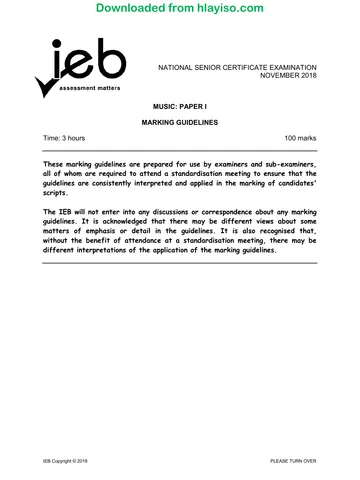
NATIONAL SENIOR CERTIFICATE EXAMINATION
NOVEMBER 2018
MUSIC: PAPER II
MARKING GUIDELINES
Time: 1½ hours 50 marks
These marking guidelines are prepared for use by examiners and sub-examiners,
all of whom are required to attend a standardisation meeting to ensure that the
guidelines are consistently interpreted and applied in the marking of candidates'
scripts.
The IEB will not enter into any discussions or correspondence about any marking
guidelines. It is acknowledged that there may be different views about some
matters of emphasis or detail in the guidelines. It is also recognised that,
without the benefit of attendance at a standardisation meeting, there may be
different interpretations of the application of the marking guidelines.
IEB Copyright © 2018 PLEASE TURN OVER
Skip to contentMemorandum 
View all
Music Grade 12 IEB Paper 2 2018 Memo
IEB Grade 12 Music Paper 2 memorandum from the 2018, 12 pages. Read online or get the free PDF download, question paper linked when available.
Publisher: IEB
Music · Grade 12 · 2018. Memorandum, 12 pages. Read online or download the PDF.
- Subject
- Music
- Grade
- Grade 12
- Document type
- Memorandum
- Year
- 2018
- Paper
- 2
- Publisher
- IEB
- Curriculum
- IEB
- Pages
- 12
- File size
- 598.8 KB
Loading document…
Loading document…
1 of 12
Document textSearch extracted text and jump to a page.
Downloaded from hlayiso.com
NATIONAL SENIOR CERTIFICATE: MUSIC: PAPER II – MARKING GUIDELINES Page 2 of 12
QUESTION 1
1.1 Write one octave, ascending, of the scale of which the given starting note is
the mediant. Do not use a key signature, but add all necessary accidentals.
MARKING: Scale = 1: the scale is right or wrong. 0.5 if double tonic is omitted
1.2 Add the missing notes to complete the scale of G sharp melodic minor.
MARKING: Scale = 1: the scale is right or wrong.
1.3 Write the Phrygian mode on B flat, descending. Do not use a key signature,
but add any necessary accidentals.
MARKING: Scale = 1: the scale is right or wrong.
1.4 Write the scale of C harmonic minor, ascending, with a key signature. Use
the given time signature, and your own rhythm, grouping the notes
correctly. End on the given note value and complete the second bar with
rests.
MARKING: Scale + Key Signature = 1: the scale is right or wrong.
Grouping including rests: 0.5 per beat × 4 = 2 marks. Any grouping
will be accepted, as long as it is correct in compound duple time.
1.5 Add the necessary accidentals to create the chromatic scale on E.
MARKING: Scale = 1: the scale is right or wrong.
IEB Copyright © 2018 PLEASE TURN OVER
Downloaded from hlayiso.com
NATIONAL SENIOR CERTIFICATE: MUSIC: PAPER II – MARKING GUIDELINES Page 3 of 12
1.6 Study the extract below and answer the questions that follow.
1.6.1 Tick three (3) statements from the given list which apply to the
music. ['Luckington' arr. Malcolm Archer from After the Last Verse –
200 Hymn Improvisations – adapted by the examiner]
Plagal cadence Compound metre Suspension x
Passing notes x Sequence x Ostinato
Pedal point x Monophonic texture Whole tone scale
There are four possible answers: only three (3) must be ticked.
1.6.2 Find, and label clearly on the music, the following intervals:
(i) An augmented 4th Bar 9 Beat 3 and Bar 11 Beat 3, Bass
clef: B Flat to E. Bar 123, 124, : C natural to F#, Bar 151 D to
G#, Bar 10 beats 1, 3 and 4 : C natural to F#
(ii) A compound diminished 5th Bar 13 Beat 2, bass clef: G# to
D and 13 Beat 4, bass clef: A#–E.
IEB Copyright © 2018 PLEASE TURN OVER
Downloaded from hlayiso.com
NATIONAL SENIOR CERTIFICATE: MUSIC: PAPER II – MARKING GUIDELINES Page 4 of 12
1.7 Harmonise the given notes in four parts (SATB or for keyboard) to form a
suitable cadence. Make use of the dominant seventh tetrad. Remember to
name the key and figure the chords.
MARKING: V7 + Resolution = 2 marks. Approach and final chord: 0.5
each.
No figuring/key = –0.5 each; /part writing faults = –0.5.
NB: in f minor: the passing progression lb V7c I is not an acceptable
answer as it is not a cadence.
IEB Copyright © 2018 PLEASE TURN OVER
Downloaded from hlayiso.com
NATIONAL SENIOR CERTIFICATE: MUSIC: PAPER II – MARKING GUIDELINES Page 5 of 12
QUESTION 2
Choose ONE of the music examples (a), (b) or (c) below and answer the questions
that follow:
(a)
(b)
(c)
2.1 Write down the letter of your choice and NAME the work and the composer
of your chosen example, e.g. (d) West Side Story – Leonard Bernstein.
(a) Catalogue Aria / Madamina from Don Giovanni – W A Mozart OR
(b) Erlkönig – Franz Schubert OR
(c) "Who will buy"? from Oliver! – Lionel Bart
2.2 Name the character that sings the extract and state the context of the
extract in the work as a whole.
(a) Leporello: he is listing his master's (Don Giovanni's) conquests
to Donna Elvira. He describes the women that Don Giovanni has
"conquered" OR
(b) The Father: he is calming his son by saying, "be still – all you
can hear/see are the leaves rustling on the trees" OR
(c) The Rose Seller: she is singing "Will you buy my sweet red
roses?". She is a street seller in London, who is joined by other
sellers, all singing about their products.
Mark with continuous accuracy. If letter of extract is not stated, no marks.
2.3 Define the type of piece/genre of your chosen extract. Motivate why the
extract is/is not a good example of the type of piece that it represents. Refer
to the specific piece rather than to a larger work from which it may be taken.
IEB Copyright © 2018 PLEASE TURN OVER
Downloaded from hlayiso.com
NATIONAL SENIOR CERTIFICATE: MUSIC: PAPER II – MARKING GUIDELINES Page 6 of 12
(a) ARIA – a song for solo voice accompanied by orchestra: this is
a good example of an aria because Leporello is expressing
himself in song. However, unlike many arias, he is describing
Don Giovanni's conquests rather than expressing his own
emotions. A Catalogue aria lists items, making this a good
example of it. Could also be Opera + definition and motivation.
(b) LIED/ART SONG – a song for solo voice accompanied by piano
– sung in German. This is a good example of the genre because
it fits this description and also because the story includes both
natural and supernatural elements, which is typical of
Romanticism. Characters are depicted through the use of the
upper, middle and lower range of the voice. The piano and the
voice are equal partners in the setting with the piano depicting
programmatic elements like the galloping horse.
(c) ENSEMBLE – a number of characters express their differing
emotions at the same time in song. In this number, each seller
is advertising his/her wares by singing a specific melody with
words relating to the goods for sale. However, unlike many
ensembles, they are not expressing their emotions. Could also
be Musical + definition
NOTE: the definition needs to be included in the answer. Other
valid points in terms of the motivation will be accepted.
Mark allocation:
1 mark for definition.
1 mark for motivation.
IEB Copyright © 2018 PLEASE TURN OVER
Downloaded from hlayiso.com
NATIONAL SENIOR CERTIFICATE: MUSIC: PAPER II – MARKING GUIDELINES Page 7 of 12
QUESTION 3
Refer to the score below and answer the questions that follow.
(i)
(iii)
(ii) *
* * *
3.1 Identify the scale used in this piece.
Pentatonic
3.2 Identify the intervals labelled (i), (ii) and (iii)
(i) Perfect 4th
(ii) Compound Minor 7th/Minor 14th
(iii) Compound Minor 3rd/Minor 10th
IEB Copyright © 2018 PLEASE TURN OVER
Downloaded from hlayiso.com
NATIONAL SENIOR CERTIFICATE: MUSIC: PAPER II – MARKING GUIDELINES Page 8 of 12
3.3 There are several changes of time signature in this piece. Add the correct
time signatures at the places marked *.
9/8; 7/8; 5/8; 3/8 (0.5 per time signature)
3.4 Rewrite bar 5, printed below, in the equivalent compound time signature.
1 mark for time signature. 0.5 per beat.
IEB Copyright © 2018 PLEASE TURN OVER
Downloaded from hlayiso.com
NATIONAL SENIOR CERTIFICATE: MUSIC: PAPER II – MARKING GUIDELINES Page 9 of 12
QUESTION 4
Refer to the score below and answer the questions that follow. [Ratisbon –
Melody Werner's Choralbuch Leipzig, 1815. Harmonised by William Henry
Havergal & William Henry Monk. Adapted by the examiner. From Ancient &
Modern: Hymns and Songs for Refreshing Worship; Hymns Ancient and
Modern Ltd, London 2013]
X
4.1 On the score, state the key and figure the chords labelled A, B, C and D.
A: vib/vi6
B: IVb/IV6
C: V7b/V6/5
D: I
No key = –0.5; if inversion is not indicated: –0.5.
4.2 Name the cadence labelled X.
Interrupted/Deceptive
4.3 Explain the presence of the A# in Bars 7, 8 and 10.
The A# is the leading note of b minor, which is the relative minor key.
The piece modulates to b minor.
IEB Copyright © 2018 PLEASE TURN OVER
Downloaded from hlayiso.com
NATIONAL SENIOR CERTIFICATE: MUSIC: PAPER II – MARKING GUIDELINES Page 10 of 12
4.4 Add, and clearly label, two different suitable non-chordal notes in the bar
printed below.
Passing
Notes
Auxiliary Notes /
Neighbouring Tones
Passing notes can be added between beat 1 and 2 in the soprano and
alto parts, and between beat 3 & 4 of the soprano line. Auxiliary/
neighbouring notes can be added between beat 1 & 2 in the tenor and
bass parts, and between beat 3 & 4 of the tenor part.
Appoggiatura & suspension are also possible alternative valid
answers.
Only 0.5 if added correctly but not labelled.
IEB Copyright © 2018 PLEASE TURN OVER
Downloaded from hlayiso.com
NATIONAL SENIOR CERTIFICATE: MUSIC: PAPER II – MARKING GUIDELINES Page 11 of 12
QUESTION 5
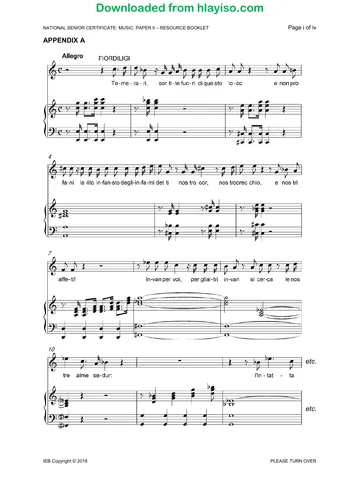
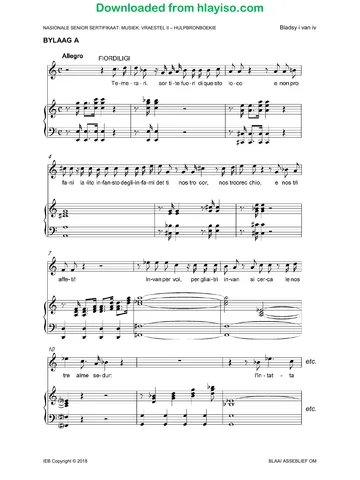
Refer to APPENDICES A, [Recitative from Act 1 no 14 of Cosi fan Tutte by W
A Mozart https://www.everynote.com/opera.show/156092.note Accessed 10
February 2018], B [3rd movement from Symphony No 5 in c minor by
Beethoven; IMSLP00081-Beethoven_-_Symphony_No_5_in_C_Minor__Op_
67_-_III_-_Allegro Accessed 6 January 2018], and C ["Little Shop of Horrors"
from Little Shop of Horrors: Miller Music Service Catalogue Number:
2123625832 NY, NY] in the Resource Booklet.
5.1 Choose the correct word/phrase from the following list to describe each
extract. Write your answers in the table below, giving a reason for each
choice.
APPENDIX DESCRIPTION REASON
Syllabic setting of words with
A Recitative
limited accompaniment.
This is in triple time: the 3rd
rd
3 movement from a movement is a Minuet or a
B
Symphony Scherzo which is always in
triple time.
The voices are singing the
C Chorus from a Musical same words in harmony in
English.
Other valid reasons will be accepted.
5.2 The following extract is written for clarinet in B flat which sounds a major
2nd lower than written. Rewrite it at concert pitch. Remember to include the
new key signature and all musical details.
MARKING: 0.5 for each note × 6 = 3. Key signature = 1.
IEB Copyright © 2018 PLEASE TURN OVER
Downloaded from hlayiso.com
NATIONAL SENIOR CERTIFICATE: MUSIC: PAPER II – MARKING GUIDELINES Page 12 of 12
5.3 Rewrite the following phrase in the tenor clef. Include the key signature.
MARKING: Key signature = 1; 0.5 for each note × 8 ÷ 4 = 2.
5.4 Use the phrase below to demonstrate:
(i) Inversion
(ii) Rhythmic diminution – include the rests. Do not change the time
signature.
ORIGINAL
INVERSION
DIMINUTION
Marking: 1 mark per compositional technique. If bar line is included in
diminution, only 0.5.
Total: 50 marks
IEB Copyright © 2018
Study this subject
Revise the topics in this paper, then practise them question by question.
Recommended for this subject
More papers and memos for this grade and subject.
MemorandumIEB
Music Grade 12 IEB Paper 1 2019 Memo
MemorandumIEB
Music Grade 12 IEB Paper 1 2019 Memo (Afrikaans)
MemorandumIEB
Music Grade 12 IEB Paper 2 2019 Memo
MemorandumIEB
Music Grade 12 IEB Paper 2 2019 Memo (Afrikaans)
MemorandumIEB
Music Grade 12 IEB Paper 1 2018 Memo
MemorandumIEB
Music Grade 12 IEB Paper 1 2018 Memo (Afrikaans)
Related documents
MemorandumIEB
Music Grade 12 IEB Paper 2 2018 Memo (Afrikaans)
Question paperIEB
Music Grade 12 IEB Paper 2 2018 Question Paper
Question paperIEB
Music Grade 12 IEB Paper 2 2018 Question Paper (Afrikaans)
AddendumIEB
Music Grade 12 IEB Paper 2 2018 Addendum
AddendumIEB
Music Grade 12 IEB Paper 2 2018 Addendum (Afrikaans)
MemorandumIEB
Music Grade 12 IEB Paper 2 2017 Memo
More from Grade 12 Music
Question paperIEB
Music Grade 12 IEB Paper 1 2019 Question Paper
Question paperIEB
Music Grade 12 IEB Paper 1 2019 Question Paper (Afrikaans)
AddendumIEB
Music Grade 12 IEB Paper 1 2019 Addendum
AddendumIEB
Music Grade 12 IEB Paper 1 2019 Addendum (Afrikaans)
Question paperIEB
Music Grade 12 IEB Paper 2 2019 Question Paper
Question paperIEB