
Downloaded from hlayiso.com
NATIONAL SENIOR CERTIFICATE EXAMINATION
NOVEMBER 2017
MUSIC: PAPER II
MARKING GUIDELINES
Time: 1½ hours 50 marks
These marking guidelines are prepared for use by examiners and sub-examiners,
all of whom are required to attend a standardisation meeting to ensure that the
guidelines are consistently interpreted and applied in the marking of candidates'
scripts.
The IEB will not enter into any discussions or correspondence about any marking
guidelines. It is acknowledged that there may be different views about some
matters of emphasis or detail in the guidelines. It is also recognised that,
without the benefit of attendance at a standardisation meeting, there may be
different interpretations of the application of the marking guidelines.
IEB Copyright © 2017 PLEASE TURN OVER
Skip to contentMemorandum 
View all
Music Grade 12 IEB Paper 2 2017 Memo
IEB Grade 12 Music Paper 2 memorandum from the 2017, 10 pages. Read online or get the free PDF download, question paper linked when available.
Publisher: IEB
Music · Grade 12 · 2017. Memorandum, 10 pages. Read online or download the PDF.
- Subject
- Music
- Grade
- Grade 12
- Document type
- Memorandum
- Year
- 2017
- Paper
- 2
- Publisher
- IEB
- Curriculum
- IEB
- Pages
- 10
- File size
- 456.5 KB
Loading document…
Loading document…
1 of 10
Document textSearch extracted text and jump to a page.
Downloaded from hlayiso.com
NATIONAL SENIOR CERTIFICATE: MUSIC: PAPER II – MARKING GUIDELINES Page 2 of 10
QUESTION 1
1.1 Add the missing notes to complete the scale of C sharp harmonic minor.
MARKING: Scale = 1: the scale is right or wrong.
1.2 Add the necessary accidentals to create the major scale of which the given
starting note is the dominant.
MARKING: (E Flat Major): Scale = 1: the scale is right or wrong.
1.3 Write the scale of D melodic minor, ascending, with a key signature. Use
the given time signature, and your own rhythm, grouping the notes
correctly. End on the given note value and complete the second bar with
rests.
MARKING: Scale including KS = 1; the scale is right or wrong.
Grouping: 1 mark – bar 1
0.5 per beat
Rests: 1 mark – bar 2
Any grouping will be accepted, as long as it is correct in compound
duple time.
IEB Copyright © 2017 PLEASE TURN OVER
Downloaded from hlayiso.com
NATIONAL SENIOR CERTIFICATE: MUSIC: PAPER II – MARKING GUIDELINES Page 3 of 10
1.4 Harmonise the following soprano notes to form an interrupted cadence in
four parts (SATB or for keyboard). Use the dominant seventh tetrad. Name
the key and figure the chords. Use correct voice leading.
MARKING: V7 = 1 mark; VI = 1 mark. Resolution: Leading note must
rise to tonic or fall to 5th; 7th must fall to mediant. – 0.5 for no
figuring/– 0.5 for incorrect resolution.
1.5 Write the blues scale on D. Use semibreves.
MARKING: 1 mark: the scale is right or wrong.
1.6 Add the necessary accidentals to create the A Lydian mode.
MARKING: 1 mark: mode is right or wrong.
IEB Copyright © 2017 PLEASE TURN OVER
Downloaded from hlayiso.com
NATIONAL SENIOR CERTIFICATE: MUSIC: PAPER II – MARKING GUIDELINES Page 4 of 10
1.7 Identify the scale used in this melody.
ANSWER: Whole Tone [on G]
1.8 Study the extract below and choose three (3) statements from the given list
which best describe the music.
Compound major 7th Irregular metre Contrary motion
Similar motion Dorian mode Ostinato
Pedal point Regular & irregular metre Pentatonic scale
Only 3 to be ticked
IEB Copyright © 2017 PLEASE TURN OVER
Downloaded from hlayiso.com
NATIONAL SENIOR CERTIFICATE: MUSIC: PAPER II – MARKING GUIDELINES Page 5 of 10
1.9 Identify each note by its (1) degree and (2) technical name according to the
given key signature.
MAJOR KEY MINOR KEY
Degree of the scale: 2nd (0.5) 5th (0.5)
Technical name: Supertonic (0.5) Dominant (0.5)
IEB Copyright © 2017 PLEASE TURN OVER
Downloaded from hlayiso.com
NATIONAL SENIOR CERTIFICATE: MUSIC: PAPER II – MARKING GUIDELINES Page 6 of 10
QUESTION 2
Refer to the melody printed below. ["Who will buy?" from Oliver! Page 105,
Bars 91–105: Oliver! by Lionel Bart; 1960; Lakeview Music Publishing Co.
Ltd, London.]
2.1 Name the scale used in this melody.
Pentatonic
2.2 What is the structure (form) of the entire melody?
AABA
2.3 With reference to the melody above, identify similarities in the way that
Mozart and Bart depict the social status of their characters in the music.
Leporello and Fagin are both comic characters (to an extent): both
sing in the "patter" style, which emphasises their lower class,
supposedly limited education. Chromatic, conjunct, narrow range.
Donna Anna and Oliver are both from higher social class, although
Oliver's present situation doesn't reflect this. They both sing lyrical
melodies with long phrases e.g. "Who will buy?" (Oliver!) and Donna
Anna's lines in the introduction to Don Giovanni. Melismatic, wide
range. Dotted rhythms, legato, diatonic.
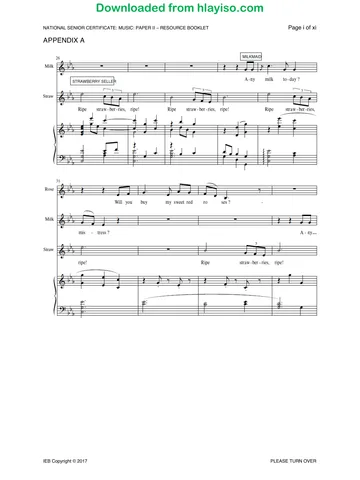
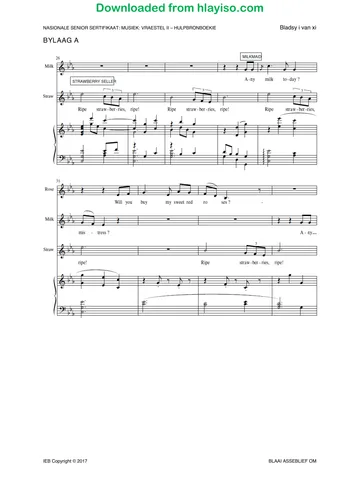
2.4 Refer to APPENDIX A in the Resource Booklet.
Identify the texture of the extract. Explain how Lionel Bart creates the
texture.
Polyphonic – [many melodies at the same time] (1 mark). Each of the
street sellers has his/her own melody, which are initially heard
individually but in this section, they are written so that they overlap,
creating a polyphonic texture. (1 mark)
IEB Copyright © 2017 PLEASE TURN OVER
Downloaded from hlayiso.com
NATIONAL SENIOR CERTIFICATE: MUSIC: PAPER II – MARKING GUIDELINES Page 7 of 10
QUESTION 3
The following questions are based on APPENDICES B ["Cool" from West Side
Story by Leonard Bernstein], C [Extract from Finale to Act 2 of La Traviata by
Giuseppe Verdi], D [An Sylvia by Schubert] and E [4th movement from
Symphony No 101 by Franz Josef Haydn
<http://ks.imslp.net/files/imglnks/usimg/8/89/IMSLP28930-PMLP07581-haydn-
sym-101-mvmt4-ccarh.pdf>] in the Resource Booklet.
3.1 Refer to APPENDIX B in the Resource Booklet.
3.1.1 Identify the century/stylistic period in which this work was written.
20th century (21st also acceptable)/Modern or Post-Modern
3.1.2 Give a reason, based on the instrumentation of the extract, for your
answer in 3.1.1.
The orchestration includes saxophones, xylophone,
vibraphone, electric guitar and piano. Large percussion section.
3.1.3 Identify the scale used in the motive labelled W.
W: Chromatic Scale
3.1.4 Identify the intervals labelled (i) and (ii).
(i) Major 7th
(ii) Diminished 5th
3.1.5 Add the correct time signature to the first bar of the phrase printed
below.
3/2
IEB Copyright © 2017 PLEASE TURN OVER
Downloaded from hlayiso.com
NATIONAL SENIOR CERTIFICATE: MUSIC: PAPER II – MARKING GUIDELINES Page 8 of 10
3.1.6 The phrase below is written for trumpet in B flat which sounds a
major 2nd lower than written. Rewrite it at concert pitch. Remember
to include the new key signature, and all musical details.
MARKING: Key signature = 0.5; 0.5 per note x 7 = 3.5 (except for
the tied note at the end).
3.2 Refer to APPENDIX C.
3.2.1 Identify the genre of this extract.
Opera
3.2.2 With reference to a non-musical element, compare the genres
represented by Appendix B and Appendix C.
Appendix B is Musical/Musical Theatre and Appendix C is
Opera. In Opera, the dialogue is sung/in musical it is spoken.
Musicals include dancing – operas generally don’t. Opera is
written in Italian or German but Musicals are in the vernacular of
the country/English. 2 acts/3-5 acts; Amplified, not amplified.
3.2.3 What is the texture of this extract? Give a reason for your answer.
Monophonic/Unison (1): all parts are singing and playing
exactly the same notes, although in different octaves. (1)
3.2.4 Use the phrase printed below to demonstrate melodic inversion:
Marking: 0.5 per bar × 4 = 2.
IEB Copyright © 2017 PLEASE TURN OVER
Downloaded from hlayiso.com
NATIONAL SENIOR CERTIFICATE: MUSIC: PAPER II – MARKING GUIDELINES Page 9 of 10
3.3 Refer to APPENDIX D in the Resource Booklet.
3.3.1 Describe the characteristics of the genre represented by this work.
It is a German Lied (no mark) which became a very popular
genre in the Romantic period because of the combination of
music and poetry. Solo voice + piano set German poetry. Piano
has an equal role. Can be strophic/through composed. Any
other valid answer.
3.3.2 Identify the key of the work.
A Major
3.3.3 Figure the chords in the block labelled X.
Bar 9 Beat 1: V
Bar 9 Beat 2: V7d / V4/2
Bar 9 Beat 3: Ib / I6
3.4 Refer to APPENDIX E in the Resource Booklet.
3.4.1 Identify the genre and the stylistic period of the extract.
Classical Symphony.
3.4.2 Comment on how the woodwind section of the orchestra assists you in
identifying the style of the work.
The woodwinds are paired, typical of a Classical orchestra.
Given a more prominent role in the orchestra, e.g. melodic
interplay with strings.
3.4.3 Rewrite the phrase at the same pitch in the treble clef.
Marking: 1 mark per bar
IEB Copyright © 2017 PLEASE TURN OVER
Downloaded from hlayiso.com
NATIONAL SENIOR CERTIFICATE: MUSIC: PAPER II – MARKING GUIDELINES Page 10 of 10
3.4.4 Refer to Bar 43 in the score. Find and name the non-harmonic notes
in the 2nd violin and viola parts. Label them on the extract below.
Total: 50 marks
IEB Copyright © 2017
Study this subject
Revise the topics in this paper, then practise them question by question.
Recommended for this subject
More papers and memos for this grade and subject.
MemorandumIEB
Music Grade 12 IEB Paper 1 2019 Memo
MemorandumIEB
Music Grade 12 IEB Paper 1 2019 Memo (Afrikaans)
MemorandumIEB
Music Grade 12 IEB Paper 2 2019 Memo
MemorandumIEB
Music Grade 12 IEB Paper 2 2019 Memo (Afrikaans)
MemorandumIEB
Music Grade 12 IEB Paper 1 2018 Memo
MemorandumIEB
Music Grade 12 IEB Paper 1 2018 Memo (Afrikaans)
Related documents
MemorandumIEB
Music Grade 12 IEB Paper 2 2017 Memo (Afrikaans)
Question paperIEB
Music Grade 12 IEB Paper 2 2017 Question Paper
Question paperIEB
Music Grade 12 IEB Paper 2 2017 Question Paper (Afrikaans)
Question paperIEB
Music Grade 12 IEB Paper 2 2017 Question Paper
Question paperIEB
Music Grade 12 IEB Paper 2 2017 Question Paper (Afrikaans)
MemorandumIEB
Music Grade 12 IEB Paper 1 2017 Memo
More from Grade 12 Music
Question paperIEB
Music Grade 12 IEB Paper 1 2019 Question Paper
Question paperIEB
Music Grade 12 IEB Paper 1 2019 Question Paper (Afrikaans)
AddendumIEB
Music Grade 12 IEB Paper 1 2019 Addendum
AddendumIEB
Music Grade 12 IEB Paper 1 2019 Addendum (Afrikaans)
Question paperIEB
Music Grade 12 IEB Paper 2 2019 Question Paper
Question paperIEB