
Downloaded from hlayiso.com
NATIONAL SENIOR CERTIFICATE EXAMINATION
NOVEMBER 2019
MUSIC: PAPER I
MARKING GUIDELINES
Time: 3 hours 100 marks
These marking guidelines are prepared for use by examiners and sub-examiners,
all of whom are required to attend a standardisation meeting to ensure that the
guidelines are consistently interpreted and applied in the marking of candidates'
scripts.
The IEB will not enter into any discussions or correspondence about any marking
guidelines. It is acknowledged that there may be different views about some
matters of emphasis or detail in the guidelines. It is also recognised that,
without the benefit of attendance at a standardisation meeting, there may be
different interpretations of the application of the marking guidelines.
IEB Copyright © 2019 PLEASE TURN OVER
Skip to contentMemorandum 
View all
Music Grade 12 IEB Paper 1 2019 Memo
IEB Grade 12 Music Paper 1 memorandum from the 2019, 18 pages. Read online or get the free PDF download, question paper linked when available.
Publisher: IEB
Music · Grade 12 · 2019. Memorandum, 18 pages. Read online or download the PDF.
- Subject
- Music
- Grade
- Grade 12
- Document type
- Memorandum
- Year
- 2019
- Paper
- 1
- Publisher
- IEB
- Curriculum
- IEB
- Pages
- 18
- File size
- 593.7 KB
Loading document…
Loading document…
1 of 18
Document textSearch extracted text and jump to a page.
Downloaded from hlayiso.com
NATIONAL SENIOR CERTIFICATE: MUSIC: PAPER I – MARKING GUIDELINES Page 2 of 18
QUESTION 1
1.1 Listen to Track 1 (02:17) [Minuet and Trio from Eine Kleine Nachtmusik
by W A Mozart. Music – An Appreciation by Roger Kamien. CDs to
accompany the 9th Edition; Disk 3 Track 46-48; McGraw-Hill
Companies/Sony BMG Music 2006]. The melody line, with some bars
missing, is printed below.
IEB Copyright © 2019 PLEASE TURN OVER
Downloaded from hlayiso.com
NATIONAL SENIOR CERTIFICATE: MUSIC: PAPER I – MARKING GUIDELINES Page 3 of 18
1.1.1 This is a Minuet and Trio by Mozart. The end of the first section of
the Minuet is indicated in Bar 8a and 8b using 1st and 2nd time bars
and repeat signs. In the same way, on the score, mark the following:
(a) end of the Minuet/beginning of the Trio.
(b) the end of the first section of the Trio.
Marking: 1 mark for end of section
½ for correct use of 1st and 2nd time bars
1.1.2 Name the cadence at the end of the Minuet and state the chords that
form it.
Perfect: V – I
1.1.3 Name the key of the Trio and state its relationship to the key of the
Minuet.
D Major – the dominant key.
1.1.4 Bar 27, 29, 30 and 32 are printed below in random order. Listen to
Track 1a (00:49) which is the Trio and write the correct bar number
next to each phrase.
BAR NUMBER
32
29
30
27
1.1.5 State the bar number in which you find six consecutive notes of a
chromatic scale.
Bar 21 or Bar 33
IEB Copyright © 2019 PLEASE TURN OVER
Downloaded from hlayiso.com
NATIONAL SENIOR CERTIFICATE: MUSIC: PAPER I – MARKING GUIDELINES Page 4 of 18
1.2 Listen to Track 2 (01:05). [Extract from the Overture to Candide by
Leonard Bernstein. <https://www.youtube.com/watch?v=YaY2iAC4Y-
w>: accessed 9 February 2019]. An extract from the piano reduction of
the score is printed below.
A
1.2.1 This extract contains three changes of time signature. Add the
correct time signatures where necessary.
Bar 1: 2/4; Bar 3: 3/2; Bar 4: 2/2 or 4/4
1.2.2 Apart from the changing time signatures, name one other way in
which the composer creates rhythmic interest in the piece.
Use of shifting accents, which create a feeling of syncopation.
Use of sforzando. Triplets, repetition of rhythmic motive, triplet
motive gives way to quaver motive.
1.2.3 Name a scale which contains the five notes in the block labelled A.
B Flat major / g minor / F Major / d melodic minor
Listen to Track 3 (01:13): [Extract from "Mars, the Bringer of War", from The
Planets – Gustav Holst: Holst The Planets. Track 1; Los Angeles
Philharmonic Orchestra, Zubin Mehta; Decca 4785558, 2011]
1.3 Place six ticks to identify features present in the music.
Compound time Triple metre
Dissonant harmony x Imitation x
Sequence x Consonant harmony
Quintuple metre x Monophonic texture
Major tonality Ostinato x
Triplets x Simple time
IEB Copyright © 2019 PLEASE TURN OVER
Downloaded from hlayiso.com
NATIONAL SENIOR CERTIFICATE: MUSIC: PAPER I – MARKING GUIDELINES Page 5 of 18
Listen to Track 3a (00:16). It is the melody from Track 3. [Set on Sibelius © by
the examiner.]
1.4 Place a tick next to the melodic shape that you hear.
x
IEB Copyright © 2019 PLEASE TURN OVER
Downloaded from hlayiso.com
NATIONAL SENIOR CERTIFICATE: MUSIC: PAPER I – MARKING GUIDELINES Page 6 of 18
QUESTION 2
Listen to Track 4 (01:10) [Recitative from The Marriage of Figaro – Mozart],
Track 5 (01:04) [Quintet from West Side Story – Bernstein] and Track 6
(01:08) ["La Donna e Mobile": Luciano Pavarotti
https://www.youtube.com/watch?v=xCFEk6Y8TmM Accessed 9 February 2019]
2.1 Identify and define the element of opera/musical theatre heard in each
track.
The answer is tabulated here for ease of reference.
Track 4 Track 5 Track 6
Name the Recitative Ensemble Aria
Element of (secco)
Opera/Musical
heard in the track
[1 mark per track
× 3 = 3 marks]
Define the Speech-like Two or more
Soloist
element named song with characters
accompanied
above. limited singing at the
by orchestra.
accompaniment same time.
Expresses
[1 mark per track
used to convey Expressing
emotions /
× 3 = 3 marks]
dialogue their ownreactions to the
Harpsichord emotions /
action that has
accompaniment. feelings.just occurred
Moves action Does not
forward advance the
action.
Shows off the
skill of the
singer.
Must state two of three facts for ½ mark each. The underlined fact is
required.
Listen to Track 7 (01:27) [Oliver's melody from "Who will Buy" from Oliver! by
Lionel Bart; 1991; National Symphony Orchestra conducted by John Owen
Edwards; TER Ltd CDTER1184]
2.2 Indicate whether the following statements about this track, and the work
from which it is taken, are TRUE or FALSE. If the statement is false, provide
the correct answer: e.g. Oliver! is written in Dutch. Answer: False, it is
written in English.
(a) The melody sung by Oliver in this track is in ABA form TRUE
(b) The opening melody sung by Oliver in this track is based on the
Jewish Phrygian dominant scale. FALSE – Pentatonic Scale /
Fagin’s song, "Reviewing the situation", is based on the Jewish
Phrygian dominant scale.
IEB Copyright © 2019 PLEASE TURN OVER
Downloaded from hlayiso.com
NATIONAL SENIOR CERTIFICATE: MUSIC: PAPER I – MARKING GUIDELINES Page 7 of 18
(c) The musical Oliver! was written by Duke Ellington. FALSE – Lionel
Bart
(d) This song is sung by Oliver after he has been taken in by Mr
Brownlow. TRUE
(e) The opening of this number (before the section heard on this track)
develops into a homophonic texture because of the intertwining of
the street sellers' cries. FALSE – Polyphonic texture
Listen to Track 8 (01:05). ["Madamina"(Catalogue Aria) from Don Giovanni –
Mozart. Music – An Appreciation by Roger Kamien. CDs to accompany the
9th Edition: Disk 3 Track 62; McGraw-Hill Companies/Sony BMG Music 2006]
and Track 9 (01:05) ["I'm Reviewing the Situation" from Oliver! by Lionel
Bart; 1991; National Symphony Orchestra conducted by John Owen
Edwards; TER Ltd CDTER1184]
2.3 State how the social status/cultural background of each character is
portrayed through the musical setting.
Leporello: lower class, comic character is depicted through the patter
singing and short phrases. Syllabic (½).
Fagin: is also lower class, and he is Jewish. He also has patter
phrases and his Jewish heritage is depicted through the elements of
the Klezmer style that are evident in the song including the fluctuating
tempo, oom-pah bass and the violin flourishes which are based on the
Jewish Phrygian Dominant scale.
Both characters must be mentioned.
2.4 Compare the subject matter of the tracks. Do not refer to the language of
the tracks.
Leporello is not singing about himself – he is telling us about Don
Giovanni's conquests. We learn the most about Don Giovanni in this
aria – from how many women he has conquered to the nationalities
and the different types of women he likes.
Fagin is singing about himself: he is reviewing his life and considering
whether he should turn away from a life of crime. We learn more about
Fagin from this song.
2.5 Comment on the effectiveness of the tempo and meter change between the
two sections of Track 8 with specific reference to the setting of the lyrics.
Section B is much slower than section A and it is in triple time
whereas A is in quadruple time. This is effective because, in Section
A, Leporello is enumerating the women that Don Giovanni has
conquered and the fast tempo and "even" meter imitates an abacus/
counting machine. In Section B, he describes the characteristics of
the women and the slower tempo, in the style of a Minuet in triple time,
imitates some of the characteristics, e.g. gracefulness of the blonds
and the constancy of the brunettes are reflected in the lyrical melody.
Also accept answers directly related to what is heard in Track 8.
IEB Copyright © 2019 PLEASE TURN OVER
Downloaded from hlayiso.com
NATIONAL SENIOR CERTIFICATE: MUSIC: PAPER I – MARKING GUIDELINES Page 8 of 18
QUESTION 3
Refer to SCORE A ["Jupiter" from The Planets by Gustav Holst: IMSLP05396-
Holst_-_THE_PLANETS_-_Suite_for_Large_Orchestra_-_Partitur accessed
st
29 December 2018], SCORE B [1 movement from Symphony No 94 in G
Major by Haydn IMSLP262221-SIBLEY1802.25015.df42-39087009351356
score accessed 30 January 2018] and SCORE C [Hebrides' Overture by
Mendelssohn IMSLP122244-PMLP05059-Mendelssohn_-_Die_Hebriden_FS_
rsl accessed 29 December 2018]
3.1 Place the three scores in chronological order by completing the table below.
Write the letter of each score.
Classical Romantic 20th Century
A C B
3.1.1 Give reasons as indicated for your choice above by comparing at
least two of the scores.
REASON 1: with reference to the string family.
• Score A has the cellos and basses written on one stave –
typical of the Classical period.
• Score B and C have the lower strings written on separate
staves – typical of Romantic and later works because the
lower strings become more independent.
REASON 2: with reference to the wind instruments.
• Score B includes piccolo, cor anglais and bass clarinet
which point to a later orchestra than the one in Score C.
• Score C includes flutes, clarinets, oboes and bassoons, but
no auxiliary instruments.
• Score A and C have fewer brass instruments.
• Score A only uses flutes, oboes and bassoons. There is no
clarinet, which was only added to the orchestra by Mozart.
Other responses, relating to the melody / harmonic material of the scores or
other stylistic characteristics, were credited as long as they were correct in
relation to the scores.
IEB Copyright © 2019 PLEASE TURN OVER
Downloaded from hlayiso.com
NATIONAL SENIOR CERTIFICATE: MUSIC: PAPER I – MARKING GUIDELINES Page 9 of 18
3.2 The following extract, from another section of Score C, is written for two
clarinets in A, which sound a minor 3rd lower than written. Rewrite the music
at concert pitch. Remember to include the new key signature and all
musical details.
MARKING: ½ for each note x 6 = 3. Key signature = 1
3.3 This melody is taken from another section of Score A. Rewrite it in the
equivalent compound time signature. Remember to include the new time
signature.
MARKING: ½ × 3 beats = 1½ + ½ for time signature = 2
3.4 Identify the following intervals labelled (i), (ii) and (iii) on Score B. Intervals
(i) and (ii) are printed below for ease of reference. Please refer to the score
for interval (iii).
(i) Between the lowest note of the clarinet and the lowest note of the
oboe: Minor 7th
(ii) Between the double bass and the viola: Perfect 8ve
(iii) Between the two flutes: Major 3rd
IEB Copyright © 2019 PLEASE TURN OVER
Downloaded from hlayiso.com
NATIONAL SENIOR CERTIFICATE: MUSIC: PAPER I – MARKING GUIDELINES Page 10 of 18
QUESTION 4
Listen to Track 10 (01:29). [USA Special performed by the N D HotShots:
Track 1 from African Jazz 'n Jive: An Authentic Selection of South African
Township Swing Classics from the 50s and 60s. Gallo Record Company
CDZAC 75, 2000] and Track 11 (01:11)
[Bergville Green Lovers https//www.youtube.comwatchv=KopUIfKPSow
accessed 15 February 2019]
4.1 Read each statement and then write the track number under the correct
answer. In each case, only two of the three answers will be used.
EXAMPLE:
STATEMENT
The style of the track is: Classical Romantic 20th Century
TRACK NUMBER 8 9
STATEMENT
The roots of this style of Indigenous musical Marabi Mbaqanga
music lie in: styles
TRACK NUMBER 11 10
This style of music is Sophiatown Shebeens & Zulu migrant workers
most associated with: gangsters and all-male mining
hostels
TRACK NUMBER 10 10 11
This style of music was American Big Band Vocal jive jazz African-American
also influenced by: swing close harmony
TRACK NUMBER 10 11
A typical characteristic of Call-and-response Heavy melodic bass Short, 2–3 note
the style is: phrases
TRACK NUMBER 11 10
The texture of the track is: Mainly polyphonic Mainly homophonic A mixture of
homophonic &
polyphonic texture
TRACK NUMBER 10 / 11 10 / 11
The timbre of the track is Saxophones & brass A capella, multi-part The kwela flute
dominated by: male voices
TRACK NUMBER 10 11
IEB Copyright © 2019 PLEASE TURN OVER
Downloaded from hlayiso.com
NATIONAL SENIOR CERTIFICATE: MUSIC: PAPER I – MARKING GUIDELINES Page 11 of 18
Listen to Track 12 (01:27). [Pata Pata – Miriam Makeba from the album Welela]
4.2 Tick the cyclical chord progression that you hear in Track 12.
I – iib (ii6) – IV – V I – IV – V – I
I – IV – Ic (I6/4) – V I – vi – IV – V
4.3 This song is in D major. Write the chord progression that you have chosen
above without key signature, but with any necessary accidentals. Indicate
the key and figure the chords.
D:
Marking: ½ per chord X 4 = 2. If incorrect progression is chosen in 4.2,
but the correct corresponding chords are written in 4.3, these will be
marked correct. (-½ if no figuring)
Listen to Track 13 (01:15). [Meadowlands performed by Nancy Jacobs and
her Sisters. Track 5 from The History of Township Music – WRASSE
Records: WRASS029. All titles published by Gallo Music 2001]
4.4 The lyrics of the first and second verses of the song are printed below. In the
right hand column, add the missing musical details as indicated:
LYRICS
Number of Bars (1): 4 bars
INTRODUCTION Played by (2): piano, double bass, guitar &
drum kit (any two instruments)
Sizohamba ubusuku nemini Describe the use of the voices (1):
SiyeGoli eMeadowlands Solo female voice singing the main
Sizohamba ubusuku nemini melody with female backing vocals
SiyeGoli eMeadowlands repeating the word "Meadowlands"
Meadowlands, Meadowlands, Describe the use of the voices (1):
Meadowlands sithandwa sam All female voices singing in harmony.
Otla utlwa makgowa a re, Comment on the piano part and name the
A re yeng ko Meadowlands texture that is created (1):
Otla utlwa makgowa a re, Improvises a counter-melody above the
A re yeng ko Meadowlands singers creating a polyphonic texture.
Meadowlands, Meadowlands,
Meadowlands sithandwa sam
IEB Copyright © 2019 PLEASE TURN OVER
Downloaded from hlayiso.com
NATIONAL SENIOR CERTIFICATE: MUSIC: PAPER I – MARKING GUIDELINES Page 12 of 18
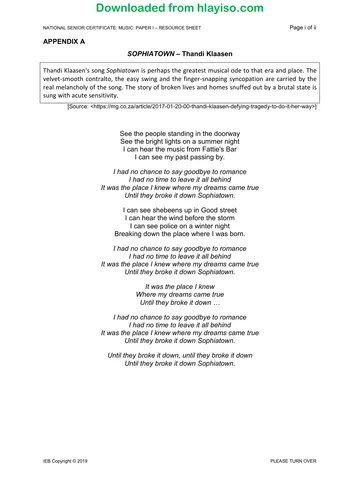
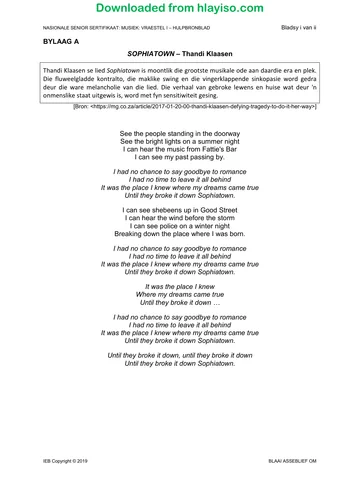
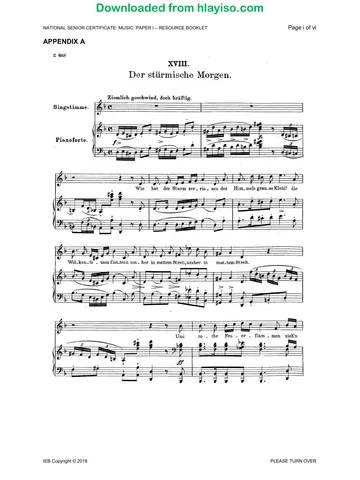
Listen to Track 14 (04:31). The lyrics can be found in the Resource Sheet as
APPENDIX A [Sophiatown by Thandi Klaasen:
<https://www.youtube.com/watch?v=Fu-vBX7oKKU>: accessed 30 January
2018]
4.5 Name the Apartheid law, and explain its consequences, which led to the
events referred to in this song.
The Group Areas Act of 1950 led to the forced removal of the residents
of Sophiatown to Meadowlands in Soweto.
4.6 Evaluate the use of the following elements of music in the creation of the
mood of the song: tempo, tonality and melody. Include appropriate
comparisons with Meadowlands to substantiate your evaluation.
This memo is tabulated for ease of reference. The answer must be written
as a paragraph.
Musical Mood created in
Track 14 Sophiatown Meadowlands
Element Sophiatown
Tempo Slow tempo Fast, upbeat Reflective mood
Tonality Major but sounds Melancholy, sad
Major key
like minor/blues mood.
Melody Vocal melody:
lyrical, wide range.
Vocal melody:
Lyrical trumpet
Limited range,
melody in the Sense of loss of
repetitive. Simple.
introduction and places that she
Improvised
then as loved and were part
countermelody in
countermelody to of her life.
the piano in verses
voice.
2, 3 and 4
Melodic bass line –
typical of Mbaqanga
Other valid responses will be considered.
Evaluation: Maximum of 3 marks
Comparison: Maximum of 4 marks
IEB Copyright © 2019 PLEASE TURN OVER
Downloaded from hlayiso.com
NATIONAL SENIOR CERTIFICATE: MUSIC: PAPER I – MARKING GUIDELINES Page 13 of 18
4.7 Compare the lyrics of Sophiatown with those of Meadowlands. Use
quotations from the lyrics to support your comparison. Do not refer to the
language of the lyrics.
• The lyrics of Sophiatown paint a picture of places that were
destroyed and refer to specific places in Sophiatown, which Thandi
Klaasen remembers: "Fattie's Bar" and "Good Street".
• There is a true sense of having belonged ("breaking down the
place where I was born") and the sadness of not having had a
chance to say goodbye. ("I had no chance to say goodbye to
romance").
• However, the lyrics of Meadowlands, written in three different
languages, are more superficial and send a mixed message that
the people of Sophiatown are seemingly willing to leave ("go to
Meadowlands, our beloved place" – sung with irony and sarcasm),
• and yet this is not the true meaning of the lyrics. The irony is subtle
and covert, ("staying here in our beloved place" – referring to
Sophiatown – their truly-beloved home – sung with honesty and
sincerity)
• Written in order to "fool" the authorities into thinking that the song
supported the relocation of the residents to Soweto.
• Sophiatown was written after the event, as a reflection on what had
happened, whereas
• Meadowlands was a protest song written at the time to express the
feelings of the people.
IEB Copyright © 2019 PLEASE TURN OVER
Downloaded from hlayiso.com
NATIONAL SENIOR CERTIFICATE: MUSIC: PAPER I – MARKING GUIDELINES Page 14 of 18
QUESTION 5
Listen to Track 15 (04:06), [Erlkönig: Schubert – Original] and Track 16 (03:45)
[Erlkönig Rammstein].
Write an essay in which you compare Track 15 and Track 16.
In addition to the general elements of music, also compare the setting of the lyrics,
word painting, programmatic elements and mood.
Include the following information in your discussion:
• The name of the poet
• A definition of the genre
• The form of the work, with an explanation
• Name two non-musical Romantic characteristics in the work
Offer your own opinion as to which track you prefer, and justify it with reference to
the use of at least two elements of music. Ensure that the comparison forms the
body of the essay and that both similarities and differences are discussed.
Your essay will be marked using the following rubric:
RUBRIC FOR ESSAY
Clearly demonstrates an understanding of the question, cites factual evidence, completes all
requirements, and provides an insightful comparison of the works, with reference to both the
20–16
general characteristics of the genres and the specific features of the two tracks. Own opinion of
the works is offered with insight and specific reference to the use of the elements of music.
Demonstrates an understanding of the question, completes all requirements, cites factual
15,5– evidence and provides some comparison of the works, with some reference to both the general
10,5 characteristics of the genres and the specific features of the tracks. Own opinion of the works is
offered with limited insight and some generalisation in terms of the use of the elements of music.
Meets all of the requirements, but demonstrates only a partial understanding of the question and
limited factual evidence. Comparison of the works is limited with only partial reference to either
10–5,5 the general characteristics of the genre or the specific features of the tracks. Own opinion is
limited with little or no reference to the use of the elements of music. There is an imbalance
between the sections of the essay.
Demonstrates minimal understanding of the question, does not complete all requirements, and
5–0,5 provides only a vague reference to, or no use of, the facts. No comparison or opinion is offered.
There is no balance within the essay.
IEB Copyright © 2019 PLEASE TURN OVER
Downloaded from hlayiso.com
NATIONAL SENIOR CERTIFICATE: MUSIC: PAPER I – MARKING GUIDELINES Page 15 of 18
THE ANSWER TO THIS QUESTION MUST BE WRITTEN IN ESSAY FORM –
THE MEMO IS TABULATED FOR EASE OF REFERENCE.
Poet (1) Goethe
Definition of Lied (0): solo voice and piano in German (1)
Genre (1)
Form + Through composed – different music for each verse
Explanation (2)
Two non-musical Fascination with nature – this is set in nature
Romantic Fascination with the supernatural – the Erlking and his daughters are supernatural
characteristics beings.
(2) Romantic belief that a child retained spiritual purity and was closer to the
supernatural realm. The child can see what the father cannot.
Miniature piece – lied. Romantic music was "miniature" or "monumental"
Combination of music and poetry.
Nationalism because of the use of folklore.
Track 15: Original Track 16 Rammstein
Tonality & Minor for the father, son and narrator. Minor throughout. No change of tonality for
harmony Major for the Erlking's sections – although the Erlking's sections whereas in the
in the last verse, the Erlking sings in the original, the Erlking sings in the major key.
minor key to display his anger.
Harmony is not as complex.
Complex, chromatic harmony. Use of
ths
diminished 7
The postlude at the end has a major
In a lower key (g minor) than the section
arrangement.
Metre Quadruple Triple / Compound
Tempo The original tempo is "Schnell". Slower than Track 15
There is an accelerando towards the end
as per the performance directions.
Melody / Pitch Each of the four characters sing in a Melody is different – triple meter
different register of the voice: the father – contributes to this as well.
low; son – upper register; Erlking and
narrator in middle register. The depiction The rising left hand melodic figure in the
of the Erlking's character is additionally introduction is not present.
enhanced by the change of tonality (to
major) and the change in the Erlking's accompaniment pattern does not
accompaniment pattern. change, as it does in the original.
Wider range than Rammstein
Lyrics True to the original German. True to the original German.
Both in German
Three characters plus a narrator are
depicted in the lyrics.
Programmatic The galloping horse is represented by a The horse is not depicted by piano triplets
Elements repetitive triplet pattern throughout in the but rather by the tambourine playing on
right hand. the off-beats, creating a triplet feel.
The accelerando towards the end depicts
the urgency of getting to safety and then
the ritardando depicts the horse slowing to
a trot as they reach home.
IEB Copyright © 2019 PLEASE TURN OVER
Downloaded from hlayiso.com
NATIONAL SENIOR CERTIFICATE: MUSIC: PAPER I – MARKING GUIDELINES Page 16 of 18
Word Painting The rising fear of the child is depicted by The rising fear of the child is not conveyed
the repetitive rising chromatic motive, by the melody – it lacks the rising
which gets higher each time the child semitone and rather falls, which detracts
sings. from the anxiety.
The death of the child at the end, originally
The narrator's line telling of the death of depicted using recitative, is now followed
the child is in recitative, which emphasises by a postlude in the major key.
the tragedy. Production techniques used to delineate/
define characters
"Todt" is sung with more empathy to reflect
the sadness of the child's death.
Rhythm Driving rhythm as a result of the triplet The triple meter results in a more relaxed
figure in the accompaniment. rhythm. Rhythm uses a lot of "long-short"
(minim/crotchet patterns). Feels like a
Narrator sings mainly in even notes values waltz. Lacks the driving rhythm of the
– indicates his objectivity as the story-teller original.
Dotted rhythms characterises the son's
melody: "Mein vater", and the father's
melody.
Erlking sings in longer, relatively even note
values.
Timbre Male voice accompanied by solo piano. Male voice – harsh tone.
Drum kit. Rhythm guitar.
Bass and lead guitar using distortion,
Piano, tambourine
Distorted voices
Texture Homophonic texture. Dense texture but mainly homophonic with
polyphonic sections where the guitar/bass
play counter melodies to the voice.
Dynamics Mezzo forte – forte throughout. Sudden Loud throughout. No dynamic variation.
changes of dynamics are not as
noticeable.
Structure Through composed with a 16-bar intro; Through-composed
3 or 4-bar interludes; perfect cadence after Much shorter introduction.
final recitative. Longer interludes between verses with the
lead guitar given a chance to solo.
Longer postlude.
Mood Anxious mood from the beginning which is The triple meter contributes to a less
heightened as the song progresses. anxious mood. The danger and panic of
the son is not as evident.
th st
Style Romantic (no mark) 20 Century / 21 Century / Rock / Metal
(½ )
IEB Copyright © 2019 PLEASE TURN OVER
Downloaded from hlayiso.com
NATIONAL SENIOR CERTIFICATE: MUSIC: PAPER I – MARKING GUIDELINES Page 17 of 18
QUESTION 6
Listen to Track 17 (01:40) [Anthropology – Charlie Parker from the album The
Genius of Charlie Parker; 2005; Savoy Jazz] and Track 18 (01:55) [Three to
get Ready – Dave Brubeck Quartet/Paul Desmond from Time Out Not Now
Music Limited 2011]
6.1 Place three ticks in Column A to identify unique features of Track 17 and
place three ticks in Column B to identify unique features of Track 18. Place
2 ticks in Column C to identify features common to both tracks.
Place ticks for common features only in Column C – do not tick in all
three columns.
COLUMN A COLUMN B COLUMN C
Unique features Unique features Common
of Track 17 of Track 18 features of Track
3 ticks 3 ticks 17 and Track 18
Parker Brubeck 2 ticks
Changing time
x
signatures
Call-and-response
between piano and x
saxophone
Saxophone
x
improvisation
Bass drum "bombs" x
Trumpet improvisation x
Piano improvisation x
Walking bass x
Quadruple time x
6.2 Identify the style of music represented by each track and state the decade
in which each developed.
Track 17: Bebop. 1940s
Track 18: Cool Jazz. 1945 / late 1940s / 1950s
MARKING: Name of style = ½ and decade = ½ = 2.
IEB Copyright © 2019 PLEASE TURN OVER
Downloaded from hlayiso.com
NATIONAL SENIOR CERTIFICATE: MUSIC: PAPER I – MARKING GUIDELINES Page 18 of 18
Listen to Track 19 (02:03) and Track 20 (01:35)
6.3 Choose six statements from the list below: two that are true for Track 19,
two that are true for Track 20 and two that are true for both tracks. Write the
NUMBER ONLY of each statement in the relevant column in the table
below.
6.3.1 Rhythm section consisting 6.3.6 Slower than Track 19
of bass, piano, drum kit.
6.3.2 Head is played twice at the 6.3.7 Solo improvisations on violin &
beginning muted trombone
6.3.3 No collective improvisation 6.3.8 The last solo is played by the
muted cornet
6.3.4 4-bar solo break precedes 6.3.9 Solo improvisations on trumpet
each improvisation & saxophone
6.3.5 Improvisations on trumpet 6.3.10 Imitation between the solo
and clarinet instruments
Unique to Unique to Common to
Track 19 Track 20 both
Statement
6.3.4 6.3.5 6.3.1
Number
Statement
6.3.7 6.3.10 6.3.2
Number
Statement
6.3.3
Number
6.4 Some of the solo instruments are in B flat, which sound a major 2nd lower
than written. Transpose the C blues scale so that it can be played by the
solo instruments. Use a key signature, and add any necessary accidentals.
MARKING: 1 mark – the scale is right or wrong. If correct, but written
without a key signature, -½. Can be written using the KS of D minor.
Total: 100 marks
IEB Copyright © 2019
Study this subject
Revise the topics in this paper, then practise them question by question.
Recommended for this subject
More papers and memos for this grade and subject.
MemorandumIEB
Music Grade 12 IEB Paper 1 2019 Memo (Afrikaans)
MemorandumIEB
Music Grade 12 IEB Paper 2 2019 Memo
MemorandumIEB
Music Grade 12 IEB Paper 2 2019 Memo (Afrikaans)
MemorandumIEB
Music Grade 12 IEB Paper 1 2018 Memo
MemorandumIEB
Music Grade 12 IEB Paper 1 2018 Memo (Afrikaans)
MemorandumIEB
Music Grade 12 IEB Paper 2 2018 Memo
Related documents
Question paperIEB
Music Grade 12 IEB Paper 1 2019 Question Paper
Question paperIEB
Music Grade 12 IEB Paper 1 2019 Question Paper (Afrikaans)
AddendumIEB
Music Grade 12 IEB Paper 1 2019 Addendum
AddendumIEB
Music Grade 12 IEB Paper 1 2019 Addendum (Afrikaans)
MemorandumIEB
Music Grade 12 IEB Paper 1 2017 Memo
MemorandumIEB
Music Grade 12 IEB Paper 1 2017 Memo (Afrikaans)
More from Grade 12 Music
Question paperIEB
Music Grade 12 IEB Paper 2 2019 Question Paper
Question paperIEB
Music Grade 12 IEB Paper 2 2019 Question Paper (Afrikaans)
Question paperIEB
Music Grade 12 IEB Paper 1 2018 Question Paper
AddendumIEB
Music Grade 12 IEB Paper 1 2018 Addendum
AddendumIEB
Music Grade 12 IEB Paper 1 2018 Addendum (Afrikaans)
Question paperIEB