
Downloaded from hlayiso.com
NATIONAL SENIOR CERTIFICATE EXAMINATION
NOVEMBER 2017
MUSIC: PAPER I
MARKING GUIDELINES
Time: 3 hours 100 marks
These marking guidelines are prepared for use by examiners and sub-examiners,
all of whom are required to attend a standardisation meeting to ensure that the
guidelines are consistently interpreted and applied in the marking of candidates'
scripts.
The IEB will not enter into any discussions or correspondence about any marking
guidelines. It is acknowledged that there may be different views about some
matters of emphasis or detail in the guidelines. It is also recognised that,
without the benefit of attendance at a standardisation meeting, there may be
different interpretations of the application of the marking guidelines.
IEB Copyright © 2017 PLEASE TURN OVER
Skip to contentMemorandum 
View all
Music Grade 12 IEB Paper 1 2017 Memo
IEB Grade 12 Music Paper 1 memorandum from the 2017, 15 pages. Read online or get the free PDF download, question paper linked when available.
Publisher: IEB
Music · Grade 12 · 2017. Memorandum, 15 pages. Read online or download the PDF.
- Subject
- Music
- Grade
- Grade 12
- Document type
- Memorandum
- Year
- 2017
- Paper
- 1
- Publisher
- IEB
- Curriculum
- IEB
- Pages
- 15
- File size
- 494.6 KB
Loading document…
Loading document…
1 of 15
Document textSearch extracted text and jump to a page.
Downloaded from hlayiso.com
NATIONAL SENIOR CERTIFICATE: MUSIC: PAPER I – MARKING GUIDELINES Page 2 of 15
QUESTION 1
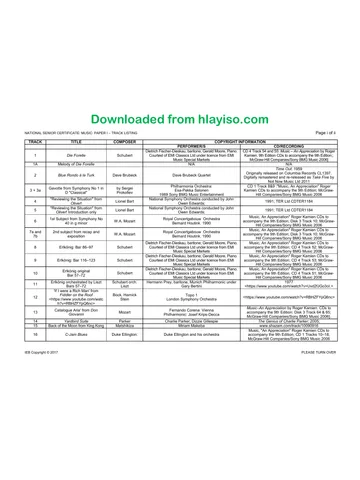
Listen to Track 1 (Die Forelle – Schubert: Music – An Appreciation by Roger
Kamien. 9th Edition CDs to accompany the 9th Edition; Disk 4 Track 54 and
55; McGraw-Hill Companies/Sony BMG Music 2006)
1.1 Place four (4) ticks to identify features present in the music.
Major tonality Lied
Consonant harmony Dissonance
Aria Through-composed
Modified strophic form Melodic inversion
Polyphonic texture Major and minor tonality
1.2 Listen to Track 1a. It is the opening of the melody from Track 1 above. (set
on Sibelius © by examiner)
Place a tick next to the phrase that matches what you hear.
(
MARKING: 1 mark for MELODY D/0.5 mark for MELODY B or MELODY C
(one element is correct)
Listen to Track 2 (Blue Rondo à la Turk from Time Out performed by the Dave
Brubeck Quartet: 1959 originally released on Columbia Records CL1397.
Digitally remastered and re-released as Take Five by Not Now Music Ltd
2011)
1.3 Identify the style of jazz.
Cool Jazz
1.4 Motivate your answer in 1.3 with reference to two characteristics of the
style.
Unusual/irregular grouping of beats, use of the cymbals rather than
drums to emphasise the beat/grouping of the beats, limited dynamic
range, warm timbre of the saxophone, swung quavers. For listening,
not dancing, more arranged – less improvised than Bebop, polytonal,
polyphonic/contrapuntal. Unusual instruments like vibraphone,
French Horn. Any other convincing answer will be accepted.
IEB Copyright © 2017 PLEASE TURN OVER
Downloaded from hlayiso.com
NATIONAL SENIOR CERTIFICATE: MUSIC: PAPER I – MARKING GUIDELINES Page 3 of 15
1.5 Listen again to Track 2 and tick the correct answer to show the rhythm of
one 4-bar phrase of the extract.
1.6 Name an artist, or group, associated with this style.
Dave Brubeck Quartet/Paul Desmond/Modern Jazz Quartet
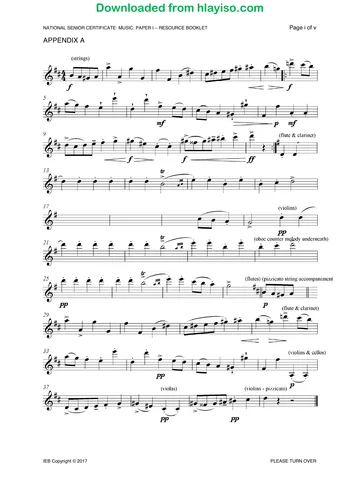
1.7 Listen to Track 3 (Gavotte from Symphony No 1 in D "Classical" by
Sergei Prokofiev): while following the melody line in the Resource Booklet,
APPENDIX A. This is the Gavotte, the third movement from the "Classical"
Symphony by Prokofiev, which was composed in 1917.
1.7.1 Complete the following:
Section B begins at bar 12 beat 3 and section A2 begins at bar 28
beat 3.
1.7.2 Identify the key of section B.
G Major
1.7.3 What is the relationship of this key to the tonic key?
Subdominant (1); Perfect 4th (0.5)
1.7.4 Listen to Track 3a, which begins at bar 122, and notate the melody in
bars 17, 18 and 19.
This phrase is an exact repeat of the previous phrase until bar
192. MARKING: Bar 17: 0.5/Bar 18: 0.5 / Bar 19: 1
1.7.5 Give the bar numbers of a pattern and sequence in the music.
Bar 43 to 62/ Bar 63 to 82
Bar 83 to 102 / Bar 103 to 122
Or any other correct answer.
IEB Copyright © 2017 PLEASE TURN OVER
Downloaded from hlayiso.com
NATIONAL SENIOR CERTIFICATE: MUSIC: PAPER I – MARKING GUIDELINES Page 4 of 15
QUESTION 2
Listen to Track 4 ("Reviewing the Situation" from Oliver! by Lionel Bart; 1991;
National Symphony Orchestra conducted by John Owen Edwards; TER Ltd
CDTER1184)
2.1 Identify the character that you hear.
Fagin – a Jewish thief, who leads a gang of street urchins in London,
who are pick pockets.
2.2 State the context of this song in the musical.
This is sung towards the end of the musical where Fagin is thinking
about his personal situation; what he has done with his life, and how
he should go about changing it: possibly following the straight and
narrow.
2.3 Identify and comment on two characteristics in the music that inform the
audience of the character's cultural background.
Fagin is Jewish: the use of the "oom-pah-pah" bass, which is typical
of the Jewish Klezmer style – a traditional Jewish/Hebrew/Israeli style
of music; violin interludes using the Jewish Phrygian mode and the
gradual accelerando, reminiscent of traditional Israeli songs like
"Hava Nagila".
2.4 How is this song typical of a musical theatre number?
It tells us more about Fagin's character, in particular the mixed
feelings he has about his current life. The character bursts into song.
Interspersed with dialogue, moves action forward, tells us about the
character's thoughts and emotions, not technically demanding, 32-
bar, AABA.
Listen to Track 5. It is the introduction to Track 4 (Introduction to "Reviewing
the Situation" from Oliver! by Lionel Bart; 1991; National Symphony
Orchestra conducted by John Owen Edwards; TER Ltd CDTER1184)
2.5 How does the composer create tension in the introduction to this number?
What dispels the tension as the song progresses?
Forte, chord and tremolo on low strings and timpani. Falling two note
patterns which rise sequentially, held note/pedal in LH. Rising triadic
patterns. Chromaticism. Accents. Minor key. Woodwinds play rising
patterns. Pause/bar's rest. Diminished 7ths
Tension is dispersed by faster second section of the verse with the
oom-pah-bass. Flute pattern – 4 quavers on alternating notes.
Mocking nature of lyrics.
IEB Copyright © 2017 PLEASE TURN OVER
Downloaded from hlayiso.com
NATIONAL SENIOR CERTIFICATE: MUSIC: PAPER I – MARKING GUIDELINES Page 5 of 15
QUESTION 3
Listen to Track 6 (1st Subject from Symphony No 40 in g minor by
W.A. Mozart: Music, An Appreciation" Roger Kamien CDs to accompany the
9th Edition; Disk 3 Track 10; McGraw-Hill Companies/Sony BMG Music 2006)
3.1 Which theme of the movement is heard in the extract?
1st subject/theme
3.2 Mozart developed this theme from a 3-note motive – printed below. Name
three compositional techniques that he used, and describe how he used
them to construct the 4-bar phrase.
Repetition, Variation and Sequence (1 mark each = 3 marks): After we
hear the motive for the first time, he repeats it immediately, then he
repeats it and extends it/varies it by adding a rising 6th after the 3rd
note. Then he uses the rhythm of s-s-l in a 3-note descending pattern,
which he sequences twice – descending. (2 marks for the description
of their use.) Question and answer.
3.3 Name the Mannheim technique that is present in the first two notes of the
motive.
The Mannheim sigh
Listen to Track 7a and 7b (2nd subject from recap and exposition from
Symphony No 40 in g minor by W.A. Mozart: Music, An Appreciation" Roger
Kamien CDs to accompany the 9th Edition; CD 3 Track 17 and Track 12;
McGraw-Hill Companies/Sony BMG Music 2006)
3.4 Which theme of the movement is heard in the tracks?
2nd subject/theme
3.5 Explain the difference in tonality between the two versions of the theme.
Track 7a is from the recapitulation: we know this because it is in a
minor key (g minor) and the 2nd subject is always in the tonic key in
the recapitulation.
Track 7b is from the exposition – it is in a major key (B Flat major).
This is to be expected as the 2nd subject is in the dominant or, as in
the case of this symphony, which begins in g minor, in the relative
major.
IEB Copyright © 2017 PLEASE TURN OVER
Downloaded from hlayiso.com
NATIONAL SENIOR CERTIFICATE: MUSIC: PAPER I – MARKING GUIDELINES Page 6 of 15
3.6 Listen to Track 7b again. On the theme that is printed below, identify and
label, the cadences that are heard at the end of each phrase. Remember to
state the key.
B Flat Major Imperfect cadence
Perfect cadence /
Authentic cadence
3.7 Name two characteristics of this work, other than orchestration/
instrumentation, that indicate that it was written in the Classical period.
The texture is mainly homophonic throughout; the phrases are
balanced: 4 bars; melody is motivic; modulation is to closely-related
keys; structure is a clear sonata form. Periodic phrasing, memorable
melody, use of the Mannheim sigh, varied moods compared to
Baroque, diatonic harmony, Classical Sonata cycle, gradual dynamic
change. Any other valid answer that does not refer to the
orchestration/instrumentation.
QUESTION 4
Listen to Track 8 (Erlkönig: Bar 86–97) and Track 9 (Erlkönig: Bar 116–123:
Music, An Appreciation" Roger Kamien CDs to accompany the 9th Edition;
CD 4 Track 52 and Track 53; McGraw-Hill Companies/Sony BMG Music 2006)
4.1 Identify the 'character' depicted in these two tracks.
Erlkönig
4.2 Complete the table below to compare the two extracts.
ELEMENT TRACK 8 TRACK 9
Tonality [0.5 × 2 = 1] Major Major & Minor
Repetitive triplets in
Accompaniment Pattern Arpeggiated,
RH. Repeated chords,
[0.5 × 2 = 1] broken chords
block chords
IEB Copyright © 2017 PLEASE TURN OVER
Downloaded from hlayiso.com
NATIONAL SENIOR CERTIFICATE: MUSIC: PAPER I – MARKING GUIDELINES Page 7 of 15
4.3 With reference to the story, and to the elements in the table above, explain
the change in tone between the two verses.
In the first extract, the Erlkönig is trying to entice the child – which is
why Schubert uses the major key, which contrasts with the preceding
sections, sung by the narrator, father and son in the minor key. In the
second extract, the Erlkönig is becoming impatient because he is not
getting his own way with the boy, which is why it begins in the major
but ends in the minor to reflect the Erlkönig's frustration and anger at
the child. The arpeggiated piano accompaniment in the first extract
mirrors the enticing nature of the Erlkönig but as he becomes angry,
Schubert maintains the repetitive triplet pattern in the right hand,
which adds to the tension in the words. Arpeggiated pattern can also
represent the dancing of the Erlking's daughters.
NB: Reference must be made to the intention and "mood" of the
Erlkönig in the explanation. Straightforward repetition of the facts
from the table will not gain marks.
Listen to Track 10 (Erlkönig original Bar 57–72; Music, An Appreciation"
Roger Kamien CDs to accompany the 9th Edition; CD 4 Track 51; McGraw-
Hill Companies/Sony BMG Music 2006) and Track 11 (Erlkönig orchestrated
by Liszt Bars 57–72 Hermann Prey, baritone, Munich Philharmonic under
Gary Bertini 1977 <https://www.youtube.com/watch?v=Uvd2fJGo3oI>), which
is a different arrangement of the same section of the work.
4.4 With reference to the story, comment on the effectiveness of the
orchestrated version, compared with the original setting. State which
version you prefer, giving a reason for your choice.
Sense of the horse galloping is maintained in the strings, but very
softly. The use of the broken chords in the flute with the light harp
accompaniment serves to emphasise the enticing tone of the Erlkönig.
In the original, the accompaniment pattern changes from the triplets in
the RH to the splitting of the triplet pattern between the two hands. But
there is no counter-melody in the original. Own opinion – no mark for
opinion: 1 mark for reason.
IEB Copyright © 2017 PLEASE TURN OVER
Downloaded from hlayiso.com
NATIONAL SENIOR CERTIFICATE: MUSIC: PAPER I – MARKING GUIDELINES Page 8 of 15
QUESTION 5
Listen to Track 12 ('If I were a Rich Man' from Fiddler on the Roof by Jerry
Bock, Sheldon Harnick and Joseph Stein: <https://www.youtube.com/
watch?v=RBHZFYpQ6nc>) and Track 13 ('Madamina – Catalogue Aria' from
Don Giovanni by Mozart. Music – An Appreciation by Roger Kamien. CDs to
accompany the 9th Edition: Disk 3 Track 64 and 65; McGraw-Hill
Companies/Sony BMG Music 2006)
The lyrics to Track 12, and some background to the work, can be found in the
Resource Booklet as APPENDIX B.
In an essay, compare similarities and differences of the two pieces heard in
Track 12 and Track 13.
In addition to the comparison, which will form the body of your essay, also:
• Provide a brief background to the two genres.
• Comment on the depiction of characters in the musical settings.
• State the context of the extract from your set work, and name the character
who is singing.
In conclusion, offer your own opinion as to which track you prefer, and justify it
with reference to the use of two elements of music.
Ensure that you compare the two pieces, and not only the genres.
Your essay will be marked using the following rubric:
RUBRIC FOR ESSAY
Clearly demonstrates an understanding of the question, cites factual evidence,
completes all requirements, and provides an insightful comparison of the two works,
16–20 with reference to both the general characteristics of the genres and the specific
features of the two tracks. Own opinion of the works is offered with insight and
specific reference to the use of the elements of music.
Demonstrates an understanding of the question, completes all requirements, cites
factual evidence and provides some comparison of the two works, with some
10.5–15.5 reference to both the general characteristics of the genres and the specific features
of the two tracks. Own opinion of the works is offered with limited insight and some
generalisation in terms of the use of the elements of music.
May address all of the requirements, but demonstrates only a partial understanding
of the question and limited factual evidence. Comparison of the two works is limited
with only partial reference to either the general characteristics of the genre or the
5.5–10
specific features of the two tracks. Own opinion is limited with little or no reference
to the use of the elements of music. There is an imbalance between the sections of
the essay.
Demonstrates minimal understanding of the question, does not complete all
0.5–5 requirements, and provides only a vague reference to, or no use of, the facts. No
comparison or opinion is offered. There is no balance within the essay.
THE ANSWER TO THIS QUESTION MUST BE WRITTEN IN ESSAY FORM –
THE MEMO IS TABULATED FOR EASE OF REFERENCE.
IEB Copyright © 2017 PLEASE TURN OVER
Downloaded from hlayiso.com
NATIONAL SENIOR CERTIFICATE: MUSIC: PAPER I – MARKING GUIDELINES Page 9 of 15
TRACK 12 If I were a rich man TRACK 13 Madamina
Genre & Type of
Musical – Solo song Opera Buffa/Dramma Giocoso – Aria
number
th
Period/Century 20 Century Classical Period
Tevye – a poor, Russian Jew, who is a Leporello – Don Giovanni's servant and
milkman. He is married to Golde. wingman. Lower class – "uneducated",
Character
(Information provided so no mark given but protects DG at all costs. He aspires
for this.) to be like DG.
Close to the beginning of the musical –
4th number. (Information provided so no
mark given for this). Leporello is 'consoling' Donna Elvira,
Tevye is wishing that he was rich, and who has been recently jilted by Don
Context
imagining what his life would be like, if Giovanni, by providing her with a list of
he were. (Lyrics provided but not DG's previous conquests.
explained, so a mark can be given for
this.)
We hear a brief monologue at the A B: there is a clear definition between
beginning of the extract – which is typical the two sections.
of Musical theatre: i.e. dialogue is Section A: he lists the number of women
Structure spoken rather than sung in recitative. DG has seduced – and the countries
A B A B C B A Coda (not a standard from which they come.
structure for musical – would expect Section B: he describes DG's seduction
AABA or verse-chorus). techniques for different types of women.
nd
Modal – but there is no flattened 2 so
it's not truly in the Jewish Phrygian
Tonality Dominant Mode [1 – ♭2 – 3 – 4 – 5 – ♭ D Major
6 – ♭7 – 1], although there is a flattened
6th and 7th. It sounds modal. Minor
A = 4/4
Metre 4/4
B = ¾ – in the style of a Minuet
A moderate tempo, but use is made of
pauses into B – followed by a tempo.
The central section I is slower and has
A = Fast – Allegro: this is well-suited to
greater freedom of tempo – recitative-
Tempo the "listing" of DG's conquests.
like. The "sighs" at the end of each B
B = Slow –Andante.
verse allow for a slight rit … followed by
a tempo. The coda allows for freedom of
tempo as well.
There are two distinct melodies: A – "if I
were a rich man", moves in tones and
semitones. It is fairly repetitive, and has
In Section A, the melody and
a limited range. B – "I'd build a big tall
accompaniment is triadic. The melodic
house …" this opens with three rising
range is slightly wider than in
notes with a pause on each one; a bar of
"Reviewing". There is an element of
repeated notes is followed by a rising
"patter" to this section, which is
and falling pattern before it returns to the
appropriate for the "list" and it also fits
repeated notes.
Leporello's character.
The setting of the words is mainly
Melody and In Section B, the melody is lyrical to
syllabic, contributing to a "patter" style.
Rhythm emphasise the virtues of the ladies, and
The contrasting C phrase has a more
the ways in which DG seduces them. He
lyrical "melody", which has a distinctly
reflects the character of the women in
Hebrew/Jewish sound. The rhythm here
the music: "Tall ones – majestic" – long
is dictated by the rhythm of the words, as
note values, crescendo, ritardando
would happen in a recitative.
towards the end of the phrase/"The little
Word painting: "staircase going up" –
ones" – short notes, light, mezzo forte,
rising phrase in accompaniment/"coming
slightly staccato.
down" – descending phrase in acc.
Short "cadenza" at the end of C: typical
Hebrew/Jewish sound.
IEB Copyright © 2017 PLEASE TURN OVER
Downloaded from hlayiso.com
NATIONAL SENIOR CERTIFICATE: MUSIC: PAPER I – MARKING GUIDELINES Page 10 of 15
Tevye is Jewish, like Fagin, in Oliver!,
and many of the musical characteristics
in "Reviewing the Situation" are evident
here: the use of the "oom-pah-pah bass,
which is typical of the Jewish Klezmer
style – a traditional Jewish/Hebrew/ Patter style in Section A helps to
Israeli style of music; short counter- emphasise Leporello's position in society
Setting of words/ melodies on the clarinet using what as a servant/lower-class/uneducated/
characterisation sounds like a Jewish [Phrygian] mode comic character.
and the slight accelerando, reminiscent In Italian. Usually sung in original
of traditional Israeli songs like "Hava language.
Nagila". There is an element of patter
nd
singing in the 2 part of the verse –
which alludes to his lower class/comic/
"uneducated" character.
In English. Can be translated.
The opening phrase is sung
unaccompanied by Tevye (Bass). The
orchestral accompaniment gradually
fades in: strings and clarinet (playing Classical orchestra: paired winds (no
similar melodic patterns as the violin clarinet); 2 horns; strings. A harpsichord
Timbre does in "Reviewing …" – adding to the is heard at the very beginning (hangover
Jewish/Hebrew feel), pizzicato bass, from the recit that precedes the aria);
trumpet/brass. Tambourine to emphasise string section. Bass voice.
the off-beats. Cymbals. Guitar, harp;
accordion; glockenspiel. Barnyard
sounds.
Melody is dominant, but there are
countermelodies in the strings – these do
not detract from the melody, but do offer
Homophonic – typical of a solo song in
Texture added interest. There is a lot of imitation
musical theatre st
between the 1 violins and the basses at
the beginning, and later between strings
and woodwind.
The aria begins softly, piano, and there
is a lightness of touch in the separate
First part of each verse is soft, with the
quavers. Mozart makes use of sudden
repeat being sung loudly.
dynamic changes from piano to forte but
Dynamics and Pizzicato in the strings.
the dynamic range is limited. He uses a
articulation Light staccato emphasises the rhythm.
crescendo to forte at the end of Section
Section C: much louder and legato.
A. Section B begins softly and more use
Crescendo to a big finish.
is made of gradual dynamic changes in
this section.
Elements of cataloguing in both pieces – characteristic of opera buffa.
Both are humorous.
IEB Copyright © 2017 PLEASE TURN OVER
Downloaded from hlayiso.com
NATIONAL SENIOR CERTIFICATE: MUSIC: PAPER I – MARKING GUIDELINES Page 11 of 15
QUESTION 6
Listen to Track 14 (Yardbird Suite – Charlie Parker from the album The
Genius of Charlie Parker; 2005; Savoy Jazz) while following the lead sheet
below. (Yardbird Suite – Charlie Parker; Lead sheet;
<http://www.onlinesheetmusic.com/yardbird-suite>)
IEB Copyright © 2017 PLEASE TURN OVER
Downloaded from hlayiso.com
NATIONAL SENIOR CERTIFICATE: MUSIC: PAPER I – MARKING GUIDELINES Page 12 of 15
6.1 Identify the style of jazz, and state the decade in which it developed.
Bebop – 1940s
6.2 Why did this style develop?
Solo jazz performers who had played with big bands, were no longer
satisfied with the principles of "big band" jazz, and wanted to return to
the basic principles of jazz, which placed solo improvisation at the
heart of the genre.
6.3 List two characteristics that you can hear in the recording which are typical
of the style.
Small combo: front line & rhythm section; solo sax and trumpet; fast
tempo; short note values; ride and crash cymbals most noticeable in
rhythm accompaniment with occasional "bombs" on the bass drum.
Motivic melody – short phrases. Use of chromaticism. Articulation.
Solo improvisation – limited collective improvisation. Virtuosic
playing. Asymmetrical phrases, walking bass, fragmented melody.
6.4 Clearly mark the sections (form) of the piece on the lead sheet. Please note
that there is an 8-bar introduction which is not notated on the lead sheet.
Intro – not on lead sheet; A: 1–8; A: 1–8 (2nd time bar) – no mark for
this;
B: 9 – 16 (1 mark); A: 17–24 (1 mark)
6.5 Use the headings in the table below to comment on the improvisations.
Describe the
Solo Instrument/s
accompaniment
Improvisation 1 Saxophone Walking bass/piano
Muted trumpet and comping/light rhythm
Improvisation 2 on snare drum.
Saxophone alternating
In the 4th improvisation,
Improvisation 3 Saxophone and guitar the piano has a short solo
and then returns to its
Piano and then sax and accompanying role.
Improvisation 4
trumpet to end off
IEB Copyright © 2017 PLEASE TURN OVER
Downloaded from hlayiso.com
NATIONAL SENIOR CERTIFICATE: MUSIC: PAPER I – MARKING GUIDELINES Page 13 of 15
QUESTION 7
Listen to Track 15. It is a song called Back of the Moon from the South African
Jazz Musical King Kong, composed in 1958 by Todd Matshikiza. The lyrics are
reproduced as APPENDIX C in the Resource Booklet.
7.1 Identify and comment on the social conditions, referred to in the song,
which influenced the development of South African urban music from the
late 19th century onwards.
Shebeens, Shanty Towns and Shacks "built for Blacks". Even before
Apartheid, there was segregation of the races. Shanty Towns
developed as men from the rural areas moved to urban areas in
search of work on the mines. Living conditions were poor. Because
blacks were not allowed to buy liquor, Shebeens – illegal drinking
spots, where illegal alcohol was brewed, became social meeting
places in the shanty towns. Music was played in the shebeens and
many styles developed and were played in shebeens, long before they
were recorded. Mining hostels.
7.2 Describe the musical features of ONE style of South African urban music
that developed prior to 1958, as a direct result of the social conditions that
you have named above.
Marabi: "gangsters" – piano / keyboard music influenced by ragtime
(syncopated RH / steady LH) with much improvisation in the LH. Drew
the patrons to the shebeens because of the lively, upbeat style. Cyclic
harmonic progression: the marabi progression: I IV Ic V underpins the
music/improvisations. Cheap pedal organs
OR
Kwela: "get up" – pennywhistle music associated with shanty towns
and shebeens. Because shebeens were illegal, the police would often
raid them. Young kwela players would stand on the street corners and
play their pennywhistles to warn shebeen patrons of the approach of
the police. Characterised by short, repetitive melodic phrases and
repeating, cyclic harmonic progressions based on I, IV and V. Often
uses the marabi progression.
Also accepted: Isicathimiya, Sophiatown Jazz, Township Jazz
IEB Copyright © 2017 PLEASE TURN OVER
Downloaded from hlayiso.com
NATIONAL SENIOR CERTIFICATE: MUSIC: PAPER I – MARKING GUIDELINES Page 14 of 15
Listen to Track 16 (Duke Ellington: C-Jam Blues; Music, An Appreciation"
Roger Kamien CDs to accompany the 9th Edition; CD 1 Tracks 10–18;
McGraw-Hill Companies/Sony BMG Music 2006) and Track 17 (Way Back '50s
performed by Uhadi)
7.3 Identify features relating to Track 16 in Column A and features relating to
Track 17 in Column B.
Place three ticks (3) in Column A and three ticks (3) in Column B.
COLUMN A COLUMN B
Features of Features of
Track 16 Track 17
Quadruple metre
Originally a keyboard style
Walking bass
I – IV – Ic (I6/4) – V
Swung quavers
12-bar blues
Triplets
Cyclic structure
3-bar riff
7.4 Name two features from the above list that are common to both tracks.
Quadruple metre, swung quavers.
7.5 How did the styles represented by Track 16 and Track 17 contribute to the
development of mbaqanga/Sophiatown Jazz in the 1950s?
Marabi: the "marabi" chord progression (I – IV – Ic/I 6/4 V) is frequently
used in Mbaqanga; failing that, the chord progression will mainly use
I, IV and V. Cyclical Structure.
Swing/Big Band: Influenced the instrumentation of Mbaqanga:
saxophones, trumpets.
Swing rhythm of both styles is present in Mbaqanga.
Simple melodies.
All styles are in quadruple time with subdivisions into quavers.
IEB Copyright © 2017 PLEASE TURN OVER
Downloaded from hlayiso.com
NATIONAL SENIOR CERTIFICATE: MUSIC: PAPER I – MARKING GUIDELINES Page 15 of 15
Listen to Track 18 (Ndodemnyama – Beware Verwoerd by Vuyisile Mini:
Album: Miriam Makeba – Africa; Novus Series 70 <https://www.youtube.com/
watch?v=DYwgmOxhUvk>) and refer to the translated lyrics, and background to
the song, that are provided in APPENDIX D in the Resource Booklet.
7.6 'Ndodemnyama' (Track 18) and your set work, Meadowlands both protest
against aspects of apartheid. Compare the lyrics of the two songs. State
which song, in your opinion, is a more effective means of protest, giving
three reasons for your view.
The answer must be written as a paragraph – the table is just for easy
reference.
3 marks for the comparison of the lyrics.
3 marks for reasons: no mark allocated for opinion.
Ndodemnyama Meadowlands
Lyrics More repetitive than those Three languages – isiZulu,
of Meadowlands. seSotho and Tsotsitaal.
Mainly one language – is Greater variety of emotion,
isiXhosa. "Pasop" = e.g. we don't want to move!
Afrikaans our beloved place – used
A warning to Verwoerd – both cynically and
there is no story and only genuinely/they tell more of a
negative emotion. story.
Reasons for effectiveness as a protest song:
Track 18: simple, repetitive lyrics: easy to learn and remember. Can
easily get a crowd going: it is martial at the beginning. Mentions
Verwoerd by name – creates unity among the people against a
common "enemy".
Track 19: catchy melody and rhythm but more ambiguous as a protest
song because "our beloved place" is used cynically and sincerely.
Total: 100 marks
IEB Copyright © 2017
Study this subject
Revise the topics in this paper, then practise them question by question.
Recommended for this subject
More papers and memos for this grade and subject.
MemorandumIEB
Music Grade 12 IEB Paper 1 2019 Memo
MemorandumIEB
Music Grade 12 IEB Paper 1 2019 Memo (Afrikaans)
MemorandumIEB
Music Grade 12 IEB Paper 2 2019 Memo
MemorandumIEB
Music Grade 12 IEB Paper 2 2019 Memo (Afrikaans)
MemorandumIEB
Music Grade 12 IEB Paper 1 2018 Memo
MemorandumIEB
Music Grade 12 IEB Paper 1 2018 Memo (Afrikaans)
Related documents
MemorandumIEB
Music Grade 12 IEB Paper 1 2017 Memo (Afrikaans)
MemorandumIEB
Music Grade 12 IEB Paper 1 2017 Memo
Question paperIEB
Music Grade 12 IEB Paper 1 2017 Question Paper
Question paperIEB
Music Grade 12 IEB Paper 1 2017 Question Paper (Afrikaans)
Question paperIEB
Music Grade 12 IEB Paper 1 2017 Question Paper
Question paperIEB
Music Grade 12 IEB Paper 1 2017 Question Paper
More from Grade 12 Music
Question paperIEB
Music Grade 12 IEB Paper 1 2019 Question Paper
Question paperIEB
Music Grade 12 IEB Paper 1 2019 Question Paper (Afrikaans)
AddendumIEB
Music Grade 12 IEB Paper 1 2019 Addendum
AddendumIEB
Music Grade 12 IEB Paper 1 2019 Addendum (Afrikaans)
Question paperIEB
Music Grade 12 IEB Paper 2 2019 Question Paper
Question paperIEB